 Tajweed

| Key Takeaways |
| Izhar means producing a letter clearly from its articulation point with no nasal resonance (ghunnah) extended into the following letter. |
| The six izhar letters are all throat letters: Hamzah (ء), Haa (ه), ‘Ayn (ع), Haa (ح), Ghayn (غ), and Khaa (خ). |
| Izhar al-Halqi applies when a noon sakinah or tanwin is followed by any of the six throat letters, in one word or across two words. |
| Izhar Shafawi applies to meem sakinah followed by any letter except meem and baa, requiring special care before waw and faa. |
| The four words — دُنْيَا, صِنْوَان, قِنْوَان, بُنْيَان — require Izhar Mutlaq to prevent confusion with idgham. |
Most students learning Tajweed hear the word izhar early in their studies — but understanding why it exists, and exactly how it sounds, is what separates passive rule memorization from confident, accurate recitation.
Izhar is the first of the four rulings governing noon sakinah and tanwin. It means producing a letter with complete clarity — no nasal extension, no blending, no merging. When the six throat letters follow a noon sakinah or tanwin, the noon must be pronounced distinctly and released cleanly before the next letter begins.
Table of Contents:
What Is Izhar in Tajweed?
Izhar (إِظْهَار) is defined in classical Tajweed scholarship as producing a letter clearly from its articulation point (makhraj) without any extended ghunnah attached to the following letter. It is the first ruling of noon sakinah and tanwin, and it is triggered by six specific letters — all originating from the throat (halq).
The reason izhar is required here is phonetic. The makhraj of noon sakinah sits at the tip of the tongue, while the six izhar letters emerge from different parts of the throat.
Because these two articulation zones are distant from one another, there is no natural blending between them. Classical Tajweed scholars describe this distance as the governing reason (‘illah) for mandatory clarity.
At Buruj Academy, our Online Tajweed Classes — taught by Ijazah-certified instructors and Al-Azhar University graduates — train students to hear this distinction before they memorize any rule name. We call it Sound-before-rules: the ear leads, and the terminology follows naturally.
Book Your FREE Trial Lesson to Begin Your Tajweed Journey

Read also: Ikhfa Haqiqi: What It Is, Its 15 Letters, and How to Apply It Correctly
What Are Izhar Letters in Tajweed?
The six izhar letters are all throat letters (حروف الحلق), and this shared characteristic gives the ruling its full name: Izhar Halqi (الإظهار الحلقي) — the throat-based clear pronunciation.
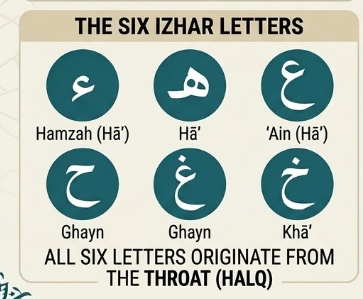
| Letter | Arabic | Makhraj Location | Example Word |
| Hamzah | ء | Deepest throat | مِنْ إِلٰهٍ |
| Haa (large) | ه | Deepest throat | مِنْ هَادٍ |
| ‘Ayn | ع | Middle throat | مِنْ عَلَقٍ |
| Haa (small) | ح | Middle throat | وَتَنْحِتُونَ |
| Ghayn | غ | Upper throat | مِنْ غِلٍّ |
| Khaa | خ | Upper throat | مِنْ خَيْرٍ |
Classical scholars gathered these six letters into a mnemonic phrase — أَخِي هَاكَ عِلْمًا حَازَهُ غَيْرُ خَاسِرٍ — “My brother, here is knowledge he acquired without loss.” Each word’s opening letter represents one of the six izhar letters in order.
The three pairs above correspond to the three zones of the throat: the deepest portion produces hamzah and haa, the middle produces ‘ayn and haa, and the upper portion produces ghayn and khaa.
Knowing these zones helps students understand why clarity is mandatory — there is simply no phonetic pathway for blending.
Excel in Your Quranic Studies
Join Buruj Academy and master the Quran with our structured, professional curriculum.
Book Your Free TrialHow to Apply Izhar Al-Halqi During Recitation?
Izhar al-Halqi applies when a noon sakinah (نْ) or tanwin (ـً ـٍ ـٌ) is directly followed by any of the six throat letters. The application remains the same whether the two letters occur within a single word or across two consecutive words.
Key application rules:
- Pronounce the noon sakinah or tanwin completely — do not shorten it or drop its sound
- Release the noon cleanly before moving to the throat letter — no blending, no assimilation
- Do not extend the ghunnah (nasal resonance) into the following letter
- Tanwin with izhar only appears across two words — never within a single word
In our sessions at Buruj Academy, the most common mistake adult beginners make when practising izhar is applying a slight nasal hum into the following letter — essentially a half-idgham.
This happens because the ghunnah of noon feels natural to extend. The correction is simple: treat the noon sakinah as a complete, closed syllable before the throat letter begins.
Izhar in a Single Word vs. Across Two Words
| Position | Example | Transliteration |
| Single word | يَنْأَوْنَ | Yan-awna |
| Two words | مَنْ أَمِنَ | Man amina |
| Tanwin (two words only) | جَنَّاتٍ أَلْفَافًا | Jannatin alfafa |
Note that tanwin never produces izhar within a single word — the structure of Arabic tanwin means it always encounters the following letter across a word boundary.
Book Your FREE Trial Lesson to Begin Your Tajweed Journey

Quranic Examples of Izhar for Each of the Six Letters
Understanding izhar becomes concrete when you see — and recite — its examples directly from the Quran. Below are verified examples for each of the six throat letters.
1. Izhar Example with the Hamzah (ء)
مِنْ إِلٰهٍ غَيْرِهِ
Min ilahin ghayrihi
“No god other than Him.”
(Noon sakinah before hamzah — pronounce the noon clearly with no nasal extension.)
عَذَابٌ أَلِيمٌ
‘Adhabun alim “A painful punishment.”
(Al-Baqarah 2:10)
(Tanwin dammah before hamzah — two words, clear noon sound before hamzah.)
2. Izhar Example with the Letter Haa (ه)
مِنْ هَادٍ
Min had
“Any guide.” (Ar-Ra’d 13:33)
(Noon sakinah before haa — release noon completely before the haa begins.)
3. Izhar Example with the Letter ‘Ayn (ع)
مِنْ عَلَقٍ
Min ‘alaq
“From a clinging clot.” (Al-‘Alaq 96:2)
(Noon sakinah before ‘ayn — one of the most-recited izhar examples in Juz Amma.)
4. Izhar Example with the Letter Haa (ح)
وَتَنْحِتُونَ
Wa tanhitun
“And you carve.” (Ash-Shu’ara 26:149)
(Noon sakinah before haa within a single word — clarity of noon is mandatory.)
5. Izhar Example with the Letter Ghayn (غ)
مِنْ غِلٍّ
Min ghillin
“Any rancor.” (Al-A’raf 7:43)
(Noon sakinah before ghayn — do not allow the ghayn’s depth to swallow the noon.)
6. Izhar Example with the Letter Khaa (خ)
مِنْ خَيْرٍ
Min khayr
“Any good.” (Al-Baqarah 2:197)
(Noon sakinah before khaa — a frequent construction throughout the Quran.)
Excel in Your Quranic Studies
Join Buruj Academy and master the Quran with our structured, professional curriculum.
Book Your Free Trial
What Is Izhar Shafawi and How Does It Differ from Izhar Halqi?
Izhar Shafawi (الإظهار الشفوي) — labial clear pronunciation — is a separate ruling that governs meem sakinah (مْ), not noon sakinah or tanwin. It applies when a meem sakinah is followed by any letter of the Arabic alphabet except meem (م) and baa (ب).
The term shafawi comes from shafah (شفة), meaning lip, because meem is a lip letter. When meem sakinah meets another letter (other than meem or baa), the meem must be pronounced clearly without any nasal extension into the following sound.
| Meem Sakinah Before | Ruling | Example |
| Any letter except م and ب | Izhar Shafawi | أَمْ جَعَلُوا |
| Meem (م) | Idgham Shafawi | — |
| Baa (ب) | Ikhfa Shafawi | — |
Special attention is required when meem sakinah precedes waw (و) or faa (ف). Because meem shares a labial articulation zone with these letters, there is a risk of unintentional blending. Classical Tajweed scholars specifically note that the student must exert additional care (tashdidul-izhar) to ensure the meem remains fully distinct. An example is عَلَيْهِمْ وَلَا — the meem before waw must be pronounced with deliberate clarity.
For a deeper look at how meem sakinah interacts with baa through concealment, our article on ikhfa rules in Tajweed explains the distinction in full detail.
Discover the Buruj Academy Difference
Step into our virtual classrooms and see how our expert instructors make learning Quran and Arabic intuitive and clear. We focus on overcoming the specific hurdles non-native speakers face, building your confidence and connection with the Quran.
What Is Izhar Mutlaq?
Izhar Mutlaq (الإظهار المطلق) — absolute clear pronunciation — is a distinct category that applies specifically to four words in the Quran where a noon sakinah is followed by waw (و) or yaa (ي) within the same word.
Normally, noon sakinah before waw or yaa triggers idgham (merging) when those letters appear in a second word. However, within a single word, idgham would cause confusion and alter the word’s meaning and structure.
Therefore, classical scholars — particularly in the recitation of Hafs ‘an ‘Asim — ruled that these four words require absolute clarity:
| Word | Arabic | Surah Reference |
| Dunya | دُنْيَا | Multiple locations |
| Sinwan | صِنْوَانٌ | Ar-Ra’d 13:4 |
| Qinwan | قِنْوَانٌ | Al-An’am 6:99 |
| Bunyan | بُنْيَانٌ | Multiple locations |
The label mutlaq (absolute/unrestricted) reflects that this ruling is not tied to a shared articulation point or phonetic cause — it exists purely to preserve word clarity and prevent recitation ambiguity. This makes izhar mutlaq unique among the izhar categories.
Students who have already worked through idgham rules in Tajweed will recognize immediately why these four words are exceptional — they are the only cases where noon sakinah before waw or yaa does not merge.
Book a FREE trial session with one of Buruj’s Azhari Quran tutors

Read also: Ikhfa Shafawi: The Complete Guide to Labial Concealment in Tajweed
How Does Izhar Compare to the Other Rulings of Noon Sakinah and Tanwin?
Understanding izhar becomes clearer when placed alongside the other three rulings that govern noon sakinah and tanwin. Each ruling is triggered by a different set of letters and produces a distinct phonetic outcome.
| Ruling | Trigger Letters | Phonetic Outcome |
| Izhar Halqi | ء ه ع ح غ خ (throat) | Full clarity — no ghunnah extension |
| Idgham | ي ر م ل و ن | Merging of noon into following letter |
| Iqlab | ب only | Noon converts to meem sound with ghunnah |
| Ikhfa | 15 letters | Partial concealment with nasal resonance |
The contrast between izhar and ikhfa is particularly instructive. In ikhfa, the noon sakinah is hidden — not fully pronounced, not fully merged — while a controlled ghunnah resonates. In izhar, the opposite is true: the noon is fully and clearly released, and no ghunnah is extended.
For students working through these distinctions, our article on ghunnah and its rules provides the foundational context for understanding nasal resonance across all four rulings.
Students beginning their Tajweed study often benefit from pairing this comparison with our Tajweed for Beginners guide, which places noon sakinah rulings within the full sequence of Tajweed topics.
Excel in Your Quranic Studies
Join Buruj Academy and master the Quran with our structured, professional curriculum.
Book Your Free TrialMaster Izhar — and All of Tajweed — with Buruj Academy’s Expert Instructors
Izhar is the foundation of noon sakinah mastery — and mastering it correctly from the start prevents deeply ingrained errors that become harder to correct later.
At Buruj Academy, our Online Tajweed Classes are taught by Ijazah-certified instructors and Al-Azhar University graduates with 12+ years of experience teaching non-Arabic speakers worldwide.
We follow the Buruj Method — Sound-before-rules — ensuring your ear recognizes correct recitation before your mind processes rule names.
Our 1-on-1 personalized sessions offer real-time pronunciation correction, flexible 24/7 scheduling, and structured progression from izhar through to advanced Tajweed mastery.
Whether you are a complete beginner or refining existing recitation, Buruj Academy’s Tajweed for Beginners course is your structured starting point.
Join a supportive learning environment tailored to your pace and lifestyle. Start your journey toward excellence by enrolling in one of our specialized tracks:
- Online Tajweed Classes
- Tajweed Classes for Beginners
- Tajweed Classes for Adults
- Tajweed Classes for Sisters
- Tajweed Classes for Kids
- Advanced Tajweed Course
- Amli Tajweed Course (Practical Application)
Book your free trial lesson today and recite with the clarity the Quran deserves.
Frequently Asked Questions About Izhar in Tajweed
What Is the Simple Definition of Izhar in Tajweed?
Izhar in Tajweed means pronouncing a noon sakinah or tanwin with complete clarity when followed by one of the six throat letters — hamzah, haa, ‘ayn, haa, ghayn, or khaa. No nasal resonance (ghunnah) is extended into the following letter. The noon is fully and distinctly pronounced before the next sound begins.
How Do I Remember the Six Izhar Letters Easily?
The six izhar letters are memorized through the classical mnemonic phrase أَخِي هَاكَ عِلْمًا حَازَهُ غَيْرُ خَاسِرٍ. Each word’s first letter — hamzah, khaa, haa, ‘ayn, haa, ghayn, khaa — represents one of the six throat letters. Repeated recitation of this phrase with a qualified teacher embeds the letters permanently within two to three practice sessions.
What Is the Difference Between Izhar Halqi and Izhar Shafawi?
Izhar Halqi governs noon sakinah and tanwin before the six throat letters, requiring clear pronunciation without nasal extension. Izhar Shafawi governs meem sakinah before any letter except meem and baa, requiring the meem to be pronounced distinctly from the following sound. Both share the principle of clarity but apply to different letters and contexts entirely.
Why Is Izhar Mutlaq Applied to Only Four Words?
Izhar Mutlaq applies to دُنْيَا، صِنْوَان، قِنْوَان، بُنْيَان because in these words a noon sakinah precedes waw or yaa within a single word. Applying idgham here would alter the word’s phonetic structure and create ambiguity. Classical scholars ruled for absolute clarity in these four cases specifically to preserve word integrity in the recitation of Hafs ‘an ‘Asim.
Can Izhar Occur Within a Single Word with Tanwin?
No. Tanwin only produces izhar across two words — never within a single word. This is because tanwin by definition sits at the end of a word, meaning its following letter always belongs to the next word. Noon sakinah, however, can produce izhar both within a single word (such as يَنْأَوْنَ) and across two words (such as مَنْ أَمِنَ).