 Arabic

Learning Arabic can be both exciting and challenging; it is a rewarding journey that opens the doors to a rich culture, history, and communication with over 400 million people worldwide. One of the biggest challenges learners face is mastering Arabic Vocabs, which is the vocabulary that forms the foundation of fluency, and it is essential for understanding and communicating effectively. At Buruj Academy, with the right guide and strategies, learners can simplify the process and build a strong vocabulary base. In this article, we’ll explore tips and tricks in Arabic learning that will make learning new words and vocabulary more effective.
Why Arabic Vocabulary Is Crucial in Arabic Learning
Vocabulary is the backbone of any language. Without the correct words and phrases , understanding and expressing yourself will be difficult. The Arabic language has rich and multiple dialects and requires a focused effort to build a strong Arabic vocabulary base. Learning the right Arabic vocabulary not only improves reading and writing but also boosts confidence in speaking and listening.
At Buruj Academy, our Online Arabic Classes use the context-before-abstraction method, building vocabulary through meaningful words and phrases from day one, guided by Arabic Language Experts with 12+ years of experience teaching non-native speakers globally.
Understand the Arabic Grammar with Buruj’s free trial lesson

Understanding Arabic Vocabs : The foundation of Learning
Mastering the Arabic language begins with a deep dive into its unique linguistic logic and structural patterns. By focusing on how words are built and used, learners can establish a solid framework for long-term fluency and comprehension.
1- The Arabic Root System and Word Structure
Unlike English , Arabic words follow a root-based pattern. By understanding the vocabulary through these roots , learners can quickly recognize multiple related terms.
2- Mastering Arabic Vocabs in Context
Instead of memorizing random lists, it is better to learn the Arabic vocabs within sentences. Contextual learning enhances comprehension and fluency. ٍStart by learning the most commonly used words and phrases. Focus on everyday vocabulary that you will encounter in conversations, media, and texts.
3- Root-Based Arabic Vocabulary Building Unlocks Exponential Word Growth
Arabic operates on a root system—typically three consonants that carry a core meaning. Mastering roots means learning one pattern that generates dozens of related words simultaneously, making arabic vocabulary building far more efficient.
The root ك-ت-ب (K-T-B) carries the meaning of writing. From it come: كَتَبَ (he wrote), كِتَاب (book), كَاتِب (writer), مَكْتُوب (written/letter), مَكْتَب (office/desk). One root. Five words learned simultaneously.
This is structurally impossible in English, which borrows from multiple languages with no consistent internal logic. Arabic learners who discover root patterns typically double their vocabulary acquisition speed within three months of applying the method consistently.
Common Quranic Roots Every Adult Learner Should Prioritize
Consider these roots based on Quranic frequency and daily Islamic usage:
| Root | Core Meaning | Key Derivatives |
| ع-ل-م | Knowledge | عَلِمَ, عِلْم, عَالِم, مَعْلُوم |
| ح-م-د | Praise | حَمِدَ, حَمْد, مَحْمُود, أَحْمَد |
| ر-ح-م | Mercy | رَحِمَ, رَحْمَة, رَحِيم, رَحْمَن |
| ق-ر-أ | Reading | قَرَأَ, قِرَاءَة, قُرْآن, قَارِئ |
| س-ل-م | Peace/Safety | سَلِمَ, سَلَام, مُسْلِم, إِسْلَام |
Notice that إِسْلَام and مُسْلِم share the root س-ل-م with سَلَام (peace). This connection isn’t coincidental—it reflects Islam’s core meaning of peaceful submission.
Through Buruj Academy’s Arabic Classes for Adults, students learn to recognize and apply root patterns systematically, building vocabulary at a pace that respects adult learning and busy professional schedules.
Book your free Arabic trial lesson at Buruj

Effective methods for expanding Arabic vocabs
Expanding your Arabic vocabulary requires a strategic blend of cognitive science and consistent daily exposure. The following methods offer a comprehensive roadmap to move beyond basic terms and achieve a more nuanced command of the language.
1. Spaced Repetition System (SRS) and Flash Cards
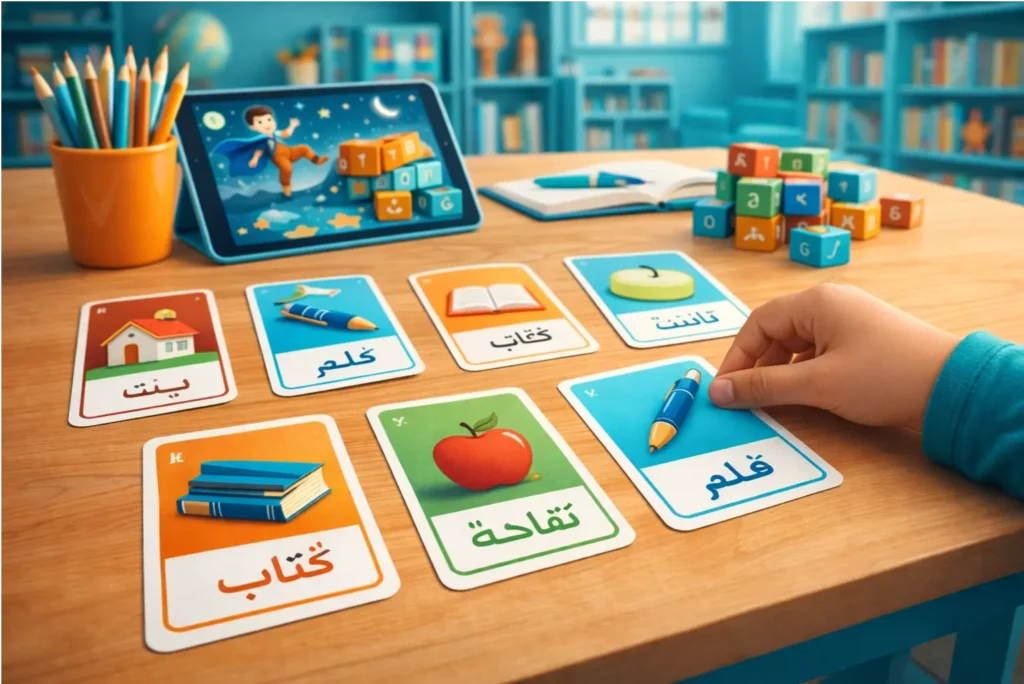
Spaced repetition systems and flashcards are powerful and proven ways to retain vocabulary and help you memorize , as frequent exposure to the words will ensure long-term memory retention. Using spaced repetition helps transfer Arabic Vocabs from short-term to long-term memory by reviewing words just before you forget them. This technique reduces study time and improves retention , making your learning more efficient and less frustrating .
2- Immersion through Arabic Media
Listening to Arabic music , watching TV shows , listening to podcasts, and reading articles expose learners to everyday Arabic naturally.
3- Using dual-language books
Reading Arabic texts alongside English translations helps learners understand the meaning and structure.
4- Join Online Arabic Learning Communities
Engage with others learning Arabic to share tips , ask questions and practice
How to do that :
- Join Facebook groups , communities, or forums.
- Participate in weekly challenges or language exchange meetups.
- Share your vocabulary lists or writing for feedback
Discover the Buruj Academy Difference
Step into our virtual classrooms and see how our expert instructors make learning Quran and Arabic intuitive and clear. We focus on overcoming the specific hurdles non-native speakers face, building your confidence and connection with the Quran.
Tips and Tricks for Memorizing Arabic Vocabulary
1. Set Clear and Realistic Goals
Before diving into Arabic , you should ask yourself why you want to learn the language. Are you interested in Modern Standard Arabic (MSA) for reading and formal communication? Or do you want to speak a specific dialect like Egyptian Arabic? Setting clear goals helps you focus more on learning vocabulary and its learning methods.
2. Word Association
Using creative memory techniques can significantly improve recall, as learners can create visual associations or link words to similar-sounding terms in their native language.
3. Practice writing for better retention
In general, writing new words helps keep them in memory. Keeping an Arabic vocabulary dictionary allows learners to practice spelling, form sentences, and track their progress. Writing helps solidify vocabulary. You can start with simple sentences about your day and what you do in it. Also try to watch Arabic subtitles or transcripts to connect spoken words with their written form.
4- Using Mind Maps and Categorization
Grouping words by topic will strengthen connections between related vocabulary.
5. Using Games in Learning Arabic
Interactive games and challenges help make learning Arabic vocabs acquisition fun and effective .
6. Creating Personalized Sentences
Making up sentences using new words ensures active recall .
7. Don’t fear Mistakes
Making mistakes is a normal and natural part of learning. You can use errors as learning opportunities and seek feedback from native speakers or teachers to improve.
8- Incorporate Arabic into your daily life
Label items in your home with Arabic words , think in Arabic during daily routines , and try to use new Arabic vocabs in conversations or social media posts. The more you integrate Arabic into your life , the faster you wll learn
9. Spaced Repetition Systems Prevent the Forgetting Curve From Erasing Progress
The brain’s forgetting curve drops retention to 40% within one week without review. Spaced repetition scheduling—reviewing material at increasing intervals—counteracts this precisely and has the strongest research backing of any memory technique available.
Digital tools like Anki allow you to build custom Arabic vocabulary decks with audio. Set cards to include the Arabic word, its root, English meaning, and one Quranic example sentence. Review sessions of 15-20 minutes daily produce dramatically better retention than three-hour weekend cramming sessions.
| Review Interval | Retention Rate | Method |
| No review | ~20% after 1 week | None |
| Daily review | ~80% after 1 week | Flashcards |
| Spaced repetition | ~90% after 1 month | Anki/SRS apps |
| SRS + contextual use | ~95% after 3 months | SRS + speaking practice |
Adult learners with 20 minutes daily consistently outperform those studying for two hours weekly. Regularity matters more than session length when building arabic vocabulary that genuinely sticks long-term.
10. Speaking Practice Cements Arabic Vocabulary Into Active Rather Than Passive Memory
Recognizing a word during reading differs entirely from producing it during speech. Most self-study learners accumulate large passive vocabularies but freeze when attempting actual Arabic conversation. This gap requires specific and targeted intervention.
Passive vocabulary recognition activates one neural pathway. Active production—retrieving and speaking a word under conversational pressure—activates multiple pathways simultaneously, creating stronger, faster retrieval for future use.
Dedicate at least one-third of your weekly Arabic study time to speaking attempts, even if speaking aloud alone. Describe your surroundings in Arabic. Narrate simple actions. Use new vocabulary in sentences before you feel “ready”—waiting for perfect readiness delays fluency indefinitely.
Practical Techniques for Activating Passive Arabic Vocabulary
Shadow native Arabic speakers in short clips. Arabic news programs, Quranic recitation commentary, and Islamic lectures in Arabic provide excellent input that contextualizes vocabulary in natural speech patterns you can imitate immediately.
Label household objects with Arabic names and their roots written below. Every time you see your مَكْتَب (desk) label, you reinforce both the word and its connection to the root ك-ت-ب. Immersion techniques like this accelerate passive-to-active vocabulary transfer significantly.
Through Buruj Academy’s Arabic Speaking Course, students address the confidence gap directly with structured conversation practice from the very first lesson, eliminating hesitation through real-time instructor feedback and guided oral vocabulary production.
Speak Arabic fluently with a free Buruj trial

Common Mistakes to Avoid in Arabic Learning
Mastering a rich bank of words is the cornerstone of fluency, yet it often requires more than just simple repetition. To help you build a lasting and practical lexicon, here are several effective strategies designed to simplify the process of memorizing Arabic vocabulary.
1- Over Reliance on Translation
Thinking directly in Arabic instead of constantly translating improves fluency and comprehension.
2- Ignoring Pronunciation
Correct pronunciation is key to understanding words correctly; Arabic has unique sounds that differ from English. Generally, regular pronunciation practice helps avoid misunderstanding.
3- Skipping Grammar and Sentence Structure
While vocabulary is essential , learners should also focus on sentence building and grammar. Understanding verb conjugations and noun-adjective rules enhances communication skills.
4- Not Previewing Old Vocabulary
It is exciting to learn more words , but reviewing previously learned vocabulary ensures long-term retention, and also scheduling regular review sessions strengthens recall.
Read Also: Improve Arabic Writing With Dictation
How These Tips help you Master Arabic Vocabulary
By applying these tips and strategies , you will
- Expand your vocabulary steadily and effectively .
- Improve your ability to understand and use Arabic in real conversations.
- Gain confidence in speaking , reading, and writing.
- Develop a deeper cultural understanding through language immersion.
What is the best way to memorize Arabic vocabulary?
Using spaced repetition flashcards combined with daily practice and real-life usage is the most effective method to memorize and retain Arabic vocabs.
Read Also: Arabic Sentence Structure
How can I avoid forgetting new Arabic words ?
Regular review through spaced repetition, active usage in speaking and writing , and exposure through media channels helps prevent forgetting Arabic vocabs.
Master the Arabic Language
Develop reading, writing, speaking, and comprehension skills through interactive Arabic lessons for all levels.
Start Arabic ClassesRead Also: How to Learn Arabic Grammar Easily: A beginner Friendly Guide
Build Your Arabic Vocabulary Fluency with Buruj Academy’s Expert Instructors
Arabic vocabulary mastery requires structured guidance, not guesswork. Buruj Academy’s Online Arabic Classes deliver exactly that—systematic, expert-led instruction built for non-native speakers.
Here’s what sets Buruj Academy apart:
- Al-Azhar University graduate instructors with specialized Arabic linguistics training
- 12+ years experience teaching non-Arabic speaking adults globally
- The Buruj Method: context-before-abstraction for natural vocabulary acquisition
- Personalized learning plans adapted to your Quranic comprehension and speaking goals
- Flexible 1-on-1 online sessions with 24/7 scheduling for working professionals
- Real-time feedback and individualized correction in every session
Book your free trial lesson today and experience the difference expert instruction makes in accelerating your Arabic vocabulary growth, Insha’Allah.
Find your perfect match among Buruj’s top Arabic courses:
- Arabic Classes for Adults
- Arabic Course for Beginners
- Alphabet course
- Arabic Grammar
- Reading Arabic fluently
- Speaking Arabic fluently
- Arabic writing

Conclusion : Your Arabic Adventure Awaits
Mastering Arabic Vocabs is the gateway to fluency in Arabic. By following these tips and tricks in Arabic learning , you will make steady progress , build confidence, and enjoy the process. At Buruj Academy burujacademy.com, we are committed to supporting you every step of the way with expert resources , a supportive community, and personalized learning paths.
Remember , every step you take , no matter how small it is, will bring you closer to your goal .Embrace the process and celebrate small victories and stay consistent; the journey of learning Arabic is a skill that will enrich your life personally and culturally and even professionally. Opening doors to unique experience and deeper connections.
Are you ready to start your Arabic journey? Explore our courses , join our community , and let Buruj Academy be your partner in mastering Arabic.
Ready to take your Arabic skills to the next level? Visit https://burujacademy.com/ for more expert tips , resources, and interactive courses designed for learners like you !
For more personalized advice or to share your own tips and tricks in Arabic learning , leave a comment below or contact our team – we’re here to help.
For more educational videos you can Subscribe on YouTube for more educational videos


Leave a Reply