 Quran
Quran
| Key Takeaways |
| Mastering these high-frequency words gives non-Arabic speakers meaningful Quran comprehension without requiring full classical Arabic fluency. |
| The Quranic Corpus (corpus.quran.com) provides frequency-ranked word data drawn directly from the Uthmani text with morphological tagging. |
| Words like اللَّه (Allah), قَالَ (he said), and رَبّ (Lord) appear thousands of times and should be learned first for maximum comprehension gain. |
| Structured vocabulary study, combined with proper Tajweed, produces faster memorization retention and deeper connection during Salah. |
Learning Arabic from scratch is not a prerequisite for understanding the Quran. Frequency-based vocabulary study — focusing on the words Allah repeats most — is one of the most efficient and spiritually rewarding strategies available to English-speaking Muslims today.
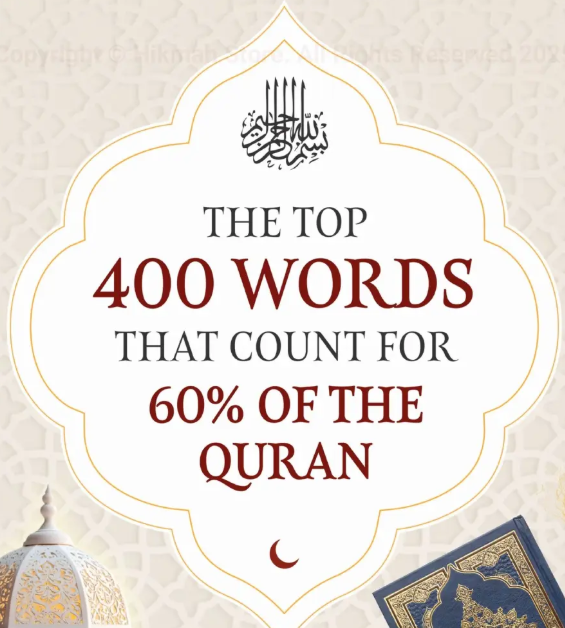
The 400 most common words in the Quran, when learned systematically, give a student access to roughly 60% of the text they encounter in every recitation and every page of the Mushaf.
Table of Contents:
Why Do the 400 Most Repeated Words in the Quran Matter?
The 400 most repeated words in the Quran are the structural and spiritual backbone of the entire Book. These words form the core of Allah’s speech: His commands, His descriptions of the unseen, His accounts of the Prophets, and His promises to believers.
In our sessions at Buruj Academy, we consistently find that students who invest six to eight weeks learning high-frequency Quranic vocabulary experience a qualitative shift in their Salah. They stop reciting sounds and begin engaging with meaning — and that shift changes everything about how they relate to the Quran.
Understanding these words also dramatically accelerates Hifz progress. When a student recognizes اللَّه, إِنَّ, or يَوْم the moment they appear, the memorization load decreases because the brain processes meaning, not just phonetic sequences.
Our Online Hifz Program integrates Quranic vocabulary study directly into its memorization curriculum for exactly this reason.
Start Hifz today with a FREE trial session
What Does the Quranic Corpus Data Actually Show?
The Quranic Corpus — developed using computational linguistics and classical Arabic morphology — provides the most reliable frequency data available for Quranic vocabulary. Its word-by-word tagging covers all 77,430 words of the Quran across 6,236 verses and 114 surahs.
The data reveals a clear pattern: a small number of roots and words carry an enormous percentage of the total text. This follows what linguists call Zipf’s Law — a principle found in all natural languages — and the Quran is no exception.
| Arabic Word | Transliteration | Meaning | Approx. Frequency |
| اللَّه | Allah | Allah | 2,699 |
| رَبّ | Rabb | Lord / Sustainer | 980+ |
| قَالَ | Qāla | He said | 1,700+ |
| إِنَّ | Inna | Indeed / Verily | 1,600+ |
| مَا | Mā | What / Not | 1,400+ |
| مِن | Min | From / Of | 3,200+ |
| فِي | Fī | In | 1,700+ |
| عَلَى | ʿAlā | Upon / On | 1,400+ |
| وَ | Wa | And | 45,000+ |
| لَا | Lā | No / Not | 2,000+ |
Frequency data drawn from corpus.quran.com morphological tagging. Counts include all grammatical forms of each root.
The prepositions, conjunctions, and particles alone — words like مِن, فِي, عَلَى, and وَ — appear tens of thousands of times combined. Learning them first produces the highest comprehension return per hour of study.
Buruj Academy’s Quranic Arabic Classes are taught by Al-Azhar University graduates with 12+ years of experience teaching non-Arabic speakers globally.
Begin Understanding Quranic Arabic with a FREE Lesson
Lists of the Top 400 Quranic Words Categorized by Type
The 400 most common words in the Quran fall into distinct grammatical categories. Understanding this structure helps students prioritize their learning sequence intelligently rather than memorizing words in isolation.
1. List of Particles and Prepositions in the Top 400 Quranic Words
These are the highest-frequency words in the entire Quran. They are short, unchanging, and once learned, recognizable in every single page.
| Arabic | Transliteration | Meaning | Frequency |
| مِن | Min | From, of | 3,200+ |
| فِي | Fī | In, within | 1,700+ |
| عَلَى | ʿAlā | Upon, on, over | 1,400+ |
| إِلَى | Ilā | To, toward | 740+ |
| عَن | ʿAn | From, about | 380+ |
| بِ | Bi | With, by, in | 2,000+ |
| لِ | Li | For, to | 2,500+ |
| كَ | Ka | Like, as | 400+ |
2. List of Pronouns in the Top 400 Quranic Words
Quranic pronouns appear constantly because the Quran speaks directly — to the Prophet ﷺ, to the believers, about Allah, about the disbelievers. Mastering pronouns unlocks the relational dimension of every verse.
| Arabic | Transliteration | Meaning |
| هُوَ | Huwa | He |
| هُمْ | Hum | They (masc.) |
| أَنتَ | Anta | You (sing. masc.) |
| نَحْنُ | Naḥnu | We |
| هِيَ | Hiya | She |
| أَنتُمْ | Antum | You (plural) |
3. List of High-Frequency Nouns in the Top 400 Quranic Words
These are the theological and narrative keywords of the Quran — the words that carry its core messages about Allah, the hereafter, the believers, and the messengers.
| Arabic | Transliteration | Meaning |
| رَبّ | Rabb | Lord, Sustainer |
| يَوْم | Yawm | Day |
| نَاس | Nās | People, mankind |
| أَرْض | Arḍ | Earth |
| سَمَاء | Samāʾ | Sky, heaven |
| قَلْب | Qalb | Heart |
| نَفْس | Nafs | Soul, self |
| دِين | Dīn | Religion, way of life |
| آيَة | Āya | Sign, verse |
Begin Understanding Quranic Arabic with a FREE Lesson
4. List of High-Frequency Verbs in the Top 400 Quranic Words
Quranic verbs encode action, divine will, and human response. Many appear in past tense (فعل ماضي) for narrative, present/future tense for commands and promises, and imperative form for direct instruction.
| Arabic | Transliteration | Meaning |
| قَالَ | Qāla | He said |
| كَانَ | Kāna | He was / It was |
| جَاءَ | Jāʾa | He came |
| أَمَنَ | Āmana | He believed |
| عَمِلَ | ʿAmila | He did / He worked |
| كَفَرَ | Kafara | He disbelieved |
| ظَلَمَ | Ẓalama | He wronged / oppressed |
| رَحِمَ | Raḥima | He showed mercy |
| عَلِمَ | ʿAlima | He knew |
| أَرَادَ | Arāda | He willed / intended |
Read also: Stages of Revelation of the Quran
Which Words Should Beginners Learn First from the Top 400 Quranic Words?
Beginners should prioritize the top 100 words before attempting the full 400. This is because the first 100 alone — primarily particles, prepositions, and the most common nouns — appear so frequently that understanding them produces an immediate and noticeable improvement in Salah comprehension.
In our experience teaching non-Arabic speakers at Buruj Academy, students who learn the first 50 high-frequency words with their correct pronunciation and basic usage report understanding fragments of nearly every Surah they recite within four to six weeks. That early win is spiritually powerful — and it sustains motivation through the longer journey ahead.
The sequence we recommend for complete beginners:
Week 1–2: Particles and prepositions (مِن، فِي، عَلَى، إِلَى، بِ، لِ، وَ، أَو)
Week 3–4: Core pronouns and demonstratives (هُوَ، هُمْ، هَذَا، ذَلِك، الَّذِي)
Week 5–6: Top 20 nouns (اللَّه، رَبّ، يَوْم، نَاس، أَرْض، نَفْس، آيَة)
Week 7–8: Top 15 verbs (قَالَ، كَانَ، أَمَنَ، عَلِمَ، رَحِمَ، كَفَرَ)
If you are simultaneously working on your Quran reading foundations, our Quran Reading Course pairs naturally with vocabulary study — correct pronunciation of the words you are memorizing reinforces both skills simultaneously.
Book your Free trial lesson and start reading the Quran
Lists of The 400 Most Common Quran Words Organized by Thematic Group
Beyond grammatical categories, grouping Quranic vocabulary thematically helps students retain words within meaningful spiritual contexts — connecting vocabulary to belief rather than memorizing lists in isolation.
1. Common Quranic Words Related to Allah’s Names and Attributes
| Arabic | Transliteration | Meaning |
| رَحْمَان | Raḥmān | The Most Merciful |
| رَحِيم | Raḥīm | The Most Compassionate |
| عَلِيم | ʿAlīm | The All-Knowing |
| حَكِيم | Ḥakīm | The All-Wise |
| قَدِير | Qadīr | The All-Powerful |
| غَفُور | Ghafūr | The Oft-Forgiving |
| سَمِيع | Samīʿ | The All-Hearing |
| بَصِير | Baṣīr | The All-Seeing |
These eight words alone appear across hundreds of verses. When a student recognizes عَلِيمٌ حَكِيمٌ at the end of a verse — “the All-Knowing, the All-Wise” — they are no longer reciting syllables. They are hearing Allah describe Himself.
Excel in Your Quranic Studies
Join Buruj Academy and master the Quran with our structured, professional curriculum.
Book Your Free Trial2. Common Quranic Words Related to the Day of Judgment
| Arabic | Transliteration | Meaning |
| يَوْمُ الْقِيَامَة | Yawm al-Qiyāma | Day of Resurrection |
| جَنَّة | Janna | Garden, Paradise |
| نَار | Nār | Fire |
| حِسَاب | Ḥisāb | Account, reckoning |
| عَذَاب | ʿAdhāb | Punishment |
| ثَوَاب | Thawāb | Reward |
| أَجْر | Ajr | Recompense, wage |
| مِيزَان | Mīzān | Scale, balance |
3. Common Quranic Words Related to the Prophets and Revelation
| Arabic | Transliteration | Meaning |
| نَبِيّ | Nabī | Prophet |
| رَسُول | Rasūl | Messenger |
| كِتَاب | Kitāb | Book, Scripture |
| وَحْي | Waḥy | Revelation |
| قُرْآن | Qurʾān | The Quran |
| هُدًى | Hudā | Guidance |
| بَيِّنَة | Bayyina | Clear proof |
Download The 400 Most Common Words in the Quran PDF
The Scribd document “Top 400 Words of the Quran” compiles this data in a learner-friendly format. Both resources draw from the standard Uthmani rasm of the Quran.
Download Top 400 Words of The Quran PDF
How to Study the Top 400 Quranic Words Effectively?
Effective Quranic vocabulary acquisition requires a method — not just a list. Students who simply read word lists rarely retain them past the first week. The techniques that actually work combine active recall, spaced repetition, and Quranic context immersion.
1. Use Spaced Repetition With Quranic Sentences
Never study a word divorced from a Quranic sentence. When learning يَوْم (day), pair it immediately with يَوْمَ الدِّينِ — “the Day of Recompense” — from Al-Fatihah 1:4. The verse context anchors the word in memory far more durably than a flashcard alone.
يَوْمِ ٱلدِّينِ
Yawmi d-dīn
“the Day of Recompense.” (Al-Fatihah 1:4)
This verse is recited a minimum of 17 times daily in the five obligatory prayers — making it one of the most powerful vocabulary anchors available to any student.
2. Review Through Daily Salah Recitation
The five daily prayers are the most powerful vocabulary review system ever designed. Every word learned from the top 400 that appears in Al-Fatihah, the short surahs, and the standard prayer supplications gets reinforced 17 to 51 times per day.
Structure your vocabulary study so that the words you learn this week appear in the Surahs you recite this week.
If you want to move from reading the Quran letter-by-letter to reading with meaning and proper recitation, our Quran Recitation Course provides the structured environment to practice vocabulary in live recitation with immediate correction from Ijazah-certified instructors.
Book your first FREE recitation lesson
3. Track Your Cumulative Comprehension Percentage
One of the most motivating aspects of frequency-based learning is the measurable comprehension gain.
The jump from 0 to the top 100 is the steepest gain — roughly 50% coverage from just 100 words. This is why we always recommend beginners start here before expanding their vocabulary further.
Read also: What Is the Quran About?
Discover the Buruj Academy Difference
Step into our virtual classrooms and see how our expert instructors make learning Quran and Arabic intuitive and clear. We focus on overcoming the specific hurdles non-native speakers face, building your confidence and connection with the Quran.
Start Mastering Quranic Vocabulary with Buruj Academy’s Expert Instructors
Understanding the words of the Quran is an act of worship — and it deserves proper guidance from qualified teachers who know how to make classical Arabic accessible to non-native speakers.
Buruj Academy’s Quranic Arabic Classes are taught by Al-Azhar University graduates with 12+ years of experience teaching non-Arabic speakers globally. Our Buruj Method — context-before-abstraction — means students encounter every word in its Quranic setting before ever touching a grammar table.
- Ijazah-certified instructors with deep Quranic linguistics expertise
- Personalized 1-on-1 sessions with flexible 24/7 scheduling
- Vocabulary curriculum integrated with Tajweed and Hifz tracks
- Real-time feedback on pronunciation and comprehension
Book your free trial lesson today and begin your path to understanding Allah’s words directly.
Take the next step in your learning journey today by enrolling in one of our specialized programs:
- Online Quran Classes
- Online Quran Classes for Beginners
- Online Quran Classes for Adults
- Online Quran Classes for Ladies
- Online Quran Classes for Kids
- Quran Reading Course
- Quran Recitation Course
- Online Ijazah Course
- Online Qirat Course
Don’t wait to transform your relationship with the Holy Quran. Join our global community of students and book your free evaluation session now!
Excel in Your Quranic Studies
Join Buruj Academy and master the Quran with our structured, professional curriculum.
Book Your Free TrialConclusion
The 400 most common words in the Quran are the key to hearing the Quran rather than merely reciting it. When a student learns these words systematically, every prayer deepens, every page of the Mushaf opens further, and the memorization process becomes lighter and more meaningful.
Start with the particles and prepositions, build through the core nouns and verbs, and always anchor each word in a real Quranic verse. Seventy percent comprehension of Allah’s Book is within reach — and it begins with the very first word on the list.
Frequently Asked Questions About the Most Common Words in the Quran
How many unique words are in the Quran?
The Quran contains approximately 77,430 total words, but only around 18,000 unique word forms. When grouped by root, the number of distinct roots is approximately 1,750. This means the Quran’s vocabulary is highly concentrated — a small number of roots generate the vast majority of its text, making frequency-based learning an extremely efficient approach.
Can learning the top 400 Quran words replace learning Arabic grammar?
Learning the top 400 Quranic words provides strong comprehension of the Quran’s surface meaning but does not replace Arabic grammar study. Grammar (i’rab) explains how word relationships change meaning — for example, why the same word can mean “of Allah” or “to Allah” depending on its grammatical position. Vocabulary and grammar work together; neither alone is sufficient for deep Quranic understanding.
Where can I find the most accurate Quran word frequency data?
The most authoritative publicly available resource is corpus.quran.com, which provides morphologically tagged, frequency-ranked data for every word in the Quran. The Scribd document “Top 400 Words of the Quran” also compiles this data in a learner-friendly format. Both resources draw from the standard Uthmani rasm of the Quran.