 Tajweed

| Key Takeaways |
| Madd leen uses only two letters — Waw and Ya — when they are sukoon with a fatha on the preceding letter. |
| Madd leen only applies when stopping (waqf) on a word; there is no elongation when continuing (wasl). |
| The elongation of madd leen is 2, 4, or 6 counts — identical in range to madd ‘arid lil-sukoon. |
| Madd ‘arid lil-sukoon must always be equal to or longer than madd leen in the same recitation sitting. |
| Quranic examples include words like خَيْر (khayr), يَوْم (yawm), خَوْف (khawf), and شَيْء (shay’). |
Madd leen is one of the nine essential madd types every Quran reciter must know — yet it is frequently mispronounced, even by students with years of Tajweed study behind them. The confusion usually comes from conflating its letters with standard madd letters, or from elongating it during wasl when no elongation exists.
Madd leen occurs when a Waw or Ya is sukoon (vowel-less) and the letter directly before it carries a fatha (short “a” vowel), with the word ending in a sukoon caused by stopping. These two letters — called huroof al-leen (letters of softness) — are elongated only at waqf, making this madd inseparably linked to the act of pausing in recitation.
What Is the Definition of Madd Leen in Tajweed?
Madd leen is the elongation of a Waw or Ya that is sukoon, preceded by a fatha, occurring before the final letter of a word on which the reciter stops with ‘arid (temporary) sukoon.
Three conditions must all be present simultaneously for madd leen to apply.
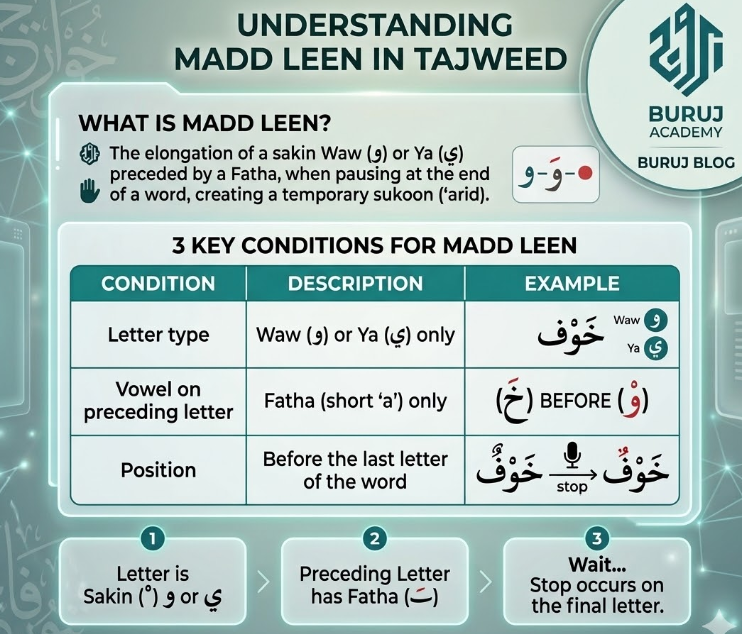
All three conditions are non-negotiable. If the letter before the Waw or Ya carries a damma or kasra instead of a fatha, the letter becomes a standard madd letter, not a leen letter — and the applicable madd changes entirely.
What Are the Letters of Madd Leen?
Madd leen has exactly two letters: Waw (و) sakinah and Ya (ي) sakinah, each preceded by a letter carrying a fatha.
Why Are They Called “Leen”?
The term leen (لِين) means softness or ease — these two letters exit the mouth with natural fluency and without strain, which distinguishes them from letters of madd proper.
The key distinction from standard madd letters is the vowel that precedes them. A standard madd Waw requires a damma on the preceding letter; a standard madd Ya requires a kasra.
In madd leen, both Waw and Ya are preceded by a fatha — meaning the vowel does not match the nature of the letter itself.
Classical Tajweed scholars note this mismatch as the reason madd leen is treated as slightly weaker than the three primary madd letters.
This phonetic gentleness is not a defect — it is a deliberate quality of Arabic that produces the characteristic soft glide heard in words like خَيْر and يَوْم.
Excel in Your Quranic Studies
Join Buruj Academy and master the Quran with our structured, professional curriculum.
Book Your Free TrialRead also: Madd Muttasil: Definition, Rule, Examples, and Symbol in Tajweed
Madd Leen Examples in Quran
The Quran contains madd leen throughout — in short, frequently recited words that appear in almost every surah. Recognising these examples in live recitation is the bridge between knowing the rule and applying it.
خَيْر (khayr) — “good/better”
بِيَدِكَ الْخَيْر
Biyadikal-khayr
“In Your hand is [all] good.” (Aal ‘Imran 3:26)
The Ya is sukoon, the kha before it carries fatha — madd leen applies on waqf.
يَوْم (yawm) — “day”
يَوْم الدِّينِ
Yawmid-deen
“The Day of Recompense.” (Al-Fatihah 1:4)
The Waw is sukoon preceded by ya with fatha — madd leen on waqf if stopping on يَوْمَ.
خَوْفٌ (khawf) — “fear”
وَلَا خَوْفٌ عَلَيْهِمْ
Wa laa khawfun ‘alayhim
“And no fear will there be concerning them.” (Al-Baqarah 2:38)
(Classic madd leen: Waw sukoon, preceded by kha with fatha.)
شَيْءٌ (shay’) “thing”
إِنَّكَ عَلَىٰ كُلِّ شَيْءٍ قَدِيرٌ
Innaka ‘alaa kulli shay’in qadeer
“Indeed, You are over all things competent.” (Aal ‘Imran 3:26)
(The Ya in شَيْءٍ is sukoon preceded by sha with fatha — madd leen when stopping on شَيْءٍ.)
In our classes at Buruj Academy, we use this very ayah — Aal ‘Imran 3:26 — as a teaching model for madd leen alongside madd ‘arid lil-sukoon. The word خَيْر contains madd leen, while قَدِيرٌ contains madd ‘arid lil-sukoon — both appearing in the same short passage, which makes the comparison concrete rather than abstract.
Book a FREE trial session with one of Buruj’s Azhari Quran tutors

Discover the Buruj Academy Difference
Step into our virtual classrooms and see how our expert instructors make learning Quran and Arabic intuitive and clear. We focus on overcoming the specific hurdles non-native speakers face, building your confidence and connection with the Quran.
Madd Leen Rules
Madd leen is elongated by 2, 4, or 6 counts — the same three options available in madd ‘arid lil-sukoon. This is one of the few areas of Tajweed where the reciter has a legitimate choice between three valid levels of elongation, rather than one fixed amount.
The choice is not arbitrary, however. A governing principle from classical Tajweed scholarship constrains it: madd ‘arid lil-sukoon must always be equal to or greater than madd leen within a single recitation. This is not a stylistic preference — it is a binding rule for all reciters of Hafs ‘an ‘Asim.
| Madd ‘Arid Amount | Madd Leen — Allowed Options |
| 2 counts | 2 counts only |
| 4 counts | 2 or 4 counts |
| 6 counts | 2, 4, or 6 counts |
The logic is straightforward: madd letters (with matching vowels) have a stronger phonetic basis than leen letters (with mismatched fatha).
Giving madd leen a longer duration than madd ‘arid lil-sukoon would invert that hierarchy — which classical scholars explicitly prohibit.
If you are reciting with 2-count ‘arid, you cannot stretch the leen to 4 — that would make the weaker madd longer than the stronger one.
At Buruj Academy, our Online Tajweed Classes train students to internalise this proportionality rule through live recitation practice — not just by memorising the table above, but by hearing and producing the correct balance in real Quranic passages under instructor feedback.
Book Your FREE Trial Lesson to Begin Your Tajweed Journey

Read also: Madd Munfasil: Definition, Ruling, Divisions, and Examples from the Quran
What Is the Difference Between Madd Leen and Madd Arid Lil-Sukoon?
Madd leen and madd ‘arid lil-sukoon are closely related but structurally different. Both involve a temporary sukoon caused by stopping (waqf), and both share the same range of elongation (2, 4, or 6 counts). The difference lies entirely in the type of letter that carries the elongation.
| Feature | Madd Leen Aridh Lil-Sukoon | Madd Leen |
| Elongation letter | Alif, Waw (after damma), Ya (after kasra) | Waw or Ya (after fatha only) |
| Vowel on preceding letter | Matches the madd letter | Fatha — does NOT match |
| Strength | Stronger | Slightly weaker |
| Elongation range | 2, 4, or 6 counts | 2, 4, or 6 counts |
| Position in hierarchy | Equal or longer | Equal or shorter |
Understanding this distinction helps reciters avoid one of the most common errors we observe: treating every elongated Waw or Ya as madd ‘arid lil-sukoon, regardless of what vowel precedes it. The fatha before the leen letter is the diagnostic marker — if you see it, you are dealing with madd leen, not standard ‘arid.
For a complete foundation in all madd types and their interactions, our Tajweed for Beginners course covers the full madd system in sequenced lessons that build from madd tabi’i upward.
Book Your FREE Trial Lesson to Begin Your Tajweed Journey

What Is the Common Mistake Students Make with Madd Leen During Wasl?
The most widespread error with madd leen is elongating the Waw or Ya when continuing recitation (wasl) — a mistake we hear consistently from students at every level. During wasl, the sukoon does not exist; the word continues into the next word with its original short vowel on the final letter. Without sukoon, there is no madd leen.
In practice, this means:
- خَوْفٌ read in continuation carries no elongation on the Waw — it is pronounced as a natural short glide
- شَيْءٍ read in continuation carries no elongation on the Ya — same principle applies
- Elongation only activates the moment the reciter stops (waqf) on that word
This error often develops because students hear madd leen during classroom listening exercises, which typically involve stopping on words. When they then recite continuously, they carry the elongation habit into wasl.
Correcting it requires deliberate practice reading full ayahs without stopping — something our instructors address specifically in Buruj Academy’s Tajweed for Beginners course.
If you are working through the madd rules systematically, our guide to Tajweed for beginners provides a structured overview of where madd leen fits within the broader Tajweed system.
Excel in Your Quranic Studies
Join Buruj Academy and master the Quran with our structured, professional curriculum.
Book Your Free TrialMaster Quranic Recitation with Buruj Academy’s Expert Tajweed Instructors
Madd leen — like every Tajweed rule — only becomes second nature through consistent, corrected recitation practice with a qualified teacher.
Buruj Academy’s Online Tajweed Classes are taught by Ijazah-certified instructors and Al-Azhar University graduates with 12+ years of experience teaching non-Arabic speakers globally. Using the Buruj Method — sound before rules, ear training before memorisation — our instructors help students move from knowing Tajweed rules to reciting with them naturally.
- Personalised 1-on-1 sessions with real-time correction
- Flexible scheduling, 24/7 availability
- Structured progression from madd tabi’i to full Tajweed mastery
Join a supportive learning environment tailored to your pace and lifestyle. Start your journey toward excellence by enrolling in one of our specialized tracks:
- Online Tajweed Classes
- Tajweed Classes for Beginners
- Tajweed Classes for Adults
- Tajweed Classes for Sisters
- Tajweed Classes for Kids
- Advanced Tajweed Course
- Amli Tajweed Course (Practical Application)
Ready to transform your recitation? book your free assessment and start your path to Tajweed mastery today!
Frequently Asked Questions About Madd Leen
What Are the Two Letters of Madd Leen?
The two letters of madd leen are Waw (و) and Ya (ي), both sukoon (vowel-less) and both preceded by a letter carrying a fatha (short “a” vowel). These are called huroof al-leen — letters of softness — because they exit the mouth with natural ease. They are distinct from the three standard madd letters, which require a matching vowel before them.
Does Madd Leen Apply When Continuing Recitation?
No. Madd leen applies only when the reciter stops (waqf) on the word. During continuous recitation (wasl), the final letter carries its original short vowel, the sukoon disappears, and no elongation takes place. The Waw or Ya is read as a natural one-count glide. Elongating it during wasl is a Tajweed error.
How Many Counts Is Madd Leen?
Madd leen may be recited with 2, 4, or 6 counts — all three are valid. However, the chosen amount must be equal to or less than the amount used for madd ‘arid lil-sukoon in the same recitation. If you recite madd ‘arid with 2 counts, madd leen must also be 2 counts. If ‘arid is 6 counts, madd leen may be 2, 4, or 6.
What Is the Difference Between a Leen Letter and a Madd Letter?
A madd letter (Alif, Waw after damma, Ya after kasra) has a vowel on the preceding letter that matches its nature, producing a full elongation. A leen letter (Waw or Ya after fatha) has a mismatched vowel — the fatha does not match Waw or Ya — resulting in a softer, slightly weaker elongation. This phonetic difference explains why ‘arid lil-sukoon must be equal to or longer than madd leen.
Where Can I Find Madd Leen Examples in the Quran?
Madd leen examples appear throughout the Quran in common words: خَيْر (khayr — Aal ‘Imran 3:26), يَوْم (yawm — Al-Fatihah 1:4 in context), خَوْف (khawf — Al-Baqarah 2:38), شَيْء (shay’ — Aal ‘Imran 3:26), and اثْنَتَيْن (ithnatain). Any Waw or Ya that is sukoon after a fatha, before the last letter of a word you stop on, is a madd leen position.
For a deeper understanding of connected Tajweed rules, explore our related guides on idgham rules in Tajweed,ikhfa letters, and how to read Quran with Tajweed.
Related Articles
Tajweed