 Tajweed

| Key Takeaways |
| Madd asli (natural madd) extends any madd letter exactly two counts — no more, no less — for all reciters by scholarly consensus. |
| Shortening madd asli below two counts is prohibited (haram) in Tajweed, making it one of the few rules with a legal ruling attached. |
| Madd asli has no triggering cause — no hamza or sukoon follows the madd letter, distinguishing it from all other madd types. |
| The three divisions of madd asli are: present in connection and pause, present in pause only, and present in connection only. |
| Letters of madd asli in disconnected Quranic letters (huruf muqatta’at) include only those spelled with two sounds: ح، ط، ي، ه، ر. |
When students first encounter the madd rules, they often focus immediately on madd muttasil or madd munfasil — the extended, rule-governed stretches of sound. Yet the foundation beneath all of them is something far simpler and far more consequential.
Madd asli, also called madd tabee’i or the natural madd, is the baseline elongation that gives every madd letter its identity. It lasts exactly two counts, applies universally to all reciters, and requires no triggering condition — making it both the easiest madd to define and one of the most important to master correctly.
What Is Madd Asli?
Madd asli is the elongation without which a madd letter cannot exist. Classical Tajweed scholars define it as the madd whose letter cannot stand without it — meaning that without the two-count extension, the letter ceases to be a madd letter at all.
It carries three names in the scholarly tradition, each reflecting a different dimension of its nature.
Why Is It Called Madd Tabee’i (Natural Madd)?
It is called natural because a person with a sound, unaffected voice will neither shorten it below two counts nor lengthen it beyond them. The two-count duration is what the natural voice produces when it encounters a madd letter without any external pressure from hamza or sukoon.
Why Is It Called Madd Asli (Original Madd)?
It is called original because it is the root from which all other madd types branch. Every extended madd — madd muttasil, madd munfasil, madd lazim — is built on top of this foundational two counts.
Why Is It Also Called Madd al-Sifah or Madd al-Dhati?
Madd al-dhati (intrinsic madd) refers to the fact that the identity of the madd letter itself depends on this extension. Madd al-sifah (madd of the form) highlights that the structural form of madd letters — alif, waw, ya — inherently carries this elongation for every reciter without exception.
At Buruj Academy, our Tajweed for Beginners course opens with madd asli precisely because students who skip this foundation often develop a persistent shortening habit that later distorts all their extended madds.
Book Your FREE Trial Lesson to Begin Your Tajweed Journey
Read also: Madd ‘Arid Li-Sukoon: Rules, Types, and Quranic Examples
What Is the Exact Rule of Madd Asli in Tajweed?
Madd asli in Tajweed requires extending the madd letter by exactly two counts (harakatayn) — neither increasing nor decreasing. This applies equally during connection (wasl) and pause (waqf), and applies to every reciter of the Quran regardless of the riwayah.
Two conditions define madd asli precisely:
| Condition | Description |
| No hamza follows | The madd letter is not followed by a hamza (glottal stop) |
| No sukoon follows | The madd letter is not followed by a sukoon (stillness marker) |
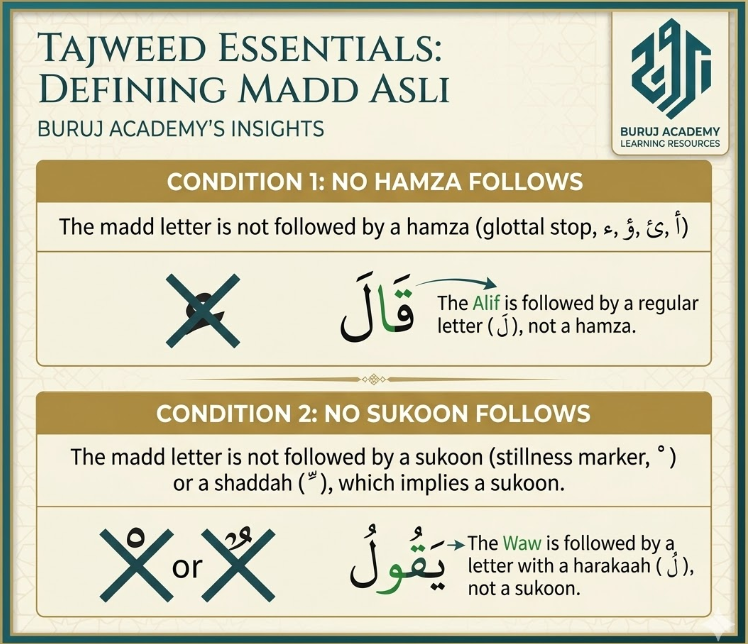
When either a hamza or sukoon follows the madd letter, the madd is no longer natural — it becomes one of the causative madds with a longer or variable duration. Madd asli is specifically the elongation that exists in the absence of both causes.
Excel in Your Quranic Studies
Join Buruj Academy and master the Quran with our structured, professional curriculum.
Book Your Free TrialHow Long Is Two Counts and How Do We Measure It?
Two counts (harakatayn) is the duration required to pronounce two consecutive moving consonants — for example, saying “ba-ba” or “ta-ta” at a natural, unhurried pace.
Scholars have described this measurement in two ways, and the difference matters:
| Measurement Method | Description | Scholarly Position |
| Movement of the finger | Extending or contracting a finger once at moderate speed | Mentioned by later scholars as a teaching aid |
| Duration of two letters | The time taken to pronounce two voweled consonants consecutively | Preferred by classical and contemporary scholars |
The second method — timing by the pronunciation of two consonants — is more precise and more consistent with how classical Tajweed masters described the harakah. The finger movement was introduced as a teaching tool for beginners but cannot reliably produce uniform timing across different individuals.
What cannot be measured by any tool, however, is captured only through repetition under a qualified teacher.
Shortening these two counts — even slightly — is not a stylistic choice. Classical scholars state clearly that reducing madd asli below two counts is prohibited (haram).
This is one of the strongest rulings attached to any Tajweed rule, and it is a point our Ijazah-certified instructors at Buruj Academy consistently emphasize in our Online Tajweed Classes.
Book a FREE trial session with one of Buruj’s Azhari Quran tutors

Read also: Madd Leen: Rules, Letters, and Examples in the Quran
What Are the Three Types of Madd Asli by Position?
Madd asli is not confined to one structural position. It divides into three types based on whether it appears during connection (wasl), pause (waqf), or both.
Type One: Madd Asli Present in Both Connection and Pause
This is the most common type — a madd letter written in the Mushaf and followed by a letter with no hamza or sukoon after it.
Examples from the Quran:
قَالُوا
Qaaloo
“They said”
The waw madd here carries two counts whether you continue reciting or pause.
الَّذِي
Alladhee
“The one who”
The ya madd is present consistently in all positions.
قِيلَ
Qeela
“It was said”
The ya madd holds its two counts in both connection and pause.
Type Two: Madd Asli Present in Pause Only
This type appears when a madd letter exists phonetically at the end of a word during pause but disappears during connection. This occurs in several known situations.
The most common case is pausing on a word ending with tanwin fath — the double fathah. When pausing on such words, the tanwin converts to an alif sound, producing a madd asli that exists only at the point of pause.
Examples:
- Pausing on بَصِيرًا — the tanwin fath produces an alif: baseeraa
- Pausing on دُعَاءً — an alif appears at pause: du’aaaa
Another case is pausing on words ending with an alif that is written deficiently (without the alif letter appearing in the Mushaf) or on words ending in a waw or ya that drop during connection.
Type Three: Madd Asli Present in Connection Only
This type occurs with haa al-kinaayah (the pronoun haa referring to a third party) when it appears between two voweled letters. In this case, a connecting waw or ya sound is produced during recitation but disappears at pause, where the haa is pronounced with sukoon.
Example:
بَلَى إِنَّ رَبَّهُ كَانَ بِهِ بَصِيرًا
Balaa inna rabbahu kaana bihi baseeraa
“But yes — his Lord has always been of him, Aware.” (Al-Inshiqaq 84:15)
In connected recitation, the haa in رَبَّهُ carries a waw extension. At pause, the waw disappears and the haa rests with sukoon — no madd remains.
What Are the Examples of Madd Asli in the Quran?
Madd asli appears throughout the Quran with remarkable frequency. Every surah contains it. Every page contains it. It is not a rule you encounter occasionally — it is present in virtually every line of recitation.
The three madd letters each carry their own madd asli:
| Madd Letter | Arabic Symbol | Condition for Madd Asli | Common Examples |
| Alif (ا) | Preceded by fathah | No hamza or sukoon follows | قَالَ، جَاءَ (before the hamza), البَاطِل |
| Waw (و) | Preceded by dammah | No hamza or sukoon follows | يَقُولُ، قَالُوا |
| Ya (ي) | Preceded by kasrah | No hamza or sukoon follows | الَّذِي، قِيلَ |
Additional Quranic examples:
نُوحِيهَا
Nooheeha
“We reveal it” (Yusuf 12:3)
Both the waw and ya madds here carry the natural two-count extension.
قَالَ
Qaala
“He said”
The alif madd appears hundreds of times across the Quran, always carrying two counts when no hamza follows.
In our sessions at Buruj Academy, we observe that students who train their ear to hear madd asli as a distinct, measured sound — rather than a vague lengthening — transition to the longer madds with significantly more control and consistency. This ear-first approach is the foundation of the Buruj Method.
If you are building your Tajweed foundation from the ground up, our guide on Tajweed for beginners explains how madd asli fits into the full structure of Tajweed rules.
Discover the Buruj Academy Difference
Step into our virtual classrooms and see how our expert instructors make learning Quran and Arabic intuitive and clear. We focus on overcoming the specific hurdles non-native speakers face, building your confidence and connection with the Quran.
What Is Madd Asli in the Disconnected Letters (Huruf Muqatta’at)?
The disconnected letters at the openings of certain Quranic surahs also carry madd asli — but only in specific letters.
The rule is precise: madd asli occurs in a disconnected letter only when that letter, when spelled out in full pronunciation, consists of exactly two sounds — and the second sound is a madd letter.
The letters that carry this madd are gathered in the phrase حَيٌّ طَاهِرٌ (Hayyun Taahir):
| Letter | Pronunciation | Madd Letter Present |
| ح (Ha) | Haa | Alif |
| ي (Ya) | Yaa | Alif |
| ط (Ta) | Taa | Alif |
| ه (Ha) | Haa | Alif |
| ر (Ra) | Raa | Alif |
Letters like ا، ل، م — which are spelled with three sounds in pronunciation (alif-lam-fah, lam-alif-meem) — do not carry madd asli in the disconnected letter form because the second element is not a madd letter; instead, they carry madd lazim.
This distinction is one that students in our Online Tajweed Classes regularly find clarifying — once the principle is understood, the sorting of disconnected letters by madd type becomes logical rather than memorized.
Book Your FREE Trial Lesson to Begin Your Tajweed Journey

How Does Madd Asli Differ from Other Madd Types?
Understanding madd asli requires knowing precisely where it ends and where the other madds begin. The key distinction is causation.
| Madd Type | Cause | Duration |
| Madd Asli (Natural) | No cause — inherent to madd letter | Exactly 2 counts |
| Madd Muttasil | Hamza follows in same word | 4–5 counts |
| Madd Munfasil | Hamza follows in next word | 4–5 counts (Hafs) |
| Madd Lazim | Sukoon follows — permanent | 6 counts |
| Madd Arid lil-Sukoon | Sukoon introduced at pause | 2, 4, or 6 counts |
Madd asli is the only madd with a fixed, unchanging duration. Every other madd type carries scholarly discussion, variation between reciters, or conditions that alter the count. Madd asli does not — it is always two counts for every reciter.
This is also why some Tajweed scholars describe madd asli as the madd that carries the most universal consensus in the entire science of Tajweed.
Madd asli in Arabic scholarship is treated as a matter of absolute agreement (ijma’), while the other madds carry degrees of permitted variation.
For a broader look at how madd rules interact with rules like idgham and ikhfa in your recitation, our article on Idgham rules in Tajweed provides essential complementary context.
Excel in Your Quranic Studies
Join Buruj Academy and master the Quran with our structured, professional curriculum.
Book Your Free TrialMaster Tajweed with Buruj Academy’s Certified Instructors
Madd asli is the starting point of correct recitation — but mastering it requires hearing it modeled correctly, having your own recitation corrected in real time, and building consistent habits through guided repetition.
At Buruj Academy, our Online Tajweed Classes are led by Al-Azhar University graduates and Ijazah-certified instructors with 12+ years of experience teaching non-Arabic speakers globally. Through the Buruj Method — sound before rules, consistency before speed — students build proper madd duration from their very first lesson.
We offer 1-on-1 personalized sessions with flexible scheduling across all time zones. Whether you are a complete beginner or refining your recitation for Ijazah pursuit, our Tajweed for Beginners course provides the structured, expert-guided path you need.
Book your free trial lesson today and let our instructors guide your recitation with precision and patience — insha’Allah.
See which of Burooj’s courses aligns with your learning path:
- Tajweed Classes
- Tafseer Al-Quran Course
- Quran Recitation Course
- Hifz Course (Quran Memorization)
- Quranic Arabic Classes
- Noorani Qaida course
- Islamic Studies
See which of Burooj’s courses aligns with your child’s learning path:
- Arabic Classes for Kids
- Alphabet course
- Noorani Qaida Course for Kids
- Islamic Studies for Kids
- Hifz Classes for Kids
- Quran Classes for Kids
- Tajweed for Kids

Frequently Asked Questions About Madd Asli
What Is the Difference Between Madd Asli and Madd Tabee’i?
Madd asli and madd tabee’i are two names for the same rule. Madd asli means “original madd” — emphasizing that it is the root of all madd types. Madd tabee’i means “natural madd” — emphasizing that it requires no external cause. Both terms refer to the two-count elongation that is intrinsic to every madd letter when no hamza or sukoon follows.
Is It Haram to Shorten Madd Asli?
Yes. Classical Tajweed scholarship states clearly that reducing madd asli below two counts is prohibited (haram) because it alters the identity of the madd letter itself. This is not a minor observational error — it represents a fundamental change to the sound of the word being recited. For this reason, our instructors treat madd asli correction as a priority in beginner recitation.
How Do I Know If a Letter Has Madd Asli or a Different Madd?
Check what follows the madd letter. If the next letter carries a vowel (harakah) and is not a hamza, the madd is asli — extend two counts and move on. If a hamza follows, the madd becomes muttasil or munfasil depending on whether they share a word. If a sukoon follows, the madd becomes lazim or arid lil-sukoon. The presence or absence of these two causes (hamza, sukoon) determines every madd type.
Does Madd Asli Apply the Same Way in All Qira’at?
Yes. Madd asli lasts two counts for every reciter across all authentic qira’at. This is one of the most agreed-upon points in Tajweed scholarship. Where qira’at differ is in the duration of the causative madds — madd muttasil, munfasil, and lazim — but the natural madd remains universally fixed at two counts.
Can I Learn Madd Asli Correctly from Online Resources Alone?
Online explanations — including this article — provide the conceptual framework. But madd duration cannot be reliably self-taught because two counts requires calibration against a trained ear. Without a teacher who can tell you whether your two counts are too short, too long, or accurate, the habit you build may be incorrect and difficult to undo later. A qualified instructor is essential for establishing correct duration from the beginning. You can explore how structured learning works through our guide on how to read Quran with Tajweed.