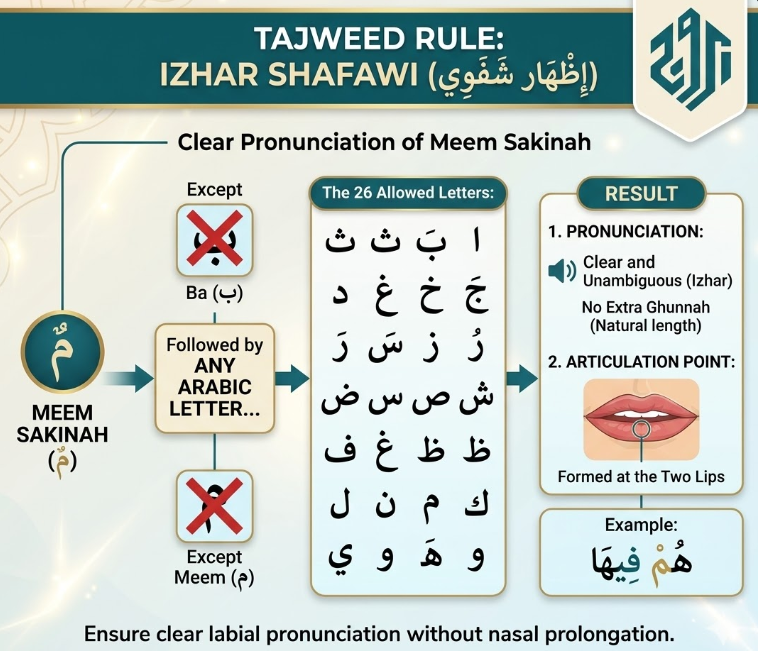
Izhar Shafawi applies when a sukoon Meem (مْ) is followed by any letter except Meem and Ba, requiring clear pronunciation without extra Ghunnah.
The rule covers 26 Arabic letters — every letter of the alphabet except Meem (which triggers Idgham Mutamathlain) and Ba (which triggers Ikhfa Shafawi).
Izhar is strongest before Fa (ف) and Waw (و) because these letters share the lip articulation point with Meem, demanding deliberate clarity to prevent merging.
The sign of Izhar Shafawi in the Mushaf is a plain sukoon (ْ) on the Meem — no special symbol is added.
Unlike Izhar Halqi, which governs Noon Sakinah and Tanwin, Izhar Shafawi governs only Meem Sakinah and is called “Shafawi” because Meem exits from the lips (Shafatayn).
Meem Sakinah — a Meem carrying a sukoon — is one of the most frequently occurring letters in the Quran, and correctly applying its three rules is a defining mark of proper Tajweed. Of those three rules, Izhar Shafawi is the one students encounter most often, because it covers the widest range of letters.
Izhar Shafawi means pronouncing the sukoon Meem completely clearly — with full closure and release of the lips — whenever it is followed by any of the 26 letters that are neither Meem nor Ba. No extra Ghunnah is added, the Meem is not merged, and it is not concealed. The letter simply sounds as it should: distinct, clean, and complete.
What Is Izhar Shafawi?
Izhar Shafawi is one of the three rules governing Meem Sakinah in Tajweed. It occurs when a sukoon Meem is followed by any Arabic letter other than Meem (م) or Ba (ب), requiring the Meem to be pronounced clearly from its articulation point — the two lips (Shafatayn) — without any extension of Ghunnah beyond the Meem’s natural nasal resonance.
The word Izhar (إظهار) means “clarity” or “making apparent.” The word Shafawi (شفوي) means “labial” — referring to the lips. Together, the name tells you exactly what the rule demands: clear pronunciation from the lips.
Understanding this rule is not optional for students pursuing accurate recitation. At Buruj Academy, our Online Tajweed Classes with Ijazah-certified instructors treat Meem Sakinah rules as a foundational milestone — because errors here appear in nearly every Surah a student recites.
Izhar Shafawi applies before all 26 letters of the Arabic alphabet excluding Meem and Ba. There is no dedicated set of letters to memorize the way Izhar Halqi has its six throat letters — the rule is simply everything that remains after the two exceptions are removed.
The table below shows the complete picture of Meem Sakinah’s three rules side by side:
Meem Sakinah Rule
Trigger Letter(s)
What Happens
Idgham Mutamathlain Saghir
Meem (م)
Meem merges into the following Meem with Ghunnah
Ikhfa Shafawi
Ba (ب)
Meem is concealed with Ghunnah between the lips
Izhar Shafawi
All other 26 letters
Meem is pronounced clearly, no extra Ghunnah
This structure means that when you encounter a sukoon Meem and the following letter is anything other than Meem or Ba — whether it is a Ta, Dal, Kaf, Lam, Seen, Ra, or any other letter — Izhar Shafawi applies without exception.
Excel in Your Quranic Studies
Join Buruj Academy and master the Quran with our structured, professional curriculum.
Why Is Izhar Shafawi Especially Strong Before Fa and Waw?
Among all 26 Izhar Shafawi letters, Fa (ف) and Waw (و) require the most deliberate care. This is not a separate rule — it is an elevated caution within the same rule, and classical Tajweed scholars specifically highlighted it to protect students from a natural but incorrect tendency.
The reason is articulation proximity. Meem exits from the two lips pressed together. Waw is also formed at the lips. Fa is formed where the upper teeth meet the inner lower lip — extremely close to the lip region. Because the articulation points are so near, the Meem can easily soften or blend into these letters without the reciter noticing.
Letter
Articulation Point
Risk Without Care
Meem (مْ)
Both lips pressed
—
Waw (و)
Both lips slightly rounded
Meem may soften into Waw
Fa (ف)
Inner lower lip + upper teeth
Meem may be swallowed before Fa
To correct this, our instructors at Buruj Academy teach students to consciously close the lips fully on the Meem and then release before moving to the Fa or Waw. The closure must be complete — the two lips must meet — before the following letter begins.
The best way to internalize any Tajweed rule is to hear it and see it in actual Quranic text. Below are verified Izhar Shafawi examples in Quran, organized to show the rule in different letter environments.
1. Izhar Shafawi Before Fa — The Highest-Attention Case
أَلَمْ يَجْعَلْ كَيْدَهُمْ فِي تَضْلِيلٍ
Alam yaj’al kaydahum fī taḍlīl
“Did He not make their plan into misguidance?” (Al-Feel 105:2)
(The Meem in كَيْدَهُمْ carries sukoon. The following letter is Fa. Pronounce the Meem with clear, full lip closure before moving to Fa — do not reduce or soften the Meem.)
2. Izhar Shafawi Before Waw — The Second High-Attention Case
لَكُمْ دِينُكُمْ وَلِيَ دِينِ
Lakum dīnukum wa liya dīn
“For you is your religion, and for me is my religion.” (Al-Kafirun 109:6)
(The Meem in لَكُمْ and دِينُكُمْ both carry sukoon before Waw. This verse is one of the most commonly recited in Salah and is frequently misread — the Meem must be fully sounded before the Waw begins.)
3. Izhar Shafawi Before Lam
الْحَمْدُ لِلَّهِ رَبِّ الْعَالَمِينَ
Alḥamdu lillāhi rabbil-‘ālamīn
“All praise is due to Allah, Lord of the worlds.” (Al-Fatiha 1:2)
(The Meem in الْحَمْدُ carries sukoon and is followed by Dal — Izhar Shafawi applies. This is the verse every Muslim recites in every unit of prayer, making accurate application here a matter of daily worship quality.)
4. Izhar Shafawi Before Shin
وَسَقَاهُمْ رَبُّهُمْ شَرَابًا طَهُورًا
Wa saqāhum rabbuhum sharāban ṭahūrā
“And their Lord will give them a pure drink.” (Al-Insan 76:21)
(The Meem in رَبُّهُمْ carries sukoon before Shin. Clear, full pronunciation of the Meem before moving to Shin.)
Discover the Buruj Academy Difference
Step into our virtual classrooms and see how our expert instructors make learning Quran and Arabic intuitive and clear. We focus on overcoming the specific hurdles non-native speakers face, building your confidence and connection with the Quran.
This question comes up in nearly every Tajweed session we teach, and the confusion is understandable — both rules share the name “Izhar” and both mean “clear pronunciation.” But they govern completely different letters with completely different conditions.
Feature
Izhar Shafawi
Izhar Halqi
Applies to
Meem Sakinah (مْ)
Noon Sakinah (نْ) and Tanwin
Trigger letters
All 26 letters except م and ب
Six throat letters: ء ه ع ح غ خ
Articulation of base letter
Lips (Shafatayn)
Tip of tongue / nasal passage
Ghunnah present?
No extra Ghunnah
No Ghunnah
Why “Shafawi”?
Meem exits from the lips
—
Why “Halqi”?
—
The six trigger letters exit from the throat (Halq)
The practical distinction is this: Izhar Halqi requires you to memorize six specific letters. Izhar Shafawi requires no memorization of trigger letters — instead, you memorize the two exceptions (Meem and Ba) and apply Izhar to everything else.
For a deeper understanding of how Noon Sakinah rules work alongside Meem Sakinah, our blog’s guide on Idgham rules in Tajweed explains the overlapping rule structures clearly.
If you are at the stage of learning to read and identify these signs in the Mushaf, Buruj Academy’s Tajweed for Beginners course provides step-by-step instruction from letter identification to rule application, taught by Al-Azhar-trained instructors with patient, structured methods designed for non-Arabic speakers.
Common Mistakes Students Make When Applying Izhar Shafawi
In our experience teaching non-Arabic speaking students at Buruj Academy, Izhar Shafawi errors cluster into three predictable patterns. Identifying these helps students self-correct faster.
Reducing the Meem Before Fa and Waw
This is the most frequent error. Students who have learned Ikhfa Shafawi (Meem before Ba) sometimes carry that concealment habit into Meem before Fa or Waw — slightly reducing the Meem without fully forming it. The correction is conscious lip closure: the two lips must physically meet before the Fa or Waw begins.
Adding Unnecessary Ghunnah
Some students, having practiced Idgham rules extensively, add a nasal extension to the Meem in Izhar Shafawi positions. Izhar Shafawi has no added Ghunnah — the Meem carries only its natural, brief nasality as a property of the letter itself, not an extended sound.
Rushing Over the Meem
A common speed-related error: the Meem is technically present but not given its full duration. Each letter in the Quran deserves its Haqqul Harf — its right in terms of articulation. The Meem Sakinah in Izhar must be held with full lip closure, then released cleanly. Rushing eliminates the clarity the rule demands.
Our Tajweed rules guide for beginners covers the broader framework of how these rules interact — a useful reference alongside this article.
How to Practice Izhar Shafawi Effectively
Knowing the rule and applying it in recitation are two different skills. Here is a structured approach we use at Buruj Academy to help students bridge that gap.
Step 1 — Isolate the sound first
Practice pronouncing Meem with sukoon followed by each Izhar letter in isolation before attempting full verses. Sound before rule application — this is the Buruj Method.
Step 2 — Practice high-frequency verses
Al-Fatiha, Al-Ikhlas, Al-Kafirun, and Al-Falaq together contain multiple Izhar Shafawi positions. Drilling these Surahs builds automatic recognition.
Step 3 — Record and listen
Self-monitoring is essential. Recording your recitation and listening back — specifically checking Meem Sakinah positions before Fa and Waw — builds self-correction habits faster than passive practice.
Step 4 — Work with a qualified teacher
Written rules cannot replace live correction. A certified instructor hears what you cannot hear yourself. This is why every student at Buruj Academy receives real-time feedback in 1-on-1 sessions, not automated assessment.
For students interested in the fuller picture of how Ghunnah intersects with Meem and Noon rules, our guide on Ghunnah and its rules provides the essential context
Excel in Your Quranic Studies
Join Buruj Academy and master the Quran with our structured, professional curriculum.
Master Tajweed with Buruj Academy’s Expert Instructors
Izhar Shafawi is one rule among many — but accurate Meem Sakinah pronunciation affects every Surah you recite in Salah, every day. Correct application is not a detail; it is foundational.
Buruj Academy’s Online Tajweed Classes are taught by Ijazah-certified, Al-Azhar University graduates with 12+ years of experience teaching non-Arabic speakers globally.
Our instructors apply the Buruj Method — sound before rules, consistency before speed — in personalized 1-on-1 sessions with flexible scheduling across all time zones.
Join a supportive learning environment tailored to your pace and lifestyle. Start your journey toward excellence by enrolling in one of our specialized tracks:
Book your free trial lesson today and experience the difference structured, expert-guided Tajweed instruction makes in your recitation — starting from your very first session.
Frequently Asked Questions About Izhar Shafawi
What Is Izhar Shafawi in Simple Terms?
Izhar Shafawi is a Tajweed rule that applies when a sukoon Meem is followed by any Arabic letter except Meem or Ba. The rule requires the Meem to be pronounced clearly and completely from the lips without adding extra Ghunnah. It is called “Shafawi” because Meem exits from the two lips.
How Many Letters Trigger Izhar Shafawi?
Izhar Shafawi is triggered by 26 letters — all Arabic letters except Meem and Ba. There is no dedicated list to memorize. Once you know that Meem triggers Idgham Mutamathlain and Ba triggers Ikhfa Shafawi, every other letter automatically requires Izhar Shafawi.
Why Is Izhar Shafawi Stronger Before Fa and Waw?
Fa and Waw share articulation proximity with Meem — all three involve the lip region. This closeness creates a natural tendency for the Meem to soften or blend before these letters. Classical Tajweed scholars therefore specifically emphasized maximum clarity when Meem Sakinah precedes Fa or Waw.
What Is the Difference Between Izhar Shafawi and Ikhfa Shafawi?
Izhar Shafawi applies when Meem Sakinah precedes any letter except Meem or Ba — the Meem is pronounced clearly. Ikhfa Shafawi applies only when Meem Sakinah precedes Ba (ب) — the Meem is concealed between the lips with Ghunnah. The trigger letter (Ba vs. everything else) is the decisive difference between them.
Does Izhar Shafawi Occur Within One Word or Between Two Words?
Izhar Shafawi occurs both within a single word and across two consecutive words. When it spans two words — such as لَكُمْ وَ (lakum wa) — the rule still applies fully. The reciter must ensure the Meem of the first word is clearly pronounced before beginning the following word.
Unlock Your Potential at Buruj Academy: Enroll Today and Elevate Your Knowledge!
Join Buruj Academy and embark on a transformative learning journey designed to expand your skills and understanding. Experience expert guidance, interactive courses, and a supportive community that empowers you to achieve academic excellence and personal growth. Start your path to success today!
 Tajweed