 Tajweed
| Key Takeaways |
| Ikhfa haqiqi is the partial concealment of noon sakinah or tanwin before 15 specific Arabic letters, accompanied by a two-count ghunnah (nasal sound). |
| The 15 ikhfa letters are memorized through the mnemonic verse beginning: صِفْ ذَا ثَنَا كَمْ جَادَ شَخْصٌ قَدْ سَمَا — each word’s first letter is an ikhfa letter. |
| Ikhfa haqiqi has three levels of concealment based on how close the letter’s articulation point is to that of noon sakinah. |
| The ghunnah in ikhfa is pronounced with tafkhim (heaviness) before letters of isti’la (elevation) and tarqiq (lightness) before letters of istifal (lowering). |
| Overpronouncing the ghunnah in ikhfa — stretching it beyond two counts — is a recognized recitation error that changes the sound of the word. |
When students first encounter ikhfa haqiqi, many assume it means simply “hiding” the noon — as if the sound disappears entirely. In reality, ikhfa is a precise, nuanced state between full pronunciation and full merging, and getting it wrong is one of the most common errors we correct at Buruj Academy.
Ikhfa haqiqi means concealing the noon sakinah or tanwin before any of 15 designated letters, while maintaining a nasal resonance (ghunnah) for the duration of two vowel counts. Neither the noon is fully pronounced nor fully merged — it occupies a deliberate middle position that classical Tajweed scholars carefully defined.
What Is Ikhfa Haqiqi in Tajweed?
Ikhfa haqiqi is the ruling applied to noon sakinah and tanwin when either is followed by one of 15 specific Arabic letters. The noon’s physical articulation point disappears from the pronunciation, but its characteristic nasal quality — the ghunnah — remains for two counts.
This distinguishing feature is precisely why it is called haqiqi (true/real): the letter itself vanishes while its attribute persists.
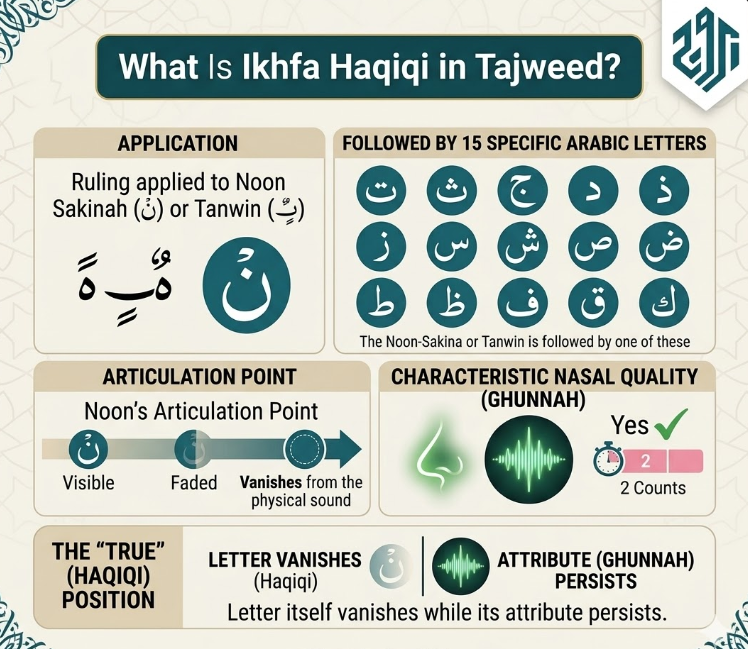
Classical scholar Imam al-Mar’ashi defined it clearly: ikhfa means “the disappearance of the noon and tanwin from pronunciation while their nasal quality — the ghunnah — remains.” This definition is the foundation every Tajweed instructor builds upon when teaching this rule.
At Buruj Academy, our Online Tajweed Classes taught by Ijazah-certified instructors and Al-Azhar University graduates treat ikhfa haqiqi as one of the first rules students must internalize aurally — not just intellectually. We train the ear before we teach the rule name, because students who hear correct ikhfa before analyzing it apply it far more naturally in live recitation.
Book Your FREE Trial Lesson to Begin Your Tajweed Journey

What Are the 15 Huruf Ikhfa Haqiqi?
The 15 ikhfa letters are every Arabic letter except the eight idgham letters (ي ن م و ل ر), the four ith-har letters (ء ه ع ح غ خ), and the two ikhfa shafawi / idgham shafawi letters (ب م).
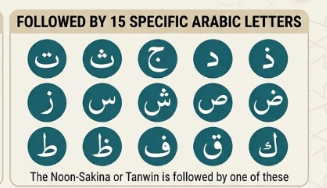
The 15 letters are memorized through the first letter of each word in this classical mnemonic verse:
صِفْ ذَا ثَنَا كَمْ جَادَ شَخْصٌ قَدْ سَمَا — دُمْ طَيِّباً زِدْ فِي تُقىً ضَعْ ظَالِمَا
Ikhfa Haqiqi Examples From the Quran
| Position | Letter | Example (Noon Sakinah) | Example (Tanwin) |
| 1 | ص | أَنْ صَدُّوكُمْ | رِيحاً صَرْصَراً |
| 2 | ذ | مِنْ ذَهَبٍ | ظِلٍّ ذِي |
| 3 | ث | مِنْ ثَمَرَةٍ | قَوْلاً ثَقِيلاً |
| 4 | ك | مَنْ كَانَ | كِتَابٌ كَرِيمٌ |
| 5 | ج | إِنْ جَاءَكُمْ | خَلْقٍ جَدِيدٍ |
| 6 | ش | إِنْ شَاءَ | غَفُورٌ شَكُورٌ |
| 7 | ق | مِنْ قَرَارٍ | سَمِيعٌ قَرِيبٌ |
| 8 | س | مِنْ سُلاَلَةٍ | وَرَجُلاً سَلَماً |
| 9 | د | مِنْ دَابَّةٍ | كَاْسَاً دِهاقاً |
| 10 | ط | مِنْ طِينٍ | صَعِيداً طَيِّباً |
| 11 | ز | مِنْ زَوَالٍ | صَعِيداً زَلَقاً |
| 12 | ف | مِنْ فَضْلٍ | خَالِداً فِيهَا |
| 13 | ت | وَمَنْ تَابَ | جَنَّاتٍ تَجْرِي |
| 14 | ض | وَمَنْ ضَلَّ | وَكُلاً ضَرَبْنَا |
| 15 | ظ | مِنْ ظَهِيرٍ | ظِلاًّ ظَالِمَا |
The mnemonic verse is among the most practical memory tools in Tajweed scholarship. We recommend students memorize it as a chant before attempting to apply the rule — it builds pattern recognition that transfers directly to recitation.
Excel in Your Quranic Studies
Join Buruj Academy and master the Quran with our structured, professional curriculum.
Book Your Free TrialRead also: Ikhfa Shafawi: The Complete Guide to Labial Concealment in Tajweed
What Are the Three Levels of Ikhfa Haqiqi?
Ikhfa haqiqi has three distinct levels, determined by how close each letter’s articulation point (makhraj) is to the makhraj of noon sakinah. Imam al-Mar’ashi documented these levels in detail, establishing a principle: the closer the letter is to noon’s makhraj, the greater the concealment and the shorter the ghunnah; the farther the letter, the lighter the concealment and the longer the ghunnah.
Level One — Maximum Concealment (Shortest Ghunnah)
This level applies before ط، د، ت — the three letters whose articulation points are closest to that of noon sakinah. Because these letters share a near proximity in the mouth, the noon conceals most deeply, leaving the ghunnah at its minimum perceptible duration.
A practical example: in كُنْتُمْ (Kuntum), the noon before ت is almost entirely absorbed — students who overpronounce the noon here are making a clear Tajweed error.
Level Two — Minimum Concealment (Longest Ghunnah)
This level applies before ق and ك — letters whose articulation points are the furthest from noon’s makhraj, positioned deep in the throat-to-palate area. The concealment is lightest here, meaning the ghunnah resonates most fully and for the greatest duration.
In بِقِنْطَارٍ for instance, the noon before ق carries a noticeably richer nasal quality compared to its recitation before ت.
Level Three — Intermediate Concealment (Moderate Ghunnah)
This level applies before the remaining 10 letters: ص ذ ث ج ش س د ز ف ض ظ. The concealment and ghunnah duration are both moderate — balanced between the two extremes.
| Level | Letters | Concealment | Ghunnah Duration |
| Maximum | ط، د، ت | Deepest | Shortest |
| Intermediate | ص ذ ث ج ش س ز ف ض ظ | Moderate | Moderate |
| Minimum | ق، ك | Lightest | Longest |
Understanding these levels separates functional Tajweed knowledge from true recitation mastery. In our sessions at Buruj Academy, students who grasp this gradation recite with noticeably more authentic phrasing — their transitions between words gain a natural flow rather than a mechanical “on/off” application of the rule.
How Does Ikhfa Haqiqi Differ from Idgham and Idh-har?
Ikhfa haqiqi occupies the middle position in the four-ruling system for noon sakinah and tanwin. Understanding where it sits requires a clear comparison across all three neighboring rulings.
Imam al-Dani explained the logic precisely: noon sakinah and tanwin are neither close enough to the ikhfa letters to require full merging (idgham), nor far enough to require full pronunciation (idh-har). This intermediate distance produces ikhfa — a state that is neither fully merged nor fully pronounced.
| Ruling | Condition | Characteristic Sound | Key Marker |
| Idh-har | Before ء ه ع ح غ خ | Noon fully pronounced | No ghunnah extension |
| Ikhfa Haqiqi | Before 15 letters | Noon concealed, ghunnah held | Two-count ghunnah, no shadda |
| Idgham | Before ي ن م و ل ر | Noon fully merged | Shadda on following letter |
| Iqlab | Before ب | Noon becomes meem sound | Ghunnah with lip closure |
The single clearest distinction between ikhfa and idgham for recitation purposes: ikhfa carries no shadda (shaddah), while idgham does. Ibn al-Jazari confirmed in An-Nashr that this is the definitive marker separating the two rulings in both classical scholarship and practical recitation.
For a deeper understanding of how idgham and ikhfa interact within the broader noon sakinah system, our article on idgham rules in Tajweed explains the merging rulings in comparable detail.
Excel in Your Quranic Studies
Join Buruj Academy and master the Quran with our structured, professional curriculum.
Book Your Free TrialHow Does the Ghunnah Function Specifically in Ikhfa Haqiqi?
The ghunnah in ikhfa haqiqi is the defining element of the ruling — it is not decorative, it is obligatory. Its duration is precisely two vowel counts (harakatayn), and its quality varies based on the phonetic nature of the letter that follows.
Ghunnah Before Letters of Isti’la (Elevation)
When the ikhfa letter belongs to the group of elevated letters — ص، ض، ط، ق، خ، غ، ظ — the ghunnah is pronounced with tafkhim (heaviness). The nasal resonance takes on a fuller, rounder quality.
A clear example: مِنْ طِينٍ — the ghunnah before ط is heavy and full, reflecting the elevated nature of that letter. Our instructors specifically address this point because many students default to a light ghunnah regardless of context, producing a phonetically incorrect sound.
Ghunnah Before Letters of Istifal (Lowering)
Before the remaining ikhfa letters — those characterized by istifal — the ghunnah is pronounced with tarqiq (lightness). The nasal resonance is thinner and more delicate.
Example: وَمَنْ تَابَ — the ghunnah here is light, consistent with the non-elevated ت.
The Critical Timing Error to Avoid
A critical caution: students frequently extend the ghunnah beyond two counts, particularly before ك and ق where the ghunnah is longest. This error causes an intrusive vowel sound to appear — in كُنْتُمْ, overstretching the ghunnah produces something resembling (كُونتم), which changes the word’s sound entirely. The ghunnah must remain precisely at two counts in all ikhfa positions.
For a full treatment of ghunnah rules across all Tajweed contexts, our complete guide to ghunnah and its rules covers every ruling systematically.
Discover the Buruj Academy Difference
Step into our virtual classrooms and see how our expert instructors make learning Quran and Arabic intuitive and clear. We focus on overcoming the specific hurdles non-native speakers face, building your confidence and connection with the Quran.
Read also: Madd Asli (Madd Tabee’i)
Where Does Ikhfa Haqiqi Occur — One Word or Two?
Ikhfa haqiqi applies in two structural contexts, and students benefit from recognizing both to catch every instance during recitation.
Ikhfa Haqiqi In two separate words
This is the most common occurrence. The noon sakinah or tanwin falls at the end of one word, and the ikhfa letter begins the next word.
مَنْ كَانَ — noon sakinah at end of first word, ك begins second word.
كِتَابٌ كَرِيمٌ — tanwin on first word, ك begins second word.
Ikhfa Haqiqi Within a single word
The noon sakinah and its following ikhfa letter both appear within the same word.
الْمُنْكَرِ — noon sakinah followed by ك within one word.
يُنْظَرُونَ — noon sakinah followed by ظ within one word.
Both contexts apply the same ruling identically — the distinction matters only for recognition, not for pronunciation.
Students beginning their Tajweed study often spot two-word ikhfa quickly but miss single-word occurrences during recitation.
Identifying these within longer words is a skill that develops with guided practice. Our Tajweed for Beginners course specifically trains this recognition skill from the earliest lessons.
Book Your FREE Trial Lesson to Begin Your Tajweed Journey

Why Is It Called Ikhfa “Haqiqi”?
The word haqiqi (حقيقي) means “true” or “real” in Arabic. The ruling is named ikhfa haqiqi to distinguish it from ikhfa shafawi — the concealment ruling that applies to meem sakinah before the letter ب.
In ikhfa haqiqi, what is being concealed is the noon sakinah or tanwin — the core noon sound genuinely disappears from articulation. The concealment is therefore “true” or “real” because the actual letter ceases to be pronounced, leaving only the ghunnah as its trace.
Imam Maki ibn Abi Talib offered an insightful phonetic explanation: noon sakinah has two exit points — its primary articulation point and the exit point of its ghunnah. This dual nature gives noon the phonetic flexibility to “share” the articulation space of neighboring letters, producing the concealment effect that ikhfa describes.
This distinction also explains why studying ikhfa letters in Tajweed alongside ikhfa shafawi produces a much clearer understanding — each ruling has a different letter being concealed, a different mechanism, and a different set of triggers.
Excel in Your Quranic Studies
Join Buruj Academy and master the Quran with our structured, professional curriculum.
Book Your Free TrialMaster Tajweed with Buruj Academy’s Expert Instructors
Ikhfa haqiqi — like all Tajweed rulings — requires trained ears and consistent correction to internalize correctly. Knowing the 15 letters and three levels intellectually is the beginning, not the destination.
At Buruj Academy, our Online Tajweed Classes are led by Ijazah-certified instructors and Al-Azhar University graduates with 12+ years of experience teaching non-Arabic speakers globally. Our Buruj Method trains sound recognition before rule memorization — producing recitation that is accurate, natural, and sustainable.
- Personalized 1-on-1 sessions with real-time correction
- Flexible scheduling for students worldwide
- Structured progression from beginner foundations to advanced mastery
- Instructors trained in the specific challenges of English-speaking learners
Join a supportive learning environment tailored to your pace and lifestyle. Start your journey toward excellence by enrolling in one of our specialized tracks:
- Online Tajweed Classes
- Tajweed Classes for Beginners
- Tajweed Classes for Adults
- Tajweed Classes for Sisters
- Tajweed Classes for Kids
- Advanced Tajweed Course
- Amli Tajweed Course (Practical Application)
Book your free trial lesson today and experience the difference that qualified, patient instruction makes in your Tajweed Insha’Allah.
Frequently Asked Questions About Ikhfa Haqiqi
What is the difference between ikhfa haqiqi and ikhfa shafawi?
Ikhfa haqiqi conceals noon sakinah or tanwin before 15 specific letters, producing a nasal ghunnah for two counts. Ikhfa shafawi applies to meem sakinah specifically before the letter ب, concealing the meem sound with a labial (lip-based) ghunnah. The mechanism, trigger letters, and articulation points differ entirely between these two rulings.
How many letters trigger ikhfa haqiqi?
Ikhfa haqiqi is triggered by exactly 15 Arabic letters: ص ذ ث ك ج ش ق س د ط ز ف ت ض ظ. These are memorized through the classical mnemonic verse beginning Sif dha thana kam jada shakhsun qad sama. Every letter in that verse’s first words represents one of the 15 ikhfa letters.
Does ikhfa haqiqi apply within a single word or only between two words?
Ikhfa haqiqi applies in both contexts. It occurs between two words — such as مَنْ كَانَ — and within a single word — such as الْمُنْكَرِ or يُنْظَرُونَ. The ruling and pronunciation are identical in both cases. Beginners often recognize the two-word form first; single-word recognition develops with continued practice.
How long should the ghunnah last during ikhfa haqiqi?
The ghunnah in ikhfa haqiqi lasts precisely two vowel counts (harakatayn) in all positions. Extending it beyond two counts is a recitation error. The ghunnah’s quality — heavy (tafkhim) before letters of isti’la, light (tarqiq) before letters of istifal — varies, but its duration of two counts remains constant throughout all 15 ikhfa letters.
Is ikhfa haqiqi considered a beginner or advanced Tajweed rule?
Ikhfa haqiqi is taught at the foundational level of Tajweed study because it applies to the noon sakinah system — one of the first major ruling categories students learn. However, mastering its three levels of concealment and correctly applying ghunnah quality (tafkhim vs. tarqiq) represents an intermediate skill that develops through guided recitation practice rather than rule memorization alone. For a structured starting point, see our Tajweed for beginners guide.