 Quran
Quran

| Key Takeaways |
| Memorizing the full Quran in 3 months requires completing approximately 6–7 pages of new content daily across 90 days. |
| The standard Madani Mushaf contains 604 pages with 15 lines per page — daily targets must be calculated against this edition consistently. |
| Revision must run in parallel with new memorization every single day — neglecting it causes rapid deterioration of earlier sections. |
| Starting with Juz 30 builds early confidence through shorter, familiar surahs before tackling longer middle sections of the Quran. |
| Half a page of new memorization daily is a realistic adult pace, completing the full Quran in approximately 3 to 3.5 years. |
Memorizing the entire Quran is one of the most spiritually profound goals a Muslim can pursue — and one of the most practically demanding. Many students set the target without a clear plan, which leads to inconsistent progress, weak retention, and eventual discouragement.
With a structured daily schedule, verified retention techniques, and the right accountability system, memorizing the Quran in 3 months is achievable — but only for students who can dedicate serious, uninterrupted daily effort. It requires memorizing approximately 6–7 pages of new content every single day while simultaneously maintaining a growing revision load of previously memorized material.
1. Understand What Memorizing the Quran in 3 Months Actually Requires
To memorize the Quran in 3 months, a student must complete all 604 pages of the standard Madani Mushaf across roughly 90 days. That works out to approximately 6.7 pages of new memorization per day — equivalent to roughly 100 new lines daily, given that the Madani Mushaf contains 15 lines per page.
This is an elite-level pace. It is not suitable for students who are still developing reading fluency, nor for those who cannot commit to a minimum of 8–10 hours of focused daily effort.
This timeline is realistically achievable only for full-time students — those with no competing work, study, or family responsibilities during the memorization period.
Buruj Academy’s Online Hifz Program pairs every student with an Al-Azhar-trained Hifz specialist who calculates a realistic daily target based on the student’s actual reading speed, retention capacity, and daily availability — not an idealized number.
What Reading Level Is Required Before Starting?
A student must be able to read Arabic fluently with correct Tajweed before beginning any Hifz program. Students who cannot yet read confidently should first complete a Quran reading course to establish the foundational reading skill that Hifz depends on entirely.
Book your Free trial lesson and start reading the Quran

Read also: How to Memorize Quran in 6 Months: A Realistic Step-by-Step Plan
2. Choose One Mushaf Edition and Use It Exclusively
Every student must select a single Mushaf edition before memorizing the first line — and use that same edition exclusively until the full Quran is complete.
Switching editions mid-memorization disrupts the visual memory anchor and significantly increases error rates during recitation checks.
The 15-line Madani Mushaf is the most widely recommended edition for Hifz students worldwide. With exactly 15 lines per page and each Juz beginning on a new page, it allows clean, measurable daily page targets that align precisely with the numbers in any structured schedule.
| Mushaf Edition | Lines Per Page | Pages in Full Quran | Best For |
| 15-line Madani Mushaf | 15 lines | 604 pages | Standard Hifz — most common globally |
| Tajweed Color-Coded Mushaf | 15 lines | 604 pages | Students combining Tajweed correction with Hifz |
| 13-line Mushaf | 13 lines | ~610 pages | Some regional preferences — less common |
Using one edition throughout is non-negotiable for reliable visual memory anchoring.
Excel in Your Quranic Studies
Join Buruj Academy and master the Quran with our structured, professional curriculum.
Book Your Free Trial3. Set Honest Daily Targets Based on Accurate Numbers
The most damaging mistake in Hifz planning is setting targets that sound inspiring but fail basic arithmetic.
Before committing to any timeline, a student needs to verify what their chosen daily page target actually requires — and what completion timeline it honestly produces.
| Daily New Pages | Days to Complete 604 Pages | Approximate Timeline |
| 6.7 pages/day | 90 days | 3 months (full-time, elite pace) |
| 4 pages/day | 151 days | ~5 months (intensive, dedicated student) |
| 2 pages/day | 302 days | ~10 months (strong part-time commitment) |
| 1 page/day | 604 days | ~20 months (steady daily practice) |
| 0.5 pages/day | 1,208 days | ~3.3 years (realistic beginner adult pace) |
This table reflects new memorization only — revision time is additional and must be factored into the daily schedule separately.
In our experience at Buruj Academy, most non-Arabic speaking adults realistically memorize between half a page and one page of new content per day when balancing work, family, and other commitments. That places a realistic full-Quran completion timeline at approximately 1.5 to 3.3 years — not 3 months.
This is not discouraging; it is honest planning that leads to durable memorization rather than rushed, fragile recall.
The 3-month target is genuinely achievable — but only for students who can commit to 6–7 pages of new memorization daily, supported by an equal or greater daily revision load. For a detailed look at how to structure your personal timeline, our Quran memorization schedule provides a day-by-day framework students can adapt to their pace.
Buruj Academy’s Hifz for Adults program is specifically designed for students who need honest, personalized pacing — not a one-size-fits-all target that sets them up for burnout within the first month.
Book Your Free Trial Lesson with Burruj’s Hifz Course for Adults

4. Build a Daily Schedule That Balances New Memorization and Revision in the 3-Month Plan
A functional Hifz schedule must account for both new memorization and revision every single day. Neglecting revision while racing to add new content is the most common and most damaging mistake we see.
Students who do this accumulate pages they can no longer recall accurately, forcing them to re-memorize material they believed was complete.
The following daily structure is what our instructors recommend for students pursuing an intensive pace:
| Time Block | Activity | Duration |
| Post-Fajr | New memorization session | 2–4 hours |
| Mid-morning | Revision of last 7 days’ memorization | 45–60 minutes |
| Post-Dhuhr | Revision of last 30 days’ memorization | 30–45 minutes |
| Post-Asr or Maghrib | Older revision — earlier Juz rotation | 30–45 minutes |
For students pursuing the 3-month target, total daily study time will realistically reach 4–7 hours minimum. This is why the timeline is only achievable for full-time students — the daily time commitment alone eliminates most people with work or school obligations.
For students on a more sustainable pace, our guide on the best time to memorize Quran explains how to protect the most effective memorization windows within a busy schedule.
Discover the Buruj Academy Difference
Step into our virtual classrooms and see how our expert instructors make learning Quran and Arabic intuitive and clear. We focus on overcoming the specific hurdles non-native speakers face, building your confidence and connection with the Quran.
5. Start With Juz 30 to Build Confidence Before the Longer Sections
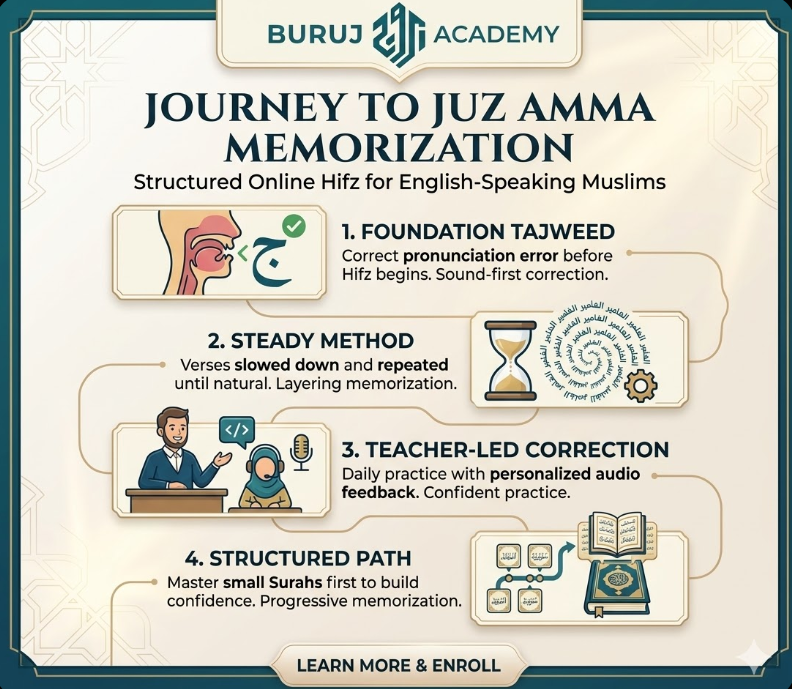
Beginning Hifz from the back of the Quran — with Juz 30 (Juz Amma) — is the approach we recommend for nearly every student, regardless of overall timeline. Juz 30 contains shorter surahs that most students partially know from daily prayer, which accelerates early memorization and builds genuine confidence.
Students who begin from Surah Al-Baqarah without prior Hifz experience frequently struggle with the length and density of early verses. This leads to discouragement within the first two weeks — precisely when the habit of daily memorization needs to be established.
Buruj Academy’s Juz 30 Memorization course allows students to master Juz Amma with proper Tajweed before committing to a full Hifz program — an ideal entry point for students assessing their genuine memorization capacity.
Book Your First Session in Buruj’s Juz 30 Memorization Course
What Order Should You Follow After Juz 30?
After completing Juz 30, continue with Juz 29, then begin Juz 1 (Al-Baqarah) and move forward sequentially.
This sequence balances shorter, review-friendly surahs with the longer foundational surahs — preventing the experience of hitting Al-Baqarah cold after months away from long-verse memorization.
Read also: How to Memorize a Page of Quran in 5 Minutes?
6. Apply Retention Techniques That Prevent Forgetting
Memorizing lines is not the same as retaining them. The gap between initial memorization and reliable long-term retention is where most students lose progress — particularly students moving at an accelerated pace.
The following techniques are grounded in classical Hifz methodology and validated through years of teaching at Buruj Academy.
A. Repeat Each Line Until It Is Truly Fixed
Never move to a new line until the previous one can be recited from memory without any visual reference. The minimum standard we use with our students is 20 consecutive correct repetitions of each new line before advancing.
Students who use this threshold retain significantly more in the first revision cycle than those who move forward after only 5–7 repetitions.
B. Chain New Lines to Previously Memorized Ones
After memorizing a new line, always recite it together with the three lines immediately preceding it. This builds contextual chaining — the mechanism by which the brain stores sequential Quranic text as a cohesive unit rather than isolated fragments.
Skipping this step produces memorization that feels solid in isolation but breaks down when recited in full passage.
C. Recite Aloud During Every Session
Silent reading reinforces visual memory only. Hifz requires auditory-motor memory — the combination of hearing your own voice and physically producing the Arabic sounds. Reciting aloud engages three memory pathways simultaneously: auditory, kinesthetic, and visual.
In our sessions, students who memorize silently almost always require significantly more revision repetitions to achieve the same retention level as those who recite aloud throughout.
For a deeper treatment of techniques that accelerate retention without sacrificing accuracy, our detailed guide on how to memorize Quran faster covers additional methods our instructors use with students at every pace level.
Excel in Your Quranic Studies
Join Buruj Academy and master the Quran with our structured, professional curriculum.
Book Your Free Trial7. Build a Revision System That Protects Everything Already Memorized
The revision system must be built in from day one — not added later when retention problems become visible. A student pursuing the 3-month target will have memorized over 100 pages within the first two weeks. Without a systematic revision structure, those earliest pages will deteriorate significantly before the memorization is complete.
| Revision Category | Pages to Cover | Frequency |
| Recent memorization (last 7 days) | Last 6–12 pages | Daily |
| Medium-term (last 30 days) | Last 30–50 pages | Every 2–3 days |
| Older memorization (beyond 30 days) | Full earlier Ajza’ rotation | Weekly cycle |
This three-tier system ensures every memorized page is revisited within a defined cycle, preventing the deterioration that forces re-memorization.
Students who attempt an accelerated timeline without this structure consistently report that their earliest memorized sections feel unfamiliar by the midpoint of their program.
The benefits of memorizing Quran are fully realized only when the memorization is durable — revision is what makes the difference between temporary recall and lifelong retention.
8. Use a Qualified Teacher to Maintain Accuracy and Accountability
Memorizing without external accountability carries a risk most students underestimate: errors that go uncorrected in early memorization become embedded in long-term memory. Correcting a deeply ingrained mistake is far harder than preventing it — and at the pace required for the 3-month target, unchecked errors accumulate rapidly.
A qualified Hifz teacher performs three functions self-study cannot replicate: real-time Tajweed correction during recitation checks, external pacing that prevents both rushing and stagnation, and sustained accountability during the periods when motivation naturally dips.
Buruj Academy’s Hifz Classes for Kids and Hifz for Ladies programs provide this structure through Ijazah-certified instructors experienced in guiding students through full memorization — with flexible 1-on-1 online sessions designed to fit around real-life schedules.
Start your child’s Hifz classes with free session

How to Memorize the Quran in 2 Months?
Memorizing the Quran in 2 months requires completing approximately 10 pages of new memorization daily (604 ÷ 60 = ~10.1 pages/day). This pace exceeds even the 3-month target and is only documented among full-time students with exceptional prior Hifz experience, ideal memorization conditions, and an already-established revision discipline from previous partial memorization.
How to Memorize the Quran in 1 Month?
Memorizing the Quran in a month — approximately 20 pages of new content daily (604 ÷ 30 = ~20.1 pages/day) — is cited in accounts of extraordinary scholars but is not a practical target for the overwhelming majority of students. Pursuing this pace without the necessary prerequisites typically produces surface-level memorization that deteriorates rapidly under pressure.
The goal of Hifz is not the fastest possible completion but memorization firm enough to be recited correctly in prayer and retained for decades. Our guide on what is the best way to memorize Quran addresses the distinction between speed and durability directly.
Excel in Your Quranic Studies
Join Buruj Academy and master the Quran with our structured, professional curriculum.
Book Your Free TrialEmbark on Your Journey to Becoming a Hafiz
Carry the words of the Divine in your heart and transform your life through the noble pursuit of Hifz. At Buruj Academy, we provide a structured, supportive, and highly personalized environment to help you achieve your memorization goals, whether you are starting with the final chapters or aspiring to complete the entire Quran.
Our experienced tutors employ proven techniques to ensure long-term retention (Mutqin) and spiritual growth, making the path to memorization accessible for every member of the family.
Take the first step toward this lifelong blessing by enrolling in a program tailored to your pace:
- Online Hifz Program (Comprehensive Quran Memorization)
- Juz 30 Memorization Course (Perfect for focused starts)
- Hifz Classes for Kids (Engaging and interactive)
- Hifz Classes for Adults (Flexible scheduling for busy lives)
- Hifz Classes for Sisters (Private, supportive learning)
- Short Surah Memorization Course (Ideal for daily prayers)
- Hifz Ijazah Course (For advanced students seeking certification)
Don’t let another day pass without moving closer to your goal. Join Buruj Academy today and schedule your free trial session to begin your Hifz journey!
Frequently Asked Questions About Memorizing the Quran in 3 Months
How Many Pages Per Day Are Required to Memorize the Quran in 3 Months?
Memorizing the full Quran in 3 months requires completing approximately 6.7 pages of new content daily across 90 days (604 pages ÷ 90 days). Each page of the standard 15-line Madani Mushaf contains 15 lines, meaning a student must memorize roughly 100 new lines every day — an elite pace suited only to full-time students.
How Long Does It Realistically Take Most Adults to Memorize the Quran?
Most non-Arabic speaking adults memorize between half a page and one page of new content per day while managing work and family responsibilities. At half a page daily, completing 604 pages takes approximately 3.3 years. At one fu