 Quran
Quran
| Key Takeaways |
| The Quran contains 604 pages across 30 Juz’; memorizing it in 2 years requires 1 new page per day on approximately 604 active memorization days. |
| With ~126 buffer days built into 730 total days, a 1-page-per-day target is fully achievable within 2 years. |
| Dividing the 2-year plan into four 6-month phases of approximately 7–8 Juz’ each creates measurable, balanced progress milestones. |
| A daily 60–90 minute session split across Fajr memorization, same-day review, and evening revision is the proven structural foundation. |
| Consistent revision of previously memorized material prevents forgetting and must be protected as aggressively as new memorization sessions. |
Memorizing the entire Quran feels like an immense undertaking — and for non-Arabic speakers especially, the question of whether a 2-year completion is truly realistic deserves a straight, honest answer.
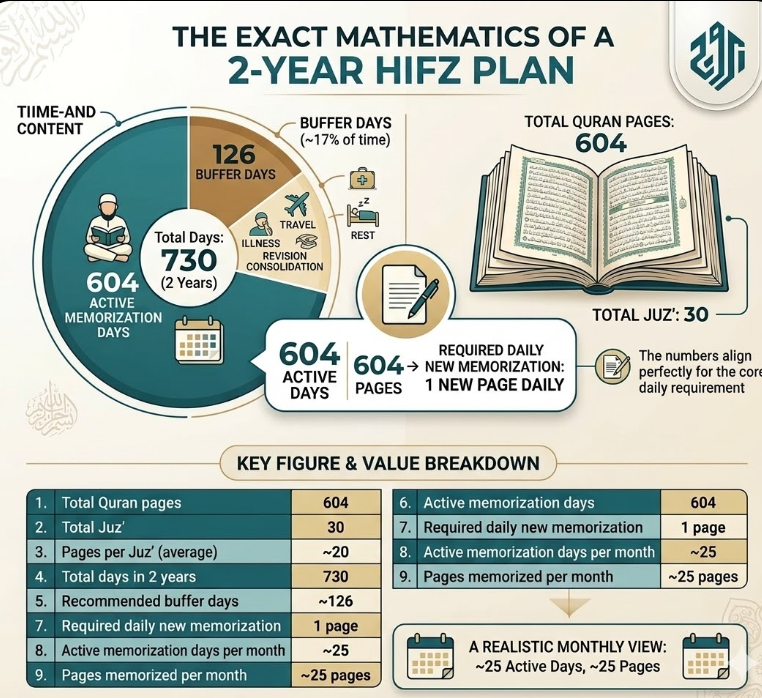
Yes — memorizing the Quran in 2 years is achievable. The Quran contains exactly 604 pages across 30 Juz’. Over 730 days, with approximately 126 buffer days for illness, travel, and consolidation, you need to memorize 1 new page on each of your 604 active memorization days. The mathematics are sound. The challenge is building the system that makes those 604 days consistent.
1. Understand the Exact Mathematics of a 2-Year Hifz Plan
Memorizing the Quran in 2 years requires memorizing exactly 604 pages across 30 Juz’ within 730 total days. When approximately 126 buffer days are reserved for illness, travel, revision-only consolidation weeks, and rest, that leaves 604 active memorization days — meaning precisely 1 new page must be memorized on each active day to complete the Quran within 2 years.
This is not an approximation. The numbers align perfectly: 604 pages across 604 active memorization days. The 126 buffer days represent just over 17% of the 2-year period — a realistic allowance for any adult’s life circumstances.
For a deeper look at structuring your memorization schedule around these numbers, our Quran memorization schedule resource provides printable templates.
Buruj Academy’s Online Hifz Program structures every student’s plan around this precise calculation — our Al-Azhar-trained Hifz specialists set a personalized daily target based on your starting capacity, ensuring the 2-year goal is achievable rather than merely theoretical.
Start Hifz today with a FREE trial session
Read also: How to Memorize Quran in 1 Year?
2. Establish the Tajweed Foundation You Need Before Beginning
Beginning Hifz without solid Tajweed is one of the most consistently damaging mistakes we see among new students at Buruj Academy. Students who memorize pages with mispronunciations must later re-memorize those same pages — effectively doubling their workload at the worst possible time in the plan.
Spend 4–8 weeks before Day 1 of your 2-year plan ensuring you can read the Quran fluently with correct basic Tajweed.
You do not need advanced mastery at this stage — but correct makharij (articulation points), accurate vowel sounds, and the ability to read without halting are non-negotiable prerequisites.
What Tajweed Level Is Sufficient Before Starting Hifz?
You need to be able to read any page of the Quran aloud, correctly, at a slow but uninterrupted pace before beginning memorization.
Tajweed rules you should have functional command of include: correct pronunciation of letters with their distinct makharij, Madd (elongation) rules, Noon and Meem Sakinah rules, and basic Waqf (stopping) rules.
Our Tajweed for Beginners resource identifies exactly which rules are prerequisite for Hifz and which can be refined during the memorization process itself. For students not yet reading fluently, Buruj Academy’s Quran Reading Course builds the pre-Hifz foundation in a structured 8–12 week program with Ijazah-certified instructors.
Book your Free trial lesson and start reading the Quran

3. Select the Correct Mushaf and Commit to It for All 730 Days
Every serious Hifz student must choose a single Mushaf edition before Day 1 and never switch. The Medina Mushaf (15-line Hafs recitation) is the globally accepted standard for Hifz because each page ends at a logical textual break, making page-by-page memorization structurally natural.
When you memorize consistently from one Mushaf, your brain encodes the text’s visual layout alongside its sounds — where a line begins, where a word falls on the page, how much text appears in the bottom third. Switching editions mid-plan destroys this visual memory and forces partial re-memorization.
| Mushaf Edition | Lines Per Page | Best For |
| Medina Mushaf — Standard (Hafs) | 15 lines | All students — globally recommended for Hifz |
| Tajweed Color-Coded Mushaf | 15 lines | Students who want rule reminders during memorization |
| Large-Print Medina Mushaf | 15 lines | Students with visual difficulties or older learners |
All three options above maintain the 15-line structure — meaning the 604-page count and 1-page-per-day calculation remain accurate regardless of which you choose.
Do not use a Mushaf with a different line count, as this changes the page total and invalidates the daily target.
Excel in Your Quranic Studies
Join Buruj Academy and master the Quran with our structured, professional curriculum.
Book Your Free Trial4. Build Your Daily Session Structure for the Full 2-Year Period
A realistic daily session for memorizing the Quran in 2 years requires 60–90 minutes of dedicated Hifz time, structured across three distinct components: new memorization, same-day review, and older material revision.
Attempting to collapse these into a single undifferentiated session produces significantly weaker retention.
The session structure we teach at Buruj Academy follows this daily framework:
| Session Block | Time | Duration | Purpose |
| Fajr — New Memorization | After Fajr prayer | 30–40 minutes | Memorize today’s new page |
| Midday — Same-Day Review | Duhr or Asr | 15–20 minutes | Repeat today’s page from memory |
| Night — Older Revision | After Isha | 15–20 minutes | Revise 2–4 previously memorized pages |
Fajr is the non-negotiable memorization window. The mind after Fajr prayer — rested, quiet, and free from the day’s accumulated distractions — retains new material at a measurably stronger rate than any other time.
In our instructors’ experience, students who protect the Fajr memorization slot consistently reach their 1-page daily target. Students who attempt new memorization in the evening regularly find themselves completing only half a page.
For the science and spiritual reasoning behind this timing, our guide on the best time to memorize Quran provides detailed guidance.
How to Memorize Exactly 1 Page of Quran Per Day
Read the new page aloud with Tajweed 7–10 times before attempting to memorize. Then cover the page and recite line by line. Memorize each line until it flows without hesitation before connecting it to the previous line.
After completing all 15 lines, recite the full page from memory at least 3 consecutive times without opening the Mushaf. Only then mark the page complete.
Read also: How to Memorize Quran in 3 Months?
5. Follow the Four-Phase 6-Month Milestone Plan
Breaking the 2-year plan into four 6-month phases transforms an abstract 730-day goal into four concrete, measurable targets. Each phase covers approximately 7–8 Juz’ and approximately 150 pages, keeping pace even across the full 2 years.
The traditional and pedagogically proven approach begins with Juz’ 30 — memorizing from the end of the Quran forward — before returning to Surah Al-Baqarah and progressing in sequence.
Juz’ 30 contains the short surahs most Muslims already partially know, building early confidence and momentum before the longer surahs of the middle Juz’.
| Phase | Months | Juz’ Covered | Pages | Cumulative Pages |
| Phase 1 | Months 1–6 | Juz’ 30 → Juz’ 24 (7 Juz’) | ~141 pages | ~141 pages |
| Phase 2 | Months 7–12 | Juz’ 23 → Juz’ 16 (8 Juz’) | ~161 pages | ~302 pages |
| Phase 3 | Months 13–18 | Juz’ 15 → Juz’ 8 (8 Juz’) | ~161 pages | ~463 pages |
| Phase 4 | Months 19–24 | Juz’ 7 → Juz’ 1 (7 Juz’) | ~141 pages | ~604 pages ✅ |
At each 6-month milestone, dedicate a full consolidation week (one of your buffer weeks) to revising all memorized material from the beginning. This consolidation prevents the common problem of strong early Juz’ and weak later Juz’.
Buruj Academy’s Hifz for Adults program is structured around exactly these four phases, with instructor milestone reviews at the end of each phase to assess retention quality before advancing.
Book Your Free Trial Lesson with Burruj’s Hifz Course for Adults

6. Implement a Revision System That Protects All 604 Pages
New memorization without a structured revision system produces the most common Hifz failure pattern: a student who has technically memorized 300 pages but can only reliably recall 80 of them. Revision is not a supplement to the 2-year plan — it is the foundation the entire plan stands on.
The Prophet ﷺ said: “Keep refreshing your knowledge of the Quran, for I swear by the One in Whose Hand is my soul, it is more liable to escape than a camel from its hobble.” (Sahih al-Bukhari 5033). This is not a warning about negligence — it is a description of how human memory works. Structured revision is the response to this reality.
We teach a three-tier revision model at Buruj Academy that protects all memorized material simultaneously as it accumulates:
Tier 1 — Daily: Revise the last 7 pages memorized every single day without exception. This is your recent-memory protection layer.
Tier 2 — Weekly: Every Friday (or your chosen weekly consolidation day), revise the last complete Juz’ memorized from beginning to end.
Tier 3 — Monthly: In the final 3 days of each month, revise all memorized Juz’ sequentially from Juz’ 30 forward. As your memorized total grows, this monthly session will require increasing time — plan for it.
Discover the Buruj Academy Difference
Step into our virtual classrooms and see how our expert instructors make learning Quran and Arabic intuitive and clear. We focus on overcoming the specific hurdles non-native speakers face, building your confidence and connection with the Quran.
7. Apply Retention Techniques Designed for Non-Arabic Speakers
Non-Arabic speakers face a memorization challenge that generic Hifz advice rarely addresses: the sounds are phonetically unfamiliar and the meaning is not immediately transparent.
Techniques that work for native Arabic speakers do not transfer directly, which is why retention strategies must be adapted to this specific learner profile.
Meaning Anchoring Before Each New Page
Before memorizing any page, spend 3–5 minutes reading a brief translation and basic Tafsir note for that page. Understanding even minimal context gives the memory something concrete to attach the Arabic sounds to.
Students who use meaning anchoring consistently retain pages significantly more securely than those who memorize sounds alone. Our easy Tafseer in English resource supports this practice throughout the 2-year plan.
Audio Looping as Pre-Memorization Priming
Listen to a reliable reciter performing your day’s page 10–15 times before your Fajr memorization session — even while performing morning activities. Sheikh Mahmoud Khalil Al-Husary’s Muallim (teaching) recitation is specifically designed for memorization, with clear, deliberate pacing.
Your brain begins encoding the sound patterns before conscious memorization begins, reducing the effort required during the session itself.
For more retention strategies tailored to different learning styles, see our guide on how to memorize Quran faster.
Excel in Your Quranic Studies
Join Buruj Academy and master the Quran with our structured, professional curriculum.
Book Your Free Trial8. Navigate the Memorization Plateau That Appears Between Months 8–14
Every student who undertakes the Quran memorization journey over 2 years will encounter at least one plateau — a period where new memorization feels genuinely difficult and previously memorized material seems unstable simultaneously.
This plateau most commonly appears between months 8 and 14, when accumulated revision load begins competing with new memorization capacity for the same daily time budget.
The correct response is not to push harder. Temporarily reduce new memorization to half a page per day for 2–3 weeks while doubling revision time. This stabilizes the accumulated material, after which the 1-page daily target resumes naturally.
Students who ignore the plateau and force through it at full pace typically experience a much larger collapse in retention 4–6 weeks later, requiring far more recovery time.
The Prophet ﷺ said: “The most beloved of deeds to Allah are the most consistent, even if small.” (Sahih al-Bukhari 6464). Maintaining a sustainable pace across all 730 days outperforms aggressive intensity across 30 days, followed by burnout and abandonment. This principle defines the entire 2-year approach.
9. Work with a Qualified Hifz Teacher Throughout All 2 Years
Memorizing the Quran without a qualified teacher substantially increases the risk of accumulated pronunciation errors that become progressively harder to correct as memorization advances.
A teacher provides live recitation correction, structured revision testing, pacing accountability, and the motivational consistency that self-study — however disciplined — cannot replicate.
The traditional chain of transmission (sanad) connecting every Hafiz back to the Prophet ﷺ is not a ceremonial formality. It is a quality assurance system guaranteeing that Quran is transmitted correctly, sound by sound, page by page, generation by generation. Memorizing without teacher oversight breaks this chain.
Buruj Academy’s Hifz Program connects students with Ijazah-certified instructors and Al-Azhar University graduates for personalized 1-on-1 online sessions. Our Hifz for Ladies program offers qualified female instructors for sisters who prefer that arrangement.
For younger students, our Hifz for Kids program adapts this same 2-year structure with age-appropriate session lengths and teaching methods.
Start your child’s Hifz classes with free session

For a broader overview of what a structured Hifz program looks like from the inside, our guide on what is the best way to memorize Quran covers the key principles in detail.
Excel in Your Quranic Studies
Join Buruj Academy and master the Quran with our structured, professional curriculum.
Book Your Free TrialBegin Your 2-Year Hifz Plan with Buruj Academy’s Expert Instructors
Memorizing the Quran in 2 years is mathematically achievable and practically realistic — with the right structure and qualified guidance from Day 1.
Buruj Academy’s Online Hifz Program provides every element this plan requires:
- Ijazah-certified instructors and Al-Azhar University graduates with 12+ years teaching non-Arabic speakers globally
- Personalized daily targets calibrated to your capacity from Week 1
- The Buruj Method: Consistency-before-speed — retention systems built to last all 730 days
- Flexible 1-on-1 online sessions with 24/7 scheduling worldwide
- Four-phase milestone reviews with real-time recitation correction throughout
Take the first step toward this lifelong blessing by enrolling in a program tailored to your pace:
- Online Hifz Program (Comprehensive Quran Memorization)
- Juz 30 Memorization Course (Perfect for focused starts)
- Hifz Classes for Kids (Engaging and interactive)
- Hifz Classes for Adults (Flexible scheduling for busy lives)
- Hifz Classes for Sisters (Private, supportive learning)
- Short Surah Memorization Course (Ideal for daily prayers)
- Hifz Ijazah Course (For advanced students seeking certification)
Book your free trial lesson today and begin the 2-year plan with expert guidance from the very first page.
Frequently Asked Questions About Memorizing the Quran in 2 Years
How many pages of Quran must I memorize daily to finish in exactly 2 years?
The Quran contains exactly 604 pages. Over 730 days (2 years), reserving approximately 126 days as buffer for illness, travel, and revision consolidation, leaves 604 active memorization days. Memorizing 1 new page on each active day completes the full Quran in exactly 2 years. This calculation is mathematically precise — 604 pages across 604 active days.
Is memorizing the Quran in 2 years realistic for a working adult?
Yes — for an adult who commits 60–90 minutes daily, split between Fajr memorization and evening revision, completing the Quran in 2 years is genuinely achievable. The key variables are protecting the Fajr memorization window, maintaining a structured revision system, and working with a qualified instructor who can adjust your pace during plateaus before they become crises.
What is the correct order to memorize the Quran for a 2-year plan?
Begin with Juz’ 30 — the final Juz’ containing shorter surahs most Muslims already partially know — to build early confidence. Then begin from Surah Al-Baqarah (Juz’ 1) and progress forward. This is the approach used in Phase 1 of the 4-phase 2-year plan, and it is the method most classical scholars and modern structured Hifz programs follow.
How do I prevent forgetting earlier memorized material as I advance through the 2 years?
Use a three-tier revision system: revise the last 7 pages every day, revise the most recently completed full Juz’ every Friday, and revise all memorized Juz’ sequentially during the final 3 days of each month. Never sacrifice revision sessions for new memorization speed — consistent retention of 300 pages outperforms memorizing 500 pages with poor recall.
What are the spiritual benefits of completing Hifz in 2 years?
The Quran’s own description of its bearers is profound: the Prophet ﷺ described the Hafiz as one who will be crowned on the Day of Judgment, with his parents crowned alongside him. (Sunan Abi Dawud 1453). Beyond the reward, the daily discipline of Hifz — 730 consecutive days of Quran recitation, revision, and connection — reshapes a person’s entire relationship with worship. Our benefits of memorizing Quran article explores these dimensions in full.