 Quran
Quran
| Key Takeaways |
| Memorizing 2 pages daily requires splitting each page into 3–4 short segments and drilling each segment before combining. |
| Active revision of the previous 7 days’ memorization every day prevents the most common cause of Hifz breakdown: forgetting. |
| Tajweed accuracy during memorization is non-negotiable — errors encoded early become exponentially harder to correct later. |
| Most adults can reach a stable 2-page daily rate within 4–6 weeks of consistent structured practice with qualified guidance. |
Memorizing 2 pages of Quran daily is a serious, achievable commitment — not a casual goal. At this pace, a student completes the entire Quran in approximately 300 days, making it one of the full-Hifz timelines for dedicated adult learners.
The students who sustain this pace share one thing: a structured, repeatable daily system — not willpower alone.
Table of Contents:
1. Calculate Your Exact Daily Target Before You Begin
To memorize 2 pages of Quran daily, you must first know precisely what “2 pages” means in your specific Mushaf. In the standard 15-line Madani Mushaf (the most widely used globally), each page contains 15 lines, meaning your daily target is exactly 30 lines.
Breaking this down further: 30 lines typically span 10–14 verses depending on the Surah. Before each session begins, count your lines, mark your start and end point with a light pencil mark, and calculate your per-segment targets.
This removes ambiguity and eliminates the single most common reason students under-memorize: vague daily targets. Knowing your endpoint before you begin is what separates productive Hifz sessions from unfocused recitation.
| Mushaf Type | Lines per Page | Daily Target (2 pages) |
| Madani Mushaf (15-line) | 15 | 30 lines |
| Pakistani/Indian Mushaf (13-line) | 13 | 26 lines |
| Tajweed Color-Coded Mushaf | 15 | 30 lines |
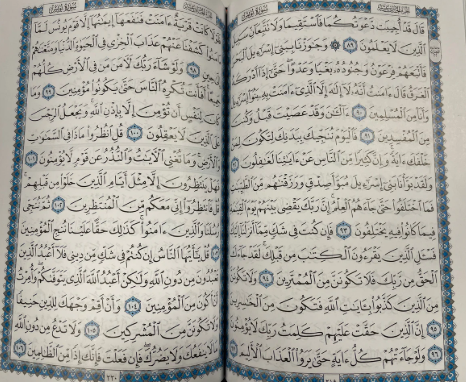
Standardize on one Mushaf and never switch — your visual memory is anchored to page layout.
These steps reflect what we teach inside Buruj Academy’s Online Hifz Program and what our Al-Azhar-trained Hifz specialists have tested across hundreds of students over 12+ years.
Start Hifz today with a FREE trial session
2. Split Each Page into Three Segments and Master Them Separately
To memorize 2 pages daily, you must never attempt to memorize a full page in one pass. Each page should be divided into three segments of 5 lines each, and each segment must be mastered before the next begins.
Our instructors at Buruj Academy consistently observe the same pattern: students who attempt full-page memorization in one sitting produce shallow, unstable memory that collapses within 48 hours. Students who work segment by segment retain material at dramatically higher rates.
For each 5-line segment, recite it aloud while reading 10 times, then attempt to recite it without looking. Repeat until you can recite that segment alone, eyes closed, without a single hesitation. Only then move to the next segment.
How to Connect Segments After Individual Mastery?
Once all three segments of a page are memorized individually, recite the full page continuously from memory at least 5 times without stopping.
This “connection drill” is what converts isolated segment memory into flowing, unified recitation — the only form of Hifz that holds under the pressure of prayer.
3. Structure Your Day Around Two Dedicated Hifz Sessions
Memorizing 2 pages daily cannot happen in a single session for most students. The most effective approach is to split the target across two sessions: Session 1 (new memorization) and Session 2 (same-day review and consolidation).
The Prophet ﷺ said: “Tie down this Quran, for by the One in Whose Hand is the soul of Muhammad, it escapes faster than a camel from its tether.” (Sahih Muslim 791a). This hadith describes exactly what happens when students memorize once and assume it is retained.
Two sessions on the same material — one for initial encoding, one for consolidation — is the system that converts short-term recall into durable memory.
| Session | Timing | Purpose | Duration |
| Session 1 | After Fajr | New memorization (Page 1 + Page 2, segments 1–3) | 45–60 min |
| Session 2 | After Asr or Maghrib | Full 2-page review + connection to yesterday’s material | 20–30 min |
Protect these two time slots as non-negotiable. Students in our Hifz for Adults course consistently report that treating Hifz sessions like scheduled appointments — not flexible study time — is the single mindset shift that makes 2-page daily targets sustainable.
Book Your Free Trial Lesson with Burruj’s Hifz Course for Adults

4. Use the Fajr Window as Your Primary Memorization Session
The post-Fajr window is the most scientifically and spiritually optimal time to memorize Quran. Cortisol levels are naturally elevated after dawn prayer, the prefrontal cortex is freshest, and the environment is typically quiet — three conditions that converge nowhere else in the day.
إِنَّ قُرْآنَ ٱلْفَجْرِ كَانَ مَشْهُودًا
Inna qur’anal-fajri kāna mashhūdā
“Indeed, the recitation of dawn is ever witnessed.” (Al-Isra 17:78)
Classical scholars of Tafsir note that this verse confirms the special standing of Fajr recitation in the Salah before Allah and the angels.
We also see this reflected in our students’ results: those who memorize exclusively at Fajr show measurably faster mastery than those who use evening-only sessions.
For our guide on the best time to memorize Quran, the answer is consistent — Fajr leads every other window.
Read also: How to Memorize One Page of Quran a Day?
5. Apply the “New + Review” Formula Every Single Day Without Exception
The most dangerous threat to a 2-page daily target is not slow memorization — it is forgetting previously memorized material. The “New + Review” formula ensures both new memorization and active revision happen every day.
The formula works as follows: every day, before beginning new memorization, spend 15–20 minutes reviewing the material from the previous 7 days. This means your daily Hifz session always opens with a structured look-back before any new ayat are touched.
In Buruj’s Azhari Quran tutors’ experience, students who skip this daily review consistently hit a “collapse point” around the 3–4 week mark where earlier portions become too weak to recite in salah.
The daily review is not optional — it is the foundation that makes all new memorization stable.
What the Daily New + Review Schedule Looks Like
| Day | New Pages | Pages Reviewed |
| Day 1 | Pages 1–2 | — |
| Day 2 | Pages 3–4 | Pages 1–2 |
| Day 3 | Pages 5–6 | Pages 1–4 |
| Day 7 | Pages 13–14 | Pages 1–12 (rolling 7-day window) |
As memorized material accumulates beyond 7 days, introduce a weekly “deep review” session on Fridays to cycle through older material. Our Quran memorization schedule guide provides detailed templates for managing both daily and weekly revision across a full Hifz timeline.
6. Anchor Every New Verse to the One Before It
Isolated verse memorization is one of the most common structural errors we observe in new Hifz students. Every new verse must be memorized in direct connection to the verse preceding it — never in isolation.
The practical method is simple: after memorizing a new verse, always recite from the last verse of the previous segment into the new verse. This “backward chaining” technique anchors each new piece of memory to an already-stable anchor point, making the chain of recitation seamless.
Students who memorize verses in isolation find that in salah or in testing, they can recall individual ayat but cannot flow from one to the next. Connection memorization eliminates this gap entirely.
7. Recite Your New Memorization Aloud in Every Session
Silent memorization — reading in your head — is insufficient for Quran Hifz. The Quran is an oral tradition, and its memorization must be primarily auditory and oral.
Every new segment must be vocalized aloud throughout the memorization process. This activates both auditory and motor memory (the muscle memory of the tongue and lips), creating a multi-layered encoding that is far more durable than visual-only memorization.
In our sessions at Buruj Academy, we stop students who default to silent reading and redirect them immediately: if your lips are not moving and your ears are not hearing your own recitation, you are reading — not memorizing.
Recite aloud even when alone, even when you feel self-conscious. This is non-negotiable for durable Hifz.
Excel in Your Quranic Studies
Join Buruj Academy and master the Quran with our structured, professional curriculum.
Book Your Free Trial8. Memorize with Correct Tajweed from the First Repetition
Tajweed accuracy must be embedded from the very first recitation of every new segment — not added later as a correction step. Errors memorized become exponentially harder to remove the more they are reinforced.
The most common errors we see students bring into their Hifz sessions include: incorrect Madd lengths, collapsed Ghunnah on Noon and Meem Mushaddad, and failure to apply Qalqalah on the five letters (ق ط ب ج د) in waqf position.
Each of these errors, if rehearsed 50 times during memorization, requires hundreds of correction repetitions to reverse.
Our beginner Tajweed resources cover the foundational rules every Hifz student must master before beginning memorization. For students whose Tajweed is not yet solid, Buruj Academy’s Tajweed for Beginners course should precede or run parallel to Hifz training.
Book Your FREE Trial Lesson to Begin Your Tajweed Journey

9. Test Yourself Without the Mushaf Before Ending Every Session
Self-testing without looking is the only reliable measure of actual memorization. Many students confuse fluent reading with genuine memorization — they are entirely different cognitive states.
At the end of every memorization session, close the Mushaf and attempt to recite the entire 2-page portion from memory. Where you hesitate or stop is your actual memorization boundary — not where you feel comfortable reading along.
In our experience, students who never close the Mushaf during practice consistently over-report their retention and are regularly surprised when they cannot recite in salah.
Blind self-testing every session gives you honest data about what is truly memorized versus what is merely familiar.
Read also: The Best Online Quran Memorization Courses for Adults
10. Use a Weekly Accountability Check with a Qualified Teacher
Memorizing 2 pages daily without teacher oversight leads to accumulated errors that students cannot self-detect. A weekly session with a qualified instructor is not supplementary — it is structurally necessary for sustained, accurate Hifz.
During your weekly teacher session, recite the full week’s memorization (14 pages) from memory without assistance. Your instructor corrects Tajweed errors, identifies weak transitions, and adjusts your revision schedule based on what they hear — not what you report.
At Buruj Academy, our Hifz for Adults course includes structured weekly review sessions with Ijazah-certified instructors who track each student’s retention patterns and intervene before small errors compound.
Book a FREE trial session with one of Buruj’s Azhari Quran tutors
For more on building a sustainable memorization plan, our guide on what is the best way to memorize Quran details the teacher-student accountability model in depth.
11. Protect Your Hifz with Consistent Use in Daily Salah
The strongest long-term preservation tool for Hifz is consistent use in the five daily prayers. Material recited in salah is reinforced through physical posture, ritual context, and emotional engagement — a combination no standalone review session can replicate.
From the day you memorize each new page, assign it to a specific Salah and use it consistently. Do not rotate randomly.
Reciting Surah Al-Mulk every night in Isha, for example, creates a deeply grooved memory through context-specific rehearsal.
Students who use their memorized portions in salah daily retain material at dramatically higher rates than those who only review during study sessions. Salah is not only worship — it is the most powerful Hifz preservation system available.
Read also: Recommended Web Portals for Quran Memorization
12. Adjust Your Pace Without Abandoning the System When Life Interrupts
Maintaining a 2-page daily target is not about perfection — it is about system resilience. Illness, travel, family obligations, and professional pressure will interrupt your schedule. The response to interruption determines whether your Hifz succeeds or stalls.
The Buruj Method principle here is: consistency before speed. If you can only do 1 page on a difficult day, do 1 page — but do not skip your revision. If you miss a full day, do not attempt to “catch up” by doubling the next day’s new memorization.
Catching up on new content at the expense of revision is the most common cause of Hifz collapse. Instead, pause new memorization for one day and spend the full session on review. Then return to your 2-page target the following day.
For detailed strategies on maintaining momentum, our article on how to memorize Quran faster provides practical techniques for recovering from interruptions without losing ground.
Discover the Buruj Academy Difference
Step into our virtual classrooms and see how our expert instructors make learning Quran and Arabic intuitive and clear. We focus on overcoming the specific hurdles non-native speakers face, building your confidence and connection with the Quran.
Accelerate Your Hifz with Buruj Academy’s Expert Instructors
Memorizing 2 pages daily is a serious commitment that produces serious results — but it requires a system, not just sincerity.
Buruj Academy’s Online Hifz Program provides:
- Al-Azhar University graduates and Ijazah-certified instructors with 12+ years of experience
- The Buruj Method: Consistency-before-speed for sustainable, error-free Hifz
- Personalized 1-on-1 sessions with individualized revision schedules
- Flexible 24/7 scheduling for working adults and parents
- Real-time Tajweed correction embedded within every Hifz session
Book your free trial lesson today and begin your Hifz with a structured plan built around your life.
Take the first step toward this lifelong blessing by enrolling in a program tailored to your pace:
- Online Hifz Program (Comprehensive Quran Memorization)
- Juz 30 Memorization Course (Perfect for focused starts)
- Hifz Classes for Kids (Engaging and interactive)
- Hifz Classes for Adults (Flexible scheduling for busy lives)
- Hifz Classes for Sisters (Private, supportive learning)
- Short Surah Memorization Course (Ideal for daily prayers)
- Hifz Ijazah Course (For advanced students seeking certification)
Don’t let another day pass without moving closer to your goal. Join Buruj Academy today and schedule your free trial session to begin your Hifz journey!
Excel in Your Quranic Studies
Join Buruj Academy and master the Quran with our structured, professional curriculum.
Book Your Free TrialConclusion
Memorizing 2 pages of Quran daily is achievable — but only through a system built on segment-based memorization, dual daily sessions, non-negotiable revision, and Tajweed accuracy from the very first recitation. Willpower without structure produces burnout; structure without accountability produces accumulated errors.
The twelve steps above represent the practitioner-tested framework our instructors at Buruj Academy have refined through years of guiding students from their first memorized ayah to completing the entire Quran.
Begin with your daily target clearly defined, protect your Fajr window, never skip revision — and Insha’Allah, the pages will accumulate steadily until the full Quran lives in your heart.
Frequently Asked Questions About How to Memorize 2 Pages of Quran a Day
Is It Realistic to Memorize 2 Pages of Quran Every Day for a Beginner?
Memorizing 2 pages daily is generally not recommended as a starting point for complete beginners. Most new students need 4–6 weeks at a 1-page daily pace to build the memorization habits, Tajweed accuracy, and revision discipline that a sustainable 2-page target requires. Beginning at a lower rate and accelerating is always more effective than starting ambitiously and collapsing.
How Long Will It Take to Finish the Quran Memorizing 2 Pages a Day?
The standard Quran contains 604 pages in the Madani Mushaf. Memorizing 2 pages daily — with no days missed — produces a theoretical completion in 302 days. Accounting for realistic interruptions, illness, and revision-heavy weeks, most students at this pace complete their Hifz within 14–18 months. Consistency across that period, not daily perfection, determines the timeline.
What Should I Do If I Keep Forgetting the Pages I Already Memorized?
Forgetting already-memorized material signals that your revision schedule is insufficient, not that your memory is weak. Implement a structured daily review of the previous 7 days before any new memorization, and add a Friday deep-revision session covering all older material. If forgetting persists, pause new memorization entirely for one week and consolidate what you already have before proceeding.