 Quran
Quran

| Key Takeaways |
| Quranic Arabic uses a classical register distinct from Modern Standard Arabic, requiring dedicated study of Quranic vocabulary and grammar structures. |
| Beginning with Arabic script mastery — letters, vowel markers, and sukoon — is the non-negotiable first step before any grammar or vocabulary study. |
| The Quran’s 600 most frequent words cover approximately 80% of the text, making targeted vocabulary acquisition the highest-leverage learning strategy. |
| Consistent daily study of 20–30 minutes produces stronger retention than occasional long sessions, particularly for non-native adult learners. |
| Structured guidance from qualified instructors significantly reduces time to comprehension compared to unassisted self-study approaches. |
For millions of Muslims worldwide, the Quran is recited daily — yet its meaning remains out of reach. That gap, between reading words and understanding them, is what learning Quranic Arabic is designed to close.
To learn Quranic Arabic effectively, a student needs to master Arabic script, build a targeted classical vocabulary, understand core Quranic grammar structures, and practice comprehension directly within Quranic text — in that specific order, with consistent daily effort.
Table of Contents:
1. Understand What Makes Quranic Arabic Different from Modern Arabic
Quranic Arabic is a classical dialect revealed over 1,400 years ago, and it differs meaningfully from Modern Standard Arabic (MSA) in vocabulary, grammatical structures, and rhetorical style.
Understanding this distinction prevents the most common mistake beginners make — studying MSA resources and expecting Quran comprehension to follow naturally.
Quranic Arabic relies heavily on classical verb forms and rhetorical devices like iltifat (shifting grammatical person mid-passage) that rarely appear in modern Arabic writing or speech.
Quranic Arabic also uses vocabulary that has shifted in meaning or fallen out of use entirely in contemporary Arabic.
That said, learning Quranic Arabic is genuinely achievable for non-Arabic speakers. Its vocabulary is limited and repetitive — the Quran uses approximately 1,700 distinct root words, and the most frequent 600 words account for roughly 80% of the entire text. That repetition is your greatest asset as a learner.
Buruj Academy’s Quranic Arabic Classes for Beginners connect students with Al-Azhar-trained instructors who have 12+ years of experience teaching non-native speakers, offering flexible 1-on-1 online sessions with real-time feedback and a personalized learning plan built around your specific starting point and goals.
Begin Understanding Quranic Arabic with a FREE Lesson

2. Master the Arabic Script Before Learning Quranic Vocabulary
To learn Arabic for Quran, you must first achieve fluency in reading the Arabic script — letters in isolation, letters in connected form, and all vowel markers (harakat).
Attempting vocabulary or grammar study without confident script reading creates a bottleneck that slows every subsequent stage.
The Arabic alphabet contains 28 letters, most of which change shape depending on their position in a word (initial, medial, final, or isolated).
Non-Arabic speakers consistently find connected script the hardest obstacle — in our experience at Buruj Academy, students who rush past this stage spend far more time later decoding letters than understanding meaning.
What Script Mastery Requires at the Foundational Level
Solid script foundations include recognizing all 28 letters in all four positional forms, reading short vowels (fathah, kasrah, dammah), reading long vowels (alif, waw, ya’), understanding sukoon and shaddah, and beginning to recognize common letter clusters.
| Script Element | What It Means | Why It Matters for Quran |
| Harakat (short vowels) | Fathah, kasrah, dammah markings | Determine word meaning and grammatical case |
| Shaddah | Doubled consonant marker | Changes word meaning; affects Tajweed rules |
| Sukoon | Vowel-less consonant marker | Activates key Tajweed rules like Qalqalah and Ikhfa |
| Tanwin | Nunation endings (-an, -in, -un) | Indicate grammatical case in nominal sentences |
Once you can read a line of Arabic text with harakat smoothly — without pausing to recall letter shapes — you are ready for the next stage.
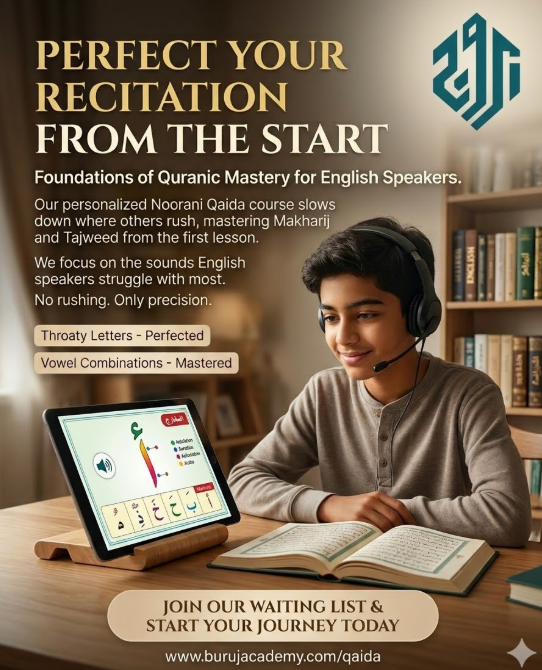
Buruj Academy’s Noorani Qaida Online Course provides systematic, phonics-based script instruction built specifically for non-Arabic speakers, taught by instructors trained in foundational reading pedagogy.
Book your FREE trial lesson in the Noorani Qaida course
3. Build Correct Pronunciation Through Tajweed Fundamentals
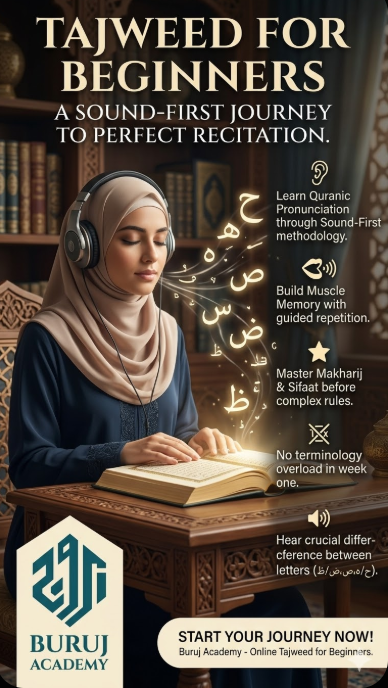
Learning how to read Quran in Arabic requires more than recognizing letters — it requires producing each letter from its correct articulation point (makhraj) with its proper characteristics (sifat).
Mispronounced letters in Quranic Arabic are not minor errors; some change meaning, and all affect the reverence owed to Allah’s speech.
Tajweed is the science governing correct Quranic pronunciation. For Quranic Arabic learners specifically, you need working familiarity with the most impactful rules: noon and meem sakinah rules (Ikhfa, Idgham, Iqlab, Izhar), the rules of Madd (elongation), and the distinction between heavy (tafkhim) and light (tarqiq) letters.
Our Tajweed for Beginners course uses the Buruj Method’s sound-before-rules approach — students train their ears and mouths before memorizing rule names, which produces lasting pronunciation accuracy rather than theoretical knowledge that doesn’t transfer to live recitation.
Book Your FREE Trial Lesson to Begin Your Tajweed Journey
For a thorough introduction to the foundational rules, our guide on Tajweed for beginners walks through the essential concepts every new learner needs.
4. Learn the Most Frequent Quranic Vocabulary First
The most effective way to learn Quranic Arabic fast is to study high-frequency vocabulary rather than working through a general Arabic dictionary.
The Quran’s vocabulary follows a clear frequency distribution — mastering the top 300 roots gives you access to the majority of the text.
Classical Arabic uses a three-letter root system (jidhr) where a single root generates dozens of related words.
For example, the root ك-ت-ب (k-t-b) produces kataba (he wrote), kitab (book), maktub (written), kuttab (writers), and many more. Learning roots rather than isolated words multiplies your vocabulary at every stage.
Excel in Your Quranic Studies
Join Buruj Academy and master the Quran with our structured, professional curriculum.
Book Your Free TrialA List of Common Quranic Vocabulary
| Arabic Word | Transliteration | Meaning |
| اللَّهُ | Allāh | Allah |
| قَالَ | Qāla | He said |
| رَبّ | Rabb | Lord |
| إِنَّ | Inna | Indeed / Verily |
| الَّذِي | Alladhī | Who / That (masc.) |
| كُلّ | Kull | Every / All |
| يَوْم | Yawm | Day |
| رَسُول | Rasūl | Messenger |
| آمَنَ | Āmana | He believed |
| عَمِلَ | ‘Amila | He did / worked |
| قَوْم | Qawm | People / Nation |
| أَرْض | Arḍ | Earth / Land |
| سَمَاء | Samā’ | Sky / Heaven |
| عَلِمَ | ‘Alima | He knew |
| كِتَاب | Kitāb | Book |
| حَقّ | Ḥaqq | Truth / Right |
| نَفْس | Nafs | Soul / Self |
| أَهْل | Ahl | People of / Family |
| جَاءَ | Jā’a | He came |
| آتَى | Ātā | He gave |
| رَأَى | Ra’ā | He saw |
| بَيْن | Bayna | Between / Among |
| أَتَى | Atā | He came / brought |
| إِذ | Idh | When (past) |
| شَاءَ | Shā’a | He willed |
| أُولَٰئِك | Ulā’ika | Those |
| مُؤْمِن | Mu’min | Believer |
| لَو | Law | If (hypothetical) |
| عِند | ‘Inda | At / With / Near |
| خَلَقَ | Khalaqa | He created |
| أَنزَلَ | Anzala | He sent down |
| خَيْر | Khayr | Good / Better |
| كَذَّبَ | Kadhdhaba | He denied / rejected |
| سَبِيل | Sabīl | Path / Way |
| دَعَا | Da’ā | He called / invited |
| أَمْر | Amr | Matter / Command |
| اتَّقَى | Ittaqā | He feared Allah / was pious |
| عَلِيم | ‘Alīm | All-Knowing |
| مَع | Ma’a | With |
| بَعْض | Ba’ḍ | Some / Part of |
| لَمَّا | Lammā | When / As soon as |
| أَيُّهَا | Ayyuhā | O (vocative) |
| إِلَٰه | Ilāh | God / Deity |
| نَار | Nār | Fire |
| هَدَى | Hadā | He guided |
| غَيْر | Ghayr | Other than / Besides |
| أَرَادَ | Arāda | He wanted / intended |
| أَم | Am | Or (interrogative) |
| اتَّبَعَ | Ittaba’a | He followed |
| مُوسَى | Mūsā | Moses |
| دُون | Dūna | Without / Besides |
| آخِر | Ākhir | Last / Other |
| قَلْب | Qalb | Heart |
| عَبْد | ‘Abd | Servant / Slave |
| أَرْسَلَ | Arsala | He sent |
| أَخَذَ | Akhadha | He took |
| اتَّخَذَ | Ittakhadha | He took (as) / adopted |
| أَجْر | Ajr | Reward |
| ظَالِم | Ẓālim | Wrongdoer / Oppressor |
| عِلْم | ‘Ilm | Knowledge |
| عَظِيم | ‘Aẓīm | Great / Mighty |
| لَن | Lan | Never / Will not |
| أَخْرَجَ | Akhraja | He brought out / expelled |
| أَكَلَ | Akala | He ate |
| لَيْسَ | Laysa | Is not / Are not |
| فَعَلَ | Fa’ala | He did / acted |
| نَظَرَ | Naẓara | He looked |
| ذَكَرَ | Dhakara | He remembered / mentioned |
| خَافَ | Khāfa | He feared |
| قَتَلَ | Qatala | He killed |
| رَجَعَ | Raja’a | He returned |
| سَمِعَ | Sami’a | He heard |
| تَوَلَّى | Tawallā | He turned away |
| أَمَرَ | Amara | He commanded |
| دَخَلَ | Dakhala | He entered |
| جَزَى | Jazā | He rewarded / recompensed |
| أَطَاعَ | Aṭā’a | He obeyed |
| أَوْحَى | Awḥā | He revealed / inspired |
| أَشْرَكَ | Ashraka | He associated partners (with Allah) |
| أَلْقَى | Alqā | He cast / threw |
| وَعَدَ | Wa’ada | He promised |
| أَنْفَقَ | Anfaqa | He spent (in Allah’s cause) |
| غَفَرَ | Ghafara | He forgave |
Begin with Surahs you already have memorized — the vocabulary becomes immediately meaningful when attached to familiar ayat.
Read also: Islamic Quran Memorization and Recitation Challenges
Buruj’s Azhari Quran tutors observe that students in our sessions who connect new vocabulary to already-memorized Surahs retain words at a measurably higher rate than those studying lists in isolation.
Book a FREE trial session with one of Buruj’s Azhari Quran tutors

5. Study Quranic Grammar Through Core Structures, Not Exhaustive Rules
Quranic grammar (nahw and sarf) is the framework that allows you to understand not just what individual words mean, but how they relate to each other within an ayah.
The goal at this stage is not to master every grammatical rule in classical Arabic — it is to understand the recurring structures that dominate Quranic text.
The most essential Quranic grammar concepts for beginners include:
the nominal sentence (jumlah ismiyyah), the verbal sentence (jumlah fi’liyyah), the mudaf-mudaf ilayh (possessive construction), verb forms in the perfect and imperfect tenses, and the basic case endings (i’rab) that shift word meaning.
إِيَّاكَ نَعْبُدُ وَإِيَّاكَ نَسْتَعِينُ
(Iyyaka na’budu wa iyyaka nasta’in
“It is You we worship and You we ask for help,” Al-Fatiha 1:5)
A sentence like this becomes fully parsable once you understand pronoun emphasis structures and imperfect verb conjugations. That level of comprehension — reaching into Surah Al-Fatiha with grammatical understanding — is an achievable early milestone.
Discover the Buruj Academy Difference
Step into our virtual classrooms and see how our expert instructors make learning Quran and Arabic intuitive and clear. We focus on overcoming the specific hurdles non-native speakers face, building your confidence and connection with the Quran.
6. Practice Comprehension Directly Within Quranic Text
The best way to learn Quranic Arabic is to apply every skill directly in the Quran rather than through artificial exercises.
Once you have foundational vocabulary and grammar, begin working through short Surahs — ideally ones you have already memorized — using a word-by-word translation and grammatical analysis tool.
Begin with Juz ‘Amma (the 30th Juz). These Surahs are short, linguistically accessible, and already familiar to most Muslims through prayer.
Working through Surah An-Nas, Al-Falaq, Al-Ikhlas, and Al-Kawthar with word-level analysis builds the habit of analytical Quran reading that supports every subsequent stage.
If you are simultaneously working on Quran memorization, our guide on how to memorize Quran faster explains how understanding meaning dramatically accelerates retention — comprehension and memorization reinforce each other powerfully.
7. Use Structured Resources Designed Specifically for Quranic Arabic
How to learn Quranic Arabic online effectively depends largely on the quality and specificity of the resources you use.
General Arabic learning apps and MSA textbooks are not designed for Quranic comprehension — they introduce vocabulary, grammar, and dialects that are largely irrelevant to the classical text.
Verified resources specifically designed for Quranic Arabic learners include word-frequency vocabulary lists built from actual Quranic text, morphological analysis tools linked to Quranic verses, and classical Arabic grammar texts that use Quranic examples as their primary evidence.
Buruj Academy’s Quranic Arabic Classes focus exclusively on the vocabulary, grammar, and reading skills needed for Quran comprehension — taught by Al-Azhar University graduates specializing in Quranic linguistics, with personalized 1-on-1 sessions that adapt to each student’s pace and prior knowledge.
Begin Understanding Quranic Arabic with a FREE Lesson
8. Establish a Daily Study Routine Built for Long-Term Retention
How to learn Quranic Arabic for beginners is as much a question of habit design as it is of content selection. The learners who reach genuine Quran comprehension are almost never those who studied hardest in a single intensive period — they are the ones who studied consistently over months and years.
Research in language acquisition consistently supports spaced repetition over massed practice.
For Quranic Arabic specifically, a daily 20–30 minute session divided between vocabulary review, grammar study, and Quran reading produces stronger long-term retention than two-hour weekend sessions.
| Daily Study Block | Time | Activity |
| Vocabulary Review | 8 minutes | Spaced repetition of learned roots |
| New Vocabulary | 5 minutes | 3–5 new roots with Quranic examples |
| Grammar Study | 7 minutes | One grammar concept with Quranic application |
| Quran Reading Practice | 10 minutes | Analytical reading of target Surah |
The best time to study for Quranic Arabic, as for all Quranic learning, is after Fajr — a time consistently endorsed in Islamic tradition and supported by what we observe in our students’ retention patterns.
9. Work with a Qualified Instructor for Guided Progression
The single most effective acceleration strategy for how to learn Quranic Arabic fast is working with a qualified instructor who can identify your specific gaps, correct grammatical misconceptions before they solidify, and design a progression path matched to your level and goals.
Self-study with good resources is genuinely valuable — but students working without feedback routinely develop grammar misunderstandings that persist for years.
An instructor identifies these patterns within the first few sessions and corrects them before they become ingrained habits.
Read also: How to Improve Quran Recitation Voice?
Start Learning Quranic Arabic with Buruj Academy’s Expert-Guided Classes
Quranic Arabic comprehension is a skill built through systematic, structured steps — and the path is clear when you follow the right sequence with qualified guidance.
Buruj Academy offers:
- Al-Azhar University graduates and Ijazah-certified instructors with 12+ years teaching non-Arabic speakers
- The Buruj Method: Context-before-abstraction — meaning before memorization, understanding before rule-drilling
- Personalized 1-on-1 sessions with flexible 24/7 scheduling
- Customized learning plans from complete beginner to confident Quran comprehension
- Real-time feedback and structured progression tracking
TBegin your journey of understanding by enrolling in a specialized track today:
- Quranic Arabic Classes (General & Immersive)
- Quranic Arabic Course for Kids (Interactive & Engaging)
- Quranic Arabic Course for Beginners (Foundation Building)
- Quranic Arabic Grammar Course (Syntax & Morphology)
Are you ready to understand what you recite? Join Buruj Academy today and book your free introductory session to begin your journey of discovery!
Excel in Your Quranic Studies
Join Buruj Academy and master the Quran with our structured, professional curriculum.
Book Your Free TrialBook your free trial lesson today and take your first step toward understanding Allah’s words directly.
Conclusion
Understanding the Quran in its original language is one of the most profound goals a Muslim can pursue — and it is far more achievable than most learners initially believe. The path runs through script mastery, pronunciation accuracy, targeted vocabulary, core grammar, and consistent direct engagement with Quranic text itself.
Each step in this guide builds on the one before it. There are no shortcuts worth taking, but with daily consistency and qualified guidance, most dedicated learners reach meaningful Quranic comprehension within one to two years.
Begin today, trust the process, and — Insha’Allah — the words of the Quran will open to you with depth and clarity.
Frequently Asked Questions About Learning Quranic Arabic
How Long Does It Take to Learn Quranic Arabic?
Most non-Arabic speakers with consistent study reach basic Quran comprehension — understanding 60–70% of Quranic text — within 12 to 18 months. Full comprehension including classical rhetorical structures typically requires two to three years of dedicated, structured study with qualified instruction.
Can I Learn Quranic Arabic Without Learning Modern Standard Arabic First?
Yes — and for most learners, studying Quranic Arabic directly is the better path. Modern Standard Arabic introduces vocabulary, expressions, and grammar patterns largely absent from the Quran. Dedicated Quranic Arabic study covers classical structures and high-frequency Quranic vocabulary directly, making comprehension achievable faster than an MSA detour would allow.
Is It Possible to Learn Quranic Arabic Completely Online?
Online learning is fully viable for Quranic Arabic when it includes live instruction with a qualified teacher, not only self-paced resources. The essential elements — script reading, pronunciation correction, grammar explanation, and Quranic comprehension practice — are all teachable through structured 1-on-1 online sessions with an experienced instructor.
What Is the Best Starting Point for a Complete Beginner in Quranic Arabic?
The Arabic script is always the correct starting point — specifically, reading letters in all positional forms with full harakat. Attempting vocabulary or grammar before confident script reading creates a persistent bottleneck. Once you read Arabic text smoothly, vocabulary and grammar acquisition accelerates significantly because cognitive effort is freed from decoding letters.
How Is Quranic Arabic Different from the Arabic Spoken in Arab Countries?
Quranic Arabic is a classical register used in the revealed text of the Quran, differing from spoken Arabic dialects (Egyptian, Levantine, Gulf, etc.) and even from Modern Standard Arabic in vocabulary, grammatical constructions, and rhetorical structures. Learning Quranic Arabic will not make you conversational in any spoken dialect — but it grants access to the Quran, classical Islamic scholarship, and formal Arabic literature.