 Arabic

| Key Takeaways |
| Hamzat al wasl is a connecting hamza that is pronounced when starting a word but silently dropped during connected speech. |
| It appears in seven specific Quranic nouns, the definitive article “ال”, and the past, command, and verbal noun forms of five- and six-letter verbs. |
| Hamzat al wasl is always written as a plain alif marked with a small صـ (saad) symbol in Uthmani Quranic script. |
| Its vowel when starting speech is either kasra, damma, or fatha, determined by strict rules tied to the word’s third root letter. |
| Distinguishing hamzat al wasl from hamzat al qat’ is essential for correct Tajweed, as confusing them changes both pronunciation and meaning. |
Reciting the Quran correctly requires more than knowing individual letter sounds — it demands understanding how words connect in flowing speech. One of the rules that surprises students most is that certain opening hamzas simply disappear mid-recitation, as if they were never there.
Hamzat al wasl is that disappearing hamza. It is pronounced only when you begin a word in isolation, and it drops completely when the word follows another in connected recitation. Mastering this rule removes one of the most common hesitation points non-Arabic speaking students face during Quran reading.
What Is Hamzat al Wasl in Arabic?
Hamzat al wasl is a prosthetic hamza added to the beginning of certain Arabic words to make them pronounceable in isolation.
Why Does Hamzat al Wasl Exist in Arabic?
Arabic phonology does not allow a word to begin with a sukoon (vowel-less consonant), so this hamza provides a temporary vowel entry point. When the word is connected to what precedes it in speech, that entry point is no longer needed — so the hamza is silently dropped.
The term “wasl” itself comes from the Arabic root meaning “to connect,” which accurately describes its function: it connects the final sound of the preceding word directly to the first consonant of the following word, bypassing the hamza entirely.
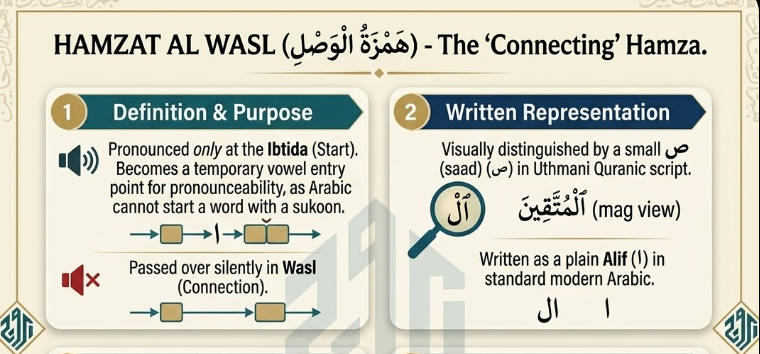
In Uthmani Quranic manuscripts, hamzat al wasl is distinguished visually by a small صـ (saad) written above the alif. This marker alerts the reciter: pronounce this hamza only when starting here; otherwise, pass over it silently.
At Buruj Academy, our Online Tajweed Classes — taught by Ijazah-certified instructors and Al-Azhar University graduates — dedicate focused time to hamzat al wasl precisely because it affects nearly every page of the Quran. Students who internalize this rule recite with noticeably smoother, more natural flow.
Book Your FREE Trial Lesson to Begin Your Tajweed Journey

Rules of Hamzatul Wasl
Hamzat al wasl occurs in three clearly defined grammatical categories. Knowing these categories removes all guesswork.
1. Hamzat al Wasl in the Definite Article ال
The most frequent appearance of hamzat al wasl in the Quran is in the definite article ال (al-). Its hamza is always pronounced with a fatha (short “a” sound) when you begin recitation with it, and it drops completely in connected speech.
Consider the opening of Surah Al-Fatihah:
ٱلْحَمْدُ لِلَّهِ رَبِّ ٱلْعَالَمِينَ
Alhamdu lillāhi rabbil-ʿālamīn
“All praise is due to Allah, Lord of the worlds.” (Al-Fatihah 1:2)
(The hamza of ٱلْحَمْدُ is pronounced at the start of recitation. In the phrase رَبِّ ٱلْعَالَمِينَ, the hamza drops entirely — the letter ب of رَبِّ connects directly to the ل of الْعَالَمِينَ.)
2. Hamzat al Wasl in the Seven Quranic Nouns
Classical Arabic grammar identifies ten nouns that carry hamzat al wasl by hearing and tradition (السماعية). Seven of these appear in the Quran. All are pronounced with a kasra when started in isolation, and all drop their hamza in connected speech.
| Noun | Transliteration | Quranic Example |
| اِبْن | Ibn (son) | ابْنَ مَرْيَمَ (Al-Baqarah 2:87) |
| اِبْنَة | Ibnah (daughter) | ابْنَتَ عِمْرَانَ (At-Tahrim 66:12) |
| اِمْرُؤ | Imru’ (man/person) | امْرُؤٌ هَلَكَ (An-Nisa 4:176) |
| اِمْرَأَة | Imra’ah (woman) | امْرَأَةُ الْعَزِيزِ (Yusuf 12:30) |
| اِسْم | Ism (name) | اسْمَ رَبِّكَ (Al-A’la 87:1) |
| اِثْنَان | Ithnan (two, masc.) | اثْنَيْنِ (Al-An’am 6:144) |
| اِثْنَتَان | Ithnataan (two, fem.) | اثْنَتَا عَشْرَةَ عَيْناً (Al-Baqarah 2:60) |
Each of these nouns begins with a kasra when recited in isolation. In connected recitation, the hamza disappears and the word flows from the final sound of whatever precedes it.
3. Hamzat al Wasl in Five- and Six-Letter Verb Forms
Hamzat al wasl also appears in the past tense (ماضي), command form (أمر), and verbal noun (مصدر) of five-letter (خماسي) and six-letter (سداسي) verbs — but never in four-letter (رباعي) verbs. This distinction matters significantly for Tajweed accuracy.
| Verb Type | Form | Example | Translation |
| Five-letter | Past | اِخْتَلَفَ | They differed |
| Five-letter | Command | اِقْتَرِبْ | Draw near |
| Five-letter | Verbal noun | اِخْتِلَاق | Fabrication |
| Six-letter | Past | اِسْتَكْبَرَ | He was arrogant |
| Six-letter | Command | اِسْتَغْفِرْ | Seek forgiveness |
| Six-letter | Verbal noun | اِسْتِغْفَار | Seeking forgiveness |
The command forms of three-letter verbs also carry hamzat al wasl — for example, اِضْرِبْ (strike), اُدْخُلُوا (enter), اِفْتَحْ (open). Four-letter verb commands, however, always begin with hamzat al qat’, not hamzat al wasl.
Buruj Academy’s Tajweed for Beginners course addresses hamzat al wasl within its foundational module, ensuring students build correct habits from their first recitation sessions rather than correcting ingrained errors later.
Book Your FREE Trial Lesson to Begin Your Tajweed Journey

Read also: Hamza Types: A Complete Guide to Hamzat al-Qat’ and Hamzat al-Wasl
What Vowel Does Hamzat al Wasl Take When You Start With It?
The vowel of hamzat al wasl when beginning speech — called the ibtida’ vowel — follows precise rules depending on the word type. This is one of the areas where students in our sessions at Buruj Academy most frequently make errors, often defaulting to kasra for every case out of habit.
1. Fatha: Only for the Definite Article
The hamzat al wasl of ال always takes a fatha — pronounced “al” — whenever you begin with it. This is the only case where hamzat al wasl is pronounced with a fatha.
2. Kasra: The Default for Nouns and Most Verbs
The seven Quranic nouns listed above all begin with kasra in isolation. For verb forms (past, command, verbal noun of five- and six-letter verbs), kasra is used when the third root letter carries a kasra or fatha — which covers the majority of cases.
اِهْدِنَا ٱلصِّرَٰطَ ٱلْمُسْتَقِيمَ
Ihdinas-sirātal-mustaqīm
“Guide us to the straight path.” (Al-Fatihah 1:6)
(The command form اِهْدِ begins with kasra because its third root letter carries a kasra.)
3. Damma: When the Third Root Letter Carries an Original Damma
When the third root letter of a verb carries an original (not borrowed) damma, the hamzat al wasl takes a damma in ibtida’. The most well-known Quranic example is اُدْخُلُوا:
اُدْخُلُواْ ٱلْجَنَّةَ لَا خَوْفٌ عَلَيْكُمْ
Udkhulul-jannata lā khawfun ʿalaykum
“Enter Paradise; no fear will there be upon you.” (Al-A’raf 7:49)
(The damma on اُدْخُلُوا is original — the root damma of يَدْخُلُ — so the hamzat al wasl takes damma.)
Master the Arabic Language
Join our expert-led courses and build a strong foundation in Classical and Modern Arabic.
Get Your Free Trial
Read also: Laam Rules in Tajweed: A Complete Guide to All Five Types
What Happens to the Letter Before Hamzat al Wasl in Connected Recitation?
When a word ending in sukoon precedes a word beginning with hamzat al wasl, the final consonant of the first word cannot remain vowel-less — Arabic phonology requires a connecting vowel. The rules for which vowel to use are precise.
| Preceding Element | Connecting Vowel | Example |
| Tanwin (nunation) | Kasra | عَدْنٍ الَّتِي → عَدْنِ لَّتِي (Ghafir 40:8) |
| مِنْ (min) | Fatha | مِنَ الْجِنَّةِ (An-Nas 114:6) |
| Plural meem (مْ) | Damma | أَلْهَاكُمُ التَّكَاثُرُ (At-Takathur 102:1) |
| All other sakin letters | Kasra | أَنِ امْشُوا (Sad 38:6) |
The plural meem rule is one that catches students off guard. When كُمْ or any group meem precedes a word with hamzat al wasl, the meem shifts to damma — not kasra. Recognizing this pattern in connected recitation is a sign of solid Tajweed grounding.
For a broader look at how these connected recitation rules interact, our article on Tajweed rules for beginners provides a helpful framework.
Discover the Buruj Academy Difference
Step into our virtual classrooms and see how our expert instructors make learning Quran and Arabic intuitive and clear. We focus on overcoming the specific hurdles non-native speakers face, building your confidence and connection with the Quran.
What is the Difference Between Hamzat al Wasl vs Hamzat al Qat’?
Hamzat al qat’ is pronounced in all positions — whether you start fresh or continue from the previous word. It is written with a visible hamza sign (ء) above or below the alif.
Hamzat al wasl, by contrast, is pronounced only in ibtida’ and drops in connected speech — it carries the small saad marker in Quranic script.
| Feature | Hamzat al Wasl | Hamzat al Qat’ |
| Pronounced when starting | Yes | Yes |
| Pronounced mid-sentence | No — drops completely | Yes — always present |
| Written marker in Quran | Small ص above alif | Hamza ء above or below alif |
| Occurs in pronouns | No | Yes (أَنَا، أَنْتَ، إِيَّاكَ) |
| Occurs in four-letter verbs | No | Yes (أَكْرَمَ، أَشْعَلَ) |
| Default ibtida’ vowel | Fatha (ال only), Kasra, or Damma | Fixed to the word’s own vowel |
A simple practical test taught to our students: add ف or و before the word and recite it connected. If the hamza disappears in your mouth, it is hamzat al wasl. If you still pronounce it clearly — فَأَكَلَ، وَإِذَا — it is hamzat al qat’. This test works reliably for both Tajweed learners and Arabic language students.
For more on how Tajweed rules function together during recitation, see our guide on how to read the Quran with Tajweed.
Master the Arabic Language
Join our expert-led courses and build a strong foundation in Classical and Modern Arabic.
Get Your Free TrialMaster Quranic Recitation with Buruj Academy’s Expert Tajweed Instructors
Hamzat al wasl is one of those rules that, once understood, makes recitation noticeably cleaner and more confident. Applying it correctly requires trained ears and structured practice under qualified guidance.
At Buruj Academy, our Online Tajweed Classes are taught exclusively by Al-Azhar University graduates and Ijazah-certified instructors with 12+ years of experience teaching non-Arabic speakers worldwide. Our Buruj Method — sound-before-rules — ensures you hear correct application before memorizing definitions. Every student receives:
- Personalized 1-on-1 sessions with flexible 24/7 scheduling
- Real-time pronunciation correction from qualified instructors
- A structured progression from foundational rules to confident Quran recitation
Begin your transformation today by choosing the path that fits your goals:
- Online Arabic Classes (General & Comprehensive)
- Arabic Course for Beginners
- Arabic Alphabet Learning Course
- Online Arabic Classes for Kids
- Arabic Classes for Adults
- Arabic Grammar Course (Nahw & Sarf)
- Intermediate Arabic Course (B1/B2)
- Arabic Speaking Course (Conversational Fluency)
- Arabic Reading Course (Literary Excellence)
- Learn Arabic Writing Course (Calligraphy & Composition)
Book your free trial lesson today and experience the difference expert-guided Tajweed instruction makes, insha’Allah.
Frequently Asked Questions About Hamzat al Wasl
What Is the Difference Between Hamzat al Wasl and Hamzat al Qat’?
Hamzat al wasl is pronounced only when starting a word in isolation and drops silently in connected speech. Hamzat al qat’ is always pronounced, whether starting or continuing. In Quranic script, hamzat al wasl carries a small saad marker above the alif, while hamzat al qat’ carries a visible hamza sign.
Does Hamzat al Wasl Appear in Four-Letter Verbs?
No. Hamzat al wasl never appears in the command, past tense, or verbal noun of four-letter (رباعي) verbs. Those forms always begin with hamzat al qat’. Hamzat al wasl in verb forms is restricted to five-letter and six-letter verb structures, plus the command forms of three-letter verbs.
How Is the Vowel of Hamzat al Wasl Determined When Starting Speech?
For ال, it is always fatha. For the seven Quranic nouns, it is always kasra. For verb forms, it follows the third root letter: kasra or fatha on the third letter → kasra on the hamzat al wasl; original damma on the third letter → damma on the hamzat al wasl.
Why Does Tanween Before Hamzat al Wasl Change to Kasra?
Arabic phonology requires a vowel when a sakin letter meets the first letter of the following word. Tanween’s final nun is sakin, so it must receive a vowel to connect. The default connecting vowel in this position is kasra, producing the characteristic -nin sound rather than -nun or -nan before words beginning with hamzat al wasl.
Can I Learn Hamzat al Wasl Without a Teacher?
You can study the theoretical rules independently, but correct application in live recitation almost always requires a trained ear correcting you in real time. Students who self-study hamzat al wasl frequently develop confident but inaccurate habits — particularly with the connecting vowels and the ibtida’ damma cases — that become difficult to correct later. Structured instruction is the faster and more reliable path. Our guide to learning Tajweed addresses this in detail.