 Islamic
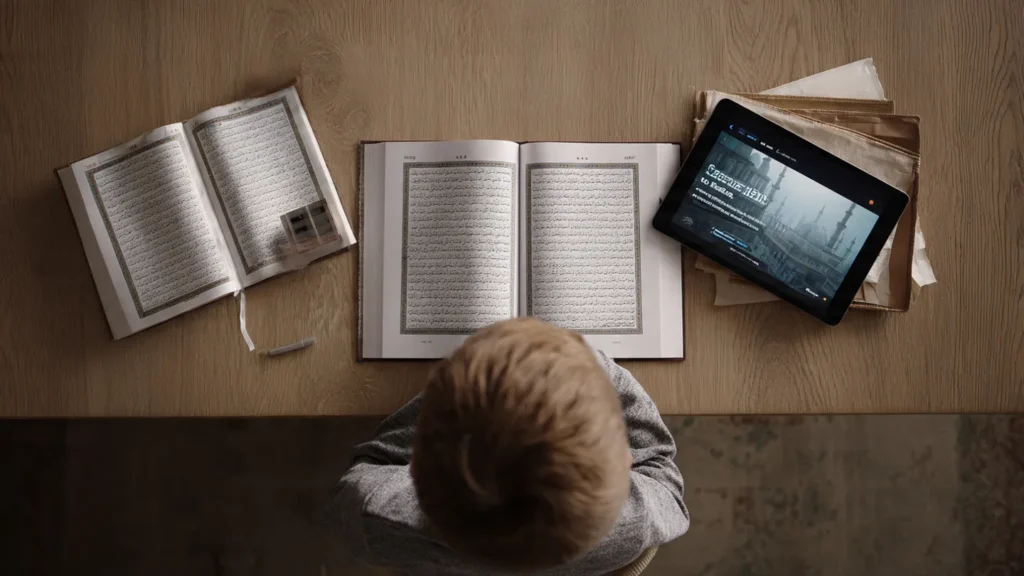
Many Muslims today open a Quran app before Fajr, recite during a commute, or follow along in Tarawih from their phone screen. A very practical question follows: does any of that actually count?
Yes — reading Quran from your phone counts fully as an act of worship, and you receive the reward for every letter recited. The phone does not take the legal ruling of a printed Mushaf, which simplifies several purity-related questions while leaving others exactly as they are.
Does Reading Quran on Your Phone Earn the Same Reward?
Reading Quran from a phone earns the same reward as reading from a printed Mushaf, because reward is attached to the recitation itself, not the medium. The Prophet ﷺ said, as recorded in Sahih al-Tirmidhi, that whoever recites one letter of Allah’s Book receives one good deed, multiplied tenfold — and this applies to every letter on your screen just as it does to every letter on paper.
The characters displayed on a phone screen are digital signals — light rendered through pixels — rather than ink permanently inscribed on a surface. This distinction matters in Islamic legal reasoning, but it does not diminish the spiritual value of what you are reciting.
At Buruj Academy, our Al-Azhar-trained instructors remind students regularly: the Quran you recite sincerely from your phone, your Mushaf, or from memory is one Book, and Allah ﷻ rewards the heart that engages with it consistently. If you are looking to recite with proper pronunciation and Tajweed, our Online Quran Reading Course helps students build that foundation from scratch.
Book your Free trial lesson and start reading the Quran

Do You Need Wudu to Read Quran on Your Phone?
Wudu is not required to read Quran from your phone if you are in a state of minor ritual impurity (hadath asghar — e.g., after using the bathroom, passing wind, or sleeping). This is the position of the majority of contemporary scholars, including the scholars of Al-Azhar, because a phone is not legally classified as a Mushaf.
The classical ruling that forbids touching the Quran without wudu — based on the verse “None shall touch it except the purified” (Al-Waqi’ah 56:79) — refers specifically to the written Mushaf. A phone that happens to contain a Quran application does not carry that ruling.
| State of Purity | May Read from Phone? | May Touch Printed Mushaf? |
| With wudu | Yes | Yes |
| Without wudu (minor impurity) | Yes | No |
| Menstruating (haidh) | Yes (majority view) | No |
| Major impurity (janabah) | No | No |
Wudu remains the more virtuous choice. In our sessions at Buruj Academy, we encourage students to maintain wudu when possible — not as a legal requirement for the phone, but as a mark of reverence toward the words of Allah ﷻ.
Our Tajweed for Beginners course helps students build the confidence to recite correctly without needing to look at a screen.
Book Your FREE Trial Lesson to Begin Your Tajweed Journey
Discover the Buruj Academy Difference
Step into our virtual classrooms and see how our expert instructors make learning Quran and Arabic intuitive and clear. We focus on overcoming the specific hurdles non-native speakers face, building your confidence and connection with the Quran.
Do You Get Reward for Reading Quran on Your Phone Without Wudu?
Yes, you receive full reward for reading Quran on your phone without wudu, provided you are not in a state of major impurity. Reward follows sincere recitation, and the absence of wudu does not invalidate or reduce that reward for minor ritual impurity.
This is an important clarification for many students, particularly new Muslims and busy adults who may feel their recitation “doesn’t count” if they haven’t made wudu. That concern, while rooted in sincerity, is not supported by scholarly opinion regarding phone recitation.
The better frame is one of aspiration: reciting with wudu reflects a higher level of mindfulness and respect, and many scholars recommend it as the ideal. But reciting without wudu — from your phone — is valid worship with complete reward, Alhamdulillah.
If you are reading the Quran for the first time and building your recitation habits, beginning with consistent daily reading — regardless of whether you always have wudu — is far better than waiting for perfect conditions that may delay you.
Expand Your Islamic Knowledge
Join our structured online courses led by qualified instructors to deepen your understanding of the Deen.
Join a Free Trial ClassWhat Are the Rewards of Reading the Quran on a Phone?
Reading the Quran carries some of the greatest rewards in Islam — rewards tied directly to every letter recited, every session completed, and every effort made to engage sincerely with Allah’s ﷻ words. These are not vague spiritual benefits; authentic narrations specify them with remarkable precision.
The Prophet ﷺ said, as recorded in Sahih al-Tirmidhi: whoever recites one letter from the Book of Allah receives one good deed, and that good deed is multiplied by ten. He ﷺ clarified that “Alif Lam Mim” counts as three separate letters — thirty rewards minimum from three letters alone.
1. Every Letter Carries Independent Reward
This is not a metaphor — it is a precise, quantifiable promise. A single verse of Surah Al-Fatiha contains dozens of letters, meaning a sincere recitation of Al-Fatiha alone generates hundreds of good deeds. Students in our Buruj Academy sessions are often moved when they calculate the reward accumulating across a single Juz.
The multiplication does not stop at ten for those whose hearts are fully engaged. Scholars note that sincerity, Tajweed accuracy, and ritual purity at the time of recitation are all factors that elevate reward further — though the baseline tenfold multiplication applies regardless.
2. The Quran Intercedes for Its Companion on the Day of Judgment
The Prophet ﷺ said, as recorded in Sahih Muslim: “Recite the Quran, for it will come as an intercessor for its companions on the Day of Resurrection.” This reward belongs specifically to those who recite consistently — the Arabic word used, sahib, implies companionship built through regular, devoted engagement.
This intercession is among the most significant rewards in Islamic belief — a direct advocate on the Day when every person will need one most.
3. Reciters Are Ranked Among the Noble and the Righteous
The Prophet ﷺ described two categories of Quran reciters in a narration recorded in Sahih al-Bukhari: the one who is skilled in recitation will be among the noble, righteous scribes (al-safarah al-kiram al-bararah), and the one who recites with difficulty, struggling through it, receives a double reward — one for the recitation itself and one for the effort.
This narration is particularly important for beginners and non-Arabic speakers. Struggling through a verse on your phone, mispronouncing letters, pausing to correct yourself — that effort is not invisible to Allah ﷻ. It is rewarded twice.
| Type of Reciter | Reward Described in Hadith |
| Skilled, fluent reciter | Ranked with the noble, righteous scribes |
| Struggling, effortful reciter | Double reward — recitation + effort |
| Consistent companion of the Quran | Intercession on the Day of Resurrection |
| Reciter of one letter | Minimum tenfold multiplication per letter |
4. Recitation Elevates Your Rank in This Life and the Next
The Prophet ﷺ also said, as recorded in Sahih Muslim: “The best of you are those who learn the Quran and teach it.” This reward extends beyond personal recitation — it encompasses the act of carrying Quranic knowledge and passing it to others, which is why teaching Quran is considered among the most honoured professions in Islam.
For those pursuing deeper engagement — whether through memorization or learning proper Tajweed — our Online Hifz Program and Online Tajweed Classes at Buruj Academy are designed to help students build the kind of consistent, accurate relationship with the Quran that these narrations describe.
Start Hifz today with a FREE trial session

5. Reciting at Night Carries Special Distinction
Night recitation holds a particular place in Islamic teaching. Allah ﷻ says in Surah Al-Muzzammil:
إِنَّ نَاشِئَةَ ٱلَّيْلِ هِىَ أَشَدُّ وَطْـًٔا وَأَقْوَمُ قِيلًا
Inna nashi’atal-layli hiya ashaddu wat-anw wa aqwamu qeela
“Indeed, worship in the night is more impactful and better for recitation.” (Al-Muzzammil 73:6)
Scholars of Tafsir note that the night environment — quieter, free from distraction — creates conditions where the heart absorbs the Quran more deeply. Our guide on the best time to memorize Quran explores both the spiritual and practical dimensions of night recitation for students building a consistent routine.
The rewards of reading the Quran are among the clearest, most documented gifts Allah ﷻ has made accessible to every Muslim — including those reading from a phone screen after a long day, with or without wudu, struggling through unfamiliar letters. Every sincere effort counts, and none of it is lost.
Expand Your Islamic Knowledge
Join our structured online courses led by qualified instructors to deepen your understanding of the Deen.
Join a Free Trial ClassStart Reciting with Confidence — Buruj Academy Can Help
Reciting Quran, whether from a phone, a Mushaf, or from memory, is an act of worship that deserves to be done well. Knowing the ruling is the first step — reciting with correct Tajweed is the next.
Buruj Academy’s Online Quran Classes are led by Ijazah-certified instructors and Al-Azhar University graduates with 12+ years of experience teaching non-Arabic speakers globally.
Through personalized 1-on-1 sessions, flexible 24/7 scheduling, and the Buruj Method — sound before rules, consistency before speed — students progress from uncertain beginners to confident, accurate reciters.
Join a global community of learners and find the path that best supports your spiritual and intellectual growth:
- Online Studies Islamic Classes (General & Flexible)
- Islamic Studies Course for Beginners (Foundational Knowledge)
- Islamic Studies Classes for Kids (Engaging & Values-Based)
- Islamic Studies Classes for Adults (In-Depth Theological Discussion)
- Islamic Studies Classes for Ladies (Sisterhood & Specialized Learning)
- Islamic Studies Classes for New Muslims (Guided Support & Essentials)
- Tafseer Al Quran Course (Unlocking Divine Meanings)
- Quranic Sciences (Uloom Al Quran) Course (Advanced Linguistic & Historical Context)
Book your free trial lesson today and take the next step in your recitation, Insha’Allah.
Frequently Asked Questions About Reading Quran on a Phone
Does Reading Quran on a Phone Count as Real Worship?
Yes, reading Quran on a phone counts as full and valid worship. Reward is attached to the sincere recitation of Allah’s words, not the physical medium. Every letter recited — whether from a phone screen or a printed page — earns reward as established in authentic hadith narrations about the merit of Quranic recitation.
Do You Get Reward for Reading Quran on Your Phone?
You receive the same reward for reading Quran on your phone as you would from a Mushaf. The Prophet ﷺ described reward for every letter of Quran recited, and this is not conditional on using a printed book. Wudu is recommended but not required for phone recitation in minor impurity.
Is It Haram to Read Quran Without Wudu on Your Phone?
It is not haram to read Quran from your phone without wudu if you are in a state of minor ritual impurity. Scholars agree the phone does not carry the Mushaf’s ruling, so the condition of wudu for touching does not apply. However, for those in major impurity (janabah), recitation itself is not permitted.
Can a Woman on Her Period Read Quran from Her Phone?
Yes, the majority of contemporary scholars permit menstruating women to read Quran from a phone. Since the phone is not legally classified as a Mushaf, the prohibition that applies to touching the printed Mushaf during haidh does not extend to a phone screen displaying Quranic text.
Does It Matter Which Quran App You Use?
Any Quran app that displays accurate Uthmani-script text is acceptable for recitation and reference. Scholars do not distinguish between apps for the purposes of worship validity. What matters is that the text is accurate, and that the user interacts with it respectfully and with the intention of Quranic recitation.