 Quran
Quran

| Key Takeaways |
| Short, consistent daily sessions of 10–20 minutes outperform long irregular lessons for children’s Quran retention. |
| Children aged 4–7 learn best through repetition and visual aids rather than rule-heavy formal instruction. |
| A qualified online instructor removes the most common barrier Western parents face: lack of personal Tajweed knowledge. |
| Positive reinforcement and milestone celebrations sustain motivation far longer than correction-focused teaching approaches. |
| Connecting Quran learning to daily prayer gives children an immediate, meaningful reason to practice what they memorize. |
Teaching the Quran to children in the West comes with a specific set of pressures most Islamic resources simply don’t address — non-Arabic-speaking parents, packed school schedules, short attention spans, and a cultural environment that rarely reinforces what children learn at home.
The good news is that these challenges are entirely solvable with the right structure, the right expectations, and the right support.
When Western parents understand why each obstacle appears — and have a concrete strategy to meet it — Quran learning becomes one of the most rewarding parts of a child’s week, not the most stressful.
Table of Contents:
1. Start with Short Daily Sessions Instead of Long Weekly Ones
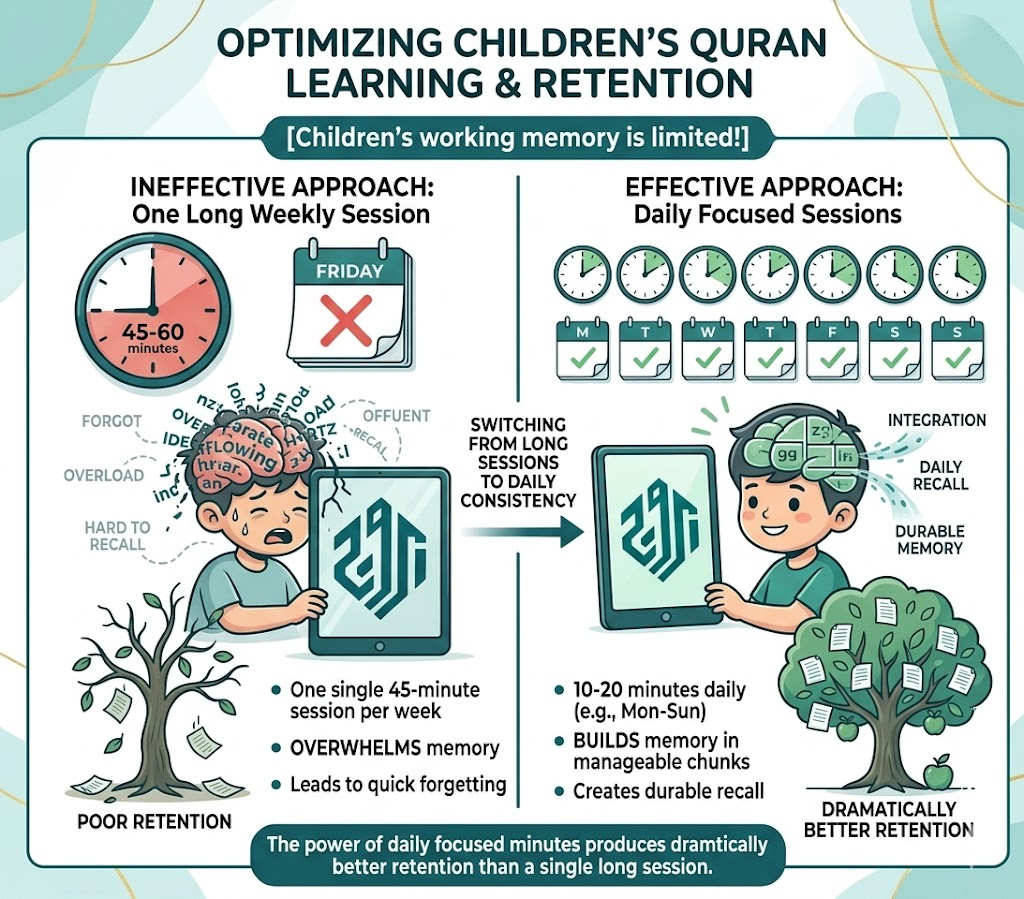
Children’s working memory is limited, and Quran learning for children suffers most when parents default to one or two long sessions per week. Ten to twenty focused minutes daily produces dramatically better retention than a single forty-five-minute session every Friday.
The Prophet ﷺ said:
“The most beloved deeds to Allah are those done consistently, even if they are small.” (Sahih al-Bukhari 6465)
This principle applies beautifully to children’s Quran education — consistency is the mechanism, not duration.
What a 15-Minute Daily Session Looks Like in Practice
A structured short session removes the guesswork that makes many parents abandon the routine:
| Time | Activity |
| 0–3 minutes | Review yesterday’s verse or portion aloud |
| 3–11 minutes | Introduce and repeat new material (3–5 repetitions) |
| 11–15 minutes | Recite both old and new together, praise and close |
This structure keeps children engaged without resistance. In our experience at Buruj Academy, families who commit to this format for four weeks consistently report that their children begin requesting their Quran time — because it never feels overwhelming.
2. Choose Age-Appropriate Quran Material So Children Experience Early Success
One of the most common mistakes parents make is starting too ambitiously. Beginning with longer surahs or complex Tajweed rules before a child can read Arabic fluently creates frustration on both sides of the table.
For children aged 4–7, the right starting material is the short surahs of Juz ‘Amma. These surahs are phonetically repetitive, rhythmically memorable, and immediately applicable in daily Salah — giving children an instant sense of purpose for what they are memorizing.
Our article on easy surahs of the Quran to memorize provides a ranked guide that helps parents sequence material from most accessible to progressively more challenging. Starting with Surah Al-Fatiha, Al-Ikhlas, Al-Falaq, and An-Nas builds both confidence and functional prayer readiness within weeks.
Matching Material to Age Group
| Age Range | Recommended Starting Point | Realistic Monthly Target |
| 4–6 years | 3-ayah surahs (Al-Ikhlas, An-Nas) | 1–2 short surahs |
| 7–10 years | Juz 30 short surahs | 2–4 surahs per month |
| 11–14 years | Structured Hifz plan, Juz 30 completion | 4–8 pages per month |
Buruj Academy’s Online Quran Classes for Kids are structured around exactly this age-differentiated progression, pairing each child with an instructor trained in child-appropriate Quran pedagogy.
Help your child start learning the Quran with a FREE trial

3. Address the Parent’s Own Tajweed Gap Before It Becomes the Child’s Problem
Many Western parents carry a quiet anxiety: “How can I teach my child Quran correctly when I don’t know Tajweed myself?” This is one of the most honest and important challenges in teaching the Quran for children, and it deserves a direct answer.
The solution is not for parents to master Tajweed before their child starts — that timeline helps no one. The solution is to separate the parent’s role from the instructor’s role. Parents provide consistency, encouragement, and environment. A qualified teacher provides accuracy.
When no qualified teacher is present, common Tajweed errors — mispronouncing the letter ض (Daad), missing Ghunnah on Noon Mushaddad, shortening Madd letters — transfer from parent to child and calcify over years.
Our team has worked with teenagers who needed months of correction for habits absorbed in early childhood from well-intentioned but unsupported home teaching.
Buruj Academy’s Tajweed for Kids course pairs children with Ijazah-certified instructors and Al-Azhar University graduates who correct pronunciation in real time — relieving parents of the technical burden entirely while keeping them involved in the motivational and routine-building aspects.
You can also explore more about Tajweed for beginners to build your own foundational awareness.
Book your child’s free Tajweed trial lesson today
4. Use Repetition Methods That Match How Children’s Brains Actually Retain Information
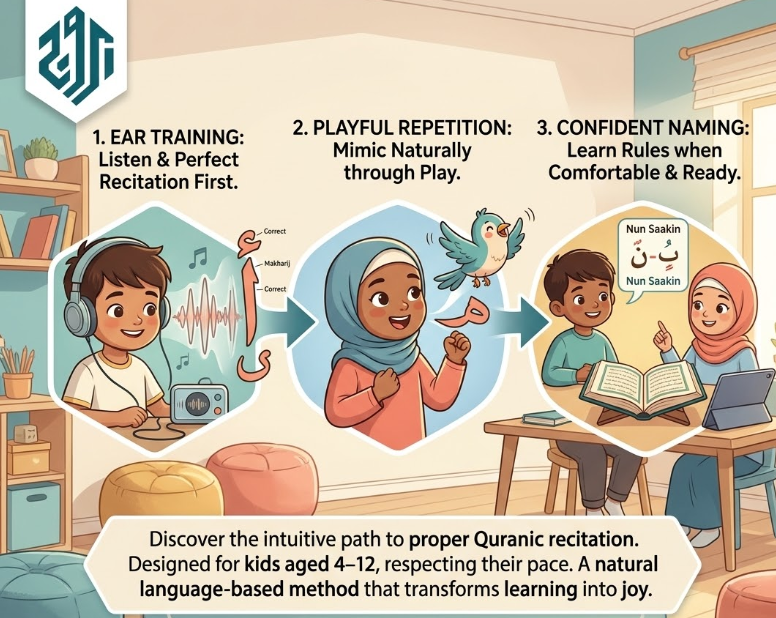
Children do not memorize the same way adults do. Adult learners respond well to analytical breakdown — understanding rule patterns, grammatical structures, and phonetic mechanics.
Children memorize through rhythm, movement, sound patterns, and emotional association.
The most effective repetition method for children is the echo technique: the teacher or parent recites one phrase, the child immediately echoes it, and this is repeated five to seven times per phrase before moving forward.
Studies in Quranic pedagogy confirm that spaced repetition across multiple short sessions far outperforms single-session massed repetition.
Three Repetition Techniques That Work for Children
The Echo Method: One line at a time, call-and-response format. Works best for children aged 4–8.
The Cover-and-Recite Method: Child memorizes a verse visually, covers the mushaf, and recites from memory. Works best for children aged 8–12 who already read Arabic.
The Salah Integration Method: Child recites the newly memorized portion during actual prayer the same day it is learned. This creates a powerful emotional anchor and purpose-driven repetition.
Our Quran activities for kids resource offers additional engagement techniques that extend learning beyond the formal session into daily family life.
Read also: How to Make Reading the Quran Fun for Kids?
5. Build a Physical Environment That Signals Quran Time Consistently
Children are profoundly environment-dependent learners. When the physical context shifts — same chair, same corner, same time of day — the brain enters a prepared state more readily. This is not a spiritual point alone; it is how childhood memory and habit formation work neurologically.
A dedicated Quran corner at home does not require elaborate setup. A small prayer rug, a Quran stand, and a consistent lamp or natural light source are sufficient. The key is that this space is used only for Quran-related activity, so entering it becomes a cue for focused attention.
Elements of an Effective Quran Learning Space for Children
| Element | Purpose |
| Fixed location | Conditions the brain to enter focus mode |
| Consistent time | Aligns with the child’s natural energy rhythms |
| Phone-free zone | Removes the most common attention disruptor |
| Progress chart visible | Provides ongoing visual motivation |
Timing matters more than parents often realize. After Fajr or immediately after school — before screens and activities — captures children at their most receptive.
Our guide on the best time to memorize Quran explains both the Islamic and cognitive science basis for timing choices.
6. Replace Punishment-Based Correction with a Structured Positive Reinforcement System
Correction is essential in Quran teaching — mispronunciation of Arabic letters changes meaning and must be addressed. The challenge is how correction is delivered. Harsh correction during childhood Quran sessions is one of the most frequently cited reasons adults report negative associations with Quran learning in adulthood.
The alternative is not ignoring errors — it is a structured correction sequence: acknowledge the effort first, model the correct sound immediately, have the child repeat the correct version three times, and move forward. This sequence corrects the error without shaming the child.
Alongside correction, a milestone reward system provides forward-looking motivation. Small celebrations — a family acknowledgment after completing Surah Al-Mulk, a special outing after finishing Juz ‘Amma — create positive memory markers that children associate with Quran achievement.
Our detailed resource on Quran learning tools for kids includes printable progress charts and milestone tracker templates parents can use at home.
Excel in Your Quranic Studies
Join Buruj Academy and master the Quran with our structured, professional curriculum.
Book Your Free Trial7. Connect Every Memorized Verse to Its Meaning So Children Feel What They Are Reciting
Children who memorize Quran without any connection to meaning treat recitation as a phonetic exercise rather than an act of worship. This produces technically adequate recitation with zero spiritual engagement — and significantly higher dropout rates during adolescence when children begin questioning the purpose of what they have memorized.
Age-appropriate Tafsir does not require scholarly depth. A simple one-sentence meaning given after the memorization work — not before — is sufficient at young ages. “This surah tells us that Allah is One, and nothing is equal to Him” is enough context for a five-year-old learning Al-Ikhlas.
As children grow older, meaning can deepen progressively. The Quran facts for kids resource at Buruj Academy provides accessible, age-calibrated context parents can share during or after sessions.
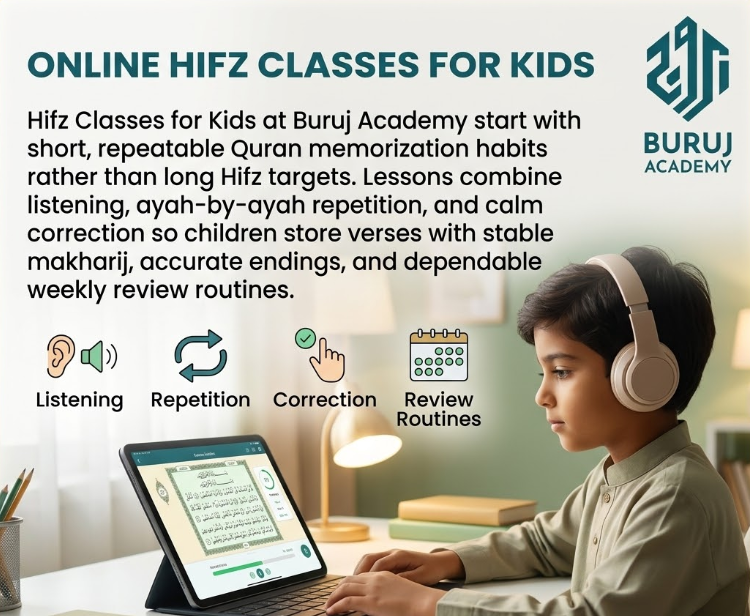
Buruj Academy’s Hifz for Kids course connect children globally with Al-Azhar-trained instructors through personalized 1-on-1 sessions, with flexible scheduling that accommodates Western school timetables.
Parents remain fully informed through session updates while the instructor manages the technical progression.
Start your child’s Hifz classes with a FREE session
8. Create a Realistic Weekly Schedule and Protect It From Disruption
Inconsistency is the single greatest threat to children’s Quran progress in Western households. School activities, weekend events, family gatherings, and holiday breaks erode what was built — and parents often restart rather than resume, losing weeks of progress.
A written weekly Quran schedule — shared with the child and placed visibly in the home — transforms Quran learning from a flexible suggestion into a protected commitment. Children respond to structures that are predictable and communicated clearly.
Sample Weekly Quran Schedule for School-Age Children
| Day | Activity | Duration |
| Sunday | New lesson with teacher/parent | 15 minutes |
| Monday | Independent review of Sunday’s lesson | 10 minutes |
| Tuesday | New lesson — continue sequence | 15 minutes |
| Wednesday | Review both Sunday + Tuesday lessons | 10 minutes |
| Thursday | New lesson | 15 minutes |
| Friday | Full week revision — recite all learned portions | 20 minutes |
| Saturday | Rest or light listening — audio recitation only | Optional |
Our Quran memorization schedule article provides additional schedule templates for different age groups and learning intensities.
9. Enroll Children with a Qualified Online Instructor to Provide Expert Oversight
The most effective long-term solution for overcoming challenges in teaching the Quran for children is expert support. Parents who attempt to manage both the motivational and the technical dimensions of Quran education without formal help consistently report burnout within three to six months.
A qualified online Quran instructor provides real-time Tajweed correction, a structured curriculum, consistent external accountability, and a relationship that children often respond to with more receptivity than they show to parents alone.
Book Your Kid a Free Trial Lesson With One of Buruj’s Quran Tutors for Children
This is not a failure of parenting — it is a recognition that specialized instruction requires specialized expertise.
For children beginning from complete zero, the Noorani Qaida for Kids course builds the foundational Arabic reading skills that make all subsequent Quran learning significantly easier.
Sign up your kid for a free Noorani Qaida lesson

Discover the Buruj Academy Difference
Step into our virtual classrooms and see how our expert instructors make learning Quran and Arabic intuitive and clear. We focus on overcoming the specific hurdles non-native speakers face, building your confidence and connection with the Quran.
Read also: Best Quran Tafseer for Kids
Begin Your Child’s Quran Education with Buruj Academy’s Expert Instructors
These nine strategies address the real challenges Western parents face — not with theory, but with practical, tested approaches drawn from over 12 years of teaching children globally.
Buruj Academy offers Online Quran Classes for Kids taught by Ijazah-certified, Al-Azhar University graduates with deep experience in child Tajweed pedagogy.
Enroll your child in one of our specialized, kid-friendly tracks today:
- Online Quran Classes for Kids
- Tajweed Classes for Kids
- Hifz Classes for Kids
- Online Arabic Classes for Kids
- Quranic Arabic Course for Kids
- Noorani Qaida Course for Kids
- Islamic Studies Classes for Kids
Ready to watch your child grow in knowledge and character? Join the Buruj Academy family and book a free trial session for your child today!
Our personalized 1-on-1 sessions, flexible scheduling, and the Buruj Method — built on patience-before-performance — ensure your child builds correct habits from day one.
Book a free trial lesson and let our team assess your child’s current level and design a personalized learning path — at no cost and no commitment.
Excel in Your Quranic Studies
Join Buruj Academy and master the Quran with our structured, professional curriculum.
Book Your Free TrialConclusion
Teaching the Quran to children in the West is not simply about finding the right surah to start with — it is about building a system that works within real family life. Short daily sessions, age-appropriate material, qualified instruction, and consistent positive reinforcement form the foundation every child deserves.
When parents separate their role as encouragers from the teacher’s role as technical guide, the entire process becomes more sustainable — for both the parent and the child.
With the right structure in place, Quran learning stops being a source of household friction and becomes one of the most meaningful habits a Muslim family can share.
Frequently Asked Questions About Teaching the Quran to Children
At What Age Should Children Begin Learning the Quran?
Children can begin Quran exposure as early as age 3 through listening and simple repetition, but structured learning is most effective from age 4–5. At this stage, short surahs learned through echo repetition and song are ideal. Our guide on the best age to memorize Quran provides a detailed age-by-age breakdown for parents.
How Do I Teach My Child Quran When I Don’t Know Arabic Myself?
You do not need to know Arabic to support your child’s Quran learning effectively. Your role is consistency, encouragement, and environment. A qualified instructor — such as those at Buruj Academy — manages the technical Tajweed and Arabic reading components. Many of the parents whose children excel in our programs are themselves non-Arabic speakers who simply created structure at home.
How Long Does It Take a Child to Memorize Juz ‘Amma?
With 15 minutes of daily focused work and qualified instruction, most children aged 7–10 complete Juz ‘Amma (the 30th Juz, comprising 37 surahs across approximately 20 pages) in 7–16 months. The shortest surahs to memorize article helps parents prioritize which surahs to target first for maximum early progress.
How Do I Keep My Child Motivated When They Want to Quit?
Motivation dips are universal and expected, not signs of failure. The most effective responses are: shortening the session temporarily rather than skipping it entirely, introducing a milestone reward, and giving the child a visible progress chart. Children who see how far they have come are far less likely to quit than those with no visual record of their achievement.
Should I Teach My Child Tajweed Rules Alongside Memorization?
At ages 4–8, prioritize correct pronunciation through modeling and correction — not rule terminology. A child does not need to know the name “Ikhfa” to pronounce it correctly when a skilled teacher models it consistently. Formal Tajweed rule names can be introduced gradually from age 9 onward. Our Tajweed rules for kids guide explains exactly how to sequence this introduction appropriately.