 Quran
Quran

| Key Takeaways |
| Solo Quran memorization is possible but requires structured daily sessions, a verified recitation baseline, and a consistent revision system. |
| Without a teacher to correct recitation errors, self-memorizers risk encoding mispronounced verses that become progressively harder to fix. |
| The Quran contains 604 pages across 30 Juz’; realistic solo memorization timelines range from 3 to 10 years depending on daily input. |
| A proven solo Hifz system separates new memorization, same-day review, weekly consolidation, and long-term revision into four distinct daily slots. |
| Pairing self-memorization with periodic teacher checks — even monthly — dramatically improves both accuracy and long-term retention rates. |
Thousands of Muslims around the world have memorized the Quran without sitting in a traditional madrasa, and many continue doing so today through disciplined self-study.
The question is not whether it is possible — it clearly is — but whether you are doing it in a way that will actually hold.
Can You Memorize the Quran by Yourself?
Yes, you can memorize the Quran by yourself, provided you have a verified recitation foundation, a structured revision system, and the discipline to maintain both without external accountability. What solo memorization cannot replace on its own is accurate pronunciation feedback — but this guide shows you exactly how to build around that gap.
Can I Memorize the Quran by Myself Without Any Teacher at All?
Yes, you can memorize the Quran independently, but accuracy is the critical risk. Without any teacher involvement, mispronounced words get locked into memory and become progressively harder to correct. Monthly recitation checks with a qualified instructor, even remotely, significantly reduce this risk without requiring full-time teacher commitment.
Book a FREE trial session with one of Buruj’s Azhari Quran tutors

1. Honestly Assess Whether Your Recitation Is Ready for Solo Hifz
Before memorizing a single verse independently, you need to confirm that your recitation baseline is accurate enough to work from. Memorizing incorrect pronunciation locks errors into long-term memory, making them significantly harder to correct later.
The standard to aim for is functional Tajweed — not perfection, but consistent accuracy in the foundational rules: correct makharij (articulation points), clear distinction between letters like ض and ظ, and proper application of basic Noon sakinah and Meem sakinah rules.
How Do You Know If Your Recitation Is Ready?
Record yourself reciting Surah Al-Fatiha and Surah Al-Ikhlas, then compare your recitation against a verified reciter such as Sheikh Mahmoud Khalil Al-Hussary’s Murattal recording.
Listen specifically for letter clarity, not melody. If you can identify your own errors by ear, your baseline awareness is sufficient to begin.
If you cannot hear the difference between your recitation and the verified recording, invest in at least a foundational Tajweed course before starting Hifz.
Buruj Academy’s Hifz Classes for Adults begins every student with a recitation assessment precisely because we have seen, across twelve years of teaching, that students who skip this step spend months memorizing verses they later have to re-memorize correctly. That double effort is entirely avoidable.
Book Your Free Trial Lesson with Burruj’s Hifz Course for Adults

Read also: How to Memorize Quran in 3 Years?
2. Choose One Mushaf and One Reciter and Never Switch
One of the most consistently damaging mistakes we observe in self-taught memorizers is switching between different printed Mushafs or audio reciters during the memorization process.
The human memory stores Quran spatially. Your brain encodes not just the words but the position of the text on the page, the line breaks, and the visual layout.
Switching from the Madinah Mushaf to a different print mid-Hifz forces your memory to rebuild spatial anchors from scratch, introducing confusion at the page-layout level before you even address pronunciation.
Which Mushaf Should You Use for Self-Memorization?
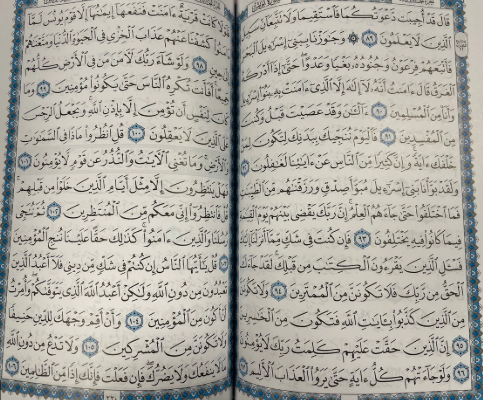
Use the 15-line Madinah Mushaf (also called the King Fahd Complex Mushaf), which is the most widely used edition globally and the one almost every online Hifz resource, app, and teacher references.
Each page of this edition ends at a natural ayah break, which makes page-based memorization targets clean and trackable.
Pair it with one reciter whose voice you find clear and whose pace is measured — Sheikh Al-Hussary’s Murattal at standard speed is widely recommended for memorization because of its deliberate, rule-accurate delivery.
Listen to your target section before memorizing, during memorization, and during review. Consistency in both visual and auditory input accelerates retention measurably.
Excel in Your Quranic Studies
Join Buruj Academy and master the Quran with our structured, professional curriculum.
Book Your Free Trial3. Build a Realistic Daily Memorization Target Based on Your Actual Timeline
The Quran contains 604 pages across 30 Juz’. Your daily memorization target must be calculated from your honest available time — not from motivation, which fluctuates, but from your sustainable minimum on the hardest day of your week.
The table below shows how daily page targets translate into realistic completion timelines for solo memorizers:
| Daily New Memorization | Pages Per Week | Estimated Completion (604 pages) |
| ¼ page per day | ~1.75 pages | Approximately 6–7 years |
| ½ page per day | ~3.5 pages | Approximately 3–4 years |
| 1 page per day | ~7 pages | Approximately 1.5–2 years |
| 2 pages per day | ~14 pages | Approximately 7–12 months |
These timelines assume consistent revision running parallel to new memorization. Without active revision, new material displaces old material — and you do not accumulate Hifz, you cycle through it.
For most working adults and parents memorizing independently, ½ page per day is the most sustainable and durable target.
We consistently find that students who begin at one page per day frequently drop to ¼ page after six weeks once life intervenes — and then abandon the effort entirely from discouragement.
Starting conservatively and maintaining it is always more productive than starting ambitiously and collapsing.
For a more detailed breakdown of scheduling approaches, the Quran memorization schedule guide on our blog walks through day-by-day structures across different weekly targets.
Read also: How to Memorize Quran in 2 Years?
4. Use the Four-Slot Daily System to Separate New Memorization from Revision
The most common structural error in solo Hifz is treating memorization and revision as a single activity. They are neurologically distinct processes and must be separated in your daily practice.
Here is the four-slot system we teach at Buruj Academy for independent memorizers:
| Slot | Timing | Activity | Duration |
| Slot 1 | Fajr or early morning | New memorization | 15–30 minutes |
| Slot 2 | Mid-morning or lunch | Same-day review of new section | 10 minutes |
| Slot 3 | Asr or late afternoon | Weekly consolidation (last 7 days’ material) | 15 minutes |
| Slot 4 | After Isha | Long-term revision (older Juz’) | 15–20 minutes |
Slot 1 is where actual encoding happens — your brain is freshest and most receptive in the early morning, particularly after Fajr. This is not motivational language; it aligns with established memory consolidation research and with the Islamic tradition of barakah in early morning hours.
Slot 4 is the most commonly skipped and the most critical for retention. Old material that is not actively revised fades. Many self-memorizers complete Juz’ 30, 29, and 28 strongly — then discover, when they reach Juz’ 25, that Juz’ 30 has significantly deteriorated. Long-term revision prevents this collapse.
The best time to memorize Quran article explains the science and Islamic scholarship behind optimal memorization timing in greater detail.
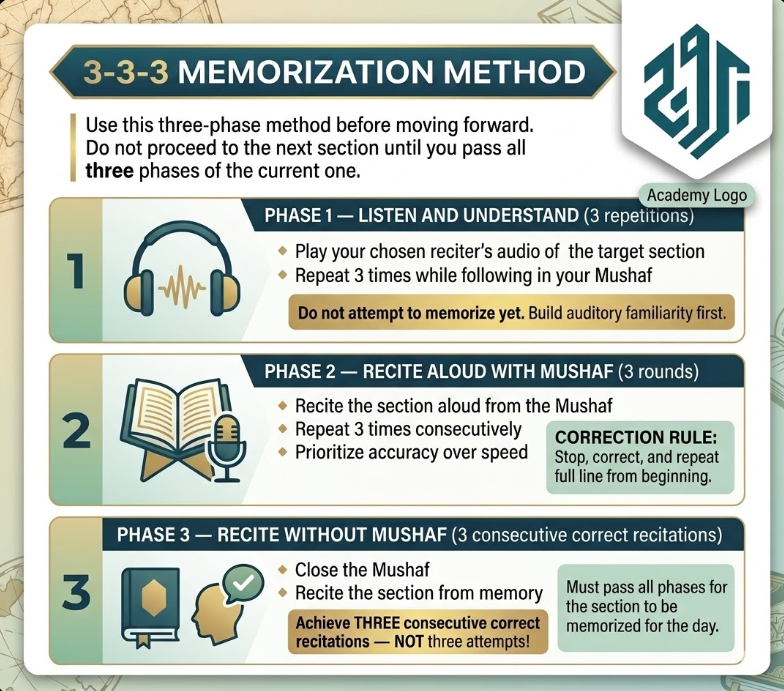
5. Apply the 3-3-3 Memorization Method for Each New Section
For each new section you memorize, use this three-phase method before moving forward. Do not proceed to the next section until you pass all three phases of the current one.
Phase 1 — Listen and Understand (3 repetitions)
Play your chosen reciter’s audio of the target section three times while following along in your Mushaf. Do not attempt to memorize yet. Build auditory familiarity first.
Phase 2 — Recite Aloud with Mushaf (3 rounds)
Recite the section aloud from the Mushaf three times consecutively, prioritizing accuracy over speed. If you mispronounce a word, stop, correct it, and repeat the full line from the beginning before continuing.
Phase 3 — Recite Without Mushaf (3 consecutive correct recitations)
Close the Mushaf and recite the section from memory. You must achieve three consecutive correct recitations — not three attempts, three consecutive successes — before this section is considered memorized for the day.
This method takes longer per session but dramatically reduces the revision burden later. Students who rush Phase 3 frequently discover in weekly review that their memorization was surface-level and does not hold under pressure.
6. Establish a Weekly Self-Testing Protocol That Mimics Teacher Accountability
The primary structural advantage a teacher provides is accountability and error correction. In solo Hifz, you must build both into your own system deliberately.
Every Friday (or your chosen weekly anchor day), conduct a full self-assessment of the week’s new memorization plus one randomly selected section from your older material. Use this format:
How to Test Your Own Memorization Accurately
Close your Mushaf completely. Recite the target section. Then open the Mushaf and compare what you recited against the text — not from memory of what you said, but from reading the actual page carefully. Mark any word where you hesitated, skipped, or substituted. Those words return to daily drilling until they are solid.
Record your weekly recitations on your phone and listen back. This is not optional. The ear hears what the mind overlooks in live recitation, and recorded playback catches substitution errors — replacing one similar word with another — that feel invisible in real time.
For guidance on what constitutes a strong memorization session and how to benchmark your own progress, what is the best way to memorize Quran article provides clear qualitative markers.
Discover the Buruj Academy Difference
Step into our virtual classrooms and see how our expert instructors make learning Quran and Arabic intuitive and clear. We focus on overcoming the specific hurdles non-native speakers face, building your confidence and connection with the Quran.
7. Address Tajweed Accuracy Without a Full-Time Teacher
Self-memorizers cannot self-correct what they cannot hear. This is the honest limitation of solo Hifz, and it must be managed rather than ignored.
Three practical approaches resolve this without requiring a full-time teacher:
Monthly Recitation Check: Book a single session monthly with a qualified instructor specifically to check accumulated memorization — not to learn new material, but to catch errors before they solidify. Buruj Academy’s Online Hifz Program offers flexible session structures that work well for this purpose, allowing students to use their instructor time purely for verification rather than instruction.
Start Hifz today with a FREE trial session
Verified Audio Comparison: After every new section is memorized, record yourself and compare your recording against Sheikh Al-Hussary’s recording of the same section at 0.75x speed, listening specifically for letter articulation rather than melody or rhythm.
Tajweed Reference: Keep a reliable Tajweed reference accessible. Our Tajweed for beginners guide covers the rules most likely to produce errors in memorization — particularly Ikhfa, Idgham, and Qalqalah — in accessible, practitioner-verified language.
The table below shows the most common Tajweed errors self-memorizers make and how to self-check each:
| Common Error | What It Sounds Like | Self-Check Method |
| Dropping Ghunnah on Noon Mushaddad | Nasalization absent on نّ | Hold nasalization for 2 full counts — count internally |
| Missing Qalqalah on ق at end of ayah | Letter stops dead with no echo | Release the letter with slight rebound — do not hold |
| Mispronouncing ض as د | Thin, dental sound instead of lateral emphatic | Place tongue against upper molars — the sound should feel wide |
| Skipping Madd rules on long vowels | Shortening آ، وو، يي to one count | Count Madd vowels: natural Madd = 2 counts minimum |
8. Build Spiritual Consistency Into the System, Not Just Routine
Solo Hifz without spiritual intention is a memory exercise. Quran memorization is an act of worship, and the spiritual dimension is not separate from the practical system — it is what sustains the practical system across years.
The Prophet ﷺ said, as recorded in Sahih al-Bukhari (5031): “The one who recites the Quran and memorizes it will be with the noble righteous scribes, and the one who recites the Quran and struggles with it because it is difficult for him will have a double reward.”This hadith is not simply motivational — it is a theological framework for understanding that difficulty in solo Hifz carries its own particular spiritual weight and reward.
Make sincere du’a before every memorization session. Begin with Isti’adhah and Basmalah not as ritual formality but as deliberate acknowledgment that you are engaging with the speech of Allah. Students who approach Hifz as worship sustain the effort across years; those who approach it as achievement frequently plateau and disengage at the first significant plateau.
Review the benefits of memorizing Quran when motivation dips — not to motivate yourself with rewards, but to reconnect with the purpose that started this commitment.
Excel in Your Quranic Studies
Join Buruj Academy and master the Quran with our structured, professional curriculum.
Book Your Free TrialAccelerate Your Hifz with Buruj Academy’s Personalized Online Hifz Program
Solo memorization is achievable — and Buruj Academy’s Online Hifz Program is specifically designed to support students at every level of independence. Our Al-Azhar-trained Hifz specialists provide personalized revision schedules, real-time recitation correction, and milestone tracking that transforms a solo effort into a guided progression.
What sets our program apart:
- Ijazah-certified instructors with 12+ years teaching non-Arabic speakers globally
- The Buruj Method: Consistency-before-speed — building durable Hifz that holds
- Flexible 1-on-1 online sessions scheduled around your life
Take the first step toward this lifelong blessing by enrolling in a program tailored to your pace:
- Online Hifz Program (Comprehensive Quran Memorization)
- Juz 30 Memorization Course (Perfect for focused starts)
- Hifz Classes for Kids (Engaging and interactive)
- Hifz Classes for Adults (Flexible scheduling for busy lives)
- Hifz Classes for Sisters (Private, supportive learning)
- Short Surah Memorization Course (Ideal for daily prayers)
- Hifz Ijazah Course (For advanced students seeking certification)
Book your free trial lesson at Buruj Academy and let our team build a Hifz plan that works for your real life — Insha’Allah.

Frequently Asked Questions About Memorizing the Quran by Yourself
How Long Does It Take to Memorize the Quran by Yourself?
At a sustainable pace of ½ page daily with consistent revision, solo memorization takes approximately 3–4 years for most adults. Faster targets of 1–2 pages daily can reduce this to 1–2 years, but require exceptional time discipline and robust revision systems running parallel to new memorization throughout.
What Is the Best Surah to Start Memorizing Alone?
Begin with Juz’ 30 — the final section of the Quran containing the shorter surahs. These surahs are shorter, rhythmically strong, and already familiar from daily prayer, giving your memory natural anchors. Starting from Al-Baqarah as a beginner without a teacher is inadvisable due to its length and Tajweed complexity.
How Do I Memorize the Quran Faster by Myself?
Consistency compounds faster than daily volume. Memorizing ½ page every day without breaks outperforms memorizing 2 pages on weekends over any meaningful timeframe. Use the how to memorize Quran faster guide for specific techniques including spaced repetition and verbal repetition density.
Is There a Dua for Memorizing the Quran?
The scholars recommend beginning each Hifz session with seeking refuge in Allah from Shaytan and reciting Basmalah. Many students also recite the supplication: “Rabbi zidni ‘ilma” — “My Lord, increase me in knowledge” (Ta-Ha 20:114) — as an opening intention before each session.