 Quran
Quran

| Key Takeaways |
| Every letter of the Quran recited earns ten rewards, as confirmed in an authentic hadith from Tirmidhi. |
| Reading Quran daily reduces anxiety and cortisol levels, with measurable psychological and physiological effects documented in peer-reviewed studies. |
| Reciting Quran during Ramadan multiplies spiritual rewards exponentially, following the Prophet’s ﷺ intensified practice confirmed in Bukhari. |
| Reading Quran with translation deepens comprehension and produces stronger emotional connection and behavioral change than recitation alone. |
| Pregnant women who recite Quran regularly report significant reductions in stress and improved emotional bonding with their unborn child. |
Every Muslim carries an intuitive sense that the Quran is more than a book — it is a source of peace, guidance, and nearness to Allah. Yet many believers recite without fully appreciating the depth of what that recitation earns them spiritually, psychologically, and physically.
The benefits of reading Quran span every dimension of human life. From the ten rewards per letter promised in authentic hadith, to measurable reductions in stress hormones documented by researchers, to the intensified blessings of Ramadan recitation — the Quran rewards its reader in ways both seen and unseen.
What Does the Quran Promise Those Who Read It Every Day?
Reading Quran daily earns continuous spiritual rewards that accumulate with every single letter recited, not merely every word or verse. The Prophet Muhammad ﷺ said: “Whoever reads a letter of the Book of Allah will receive a good deed, and a good deed is multiplied by ten” — verified in Sunan al-Tirmidhi, hadith 2910.
This multiplied reward applies every single day one recites, making daily Quran reading one of the highest-yield acts of worship in Islam.
Daily Quran Reading Builds a Living Relationship with Allah
Consistent daily recitation does more than accumulate rewards — it maintains an open channel of communication between the servant and his Lord. Allah ﷻ describes the Quran in Surah Al-Isra:
وَنُنَزِّلُ مِنَ ٱلْقُرْءَانِ مَا هُوَ شِفَآءٌ وَرَحْمَةٌ لِّلْمُؤْمِنِينَ
Wa nunazzilu minal-Qur’ani ma huwa shifa’un wa rahmatun lil-mu’minin
“And We send down of the Quran that which is healing and mercy for the believers.” (Al-Isra 17:82)
This verse establishes the Quran as an active source of healing — not a passive text. In our sessions at Buruj Academy, students who commit to daily recitation — even 10–15 minutes — consistently report a qualitative shift in their emotional baseline within two to three weeks.
What Happens When You Miss Days of Reading?
Classical scholars noted that abandoning Quran recitation for extended periods produces a spiritual dullness — described in Arabic as ران (Raan) — a covering over the heart. Daily reading, even of a small portion, maintains the heart’s receptiveness to guidance and prevents this spiritual stagnation.
At Buruj Academy, our Online Quran Recitation Course is designed specifically for students who want to build a sustainable daily recitation habit — with personalized scheduling, Ijazah-certified instructors, and accountability systems that make consistency achievable.
Book your first FREE recitation lesson
Read also: Best Time to Read Quran
What Are the Spiritual Benefits of Reading Quran?
The spiritual benefits of reading Quran are direct, documented in revelation, and confirmed by 1,400 years of lived Muslim experience. The Quran is simultaneously an act of dhikr (remembrance of Allah), a source of intercession on the Day of Judgment, and a means of elevating one’s rank in Jannah. These are not abstract promises — they are specific, hadith-verified outcomes tied to the act of recitation itself.
The Quran Intercedes for Its Companion on the Day of Judgment
The Prophet ﷺ said: “Read the Quran, for it will come as an intercessor for its companions on the Day of Resurrection”— recorded in Sahih Muslim, hadith 804. The word used — sahib (companion) — is significant. It implies a sustained relationship with the Quran, not occasional reading.
Reciting Quran Is Among the Highest Forms of Dhikr
Every act of Quran recitation is simultaneously an act of remembrance of Allah. Allah ﷻ says in Surah Al-Ra’d:
أَلَا بِذِكْرِ ٱللَّهِ تَطْمَئِنُّ ٱلْقُلُوبُ
Ala bi-dhikrillahi tatma’innul-qulub
“Verily, in the remembrance of Allah do hearts find rest.” (Al-Ra’d 13:28)
This verse is among the most cited in Islamic psychology. The Arabic verb tatma’inn (تَطْمَئِنُّ) conveys a deep, settled stillness — not mere temporary calm. Reciting Quran produces this stillness in a way that no other dhikr quite replicates.
The Reader’s Rank in Jannah Is Elevated by Their Memorized Verses
The Prophet ﷺ said: “It will be said to the companion of the Quran: Recite and ascend, and recite as you used to recite in the world, for your position will be at the last verse you recite” — verified in Sunan Abi Dawud, hadith 1464. Every verse memorized and recited in this life directly determines one’s station in the next.
Excel in Your Quranic Studies
Join Buruj Academy and master the Quran with our structured, professional curriculum.
Book Your Free Trial
What Are the Scientific and Health Benefits of Reading Quran?
The scientific benefits of reading Quran have attracted increasing research attention, particularly in Muslim-majority academic institutions. Studies from Egyptian, Malaysian, and Saudi Arabian universities have documented measurable physiological responses to Quran recitation — including reduced cortisol (the primary stress hormone), lowered blood pressure, and measurable improvements in focus and emotional regulation.
| Health Benefit | Documented Mechanism | Population Studied |
| Reduced anxiety | Cortisol reduction via parasympathetic activation | Adult Muslim participants |
| Improved focus | Rhythmic recitation engages prefrontal cortex | Students in controlled settings |
| Lower blood pressure | Breathing regulation during measured recitation | Hypertensive patients |
| Enhanced emotional stability | Meaning-engagement activates reward pathways | General Muslim adults |
| Improved sleep quality | Pre-sleep recitation reduces sympathetic arousal | University students |
These effects are not exclusive to those who understand Arabic. Research indicates that even phonetic recitation — reading the Arabic sounds correctly — produces measurable physiological benefits, likely through the regulated breathing patterns that proper Tajweed recitation requires.
Proper Tajweed Amplifies the Health Benefits of Recitation
Tajweed-compliant recitation involves controlled breath management, precise articulation from specific points in the mouth and throat, and a measured rhythmic pace.
These physical dimensions of recitation naturally engage the parasympathetic nervous system — the body’s rest-and-digest state — which directly opposes the stress response.
Students at Buruj Academy who transition from informal reading to structured Tajweed practice frequently report that their post-recitation calm deepens noticeably. This aligns with what our Al-Azhar-trained instructors have observed across hundreds of adult students over 12+ years of teaching.
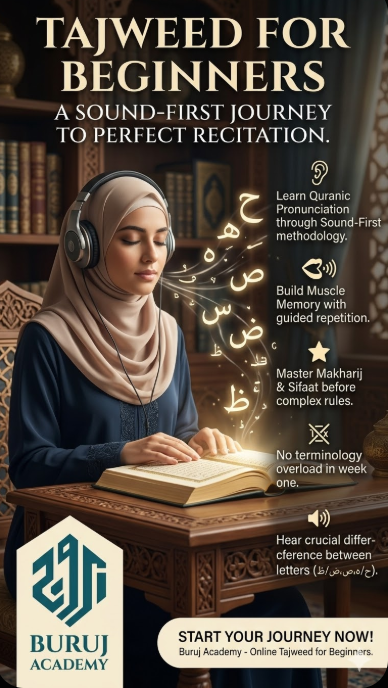
If you want to experience this more fully, our Tajweed for Beginners course trains you in the precise articulation patterns that make recitation both spiritually and physically restorative.
Book Your FREE Trial Lesson to Begin Your Tajweed Journey
What Are the Benefits of Reading Quran with Translation?
Reading Quran with translation produces a categorically different — and often deeper — engagement with the text than phonetic recitation alone. When a reader understands what Allah ﷻ is saying to them directly, the emotional impact intensifies, behavioral change becomes more likely, and the act of recitation shifts from ritual repetition to active dialogue with the Divine.
| Reading Mode | Primary Benefit | Limitation |
| Arabic recitation only | Full reward per letter, proper Tajweed possible | Limited comprehension for non-Arabic speakers |
| Translation reading only | Strong comprehension and reflection | No direct reward for letter-by-letter recitation |
| Arabic + translation together | Maximum spiritual and intellectual engagement | Requires more time per session |
| Arabic recitation + tafsir study | Deepest understanding of meaning and context | Requires dedicated study time |
The optimal approach for non-Arabic speaking Muslims is to recite in Arabic — preserving the full reward — while gradually building comprehension through parallel translation reading and, eventually, Quranic Arabic study.
Which Translation Should Non-Arabic Speakers Use?
Among the most widely recommended English translations for clarity and scholarly accuracy is the Sahih International translation, which we use as the standard reference in our Buruj Academy courses. It renders meaning with appropriate precision without sacrificing readability for English speakers.
For those who want to move beyond translation into genuine Quranic understanding, our Quranic Arabic Classes offer a structured path from basic comprehension to full grammatical understanding of Quranic text.
Book your FREE Arabic trial online Arabic class at Buruj

Read also: Can We Read Quran for the Dead?
What Are the Benefits of Reading Quran During Ramadan?
The benefits of reading Quran during Ramadan are spiritually amplified beyond any other month of the year. Ramadan is the month in which the Quran was revealed — “The month of Ramadan in which was revealed the Quran” (Al-Baqarah 2:185) — and the connection between this month and the Book of Allah is inseparable. Rewards for all righteous deeds are multiplied in Ramadan, and the Prophet ﷺ intensified his own Quran engagement significantly during this period.
The Prophet ﷺ and Jibreel (عليه السلام) would review the entire Quran together each Ramadan — and in the final year of the Prophet’s life ﷺ, they reviewed it twice — as recorded in Sahih al-Bukhari, hadith 3554. This practice establishes the Ramadan Quran khatm (complete recitation) as a deeply rooted Prophetic sunnah.
Practical Ramadan Quran Reading Goals
| Daily Target | Pages Per Day | Completion Timeline |
| 1 Juz per day | ~20 pages | Full Quran in 30 days |
| Half Juz per day | ~10 pages | Full Quran in 60 days |
| 5 pages per day | 5 pages | 7 Juz’ in 30 days |
| 10 minutes of recitation | Varies by pace | Consistent habit-building focus |
For students pursuing their first complete Quran reading, our Quran Reading Course provides the foundational fluency needed to make consistent Ramadan recitation a realistic goal, not an aspirational one.
Book your Free trial lesson and start reading the Quran
What Are the Benefits of Reading Quran During Pregnancy?
The benefits of reading Quran during pregnancy span both the mother and the developing child. From an Islamic perspective, reciting Quran during pregnancy is a spiritually protective act — surrounding the child with the words of Allah ﷻ from before birth.
From a physiological standpoint, Quran recitation during pregnancy reduces maternal stress hormones, promotes emotional stability, and creates a calm prenatal environment.
Research published in Muslim-majority academic settings has explored the effects of Quran recitation on prenatal stress. The consistent finding is that regular recitation sessions produce measurable reductions in maternal anxiety — a factor with well-documented positive effects on fetal development and birth outcomes.
Discover the Buruj Academy Difference
Step into our virtual classrooms and see how our expert instructors make learning Quran and Arabic intuitive and clear. We focus on overcoming the specific hurdles non-native speakers face, building your confidence and connection with the Quran.
What Does Hadith Say About the Benefits of Reciting Quran?
The hadith literature on the benefits of reciting Quran is extensive, specific, and deeply motivating. The Prophet Muhammad ﷺ addressed Quran recitation’s rewards from multiple angles — the reward per letter, the status of the skilled reciter, the benefit to the family household, and the Quran’s intercession on the Day of Judgment.
| Benefit | Hadith Source | Key Detail |
| Ten rewards per letter | Tirmidhi 2910 | Applies to every letter, not every word |
| Quran intercedes on Judgment Day | Muslim 804 | For the Quran’s sustained “companion” |
| Skilled reciter with noble angels | Bukhari 4937 | The one who recites skillfully is with the noble, obedient angels |
| House with Quran recitation is illuminated | [Bayhaqi — Shu’ab al-Iman] | The home where Quran is recited is described as spacious and filled with goodness |
| Best of you learns and teaches Quran | Bukhari 5027 | Excellence linked to Quran education, not only recitation |
The hadith in Sahih al-Bukhari — “The one who is proficient in the recitation of the Quran will be with the honorable and obedient scribes (angels)” (Bukhari 4937) — is particularly significant. It ties the quality of recitation directly to one’s companionship in the hereafter. This is why Tajweed is not merely a technical discipline — it is an act of worship with eternal consequences.
For those beginning their recitation path, our article on reading the Quran for the first time provides the practical starting point you need.
Excel in Your Quranic Studies
Join Buruj Academy and master the Quran with our structured, professional curriculum.
Book Your Free TrialStart Your Quran Reading Journey with Buruj Academy’s Expert Instructors
The benefits of reading Quran are available to every Muslim — but experiencing them fully requires reading correctly, consistently, and with growing understanding.
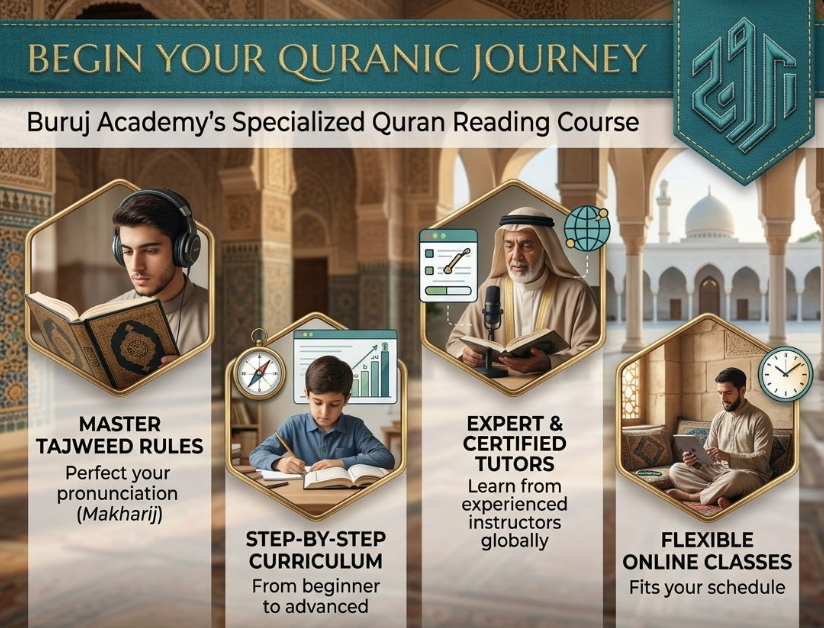
Buruj Academy offers personalized Online Quran Classes taught by Ijazah-certified instructors and Al-Azhar University graduates with 12+ years of experience teaching non-Arabic speakers worldwide.
What sets us apart:
- The Buruj Method: Sound-before-rules, consistency-before-speed
- Flexible 1-on-1 online sessions with 24/7 scheduling
- Personalized Learning Plans by age, level, and goal
- Real-time recitation correction and measurable progress
Join a global community of learners and find the path that best supports your spiritual and intellectual growth:
- Online Studies Islamic Classes (General & Flexible)
- Islamic Studies Course for Beginners (Foundational Knowledge)
- Islamic Studies Classes for Kids (Engaging & Values-Based)
- Islamic Studies Classes for Adults (In-Depth Theological Discussion)
- Islamic Studies Classes for Ladies (Sisterhood & Specialized Learning)
- Islamic Studies Classes for New Muslims (Guided Support & Essentials)
- Tafseer Al Quran Course (Unlocking Divine Meanings)
- Quranic Sciences (Uloom Al Quran) Course (Advanced Linguistic & Historical Context)
Book your free trial lesson today and begin reciting with confidence, Insha’Allah.
Frequently Asked Questions About the Benefits of Reading Quran
Is There a Reward for Reading Quran Without Understanding the Meaning?
Yes — the reward for reciting Quran is attached to every letter of the Arabic text, regardless of comprehension. The Prophet ﷺ confirmed ten rewards per letter in Tirmidhi 2910. Understanding the meaning adds additional layers of reflection and behavioral benefit, but the foundational letter-by-letter reward applies to all sincere reciters.
How Much Quran Should a Muslim Read Daily?
There is no single prescribed daily amount, though scholars recommend consistency over volume. Many classical scholars advised completing the Quran once per month — approximately one Juz per day. For busy adults, even 10–15 minutes of daily recitation maintains the habit and accumulates significant rewards over time.
Does Reading Quran on a Phone or Screen Carry the Same Reward?
Yes — reading Quran from a digital device carries the same recitation reward as reading from a physical mushaf. The reward is tied to the act of reciting the words of Allah ﷻ, not the medium. However, scholars recommend maintaining proper etiquette — cleanliness, focus, and reverence — regardless of the medium used.
Can Non-Arabic Speakers Benefit from Quran Recitation?
Absolutely. Non-Arabic speakers receive the full per-letter reward for sincere Arabic recitation. They additionally benefit spiritually, psychologically, and physically from the act of recitation itself. Building correct pronunciation through Tajweed Course for Beginners maximizes both the reward and the physiological benefits of regulated, rhythmic recitation.
What Is the Best Time of Day to Read Quran for Maximum Benefit?
The pre-Fajr period (the last third of the night) carries the highest spiritual weight, as Allah ﷻ descends in a manner befitting His majesty in this time and the atmosphere is free from distraction. After Fajr and after Asr are also times of particular blessing. Our guide on the best time to memorize Quran covers the spiritual and scientific dimensions of timing in detail.