 Quran
Quran

| Key Takeaways |
| Listening to Quran recitation strengthens memorization retention by reinforcing audio-phonetic pathways in the brain. |
| Regular Quran listening improves Tajweed accuracy by training the ear to recognize correct pronunciation patterns instinctively. |
| Scientific studies confirm that Quran recitation listening reduces cortisol levels, producing measurable psychological calm. |
| Consistent listening builds familiarity with Quranic Arabic sounds, accelerating reading fluency for non-native speakers. |
| Listening to verified reciters exposes students to authentic Makhraj and Sifah application in real recitation context. |
Millions of Muslims worldwide make Quran listening a daily practice — not merely as background sound, but as an act of worship with documented spiritual and cognitive effects. What many students discover, often with surprise, is that listening does far more than comfort the soul.
The benefits of listening to Quran recitation include strengthened memorization, sharpened Tajweed accuracy, measurable psychological calm, improved Arabic phonetic recognition, and a deepened spiritual connection — making it one of the most accessible and effective tools in any student’s Quran learning plan.
Table of Contents:
1. Listening to Quran Recitation Builds a Stronger Memorization Foundation
Consistent Quran listening directly reinforces Hifz retention by embedding audio patterns into long-term memory. When students hear a verse repeatedly from a skilled reciter, the brain forms strong phonetic anchors that make written memorization faster and more durable. This audio-first exposure is not passive — it is active neural encoding.
In our sessions at Buruj Academy, students enrolled in the Online Hifz Classes for Adults who combine daily listening with active memorization consistently outperform those who rely on reading alone.
The difference is most visible during revision — audio-anchored students recall verses with fewer hesitations and recover from gaps more quickly.
This is why our Al-Azhar-trained Hifz specialists recommend pairing every new memorization session with dedicated listening time, ideally to the same reciter, maintaining consistency of rhythm and melody.
Book Your Free Trial Lesson with Buruj’s Hifz Course for Adults

| Listening Approach | Memorization Benefit |
| Listening before memorizing | Creates phonetic template for the verse |
| Listening during revision | Reinforces existing memory traces |
| Listening after memorization | Catches errors before they solidify |
| Looped listening overnight | Builds passive long-term retention |
For practical guidance on building a structured listening-memorization routine, our article on how to memorize Quran faster outlines techniques that integrate audio practice effectively.
2. Regular Listening Trains the Ear to Recognize Correct Tajweed Instinctively
One of the most underappreciated benefits of listening to Quran recitation is what Tajweed scholars call al-talaqqi bil-mushāfaha — receiving recitation directly through attentive hearing. Consistent exposure to expert reciters trains the ear to distinguish correct Makhraj placement, proper Ghunnah duration, and accurate Madd lengths before the student consciously studies these rules.
Our Ijazah-certified instructors observe this consistently: students who listen daily to verified reciters — particularly Sheikh Mahmoud Khalil Al-Husary or Sheikh Abdul Basit — arrive at their Online Tajweed Classes with already-calibrated hearing. They detect their own errors faster and internalize corrections more readily.
Book Your FREE Trial Lesson to Begin Your Tajweed Journey

This ear-training effect is not incidental. It is the foundation of how Quran recitation was transmitted for centuries — through direct oral exposure before formal rule instruction.
Which Reciters Are Best for Tajweed Ear-Training?
For students focusing on Tajweed development, we recommend listening to reciters known for measured, rule-precise recitation:
- Sheikh Mahmoud Khalil Al-Husary — renowned for didactic clarity, ideal for beginners
- Sheikh Abdul Basit Abdus-Samad — precise Makhraj and measured Madd lengths
- Sheikh Mishary Rashid Alafasy — accessible tempo suitable for active listening study
For a structured understanding of how Tajweed rules function during recitation, our Tajweed for beginners guide provides the foundational framework that listening experience brings to life.
3. Listening to Quran Recitation Produces Measurable Psychological Calm
Quran listening has a documented effect on psychological well-being that goes beyond spiritual experience.
Research published in peer-reviewed medical literature, including studies conducted in Muslim-majority clinical settings, has recorded reduced anxiety indicators and lower perceived stress in participants who listened to Quran recitation regularly.
Allah ﷻ describes this effect directly in the Quran:
أَلَا بِذِكْرِ اللَّهِ تَطْمَئِنُّ الْقُلُوبُ
Alā bidhikrillāhi taṭmaʾinnu al-qulūb
“Verily, in the remembrance of Allah do hearts find rest.” (Ar-Ra’d 13:28)
This verse is not metaphorical consolation — it is a statement of a real phenomenon that students experience and that modern research is beginning to document.
The rhythmic patterns of recitation, the measured breath control of Tajweed, and the semantic weight of the words combine to produce a calming neurological response.
For students experiencing memorization anxiety or recitation performance pressure, we specifically recommend structured listening sessions as a de-stressing tool before attempting new memorization.
4. Consistent Listening Accelerates Arabic Phonetic Recognition for Non-Native Speakers
Non-Arabic speakers face a specific challenge: Arabic contains sounds that do not exist in English or European languages. Letters such as ع (ʿAyn), غ (Ghayn), ح (Ḥa), and خ (Kha) require articulation points that Western tongues have never practiced. Listening to fluent recitation is the most efficient way to internalize these sounds before attempting to produce them.
In our experience teaching non-Arabic speakers at Buruj Academy, students who spend two to three weeks in focused Quran listening before beginning formal Quranic Arabic Classes demonstrate noticeably more accurate early pronunciation. The listening phase builds phonetic familiarity that classroom instruction alone cannot replicate at the same speed.
Begin Understanding Quranic Arabic with a FREE Lesson

This phonetic immersion effect also benefits students learning through the Noorani Qaida with Tajweed Course, where correct letter sounds are the entire foundation of the curriculum.
| Arabic Sound Category | Listening Benefit |
| Emphatic letters (ص، ض، ط، ظ) | Trains ear to distinguish heavy from light |
| Throat sounds (ع، غ، ح، خ) | Builds recognition before production |
| Madd (elongation) durations | Develops instinctive length calibration |
| Ghunnah (nasal resonance) | Identifies nasalization patterns in context |
Our article on Makharij al-Huruf explains in detail how articulation points function — knowledge that listening experience makes immediately practical.
Read also: Can I Listen to the Quran While Playing Video Games?
Discover the Buruj Academy Difference
Step into our virtual classrooms and see how our expert instructors make learning Quran and Arabic intuitive and clear. We focus on overcoming the specific hurdles non-native speakers face, building your confidence and connection with the Quran.
5. Listening to Quran Deepens Spiritual Connection and Increases Khushū’ in Salah
One of the most profound benefits of listening to Quran recitation is its effect on Khushū’ — the quality of focused, humble presence during prayer. When a person regularly listens to Quranic recitation with attention, the verses of Salah transform from familiar sounds into recognized meanings, producing genuine emotional engagement during worship.
The Prophet ﷺ wept when listening to Quran recitation, as recorded in Sahih Al-Bukhari (5055) — a testament to the spiritual depth that attentive listening cultivates. This is a capacity that develops with practice, not overnight.
Students who commit to daily listening — even ten to fifteen minutes — report that Surah Al-Fatiha in Salah takes on new weight as their ear becomes attuned to the rhythms and patterns of Quranic Arabic.
Excel in Your Quranic Studies
Join Buruj Academy and master the Quran with our structured, professional curriculum.
Book Your Free Trial6. Listening Corrects Existing Recitation Errors Before They Become Permanent Habits
Incorrect recitation habits are significantly harder to correct once they solidify. Listening to expert reciters provides ongoing exposure to the correct version of every verse, creating a natural self-correction mechanism.
When a student’s internal audio model of a verse is accurate, they instinctively notice when their own recitation deviates.
Our Ijazah-certified instructors describe this as building a “reference recording” in the student’s memory. Students who listen regularly come to lessons with sharper self-awareness of their errors — they often identify the mistake themselves before the instructor points it out.
For students who are beginning their Quran reading practice, our guide on reading the Quran for the first time pairs effectively with this listening practice from the very start.
7. Listening to Quran Recitation Supports Children’s Early Quran Learning
Children exposed to Quran recitation from an early age develop a phonetic familiarity with Arabic sounds during their critical language acquisition window. This is not simply anecdotal — it reflects the same neurological principle that makes children in bilingual households acquire both languages naturally.
Early Quran listening plants the phonetic roots that formal instruction later cultivates.
Parents often ask us when to begin. Our recommendation at Buruj Academy is consistent: begin from birth. Even infants benefit from exposure to the melodic patterns of recitation.
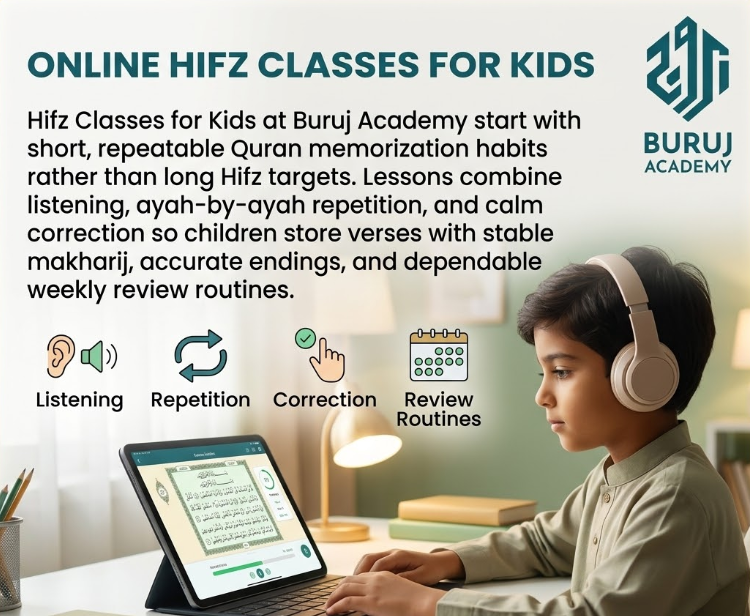
By the time a child begins formal Quran learning — through our Hifz for Kids course orNoorani Qaida course — years of passive listening have already built a phonetic foundation.
Start your child’s Hifz classes for free session
| Age Group | Recommended Listening Practice |
| 0–3 years | Background recitation during daily routines |
| 3–6 years | Short focused listening with named Surahs |
| 6–10 years | Listening paired with reading along in Mushaf |
| 10+ years | Active listening with Tajweed rule identification |
8. Consistent Quran Listening Strengthens Revision During Hifz
For students actively memorizing Quran, listening is not supplementary — it is a core revision tool.
Passive listening to previously memorized portions reinforces memory traces without the mental effort of active recall, allowing the brain to consolidate memorization during low-attention periods such as commuting, cooking, or light exercise.
Our Hifz specialists with 12+ years of experience recommend what we internally call “ambient revision” — looping memorized Juz’ during daily tasks.
Students who adopt this practice consistently maintain stronger long-term retention and report fewer revision gaps in their weekly recitation checks.
For a structured approach to building this into a complete Hifz schedule, our Quran memorization schedule guide provides a practical weekly framework.
Start Your Quran Journey with Buruj Academy’s Expert Instructors
Listening to Quran recitation opens the door — but structured guidance is what takes you through it.
At Buruj Academy, our Al-Azhar University graduates and Ijazah-certified instructors combine the benefits of listening with systematic, personalized instruction to accelerate every student’s progress.
We offer flexible 1-on-1 online sessions, personalized learning plans, and real-time recitation correction across our full course range — from our Online Quran Recitation course to our Online Hifz Program. With 12+ years of experience teaching non-Arabic speakers globally, we know exactly what works.
Book your free trial lesson today and experience the Buruj Method firsthand.
Take the next step in your learning journey today by enrolling in one of our specialized programs:
- Online Quran Classes
- Online Quran Classes for Beginners
- Online Quran Classes for Adults
- Online Quran Classes for Ladies
- Online Quran Classes for Kids
- Quran Reading Course
- Quran Recitation Course
- Online Ijazah Course
- Online Qirat Course
Don’t wait to transform your relationship with the Holy Quran. Join our global community of students and book your free evaluation session now!
Excel in Your Quranic Studies
Join Buruj Academy and master the Quran with our structured, professional curriculum.
Book Your Free TrialConclusion
The benefits of listening to Quran recitation reach every dimension of a student’s relationship with the Quran — from the precision of Tajweed accuracy to the peace of heart that consistent engagement with Allah’s words produces. Listening is not a passive activity. When practiced with intention, it is an act of worship that simultaneously trains the ear, anchors memorization, calms the mind, and deepens Salah.
Making Quran listening a daily habit — even in short, consistent sessions — is one of the most accessible investments any student can make in their Quran learning, Insha’Allah.
Read also: Is Evil Eye Mentioned in the Quran?
Frequently Asked Questions About the Benefits of Listening to Quran Recitation
Does Listening to Quran Recitation Count as Worship?
Listening to Quran recitation with attention and reverence is considered an act of worship in Islamic scholarship. Allah ﷻ commands in Surah Al-A’raf (7:204) to listen to the Quran attentively and remain silent when it is recited. Scholars across all major madhabs affirm that attentive listening earns reward, particularly when the listener reflects on the meaning.
How Long Should I Listen to Quran Each Day to See Benefits?
Even ten to fifteen minutes of focused daily listening produces measurable benefits over four to six weeks, based on our instructors’ consistent observation across hundreds of students. Consistency matters more than duration. Students who listen for fifteen focused minutes daily progress faster than those who listen sporadically for longer sessions.
Can Listening to Quran Help My Children Learn Arabic Sounds?
Yes — and the earlier, the better. Children exposed to Quran recitation regularly develop phonetic familiarity with Arabic sounds during their natural language acquisition period. This gives them a significant advantage when they begin formal Quran reading or Arabic instruction, as the sounds are already neurologically familiar rather than entirely new.
Which Reciter Should Beginners Listen To for Tajweed Learning?
For Tajweed development, we consistently recommend Sheikh Mahmoud Khalil Al-Husary’s Muallim (teaching) recitation. It is slower in tempo, precise in rule application, and specifically designed for students. Once foundational recognition develops, Sheikh Abdul Basit Abdus-Samad’s recitation provides excellent training in Makhraj precision and Madd accuracy.
Does Listening to Quran Help with Memorization Even Without Reading Along?
Yes. Listening without reading engages auditory memory pathways independently, which strengthens the phonetic anchor of each verse. Many Hifz students find that looping memorized sections during daily tasks — without looking at the text — is one of their most effective passive revision tools, reducing forgetting rates between active study sessions.