 Arabic
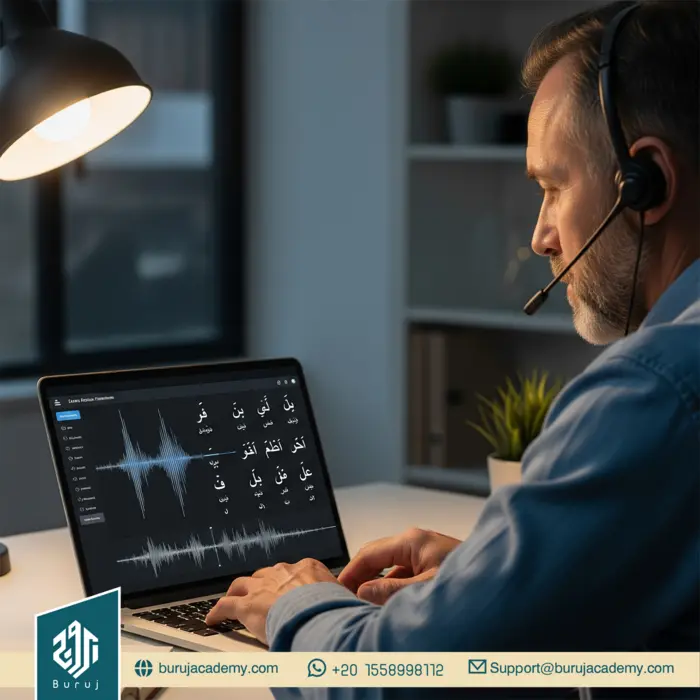
The Arabic language, with its rich history and global significance, holds immense beauty and depth. For those embarking on the journey to learn Arabic, one of the initial and often most challenging hurdles is mastering its unique sounds. Accurate Arabic pronunciation online is not just about speaking correctly; it’s about understanding and being understood, connecting with the culture, and for many, deepening their connection with the Quran.
Unlike languages with Latin-based alphabets, Arabic features sounds that don’t exist in English, articulated from different parts of the throat and mouth. Getting these sounds right is crucial for clear communication and for preserving the integrity of the language, especially in religious contexts.
This comprehensive guide will delve into the intricacies of Arabic pronunciation online, highlighting the key sounds that learners often find difficult, providing practical tips for improvement, and showcasing how Buruj Academy’s online resources and expert tutors can be your ultimate partners in achieving flawless Arabic pronunciation.
The Importance of Accurate Arabic Pronunciation
Why is correct pronunciation so vital when learning Arabic online?
1. Clarity and Comprehension
Mispronouncing words can lead to confusion and misunderstandings. In Arabic, subtle differences in sound can completely change the meaning of a word. Mastering pronunciation ensures that your intended message is accurately conveyed and understood by native speakers.
2. Respect for the Language and Culture
Learning to pronounce Arabic correctly demonstrates respect for the language and its rich cultural heritage. It shows that you are invested in truly learning and engaging with the Arab world.
3. Essential for Quranic Recitation (Tajweed)
For Muslims, accurate pronunciation is paramount when reciting the Quran. The science of Tajweed outlines the precise rules for articulating each letter and word of the Holy Book. Incorrect pronunciation can alter the meaning of verses, making proper training in Tajweed essential for religious observance and spiritual connection.
4. Increased Confidence in Speaking
When you are confident in your pronunciation, you are more likely to speak Arabic without hesitation. This leads to more practice, greater fluency, and a more enjoyable learning experience overall.
Navigating the Challenges of Arabic Pronunciation Online
Learning Arabic pronunciation online presents both opportunities and challenges.
Opportunities for learning Arabic pronunciation online:
- Access to Audio and Video Resources: Online platforms can provide high-quality audio and video demonstrations of correct pronunciation, allowing learners to hear and see how sounds are formed.
- Global Network of Native Tutors: Online learning connects you with native speakers from various Arabic-speaking regions, exposing you to different dialects and nuances in pronunciation.
- Interactive Learning Tools: Many online courses incorporate interactive exercises, quizzes, and feedback mechanisms to help learners practice and improve their pronunciation.
Challenges in learning Arabic pronunciation online:
- Lack of Immediate Feedback: Unlike in-person classes, getting instant feedback on your pronunciation can be more difficult in a purely self-study online environment.
- Difficulty in Identifying Subtle Differences: Some Arabic sounds are very similar to the untrained ear, making it challenging to distinguish them without expert guidance.
- Maintaining Motivation: Learning pronunciation requires consistent effort and practice, which can be harder to maintain without the structure of a physical classroom.
Discover the Buruj Academy Difference
Step into our virtual classrooms and see how our expert instructors make learning Quran and Arabic intuitive and clear. We focus on overcoming the specific hurdles non-native speakers face, building your confidence and connection with the Quran.
Key Arabic Sounds That English Speakers Often Find Challenging
Several Arabic sounds pose particular difficulties for English speakers. Understanding these challenges is the first step towards overcoming them.
1. Pharyngeal Sounds (ح, ع, ه)
These sounds are produced in the pharynx (throat) and have no direct equivalents in English. The sounds represented by the letters ح (ḥaa), ع (‘ayn), and ء (hamza, often a glottal stop) require specific muscle engagement in the throat that needs practice to master.
The letter ع (Ayn), for instance, has no English equivalent—it’s a voiced pharyngeal fricative produced deep in the throat, not the mouth.
| Arabic Sound Category | English Equivalent | Articulation Location |
| ع (Ayn) | None | Deep pharynx |
| خ (Kha) | Scottish “loch” | Soft palate |
| ق (Qaf) | None | Uvula |
| ح (Ha) | None | Pharyngeal |
| ص (Sad) | Emphatic “s” | Tongue + pharynx |
Understanding this table upfront prevents the most common beginner mistake: assuming Arabic pronunciation is simply “accented English.” These are genuinely different physiological productions requiring specific training.
2. Emphatic Consonants (ص, ض, ط, ظ, ق)
Emphatic consonants are pronounced with a strong articulation involving the back of the tongue and the pharynx, giving them a “heavy” or “velarized” quality. The letters ص (ṣaad), ض (ḍaad), ط (ṭaa), ظ (ẓaa), and ق (qaaf) require careful attention to the position of the tongue and airflow.
3. The “Raa” (ر)
The Arabic “raa” can be pronounced in different ways depending on the context (sometimes like a rolled “r” and sometimes like the French “r”). Understanding these variations is crucial for natural-sounding speech.
4. Long and Short Vowels
The length of vowels in Arabic significantly affects the meaning of words. Distinguishing between short vowels (َ, ِ, ُ) and long vowels (ا, ي, و) is essential for accurate pronunciation and comprehension.
5. Master the Makharij Before Memorizing Any Vocabulary
Makharij (مَخَارِج) refers to the precise articulation points where each Arabic letter originates in the vocal tract. Makharij practice is the foundation of every correct Arabic sound—skipping this step creates pronunciation errors that compound over time.
There are 17 primary articulation points grouped across five regions: the chest, throat, tongue, lips, and nasal passage. Each region produces specific letters exclusively.
| Articulation Region | Letters Produced | Correct Technique |
| Throat (upper) | أ، ه | Open throat, relaxed larynx |
| Throat (middle) | ع، ح | Constrict pharynx consciously |
| Throat (lower) | غ، خ | Engage soft palate and uvula |
| Tongue tip | ن، ل، ر | Precise tongue-to-gum ridge contact |
| Lips | ب، م، و | Full lip closure or rounding |
Focused makharij practice means spending dedicated time on isolated letter production before combining letters into words. Our Arabic Classes for Adults at Buruj Academy begin every pronunciation module with isolated makharij drilling before any vocabulary introduction.
Book your free Arabic trial lesson at Buruj

Tips and Strategies for Mastering Arabic Pronunciation Online
Here are some effective strategies to improve your Arabic pronunciation online:
1. Utilize Audio and Video Resources Actively
Listen carefully to native speakers pronouncing words and phrases. Pay attention to the movement of their mouth and tongue in video demonstrations. Repeat the sounds aloud, trying to mimic their articulation as closely as possible.
2. Focus on One Sound at a Time
Don’t try to master all the challenging sounds at once. Focus on one specific sound, listen to examples, practice it in isolation, and then in words and sentences.
3. Seek Feedback from Native Speakers
If possible, connect with native Arabic speakers online and ask for feedback on your pronunciation. Language exchange partners or online tutors can provide valuable insights and corrections.
4. Practice Regularly and Consistently
Like any skill, mastering Arabic pronunciation requires consistent practice. Dedicate regular time to focusing on pronunciation exercises and speaking Arabic aloud.
5. Train Your Ear Through Targeted Audio Exposure Before Speaking
Your ear must recognize a sound before your mouth can reproduce it accurately. This principle—central to Buruj Academy’s context-before-abstraction method—prevents the common mistake of practicing incorrect approximations confidently.
Spend the first stage of your arabic pronunciation online practice purely listening. Use high-quality recordings of native speakers pronouncing isolated letters, then syllables, then short words.
Use Minimal Pairs to Sharpen Phonemic Discrimination
Minimal pairs are word sets differing by only one sound. They train your ear to detect subtle distinctions your native language never required. Compare سَيْن (letter S) versus صَاد (emphatic S) in actual words.
| Minimal Pair Set | Meaning Difference | Distinguishing Feature |
| سَلَّم / صَلَّم | Peace/darkened | Emphatic vs. plain S |
| قَلْب / كَلْب | Heart/dog | Uvular vs. velar K |
| حَال / خَال | State/uncle | Pharyngeal vs. velar H |
Practice these pairs with a qualified instructor who provides immediate correction. Buruj Academy’s Arabic Speaking Course builds this ear-training systematically before students attempt independent pronunciation.
Speak Arabic fluently with a free Buruj trial

6. Practice Emphatic Letters with Dedicated Muscular Conditioning
Emphatic letters—ص، ض، ط، ظ—require simultaneous tongue backing, throat constriction, and lip rounding that English speakers find genuinely difficult. These are not simply “heavier” versions of familiar sounds; they require separate muscular conditioning.
The letter ض (Dad) is particularly complex. It requires the lateral edges of your tongue to press against your upper molars while the back of your tongue rises toward the soft palate. This cannot be approximated casually.
Build Emphatic Letter Accuracy Through Isolated Drilling
Begin each session by producing the non-emphatic version first: س then ص. Feel the physical difference. The emphatic version involves your throat engaging noticeably—a sensation English speakers rarely experience in speech.
Daily 10-minute isolation drills produce measurable improvement within two to three weeks. Combine audio feedback from a teacher with self-recording for comparison.
7. Correct Short Vowel Pronunciation Before Learning Long Vowels
Arabic’s three short vowels—فَتْحة (a), كَسْرة (i), ضَمَّة (u)—affect meaning completely. Mispronouncing كَتَبَ (he wrote) as كُتِبَ (it was written) changes the entire verb form and tense.
Many learners rush past short vowels toward vocabulary building. This creates cumulative confusion because every subsequent word learned carries the foundational mispronunciation forward.
Understand How Vowel Quality Changes Near Emphatic Letters
Short vowels shift quality when adjacent to emphatic letters. The فَتْحة near ص sounds deeper and more backed than the same vowel near س. This vowel harmony is natural in Arabic but requires conscious attention from English speakers following an arabic pronunciation guide.
Practice short vowels in three environments: near regular letters, near emphatic letters, and near throat letters. Each context requires slight adjustment that native speakers produce automatically but learners must train deliberately.
8. Use Self-Recording as a Daily Pronunciation Diagnostic Tool
Recording yourself and comparing output to a native model reveals errors your own ear cannot catch in real time. This gap—between what you think you’re saying and what you actually produce—is the primary obstacle in self-study arabic pronunciation online.
Use your phone to record five minutes of Arabic letter sequences daily. Compare them to your instructor’s model immediately. Note specifically which sounds diverge and in which direction.
Apply the Three-Stage Feedback Loop for Rapid Correction
Effective pronunciation correction follows three stages: produce, compare, adjust. Never simply repeat sounds without analysis. The compare stage—where you identify the specific gap between your production and the model—drives actual improvement.
Buruj Academy’s 1-on-1 Online Arabic Classes provide real-time instructor feedback during each session, making this feedback loop immediate rather than delayed. Al-Azhar-trained instructors identify exact articulation errors and provide correction techniques specific to each student’s phonemic background.
Book your FREE Arabic trial online Arabic class at Buruj

9. Follow a Structured Pronunciation Progression from Isolation to Connected Speech
Pronunciation training follows a non-negotiable sequence: isolated letters → voweled syllables → short words → connected phrases. Skipping stages produces fluent-sounding but inaccurate speech that becomes extremely difficult to correct later.
| Learning Stage | Focus | Example Practice |
| Stage 1 | Isolated letter production | ع in isolation, 20 repetitions |
| Stage 2 | Voweled syllables | عَ / عِ / عُ with all three vowels |
| Stage 3 | Short words | عَيْن / عِلْم / عُمَر |
| Stage 4 | Connected phrases | Full sentences with target sounds |
Students who follow this sequence consistently—rather than rushing to phrases—achieve accurate pronunciation in measurably shorter time. The progression builds correct muscular memory rather than correcting ingrained errors retroactively.
Master the Arabic Language
Develop reading, writing, speaking, and comprehension skills through interactive Arabic lessons for all levels.
Start Arabic ClassesRead Also: Tajweed Rules: Essential Guide to Perfect Quranic Recitation with Buruj Academy
Perfect Arabic Pronunciation Online with Buruj Academy’s Expert Instructors
Correct Arabic pronunciation requires expert guidance, systematic progression, and real-time correction—not passive exposure alone.
Buruj Academy offers exactly this through our Online Arabic Classes for Adults:
- Al-Azhar University graduates with 12+ years teaching non-native speakers
- Makharij-first curriculum addressing articulation before vocabulary
- Real-time pronunciation correction in every 1-on-1 session
- Personalized learning plans adapted to your phonemic starting point
- Flexible 24/7 scheduling for working professionals
- Proven progression from isolated letters to fluent connected speech
- Rigorous instructor selection ensuring consistent teaching quality
Book your free trial lesson today and experience the Buruj Method difference firsthand. Insha’Allah, accurate Arabic pronunciation is closer than you think.
Find your perfect match among Buruj’s top Arabic courses:
- Arabic Classes for Adults
- Arabic Course for Beginners
- Alphabet course
- Arabic Grammar
- Reading Arabic fluently
- Speaking Arabic fluently
- Arabic writing

Conclusion: Achieving Fluency Through Accurate Pronunciation
Mastering Arabic pronunciation online is a fundamental step towards achieving fluency and a deeper appreciation for the language. While it may present initial challenges, with the right resources, dedicated practice, and expert guidance, you can unlock the beauty and clarity of Arabic.
Accurate Arabic pronunciation is built on understanding articulation points, training your ear systematically, and following a structured progression from isolated sounds to connected speech—not on memorizing vocabulary with incorrect foundations.
The physical demands of Arabic—emphatic letters, pharyngeal sounds, uvular consonants—require deliberate muscular conditioning that passive listening alone cannot provide. Daily targeted practice with qualified feedback produces measurable, lasting results.



Leave a Reply