Shortest Surahs to Memorize: 20 Short Surahs with Arabic, Transliteration & Translation
Key Takeaways
Juz 30 contains the shortest surahs in the Quran, making it the standard starting point for every memorization student.
Surah Al-Fatiha (7 verses) is the most memorized surah globally and is required in every unit of the five daily prayers.
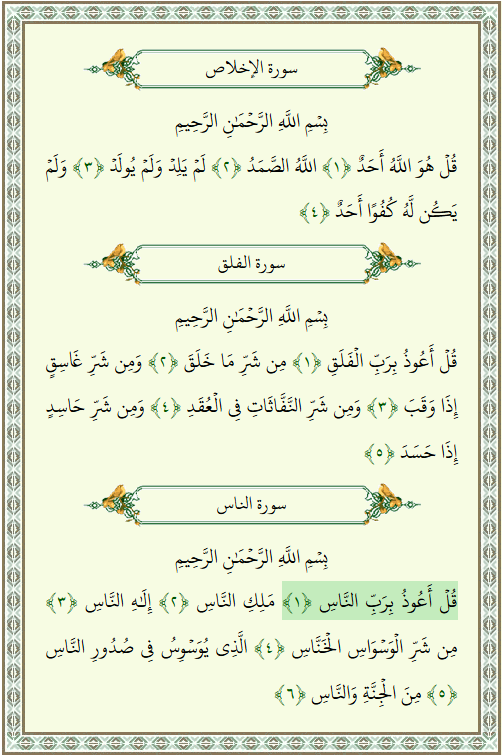
Surahs Al-Ikhlas, Al-Falaq, and An-Nas form a protective trio frequently recited together; all three can be memorized in one session.
Memorizing short surahs first builds recitation confidence, reinforces Tajweed application, and creates an early win in the Hifz journey.
Each surah below includes the full Arabic text, transliteration, and Sahih International translation for immediate learning use.
Starting Quran memorization without knowing which surahs to begin with is one of the most common obstacles we see among new students.
The 20 short surahs listed here come from Juz 30 (the 30th section of the Quran) and are the foundation of every structured Hifz program. They range from 3 to 11 verses, cover essential daily recitation needs, and are the same surahs our instructors at Buruj Academy guide every beginner through first.
Table of Contents:
Why Short Surahs Are the Right Place to Begin Memorization?
Short surahs are the universally recommended starting point for Quran memorization because they deliver early success, build the repetition habit, and are immediately applicable in Salah.
Every student who walks into Buruj Academy’s Juz 30 Memorization course begins with these surahs for one reason: early wins build momentum.
In our instructors’ experience, students who memorize their first three surahs in the first week are significantly more likely to continue than those who begin with longer portions. The Prophet ﷺ said: “The best of you are those who learn the Quran and teach it.” (Sahih al-Bukhari 5027)
Short surahs also serve as living Tajweed practice. Every rule — Ghunnah, Ikhfa, Idgham, Qalqalah — appears within Juz 30. Memorizing these surahs correctly from the start trains the tongue before tackling longer passages.
Benefit
Why It Matters
Immediate prayer use
All short surahs can be recited in Salah from day one
Quick memorization cycle
3–7 verse surahs can be memorized in 1–3 days
Full Tajweed application
Every core Tajweed rule appears in Juz 30
Psychological momentum
Early completion builds confidence for longer surahs
1. Surah Al-Fatiha (7 Verses)
Surah Al-Fatiha is the most recited surah in the Quran. It is repeated a minimum of 17 times daily across the five obligatory prayers, making it the first surah every Muslim must memorize. Its 7 verses cover praise, gratitude, and the core supplication for guidance.
Bismillāhir-raḥmānir-raḥīm. Al-ḥamdu lillāhi rabbil-‘ālamīn. Ar-raḥmānir-raḥīm. Māliki yawmid-dīn. Iyyāka na’budu wa iyyāka nasta’īn. Ihdinaṣ-ṣirāṭal-mustaqīm. Ṣirāṭal-ladhīna an’amta ‘alayhim ghayril-maghḍūbi ‘alayhim wa laḍ-ḍāllīn.
“In the name of Allah, the Entirely Merciful, the Especially Merciful. All praise is due to Allah, Lord of the worlds — the Entirely Merciful, the Especially Merciful — Sovereign of the Day of Recompense. It is You we worship and You we ask for help. Guide us to the straight path — the path of those upon whom You have bestowed favor, not of those who have evoked Your anger or of those who are astray.” (Al-Fatiha 1:1–7)
Surah Al-Ikhlas is equal in reward to one-third of the Quran according to authentic hadith. Its 4 short verses establish the absolute Oneness of Allah and are among the first surahs memorized in every structured program worldwide.
Qul huwa Allāhu aḥad. Allāhus-ṣamad. Lam yalid wa lam yūlad. Wa lam yakun lahū kufuwan aḥad.
“Say, He is Allah, [who is] One, Allah, the Eternal Refuge. He neither begets nor is born, nor is there to Him any equivalent.” (Al-Ikhlas 112:1–4)
3. Surah Al-Falaq (5 Verses)
Surah Al-Falaq is the first of the two Mu’awwidhatain (protective surahs) and is recited together with Surah An-Nas as a pair. Its 5 verses seek refuge from four specific categories of harm, making it among the most memorized and recited surahs in daily life.
Qul a’ūdhu birabbil-falaq. Min sharri mā khalaq. Wa min sharri ghāsiqin idhā waqab. Wa min sharrin-naffāthāti fil-‘uqad. Wa min sharri ḥāsidin idhā ḥasad.
“Say, I seek refuge in the Lord of daybreak from the evil of that which He created, and from the evil of darkness when it settles, and from the evil of the blowers in knots, and from the evil of an envier when he envies.” (Al-Falaq 113:1–5)
Excel in Your Quranic Studies
Join Buruj Academy and master the Quran with our structured, professional curriculum.
Surah An-Nas is the final surah of the Quran and the second of the Mu’awwidhatain. Its 6 verses seek Allah’s protection from the whispering of Shaytan — inward and outward — and are recited daily before sleep and after Fajr and Maghrib prayers.
“Say, I seek refuge in the Lord of mankind, the Sovereign of mankind, the God of mankind, from the evil of the retreating whisperer — who whispers in the breasts of mankind — from among the jinn and mankind.” (An-Nas 114:1–6)
These surahs are effectively memorized together, as learning one helps solidify the rhythm of the other. At Buruj Academy, most students typically memorize both within a single week.
Surah Al-Masad is 5 verses and among the most direct surahs in tone. It was revealed regarding Abu Lahab, the Prophet’s ﷺ uncle who actively opposed Islam. Its vocabulary is clear and its rhythm makes it easy to memorize quickly.
“May the hands of Abu Lahab be ruined, and ruined is he. His wealth will not avail him or that which he gained. He will enter to burn in a Fire of blazing flame, and his wife [as well] — the carrier of firewood. Around her neck is a rope of twisted fiber.” (Al-Masad 111:1–5)
This verse contains Idgham: حَبْلٌ مِّن — the Noon Sakinah merges into the Meem with Ghunnah.
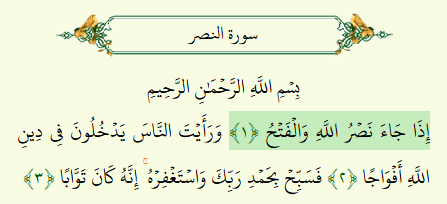
Surah An-Nasr is the shortest complete surah at 3 verses and is widely regarded as among the last surahs revealed. Its brevity makes it ideal for absolute beginners, and its meaning — the arrival of divine victory — carries deep spiritual weight.
“When the victory of Allah has come and the conquest, and you see the people entering into the religion of Allah in multitudes, then exalt [Him] with praise of your Lord and ask forgiveness of Him. Indeed, He is ever Accepting of repentance.” (An-Nasr 110:1–3)
7. Surah Al-Kafirun (6 Verses)
Surah Al-Kafirun is a 6-verse surah of clear and final declaration: the Muslim’s worship and the disbeliever’s worship are entirely separate. The Prophet ﷺ recommended reciting it in the Sunnah of Fajr and the Witr prayer.
Qul yā ayyuhal-kāfirūn. Lā a’budu mā ta’budūn. Wa lā antum ‘ābidūna mā a’bud. Wa lā anā ‘ābidum mā ‘abadtum. Wa lā antum ‘ābidūna mā a’bud. Lakum dīnukum wa liya dīn.
“Say, O disbelievers, I do not worship what you worship. Nor are you worshippers of what I worship. Nor will I be a worshipper of what you worship. Nor will you be worshippers of what I worship. For you is your religion, and for me is my religion.” (Al-Kafirun 109:1–6)
Excel in Your Quranic Studies
Join Buruj Academy and master the Quran with our structured, professional curriculum.
Surah Al-Kawthar is the shortest surah in the Quran at just 3 verses. It was revealed as a direct consolation to the Prophet ﷺ, and its rhythm and musicality make it one of the easiest surahs to memorize — typically accomplished in a single short session.
“Indeed, We have granted you, [O Muhammad], al-Kawthar. So pray to your Lord and sacrifice [to Him alone]. Indeed, your enemy is the one cut off.” (Al-Kawthar 108:1–3)
We at Buruj Academy specifically use Al-Kawthar as a confidence-builder for students who feel uncertain about memorizing. Completing it in one sitting proves to the student, concretely, that memorization is achievable.
9. Surah Al-Ma’un (7 Verses)
Surah Al-Ma’un is 7 verses and addresses a powerful social theme: the connection between true faith and compassion toward the orphan and the poor. Its vocabulary is straightforward, making it accessible for intermediate beginners.
“Have you seen the one who denies the Recompense? For that is the one who drives away the orphan and does not encourage the feeding of the poor. So woe to those who pray [but] who are heedless of their prayer — those who make show [of their deeds] and withhold [simple] assistance.” (Al-Ma’un 107:1–7)
Excel in Your Quranic Studies
Join Buruj Academy and master the Quran with our structured, professional curriculum.
Surah Quraysh is 4 verses reminding the Quraysh tribe of Allah’s favors upon them. Its compact structure and flowing rhythm make it easy to retain, and it is frequently paired with Surah Al-Fil in recitation and study.
Li’īlāfi Quraysh. Īlāfihim riḥlatash-shitā’i waṣ-ṣayf. Falya’budū rabba hādhal-bayt. Alladhī aṭ’amahum min jū’iw wa āmanahum min khawf.
“For the accustomed security of the Quraysh — their accustomed security [in] the caravan of winter and summer — let them worship the Lord of this House, who has fed them, [saving them] from hunger, and made them safe, [saving them] from fear.” (Quraysh 106:1–4)
11. Surah Al-Fil (5 Verses)
Surah Al-Fil is 5 verses recounting the destruction of Abraha’s army that marched against the Ka’bah. Its narrative rhythm is memorable and distinct, helping students lock it in memory quickly — often within two focused repetition sessions.
Alam tara kayfa fa’ala rabbuka bi’aṣḥābil-fīl. Alam yaj’al kaydahum fī taḍlīl. Wa arsala ‘alayhim ṭayran abābīl. Tarmīhim biḥijāratim min sijjīl. Faja’alahum ka’aṣfim ma’kūl.
“Have you not considered, [O Muhammad], how your Lord dealt with the companions of the elephant? Did He not make their plan into misguidance? And He sent against them birds in flocks, striking them with stones of hard clay, and He made them like eaten straw.” (Al-Fil 105:1–5)
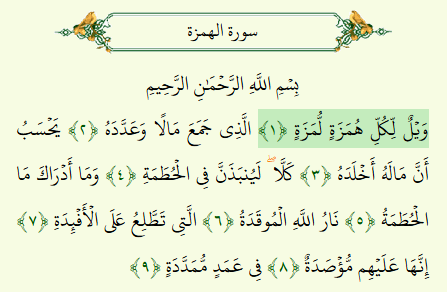
12. Surah Al-Humazah (9 Verses)
Surah Al-Humazah is 9 verses addressing the moral failure of those who mock others and hoard wealth. It contains slightly more complex vocabulary than the earlier surahs listed, making it a good bridge toward mid-length memorization.
Waylul likulli humazatil-lumazah. Alladhī jama’a mālaw wa ‘addadah. Yaḥsabu anna mālahuū akhladah. Kallā layumbadhananna fil-ḥuṭamah. Wa mā adrāka mal-ḥuṭamah. Nārullāhil-mūqadah. Allatī taṭṭali’u ‘alal-af’idah. Innahā ‘alayhim mu’ṣadah. Fī ‘amadim mumaddadah.
“Woe to every scorner and mocker who collects wealth and [continuously] counts it. He thinks that his wealth will make him immortal. No! He will surely be thrown into the Crusher. And what can make you know what is the Crusher? It is the fire of Allah, [eternally] fueled, which mounts directed at the hearts. Indeed, it [i.e., Hellfire] will be closed down upon them in extended columns.” (Al-Humazah 104:1–9)
Through Buruj Academy’s Hifz for Adults, working professionals memorize surahs like Al-Humazah with realistic weekly targets and structured revision systems designed around busy schedules.
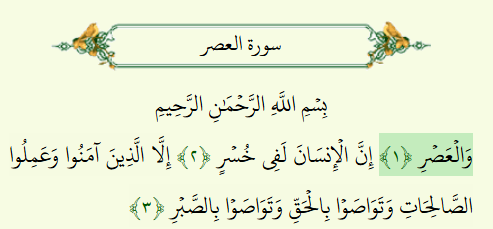
Surah Al-Asr is 3 verses and one of the most theologically dense surahs in the Quran. Imam Al-Shafi’i reportedly said that if people reflected on this surah alone, it would suffice them. Its brevity makes it suitable for absolute beginners while its depth rewards lifelong reflection.
Wal-‘aṣr. Innal-insāna lafī khusr. Illal-ladhīna āmanū wa ‘amiluṣ-ṣāliḥāti wa tawāṣaw bil-ḥaqqi wa tawāṣaw biṣ-ṣabr.
“By time, indeed mankind is in loss, except for those who have believed and done righteous deeds and advised each other to truth and advised each other to patience.” (Al-Asr 103:1–3)
For students learning easy Tafseer in English, Al-Asr is one of the most rewarding surahs to understand alongside memorization — the meaning deepens retention significantly.
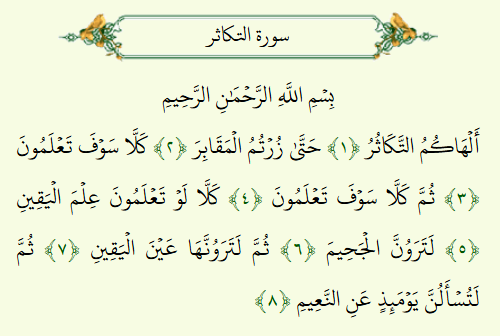
Surah At-Takathur is 8 verses warning against distraction by worldly accumulation. Its rhythmic repetition — particularly the repeated “kallā” — makes it easier to anchor in memory through auditory pattern recognition.
“Competition in [worldly] increase diverts you until you visit the graveyards. No! You are going to know. Then no! You are going to know. No! If you only knew with knowledge of certainty. You will surely see the Hellfire. Then you will surely see it with the eye of certainty. Then you will surely be asked that Day about pleasure.” (At-Takathur 102:1–8)
For students working on how to memorize Quran faster, pairing audio listening with active repetition for these rhythmic surahs accelerates retention significantly.
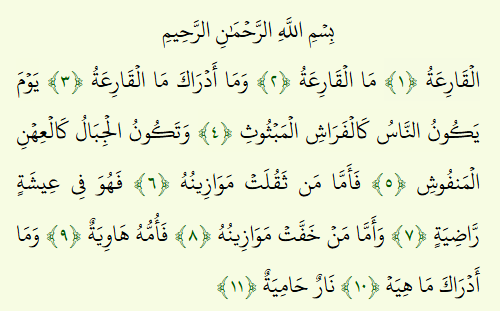
15. Surah Al-Qari’ah (11 Verses)
Surah Al-Qari’ah is 11 verses describing the Day of Judgment with vivid imagery. It is one of the longer surahs on this list and is well-suited for students who have already built initial momentum with 3–5 verse surahs. For further understanding of its themes, see our easy Tafseer in English.
Al-qāri’ah. Mal-qāri’ah. Wa mā adrāka mal-qāri’ah. Yawma yakūnun-nāsu kal-farāshil-mabthūth. Wa takūnul-jibālu kal-‘ihnil-manfūsh. Fa’ammā man thaqulat mawāzīnuh. Fahuwa fī ‘īshatir-rāḍiyah. Wa ammā man khaffat mawāzīnuh. Fa’ummuhu hāwiyah. Wa mā adrāka mā hiyah. Nārun ḥāmiyah.
“The Striking Calamity — what is the Striking Calamity? And what can make you know what is the Striking Calamity? It is the Day when people will be like moths, dispersed, and the mountains will be like wool, fluffed up. And as for one whose scales are heavy [with good deeds], he will be in a pleasant life. But as for one whose scales are light, his refuge will be an abyss. And what can make you know what it is? It is a blazing fire.” (Al-Qari’ah 101:1–11)
16. Surah Al-Adiyat (11 Verses)
Surah Al-Adiyat is 11 verses that open with a powerful oath by charging warhorses. Its dramatic imagery and rhythmic structure make it both memorable and emotionally engaging — qualities that aid retention.
“By the racers, panting, and the producers of sparks [when] striking, and the chargers at dawn, stirring up thereby [clouds of] dust, arriving thereby in the center collectively — indeed mankind, to his Lord, is ungrateful. And indeed, he is to that a witness. And indeed he is, in love of wealth, intense. But does he not know that when the contents of the graves are scattered and that within the breasts is obtained, indeed, their Lord with them, that Day, is [fully] Acquainted.” (Al-Adiyat 100:1–11)
Discover the Buruj Academy Difference
Step into our virtual classrooms and see how our expert instructors make learning Quran and Arabic intuitive and clear. We focus on overcoming the specific hurdles non-native speakers face, building your confidence and connection with the Quran.
17. Surah Az-Zalzalah (8 Verses)
Surah Az-Zalzalah is 8 verses describing the final earthquake of the Day of Judgment and the complete accountability that follows. Its closing two verses are among the most frequently cited in the Quran for their moral weight.
Idhā zulzilatil-arḍu zilzālahā. Wa akhrajatil-arḍu athqālahā. Wa qālal-insānu mā lahā. Yawma’idhin tuḥaddithu akhbārahā. Bi’anna rabbaka awḥā lahā. Yawma’idhin yaṣdurun-nāsu ashtātal liyuraw a’mālahum. Faman ya’mal mithqāla dharratin khayray yarah. Wa may ya’mal mithqāla dharratin sharray yarah.
“When the earth is shaken with its [final] earthquake and the earth discharges its burdens and man says, ‘What is [wrong] with it?’ — that Day, it will report its news because your Lord has commanded it. That Day, the people will depart separated [into categories] to be shown [the result of] their deeds. So whoever does an atom’s weight of good will see it, and whoever does an atom’s weight of evil will see it.” (Az-Zalzalah 99:1–8)
18. Surah Al-Qadr (5 Verses)
Surah Al-Qadr is 5 verses announcing the Night of Qadr — the greatest night of the year — and its reward. Every Muslim should have this surah memorized, particularly for recitation during Ramadan’s last ten nights.
Innā anzalnāhu fī laylatul-qadr. Wa mā adrāka mā laylatul-qadr. Laylatul-qadri khayrum min alfi shahr. Tanazzalul-malā’ikatu war-rūḥu fīhā bi’idhni rabbihim min kulli amr. Salāmun hiya ḥattā maṭla’il-fajr.
“Indeed, We sent the Quran down during the Night of Decree. And what can make you know what is the Night of Decree? The Night of Decree is better than a thousand months. The angels and the Spirit descend therein by permission of their Lord for every matter. Peace it is until the emergence of dawn.” (Al-Qadr 97:1–5)
Surah At-Tin is 8 verses and is known for its beautiful oaths and its clear statement on human dignity and accountability. Its flowing literary style is one of the most beloved among students of Quran and is cited frequently in our reading the Quran for the first time discussions.
“By the fig and the olive, and [by] Mount Sinai, and [by] this secure city [Makkah], We have certainly created man in the best of stature; then We return him to the lowest of the low, except for those who believe and do righteous deeds, for they will have a reward uninterrupted. So what yet causes you to deny the Recompense? Is not Allah the most just of judges?” (At-Tin 95:1–8)
20. Surah Ash-Sharh (8 Verses)
Surah Ash-Sharh is 8 short verses offering profound comfort to the Prophet ﷺ — and by extension, to every believer facing hardship. Its repeated promise, “Indeed, with hardship will be ease”, is among the most memorized phrases in the Quran.
Alam nashraḥ laka ṣadrak. Wa waḍa’nā ‘anka wizrak. Alladhī anqaḍa ẓahrak. Wa rafa’nā laka dhikrak. Fa’inna ma’al-‘usri yusrā. Inna ma’al-‘usri yusrā. Fa’idhā faraghta fanṣab. Wa ilā rabbika farghab.
“Did We not expand for you, [O Muhammad], your breast? And We removed from you your burden which had weighed upon your back. And raised high for you your repute. For indeed, with hardship will be ease. Indeed, with hardship will be ease. So when you have finished [your duties], then stand up [for worship]. And to your Lord direct [your] longing.” (Ash-Sharh 94:1–8)
What Is the Best Order to Memorize These Short Surahs?
The most effective sequence for memorizing short surahs starts with the 3-verse surahs, then progresses by length. Beginning with the longest on this list — Al-Qari’ah or Al-Adiyat — before securing the shorter ones first is the most common mistake we see among self-directed students.
Stage
Surahs to Memorize
Verse Count
Stage 1 — Absolute Beginners
Al-Ikhlas, Al-Kawthar, An-Nasr, Al-Asr
4, 3, 3, 3 verses
Stage 2 — Early Foundation
Quraysh, Al-Masad, Al-Falaq
4, 5, 5 verses
Stage 3 — Building Confidence
An-Nas, Al-Qadr, Al-Fil, Al-Kafirun
6, 5, 5, 6 verses
Stage 4 — Intermediate Growth
Al-Ma’un, Az-Zalzalah, Al-Takathur, At-Takathur
7, 8, 8, 8 verses
Stage 5 — Completing the Set
Al-Qari’ah, Al-Adiyat, At-Tin, Ash-Sharh
9–11 verses
Always pair new memorization with daily review of previously memorized surahs. Students in our Online Hifz Program follow a structured revision system — typically spending 60% of each session reviewing previous material and only 40% on new memorization.
This ratio is one of the most important lessons for long-term retention. For practical strategies, see our guide on how to memorize Quran faster.
How Long Does It Take to Memorize These 20 Short Surahs?
For a non-Arabic speaking adult memorizing with consistent daily practice, completing these 20 surahs takes between 3 and 6 months, depending on session length and revision consistency.
Daily Practice Time
Estimated Completion
15 minutes/day
5–6 months
30 minutes/day
3–4 months
45–60 minutes/day
2–3 months
These are our instructors’ estimates based on consistent experience with adult learners — not fixed guarantees, as every student’s pace differs. What matters far more than speed is accuracy.
A student who memorizes Al-Ikhlas with correct Tajweed in three days achieves more than one who memorizes it with errors in one day.
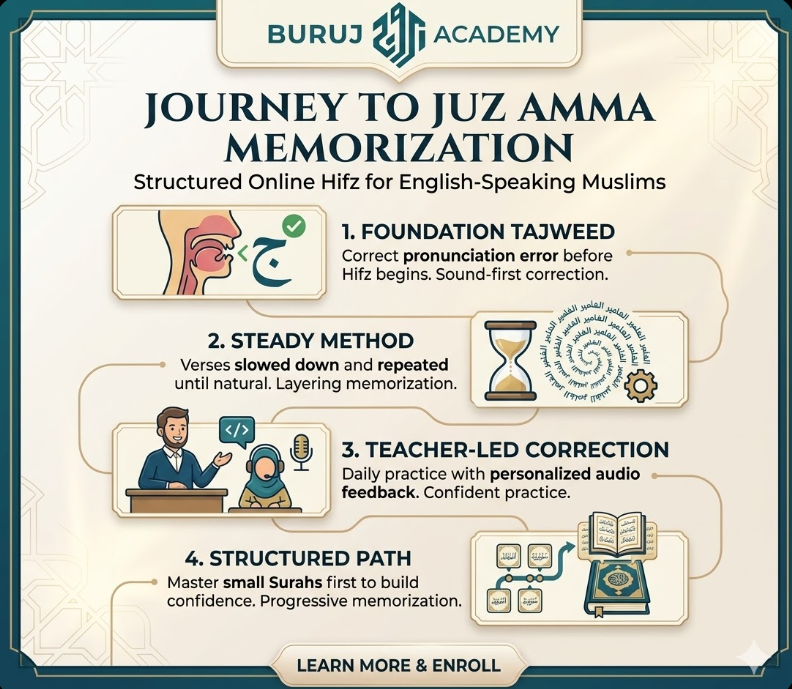
Carry the words of the Divine in your heart and transform your life through the noble pursuit of Hifz. At Buruj Academy, we provide a structured, supportive, and highly personalized environment to help you achieve your memorization goals, whether you are starting with the final chapters or aspiring to complete the entire Quran.
Our experienced tutors employ proven techniques to ensure long-term retention (Mutqin) and spiritual growth, making the path to memorization accessible for every member of the family.
Take the first step toward this lifelong blessing by enrolling in a program tailored to your pace:
Don’t let another day pass without moving closer to your goal. Join Buruj Academy today and schedule your free trial session to begin your Hifz journey!
Frequently Asked Questions About Short Surahs to Memorize
Which Is the Shortest Surah in the Quran to Memorize?
Surah Al-Kawthar (108), Surah An-Nasr (110), and Surah Al-Asr (103) are all 3 verses each, making them the shortest surahs in the Quran. Al-Kawthar is often memorized first due to its simple vocabulary and flowing rhythm, typically achievable in a single focused session of 20–30 minutes.
What Are the Most Important Short Surahs to Memorize for Daily Prayer?
Surah Al-Fatiha is required in every unit of every prayer. Beyond that, Al-Ikhlas, Al-Kafirun, Al-Falaq, and An-Nas are the most frequently recited short surahs in Salah and are considered essential for every Muslim’s daily worship. Memorizing these five gives complete Salah coverage.
Can I Memorize Short Surahs Without a Teacher?
Self-directed memorization is possible, but errors in pronunciation and Tajweed — once embedded — are very difficult to correct. Our instructors at Buruj Academy consistently find that students who learn without a teacher memorize faster initially but spend significantly more time correcting mistakes later. A qualified instructor prevents this from the start.
What Is the Difference Between Memorizing Short Surahs and Completing Juz 30?
Juz 30 contains 37 surahs, from Surah An-Naba’ (78) to Surah An-Nas (114). The 20 surahs in this list are the shortest within Juz 30 — primarily from Surah Al-Bayyinah (98) to An-Nas (114). Completing all of Juz 30 is the full goal; these 20 surahs represent the natural starting foundation within it.
How Do I Retain Short Surahs After Memorizing Them?
Daily recitation in Salah is the most effective retention method — it creates a built-in revision system. Beyond prayer, reciting memorized surahs during morning Adhkar, before sleep, and in voluntary prayers reinforces long-term retention. For a structured revision framework, see our guide on what is the best way to memorize Quran.
Unlock Your Potential at Buruj Academy: Enroll Today and Elevate Your Knowledge!
Join Buruj Academy and embark on a transformative learning journey designed to expand your skills and understanding. Experience expert guidance, interactive courses, and a supportive community that empowers you to achieve academic excellence and personal growth. Start your path to success today!
 Quran
Quran