 Tajweed
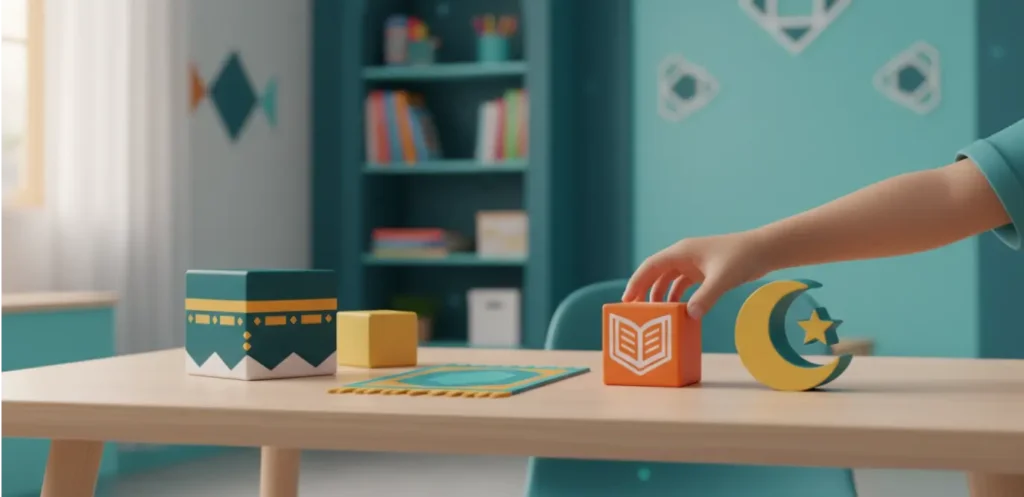
Children learn Quranic recitation the same way they pick up their favorite methods — through repetition, rhythm, and patterns that feel natural to them. The challenge for parents isn’t the rules themselves, but finding the right entry point for their child’s age.
Tajweed for children centers on mastering proper letter articulation (Makharij), understanding Lam Shamsiyya and Lam Qamariyya, applying Noon Sakinah and Tanween rules, and recognizing Madd elongation patterns. Through short daily practice, interactive activities, and structured guidance, children aged 4–15 build fluency, confidence, and lasting Quranic accuracy.
Table of Contents:
What Is Tajweed for Kids?
Tajweed is the set of pronunciation rules that govern correct Quran recitation. Tajweed for kids simply means learning to say each letter from the right place in the mouth, with the right sound, for the right duration — exactly as the Prophet Muhammad ﷺ recited.
Many parents assume Tajweed is an advanced subject reserved for older students or adults. In reality, children who begin learning Tajweed early develop correct habits naturally, without the effort of unlearning years of mispronunciation that older beginners must work through.
Main Tajweed Rules for Kids
Understanding the main Tajweed rules for kids doesn’t require an Islamic studies degree. Let’s break down each essential rule in plain language, with age-specific tips on how to learn Tajweed for kids, practical home activities, and realistic expectations for children aged 4-15 learning proper Quran recitation.
1. The First Tajweed Rule Kids Need to Learn Is Proper Letter Pronunciation (Makharij)
Every Tajweed journey begins here. Makharij refers to the exact mouth and throat position for each Arabic letter. For children, this is the single most important foundation — mispronouncing letters changes word meanings in the Quran entirely.
Start by focusing on letters that have no English equivalent. The letters ع (Ayn), خ (Kha), ح (Ha), and غ (Ghayn) are the most commonly mispronounced by non-Arabic speaking children and deserve the most practice time early on.
Ages 4-7: Mirror Practice Makes Makharij Fun
Sit with your child in front of a mirror and exaggerate mouth movements together. Children this age respond brilliantly to silly faces — making the ع sound “like a frog from the throat” gives them a physical anchor to remember it by.
Ages 8-12: Letter Comparison Charts Help Children Identify Differences
Show children a side-by-side comparison of similar-sounding letters like س (Sin) and ص (Sad). Ask them to feel the difference in their mouth.
This metacognitive approach — noticing their own speech — accelerates accurate pronunciation faster than pure repetition alone.
Ages 13-15: Independent Articulation Practice Builds Teenage Learner Confidence
Teenagers can use recorded recitations to self-assess. Ask them to record themselves reciting a short ayah, then compare it to a certified reciter. This self-directed method builds accountability and ownership of their Tajweed progress.
Discover the Buruj Academy Difference
Step into our virtual classrooms and see how our expert instructors make learning Quran and Arabic intuitive and clear. We focus on overcoming the specific hurdles non-native speakers face, building your confidence and connection with the Quran.
2. Lam Shamsiyya and Lam Qamariyya Are Among The Rules of Quran Tajweed for Kids
The Arabic definite article “Al” (ال) behaves differently depending on the letter that follows it. With Sun Letters (Lam Shamsiyya), the Lam disappears and the following letter doubles. With Moon Letters (Lam Qamariyya), the Lam is clearly pronounced.
| Type | Lam Behavior | Letters It Applies To | Example |
| Shamsiyya (Sun) | Lam silent, letter doubles | ت ث د ذ ر ز س ش ص ض ط ظ ل ن | الشَّمْس (Ash-Shams) |
| Qamariyya (Moon) | Lam pronounced clearly | ا ب ج ح خ ع غ ف ق ك م و ه ي | الْقَمَر (Al-Qamar) |
A memorable teaching method: Surah names themselves contain both types. الشَّمْس (Ash-Shams — the Sun) is a Shamsiyya example, and الْقَمَر (Al-Qamar — the Moon) is a Qamariyya example. Children find it memorable that the rule’s own names demonstrate themselves perfectly.
Buruj Academy’s Tajweed for Kids instructors use sun and moon flashcard sorting games to reinforce this rule — children physically sort letter cards under a sun or moon image, building automatic recognition over multiple short practice sessions.
Book your child’s free Tajweed trial today
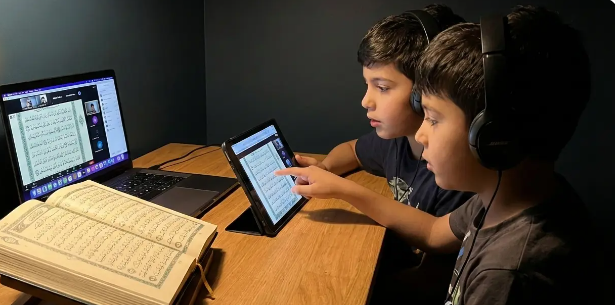
3. Noon Sakinah and Tanween in Tajweed for Children
After Makharij, Noon Sakinah (نْ) and Tanween (ً ٍ ٌ) rules are the most frequently applied in everyday Quran recitation. Because they appear constantly in the Quran, children get abundant natural practice once they learn the four categories.
| Rule Name | Arabic Term | What Happens | Simple Example |
| Clear pronunciation | Izhar | Say the Noon clearly | نْ before ه |
| Merging with Ghunnah | Idgham | Noon blends into next letter | نْ before ن or م |
| Hiding the Noon | Ikhfa | Noon softened, partial sound | نْ before ت, ث, ج |
| Converting to Meem | Iqlab | Noon becomes Meem sound | نْ before ب |
The four categories above cover every situation children will encounter. Idgham and Ikhfa are the most common and should be taught first, as they appear far more frequently than Izhar or Iqlab in the surahs children memorize early.
4. Madd Rules for Children
Madd means elongation — holding a vowel sound for a specific number of counts. Children who master Madd rules develop the flowing, melodic quality that makes Quranic recitation beautiful and immediately recognizable to the ear.
| Madd Type | Duration | When It Applies | Child-Friendly Description |
| Madd Asli (Natural) | 2 counts | Always, with ا و ي | The “regular stretch” |
| Madd Munfasil | 4-5 counts | Madd letter, then Hamza in next word | “The medium stretch” |
| Madd Muttasil | 4-5 counts (mandatory) | Madd letter, then Hamza in same word | “The long stretch” |
| Madd Lazim | 6 counts | Before Shaddah or Sukoon at pause | “The longest stretch” |
Start with Madd Asli — the two-count natural elongation — before introducing longer Madd types. Children need to internalize the baseline two counts before understanding that other Madd types simply extend it further. This progressive approach prevents confusion.
At Buruj Academy, our Online Quran Classes for Kids teach Madd through visual “stretch lines” drawn under vowels, where children physically trace longer lines for longer Madd types — making the abstract concept of duration visible and tangible for young learners.
Help your child start reading the Quran with a Free trial
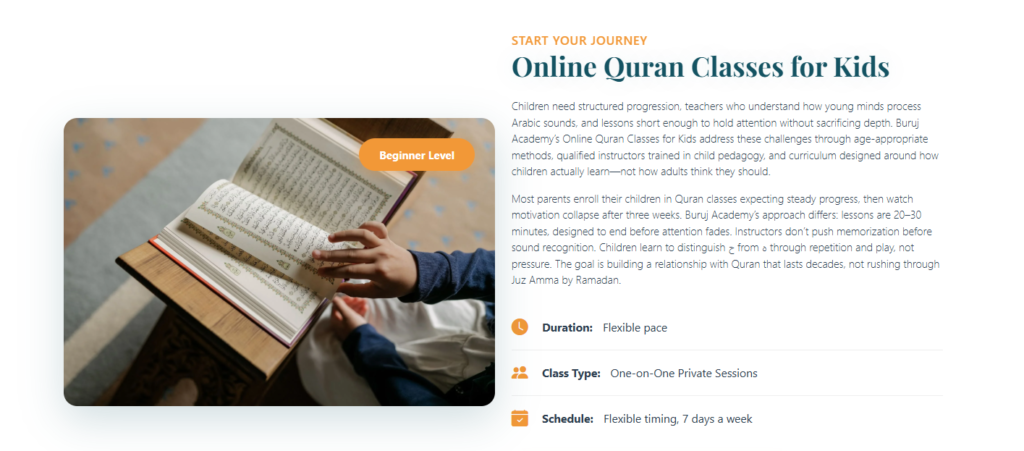
What is the Importance of Learning Tajweed for Kids?
Tajweed isn’t simply about sounding polished during recitation. Incorrect pronunciation in Arabic can change a word’s meaning entirely — and in the Quran, that carries serious weight. Teaching children Tajweed early protects the integrity of what they’re actually reciting.
Beyond accuracy, Tajweed gives children a structured relationship with the Quran. Children who recite correctly feel more confident during Salah, during family gatherings, and in Islamic school settings. That confidence becomes a lasting motivator for continued Quran engagement throughout their lives.
Tajweed for Children Builds Deeper Quran Connection
Children who understand why each rule exists — not just how to apply it — develop genuine curiosity about the Quran’s linguistic beauty. Explaining that Allah preserved the Quran’s exact sounds through Tajweed gives children a meaningful reason to care about getting it right, Alhamdulillah.
How to Teach Tajweed for Kids?
Teaching Tajweed to children at home works best when rules are introduced through recitation, not theory. Children learn Tajweed rules the same way they learn grammar — by hearing and practicing correct examples repeatedly before ever seeing a formal rule written down.
Parents don’t need to be Tajweed experts themselves. Reading alongside your child, playing correct recitation audio daily, and pointing out one rule per week during familiar surah practice is more effective than structured lessons that feel like homework to young learners.
1. Use Short Daily Sessions Rather Than Long Weekly Tajweed Practice
Ten minutes of daily Tajweed practice outperforms a single one-hour weekly session for children. Short, consistent exposure builds the muscle memory and auditory pattern recognition that correct Tajweed recitation requires. Aim for five to ten minutes after Maghrib or before bedtime as a sustainable family routine.
2. Choose One Rule Per Week to Introduce to Your Child
Introducing one Tajweed rule per week prevents cognitive overload. Spend the full week finding that rule naturally in your child’s recitation rather than moving forward. This “one rule, everywhere” approach builds automatic application rather than conscious rule-checking during recitation.
What Are The Tajweed Classes for Kids?
Online Tajweed classes for children are structured differently from adult Quran courses. Quality programs for kids use short sessions, interactive activities, and incremental rule introduction — not lecture-style explanations that quickly lose young learners’ attention and engagement.
In Buruj Academy’s Tajweed for Kids program, a typical session includes warm-up recitation review, introduction or reinforcement of one Tajweed rule through a game or visual activity, guided application in a short Quranic passage, and positive feedback before the session closes. Sessions run 20-30 minutes — precisely matching children’s natural attention capacity.
Book your child’s free Tajweed trial today

What to Look for When Choosing Online Quran Classes with Tajweed for Kids?
Not every online Quran program is designed with children in mind. Parents should look for instructors with documented experience teaching children — not just Islamic qualifications alone.
Child pedagogy training, age-grouped classes, and engagement methods beyond simple repetition are the clearest indicators of a program built genuinely for young learners.
Buruj Academy’s instructors are Al-Azhar graduates with 12+ years of experience teaching children from non-Arabic speaking families, combining authentic Islamic knowledge with proven child-friendly teaching techniques that make online Tajweed learning genuinely effective for kids aged 4-15.
Book Your Kid a Free Trial Lesson With One of Our Quran Tutors for Children

Do Kids Only Learn Tajweed in The Tajweed Classes?
Tajweed classes for children naturally develop far more than pronunciation rules alone. As children work through Tajweed, they simultaneously strengthen Arabic letter recognition, reading fluency, surah memorization accuracy, and their overall confidence in Quran recitation during daily Salah.
Many parents are pleasantly surprised to find that their child’s Hifz accuracy improves significantly after beginning structured Tajweed learning. Correct pronunciation makes memorization easier — children retain what they recite correctly far more reliably than verses memorized with approximated sounds.
Read Also: Information About Quran for Kids
1. Tajweed Classes Help Kids Build Salah Confidence Alongside Recitation Skills
Children who recite with proper Tajweed during Salah develop a qualitatively different relationship with their prayer. Rather than rushing through familiar surahs from habit, they begin to engage with the sounds and rhythm consciously. This heightened awareness of recitation often deepens a child’s overall connection to Salah, Masha’Allah.
Read Also: Tajweed Books for Kids
2. Reading Fluency and Arabic Recognition Grow Naturally Through Kids’ Tajweed Learning
Tajweed practice requires children to look carefully at diacritical marks — the small symbols above and below Arabic letters indicating vowels, elongation, and pronunciation rules. This close reading habit accelerates general Quranic Arabic literacy, giving children stronger independent reading skills well beyond Tajweed application alone.
Give Your Child the Gift of Quran Education
Safe, engaging, and professional online classes designed to help children excel in Quran, Arabic, and Islamic studies.
Start Free TrialRead Also: Quran Steps for Kids
Help Your Child Master Quran with Buruj Academy’s Expert Tajweed Instructors
Home practice lays a strong foundation, but structured instruction from qualified teachers takes children’s Tajweed from approximate to accurate, building confident, correct recitation habits that last a lifetime.
- Al-Azhar graduates with 12+ years teaching non-Arabic speaking children
- Age-appropriate curriculum for children aged 4-15
- Gamification, stories, and sorting activities — not dry drills
- Short 20-30 minute sessions matching children’s attention spans
- Patient, encouraging instructors who build confidence, not pressure
- Flexible scheduling that fits your family routine
Book your child’s free trial lesson with Buruj Academy’s Tajweed for Kids program today and see the difference child-focused instruction makes.
Find your child’s perfect match among Buruj’s top courses for kids:
- Arabic Classes for Kids
- Alphabet course
- Noorani Qaida Course for Kids
- Quranic Arabic Course
- Islamic Studies for Kids
- Hifz Classes for Kids
- Quran Classes for Kids
- Tajweed for Kids
Get a free trial for your child today.

Conclusion
Strong Tajweed for children begins with correct pronunciation and grows through consistent exposure to foundational rules like Makharij, Lam types, Noon Sakinah categories, and Madd elongation. When introduced gradually, these principles become natural habits rather than difficult corrections later in life.
Short, focused daily sessions and one-rule-at-a-time learning prevent overwhelm while reinforcing automatic application. Interactive methods, visual tools, and guided recitation ensure children internalize patterns instead of mechanically memorizing theory.
With structured instruction and supportive teaching, Tajweed strengthens far more than pronunciation. It enhances reading fluency, memorization accuracy, and Salah confidence—cultivating a deeper, lifelong connection to the Quran grounded in clarity, rhythm, and reverence.


Leave a Reply