 Quran
Quran
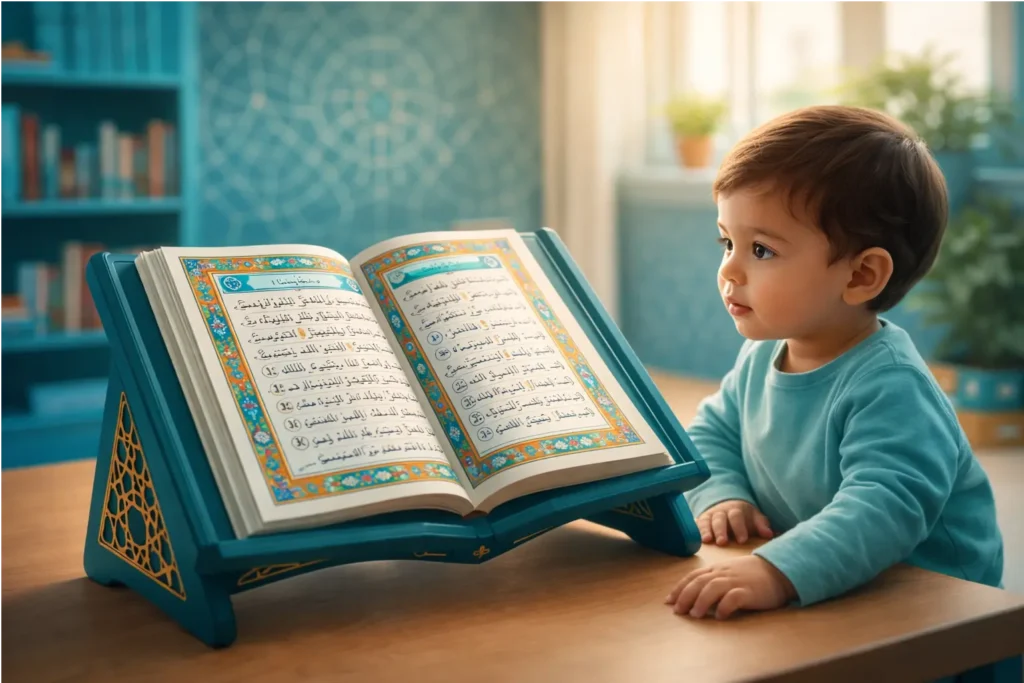
Most parents feel that quiet pull — watching their child grow and wondering, is it too early, or have we already waited too long? The truth is, there’s no single “missed window,” but there is a best approach for every age.
Knowing when children should begin learning the Quran, what to expect at each stage, and how to make the process genuinely enjoyable makes all the difference. This guide covers age-appropriate starting points, the phases of Quran learning, memorization versus reading timelines, and practical daily methods parents can start using right away.
Table of Contents:
When Should Children Begin Learning the Quran?
Children can begin Quran exposure as early as age 3 through listening, but structured learning typically starts between ages 4 and 6.
What Is The Best Time To Learn The Quran For Children?
The best time to learn Quran for children is when they can sit, focus for short periods, and repeat sounds consistently.
There is no single universal age — readiness matters more than a calendar date. Some children are ready at 4, others at 6. Watching for signs like curiosity about prayer, ability to repeat phrases, and basic listening skills will tell you more than age alone.
Starting early builds a natural connection with the Quran before school pressures and social distractions increase. Children who hear and repeat Quranic sounds from a young age develop familiarity that makes formal learning feel like continuation, not a new subject.
| Age Range | Recommended Starting Focus | Session Length |
| Age 3 | Listening to recitation, short duas | 5 min daily |
| Age 4–5 | Letter sounds, short surahs by ear | 10–15 min |
| Age 6–7 | Noorani Qaida, Arabic letter recognition | 15–20 min |
| Age 8–10 | Reading with Tajweed basics, memorization | 20–25 min |
| Age 11–15 | Full reading, structured Hifz | 25–30 min |
The table above shows how expectations should grow gradually — never pushing a 4-year-old into reading before their eyes and hands are developmentally ready for it.
While parents can begin this journey at home, Buruj Academy’s Online Quran Classes for Kids provide structured, age-calibrated instruction from teachers trained specifically in child pedagogy, ensuring your child progresses confidently without frustration.
Help your child start reading the Quran with a Free trial
What Are the Benefits of Learning the Quran at a Young Age?
The benefits of learning Quran at a young age go far beyond religious knowledge. Children’s brains between ages 4 and 10 are in peak neurological development, meaning sounds, rhythms, and patterns are absorbed faster and retained longer than at any other life stage.
Early Quran learning builds phonemic awareness — the ability to distinguish and reproduce sounds — which actually supports general literacy skills. Many parents notice improvements in their child’s reading confidence in English or other languages alongside Arabic.
There is also a deeply emotional benefit. Children who grow up with Quranic sounds feel spiritually grounded and connected to their faith identity. This foundation becomes especially important during teenage years when identity questions naturally arise.
Memorization at a young age also produces genuine pride. When a 6-year-old recites Surah Al-Ikhlas correctly in front of family, that small achievement builds confidence that carries forward into every area of learning, Insha’Allah.
Discover the Buruj Academy Difference
Step into our virtual classrooms and see how our expert instructors make learning Quran and Arabic intuitive and clear. We focus on overcoming the specific hurdles non-native speakers face, building your confidence and connection with the Quran.
Do Children Memorize the Quran Before Learning to Read?
Yes, children typically memorize portions of the Quran before they can read Arabic fluently. This is both natural and intentional.
Young children learn through listening and repetition — the same way they learn their first spoken language before reading it. Short surahs like Al-Fatiha, Al-Ikhlas, and Al-Kawthar are memorized through daily repetition, often before formal Arabic reading begins.
Reading Arabic — through the Noorani Qaida or direct Quran reading — usually begins around ages 6–7 when children have the visual tracking and fine motor skills needed for script recognition. Memorization and reading then develop in parallel after that point.
This sequence is actually the traditional Islamic model. Historically, children memorized portions by ear from their parents and teachers first, then later learned the written script to deepen their connection with what they already knew by heart.
Book Your Kid’s First Session in Juz 30 Memorization Course

What Are the Phases of Learning Quran for Kids?
Understanding the phases of learning Quran for kids helps parents set realistic expectations and celebrate the right milestones at the right times. We generally see four clear developmental phases.
Phase 1 — Quran Listening and Exposure for Ages 2 to 5
This phase requires zero pressure. Play Quran recitation during car rides, mealtimes, and bedtime. Children absorb sounds, rhythms, and eventually words without any formal instruction needed. Short duas and Surah Al-Ikhlas often emerge naturally from this listening habit.
Phase 2 — Arabic Letter Foundation for Ages 5 to 7
Formal learning begins with Arabic letter recognition through the Noorani Qaida. Children learn letter shapes, sounds, and basic joining rules. Sessions of 15–20 minutes, three to four times per week, are ideal at this stage. Colorful flashcards and letter songs work especially well.
Phase 3 — Quran Reading and Early Memorization for Ages 7 to 9
Children who completed the Noorani Qaida begin reading directly from the Quran, usually starting with short surahs in Juz Amma. Basic Tajweed rules are introduced gently. Memorization of Juz 30 surahs continues alongside reading practice during this phase.
Phase 4 — Structured Hifz and Tajweed for Ages 9 and Above
Older children who read fluently can begin structured memorization programs. Tajweed rules are taught more formally. Children in this phase benefit greatly from consistency — even 20–30 minutes of daily focused practice produces remarkable results over one to two years.
| Phase | Age Range | Key Skill | Parent’s Role |
| Listening | 3–5 | Sound familiarity | Play recitation daily |
| Letter Foundation | 5–7 | Arabic alphabet | Practice with flashcards |
| Reading + Memorization | 7–9 | Quran reading | Review with child nightly |
| Structured Hifz | 9 –15 | Memorization + Tajweed | Monitor progress, encourage |
Moving through these phases at your child’s natural pace — not rushing ahead — produces children who genuinely love the Quran rather than children who memorized it under pressure and lost interest later.
How to Start Teaching the Quran to Kids?
Learning how to start teaching the Quran to kids doesn’t require a perfectly structured curriculum on day one. Consistent small habits, introduced gently, build a foundation that formal instruction later strengthens.
1. Make Quran Sound a Normal Part of Home Life
Before any formal teaching begins, normalize Quranic sound. Play a trusted reciter during breakfast or before sleep. When children hear Surah Al-Fatiha repeatedly, they begin repeating phrases naturally — often without being asked. This is the lowest-effort, highest-impact first step.
2. Teach Short Surahs Through Joyful Repetition
Choose one short surah to focus on for two to three weeks. Repeat it together during wudu, before meals, or at bedtime. Make it conversational and light. For a 4-year-old, try:
قُلْ هُوَ ٱللَّهُ أَحَدٌ
Qul Huwa Allahu Ahad
“Say: He is Allah, the One.”
This surah is ideal for young children — it is short, rhythmic, and introduces Tawheed in the simplest possible terms.
3. Use Physical Movement to Reinforce Learning
Young children remember better when their bodies are involved. Clap once per word while reciting, trace Arabic letters in sand or salt, or walk around the room saying a new surah together. Movement anchors memory in ways that sitting still at a table never will.
Interactive Quran Learning
Understanding how to teach Quran for kids effectively means accepting one thing early: children do not learn through lectures. They learn through doing, playing, competing, and storytelling. The best Quran learning games for kids make repetition feel fun, not forced.
Learn Quran Games: The Best Quran Learning Games For Kids
Ayah Completion Game: Say the beginning of a memorized ayah and let your child finish it. Start simple — they will feel clever every time they get it right, and that feeling motivates the next round.
Arabic Letter Hunt: Write three Arabic letters on sticky notes and place them around the room. Call out a letter sound and let your child run to find it. Perfect for ages 4–7 during Noorani Qaida phase.
Recitation Relay: In families with siblings, pass a small object around. Whoever holds it recites one ayah before passing it on. Children who “perform” for each other retain far more than children who only recite for parents.
Quran Stories for Kids
Stories of the prophets — Nabi Musa, Nabi Ibrahim, Nabi Yusuf — create emotional context that makes Quranic words meaningful. When a child knows the story of Nabi Yusuf (peace be upon him), verses referencing patience and trust carry feeling, not just sound.
Interactive Quran learning tools like digital Quran apps with audio, color-coded Tajweed Qurans, and illustrated dua cards extend learning beyond formal sessions in ways children genuinely enjoy.
Buruj Academy’s Online Quran Classes for Kids build this exact approach into every lesson — gamification, storytelling, and visual activities replace dry repetition, guided by instructors who understand how children actually learn.
Help your child start reading the Quran with a Free trial
Read Also: Information About Quran for Kids
How to Learn Quran for Kids?
Knowing how to learn Quran for kids sustainably comes down to three pillars: consistency over intensity, positive reinforcement over pressure, and variety over rigid routine.
Consistency over intensity means five minutes every day produces more progress than a one-hour session once a week. Children’s memory consolidates during sleep — daily short exposures give the brain multiple consolidation cycles each week.
Positive reinforcement means celebrating every milestone, no matter how small. A child who memorizes three new ayahs deserves genuine enthusiasm — a small reward, a phone call to grandparents, or simply a big hug and specific praise: “You worked so hard on that, Masha’Allah.”
Variety means rotating between listening, reading, memorization, and games within the same week. A child who only reads will plateau. A child who reads, listens, plays letter games, and hears prophet stories stays engaged across all four learning pathways simultaneously.
Give Your Child the Gift of Quran Education
Safe, engaging, and professional online classes designed to help children excel in Quran, Arabic, and Islamic studies.
Start Free TrialRead Also: Quran Steps for Kids
Help Your Child Begin and Master Quran Learning with Buruj Academy’s Expert Instructors
Home habits build the love, but structured guidance builds the skill. Buruj Academy’s expert instructors provide the consistent, child-centered framework that accelerates your child’s Quran journey alongside your home efforts.
- Al-Azhar graduates with 12+ years teaching non-Arabic speaking children
- Age-appropriate curriculum for children aged 4–15
- Gamification, stories, and interactive activities every lesson
- Short 20–30 minute sessions matching children’s attention spans
- Patient, encouraging instructors who build confidence, not anxiety
- Flexible scheduling that fits your family’s routine
- Personalized pacing based on your child’s individual progress
Book your child’s free trial lesson with Buruj Academy today and let them experience Quran learning that genuinely excites them.
Find your child’s perfect match among Buruj’s top courses for kids:
- Arabic Classes for Kids
- Alphabet course
- Noorani Qaida Course for Kids
- Quranic Arabic Course
- Islamic Studies for Kids
- Hifz Classes for Kids
- Quran Classes for Kids
- Tajweed for Kids
Get a free trial for your child today.

Frequently Asked Questions
What are effective methods for introducing the Quran to a 3-year-old?
At age 3, introduction means listening, not studying. Play gentle recitation during daily routines — meals, car rides, bedtime. Repeat short phrases like Bismillah and Alhamdulillah together naturally. Point to the Quran respectfully so children associate it with something beautiful and important, not a chore.
Which Islamic teachings are suitable for a 2-year-old?
Two-year-olds learn through imitation and repetition. Teach Bismillah before eating, Alhamdulillah after sneezing, and simple greetings like As-salamu alaykum. These daily phrases build Islamic identity naturally without any formal instruction. Seeing parents pray regularly is itself the most powerful Islamic teaching at this age.
What approaches can I use to teach the Quran to my 4-year-old?
Four-year-olds respond beautifully to rhythms and repetition games. Choose one very short surah — Al-Ikhlas or Al-Kawthar — and repeat it together daily in a playful way. Keep sessions under 10 minutes. Praise enthusiastically every single time. Never correct harshly — just model the correct sound and move forward cheerfully.
What are the best practices for guiding a 7-year-old in learning the Quran?
At 7, children are ready for structured reading through the Noorani Qaida alongside surah memorization. Fifteen to twenty minute sessions four times weekly work well. Use a reward chart to track progress visibly — children this age respond strongly to seeing their own achievements. Connecting surahs to their meanings through simple stories deepens retention significantly.
How can I effectively teach the Quran to a 6-year-old?
Six-year-olds sit at the transition between pure listening and early reading. Begin Arabic letter recognition using colorful flashcards while continuing surah memorization by ear simultaneously. Short focused sessions of 15 minutes work best. The letter-sound matching game — calling out a sound and having your child find the letter card — builds recognition quickly and keeps energy high.
What strategies should I use to teach the Quran to a 5-year-old?
Five-year-olds thrive with movement-based learning. Trace Arabic letters together in a tray of sand, clap syllables while reciting surahs, or use large illustrated alphabet cards on the floor. Aim for 10–15 minute daily sessions with lots of variety. At this age, your enthusiasm is contagious — when you recite with joy, your child will want to join you every time.
Conclusion
Starting early — even with just listening — gives children a natural familiarity with Quranic sounds that makes every later stage easier. Readiness matters more than a fixed age, and small daily habits build extraordinary foundations over time.
The sequence of memorization before reading is both historically authentic and developmentally sound. Children absorb sounds beautifully before formal reading begins, and both skills strengthen each other as learning matures.
Interactive learning, stories, and joyful repetition are not shortcuts — they are the most effective tools available for young learners. Children who associate the Quran with positive feelings carry that connection for life, Insha’Allah.






Leave a Reply