 Arabic
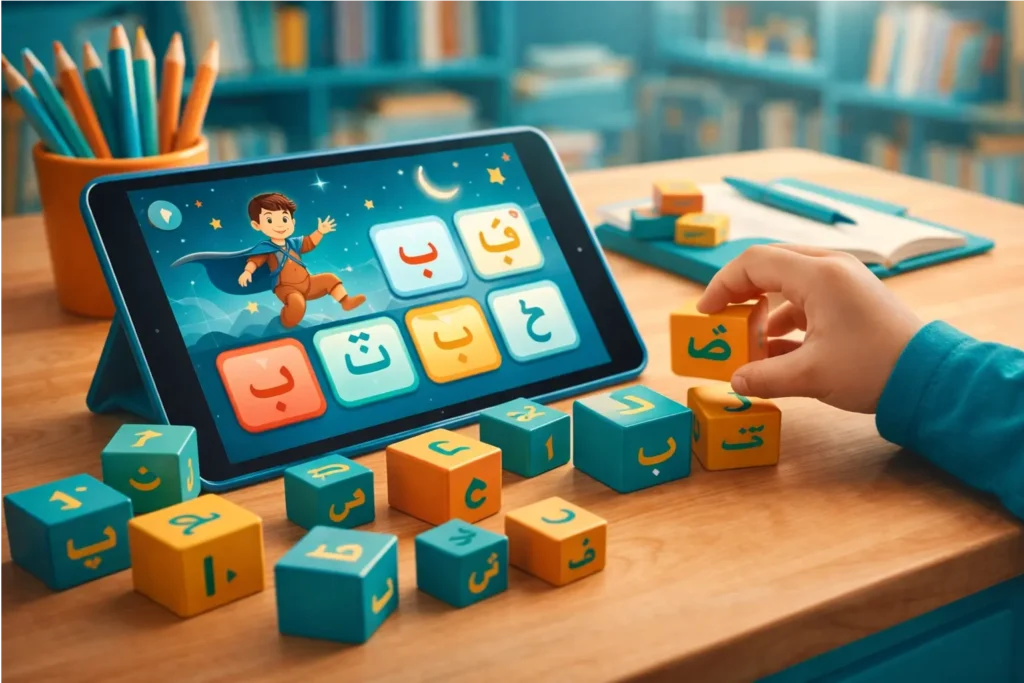
Most children pick up songs and rhymes faster than any formal lesson—yet when it comes to Arabic letters, many parents feel unsure where to start. The secret is connecting each letter to something familiar, turning recognition into a joyful habit rather than a chore.
Arabic alphabet learning for kids becomes far more effective when each letter carries a story, a sound, and a visual anchor. This guide walks through all 28 letters with child-friendly associations, practical home activities, and age-specific tips that make each letter memorable.
Table of Contents:
Letter ا (Alif) Is the First Letter Kids Learn in the Arabic Alphabet
Alif looks like a straight standing line—tall and proud. Tell your child it stands like a person.
Connect it to أسد (Asad) meaning “lion.” Ages 4–7 can trace it with their finger; ages 8–12 can write it five times while saying “Asad.”
Letter ب (Ba) – Sail a boat with one anchor for Ba
Ba has one dot underneath, like a boat floating on water. Link it to بيت (Bayt) meaning “house.”
Ask your child to draw a simple house above the letter. This visual connection makes Ba one of the easiest letters for young learners to remember independently.
Letter ت (Ta) – Spot two eyes on an apple for Ta
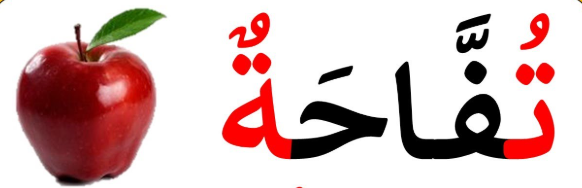
Ta looks just like Ba but carries two dots on top. Associate it with تفاحة (Tuffaha)—”apple.” Two dots, two eyes on the apple.
Children aged 4–7 love spotting the dots. This comparison between Ba and Ta also builds early letter-differentiation skills naturally.
Letter ث (Tha) – Trace three dots for a tricky fox named Tha
Tha has three dots on top. Connect it to ثعلب (Tha’lab)—”fox.” “Three dots for a tricky fox” is a phrase children remember easily.
For ages 8–12, challenge them to write Ba, Ta, and Tha in a row and count the dots together as a quick game.
The Ba family is often the first major pattern children notice in Arabic. Here is a clear breakdown of how these three letters relate:
| Letter | Name | Dots | Keyword | Meaning | Memory Hook |
| ب | Ba | 1 below | بيت (Bayt) | House | Boat with one anchor dot |
| ت | Ta | 2 above | تفاحة (Tuffaha) | Apple | Apple with two eyes |
| ث | Tha | 3 above | ثعلب (Tha’lab) | Fox | Tricky fox with three spots |
Mastering this first letter family gives children enormous confidence—they immediately see that Arabic has a logical system, not just random shapes to memorize.
Letter ج (Jim) – Follow the camel hump to find letter Jim
Jim curves like a hook with a dot inside. Link it to جمل (Jamal)—”camel.” The curved shape resembles a camel’s hump, making this association visually natural.
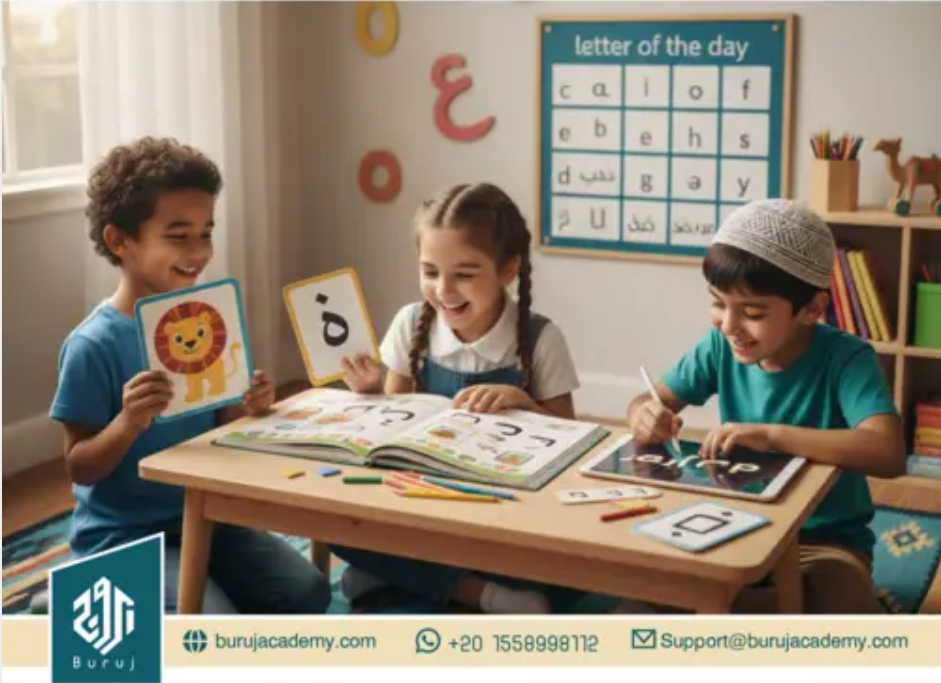
At Buruj Academy, our Arabic Alphabet Learning Course uses exactly these story-based connections to make every letter stick without drilling.
Get your kid a free trial now in the Best Alphabet course
Letter ح (Ha) introduces kids to breathed sounds in Arabic alphabet
Ha looks like Jim but has no dot—just an open curve. Connect it to حصان (Hisan)—”horse.”
Teach the sound by saying “breathe out on your hand—feel the warmth? That’s Ha!” This kinesthetic trick works especially well for ages 4–7 who learn through touch and movement.
Letter خ (Kha) – Place a sesame dot on bread for Kha
Kha is Ha with one dot on top. Link it to خبز (Khubz)—”bread.” A warm loaf with a dot of sesame on top is a fun image.
This letter completes the Jim-Ha-Kha family, helping children understand how Arabic letters form natural shape groups.
The Jim family is one of the most visually satisfying groups for children to discover:
| Letter | Name | Dot | Keyword | Meaning | Memory Hook |
| ج | Jim | 1 inside | جمل (Jamal) | Camel | Curved hump with a dot |
| ح | Ha | None | حصان (Hisan) | Horse | Open breath, no dot |
| خ | Kha | 1 above | خبز (Khubz) | Bread | Sesame dot on a loaf |
Pointing out this family pattern early teaches children to look for shapes first, then dots—a reading strategy that speeds up the entire Arabic alphabet learning journey for kids.
Letter د (Dal) is one of the easiest Arabic alphabet letters for kids to learn
Dal is simple—a gentle diagonal stroke. Associate it with دب (Dubb)—”bear.” “A sleeping bear curled up” describes the shape perfectly for younger children.
Ages 4–7 can practice drawing Dal repeatedly while saying “Dubb, Dubb, Dubb” aloud in a rhythmic chant.
Letter ذ (Dhal) – Add a golden dot to the letter Dhal
Dhal is Dal with one dot above. Connect it to ذهب (Dhahab)—”gold.” “The golden dot makes it Dhal” is a simple phrase children retain.
Pairing Dal and Dhal as a compare-and-spot game takes only five minutes and dramatically improves letter discrimination for all ages.
Letter ر (Ra) Flows Naturally as Kids Progress Through Arabic Alphabet Learning
Ra sweeps downward like a gentle curve. Link it to رمان (Rumman)—”pomegranate.” The letter flows like juice running down.
For ages 8–12, practicing Ra in connected words like رب builds early reading readiness alongside letter recognition, combining two skills efficiently in short sessions.
Discover the Buruj Academy Difference
Step into our virtual classrooms and see how our expert instructors make learning Quran and Arabic intuitive and clear. We focus on overcoming the specific hurdles non-native speakers face, building your confidence and connection with the Quran.
Letter ز (Zayn) – Add a Dot to Ra
Zayn is Ra with a dot on top. Associate it with زهرة (Zahra)—”flower.” “A flower growing above the curve” makes the dot meaningful.
Through Buruj Academy‘s Online Arabic Classes for Kids, instructors teach Ra and Zayn as a paired lesson, reinforcing the comparison skills children naturally enjoy.
Book your child’s free Arabic trial now!

Here is a helpful side-by-side view of the Dal and Ra letter families together:
| Letter | Name | Dot | Keyword | Meaning | Sound Tip for Kids |
| د | Dal | None | دب (Dubb) | Bear | Short, crisp “d” |
| ذ | Dhal | 1 above | ذهب (Dhahab) | Gold | Like “th” in “this” |
| ر | Ra | None | رمان (Rumman) | Pomegranate | Rolled, flowing “r” |
| ز | Zayn | 1 above | زهرة (Zahra) | Flower | Buzzing “z” sound |
The sound tips column is especially useful for parents reading aloud with their children—knowing the English equivalent sound makes correction much easier during home practice.
Letter س (Sin) – Count three fins on a fish for Sin
Sin has three “teeth” at the bottom—small bumps in a row. Connect it to سمكة (Samaka)—”fish.” “Three fish fins” or “smiling teeth” both work depending on your child’s personality.
Let your child choose which image they prefer—personal choice increases memory retention significantly for young learners.
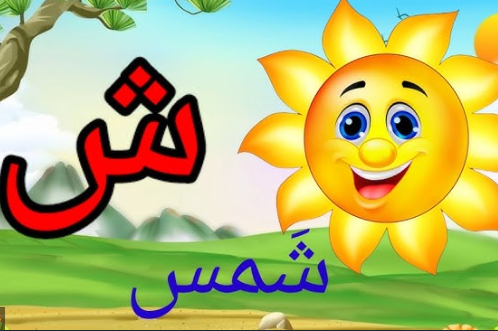
Letter ش (Shin) – Shine with three sun rays for letter Shin
Shin is Sin with three dots on top. Link it to شمس (Shams)—”sun.” “The sun shining with three rays” is a vivid image.
By this point, children begin noticing the dot-based pattern across Arabic letters, which is a key milestone in Arabic alphabet learning for kids.
Letter ص (Sad) Introduces Kids to Emphatic Sounds in Arabic Alphabet
Sad is a wide open loop. Connect it to صابون (Sabun)—”soap.” “A big soap bubble” captures the round, open shape perfectly.
The emphatic sound requires slight practice, but ages 8–12 catch it quickly when shown how the tongue sits lower in the mouth during pronunciation.
Letter ض (Dad) Is the Unique Letter That Makes Arabic Alphabet Special
Dad is Sad with one dot on top. Link it to ضفدع (Dufda’)—”frog.” “The spotted frog sitting in a bubble” makes both the shape and dot memorable together.
Arabic is famously called “the language of Dad (لغة الضاد)”—sharing this fact with older children builds pride in what they are learning.
Letter ط (Ta) – Find a bird standing in a nest for Ta
This emphatic Ta has a tall vertical stroke inside a curved base. Connect it to طائر (Ta’ir)—”bird.” “A bird standing in its nest” describes the shape vividly.
Distinguishing this Ta from the earlier ت (Ta) is important—teach them side by side for ages 8 and above.
Letter ظ (Dha) Completes the Emphatic Letter Family in Kids’ Arabic Alphabet Learning
Dha is emphatic Ta with a dot on top. Link it to ظبي (Dhabi)—”deer.” A graceful animal for a graceful letter.
At this stage, a short five-minute daily review of the emphatic letters as a group helps children consolidate what they have learned without feeling overwhelmed.
The emphatic letters are the most challenging group for non-Arabic-speaking children—this table helps parents understand what makes each one distinct:
| Letter | Name | Dot | Keyword | Meaning | vs. Non-Emphatic |
| س | Sin | None | سمكة (Samaka) | Fish | Regular “s” sound |
| ص | Sad | None | صابون (Sabun) | Soap | Heavy “s” from throat |
| ش | Shin | 3 above | شمس (Shams) | Sun | “Sh” sound |
| ض | Dad | 1 above | ضفدع (Dufda’) | Frog | Heavy “d” from throat |
| ط | Ta | None | طائر (Ta’ir) | Bird | Heavy “t” from throat |
| ظ | Dha | 1 above | ظبي (Dhabi) | Gazelle | Heavy “dh” from throat |
Showing children this table alongside a simple throat-versus-tongue gesture makes the emphatic group far less intimidating, turning a difficult concept into a manageable pattern.
Letter ع (Ayn) Is the Most Distinctive Sound in Arabic Alphabet Learning for Kids
Ayn is unlike any English sound—a deep, voiced letter from the throat. Connect it to عين (Ayn) itself—”eye.” The letter shape even resembles an eye.
For ages 4–7, have them point to their eye while saying the sound. This body-connection technique is highly effective for kinesthetic learners.
Letter غ (Ghayn) – Gargle like a desert gazelle for Ghayn
Ghayn is Ayn with one dot on top—a gargling sound at the back of the throat. Link it to غزالة (Ghazala)—”gazelle.”
Practicing Ayn and Ghayn back-to-back in a five-minute session helps children feel the sound difference physically, which is more effective than any written explanation for young learners.
Letter ف (Fa) – Curl an elephant trunk for the letter Fa
Fa has one dot above a curved body with a small hook. Connect it to فيل (Fil)—”elephant.” “The elephant’s trunk curling” describes the letter shape imaginatively.
Children who have been learning through Buruj Academy‘s Arabic Alphabet Learning Course typically reach Fa with strong confidence built across earlier letter families.
Get your kid a free trial now in the Best Alphabet course
Letter ق (Qaf) Teaches Kids the Deep Q Sound in Arabic Alphabet Learning
Qaf has two dots below a deep round bowl. Link it to قمر (Qamar)—”moon.” “A moon bowl holding two stars underneath” is poetic and memorable.
The Qaf sound comes from deep in the throat—practice it by having children say “q” while pressing their tongue to the back of the roof of their mouth.
Letter ك (Kaf) – Open a familiar book with the letter Kaf
Kaf resembles a backwards English “k” with a small diagonal mark inside. Connect it to كتاب (Kitab)—”book.” Since many children are already learning Quran, the word “Kitab” feels familiar and meaningful.
This personal connection to existing knowledge accelerates letter retention significantly for school-age children.
Letter ل (Lam) – Lean like a tall lemon tree for Lam
Lam rises tall with a graceful leftward lean at the base. Link it to ليمون (Laymun)—”lemon.” “A tall lemon tree leaning in the breeze” brings the letter to life.
Lam is also famous for the combination لا (La)—”no”—which children often know already, giving instant recognition and excitement.
Master the Arabic Language
Develop reading, writing, speaking, and comprehension skills through interactive Arabic lessons for all levels.
Start Arabic ClassesLetter م (Mim) Letter Sits Like a Circle
Mim is a small circle with a tail. Connect it to مدرسة (Madrasa)—”school.” “A round world of learning” ties the letter to something children experience daily.
Mim appears frequently in Quranic text, so recognizing it early gives children a head start in connecting Arabic alphabet learning for kids to Quran reading.
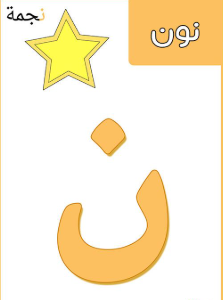
Letter ن (Nun) – Catch a shining star inside a bowl for Nun
Nun looks like a small bowl with one dot inside. Link it to نجمة (Najma)—”star.” “A star shining inside a bowl” is a lovely image for bedtime letter practice.
Nun appears in نُونْ at the start of Surah Al-Qalam, giving older children an immediate Quranic connection to celebrate.
Letter ه (Ha) – See the crescent moon in the letter Ha
Ha (the softer Ha) has several forms depending on its position in a word. Connect it to هلال (Hilal)—”crescent moon.”
Understanding its four positional forms is a key milestone for ages 8–12, as positional variation is one of the most important concepts in Arabic alphabet learning for kids progressing toward reading.
Letter و (Waw) – Curve a beautiful rose stem for letter Waw
Waw is a simple curved letter with a small hook at the top. Link it to وردة (Warda)—”rose.” “A rose stem curving downward” makes Waw immediately visual.
Waw also means “and” in Arabic, so teaching children phrases like أب وأم (father and mother) shows the letter functioning naturally in real language.
Read Also: Arabic Numbers for Kids
Letter ي (Ya) Completes the Arabic Alphabet for Kids
Ya has two dots below a long, sweeping tail. Connect it to يد (Yad)—”hand.” “Two fingers waving from a hand” completes the alphabet beautifully.
Reaching Ya is a genuine milestone—celebrate it with your child. Alhamdulillah, knowing all 28 letters opens the door to Quran reading, a gift that lasts a lifetime.
Read Also: Arabic Kids Books
The Complete Arabic Alphabet Reference Table Every Parent Needs for Kids’ Learning
Every child benefits from a single visual reference they can return to during review sessions. Print this table, stick it on a wall, or keep it open during daily practice—even five minutes of daily review using this chart builds remarkable cumulative progress over weeks.
| Letter | Name | Transliteration | Memory Keyword | Meaning | Memory Hook | |
| 1 | ا | Alif | A | أسد (Asad) | Lion | Tall, standing person |
| 2 | ب | Ba | B | بيت (Bayt) | House | Boat with one dot anchor |
| 3 | ت | Ta | T | تفاحة (Tuffaha) | Apple | Apple with two eyes |
| 4 | ث | Tha | Th | ثعلب (Tha’lab) | Fox | Tricky fox, three spots |
| 5 | ج | Jim | J | جمل (Jamal) | Camel | Curved hump with dot |
| 6 | ح | Ha | H (breathed) | حصان (Hisan) | Horse | Warm breath on your hand |
| 7 | خ | Kha | Kh | خبز (Khubz) | Bread | Sesame dot on a loaf |
| 8 | د | Dal | D | دب (Dubb) | Bear | Sleeping bear curled up |
| 9 | ذ | Dhal | Dh | ذهب (Dhahab) | Gold | Golden dot on Dal |
| 10 | ر | Ra | R | رمان (Rumman) | Pomegranate | Juice flowing downward |
| 11 | ز | Zayn | Z | زهرة (Zahra) | Flower | Flower growing above Ra |
| 12 | س | Sin | S | سمكة (Samaka) | Fish | Three fish fins in a row |
| 13 | ش | Shin | Sh | شمس (Shams) | Sun | Sun with three rays |
| 14 | ص | Sad | S (emphatic) | صابون (Sabun) | Soap | Big soap bubble |
| 15 | ض | Dad | D (emphatic) | ضفدع (Dufda’) | Frog | Spotted frog in a bubble |
| 16 | ط | Ta | T (emphatic) | طائر (Ta’ir) | Bird | Bird standing in its nest |
| 17 | ظ | Dha | Dh (emphatic) | ظبي (Dhabi) | Gazelle | Graceful dot on Ta |
| 18 | ع | Ayn | ‘ (voiced) | عين (Ayn) | Eye | Letter shaped like an eye |
| 19 | غ | Ghayn | Gh | غزالة (Ghazala) | Gazelle | Gargling dot on Ayn |
| 20 | ف | Fa | F | فيل (Fil) | Elephant | Trunk curling with a dot |
| 21 | ق | Qaf | Q | قمر (Qamar) | Moon | Moon bowl, two stars below |
| 22 | ك | Kaf | K | كتاب (Kitab) | Book | Familiar “k” shape |
| 23 | ل | Lam | L | ليمون (Laymun) | Lemon | Tall lemon tree leaning |
| 24 | م | Mim | M | مدرسة (Madrasa) | School | Round world of learning |
| 25 | ن | Nun | N | نجمة (Najma) | Star | Star shining in a bowl |
| 26 | ه | Ha | H (soft) | هلال (Hilal) | Crescent moon | Moon in different forms |
| 27 | و | Waw | W | وردة (Warda) | Rose | Rose stem curving down |
| 28 | ي | Ya | Y | يد (Yad) | Hand | Two fingers waving |
Masha’Allah—28 letters, 28 stories, and 28 reasons for your child to feel proud. Keep this table visible during daily review sessions, and encourage your child to cover the Memory Hook column and recall each association independently once they feel ready.
Read Also: Arabic Sentences for Kids
Master the Arabic Language
Develop reading, writing, speaking, and comprehension skills through interactive Arabic lessons for all levels.
Start Arabic ClassesRead Also: How to Learn Arabic for Kids?
Help Your Child Master Arabic Alphabet Learning with Buruj Academy’s Expert Instructors
Home practice with letter associations builds a wonderful foundation, but structured guidance accelerates progress significantly.
- Instructors trained in child pedagogy AND Islamic education
- Age-appropriate curriculum for children aged 4–15
- Gamification, songs, and stories—not dry drills
- Short 20–30 minute sessions matching kids’ attention spans
- Al-Azhar graduates with 12+ years teaching non-Arabic-speaking children
- Personalized pacing for every child’s learning speed
- Flexible scheduling around family routines
Book your child’s free trial lesson today with Buruj Academy‘s Arabic Alphabet Learning Course.
Find your child’s perfect match among Buruj’s top courses for kids:
- Arabic Classes for Kids
- Alphabet course
- Noorani Qaida Course for Kids
- Quranic Arabic Course
- Islamic Studies for Kids
- Hifz Classes for Kids
- Quran Classes for Kids
- Tajweed for Kids
Get a free trial for your child today.
Conclusion
Each Arabic letter for kids becomes easier to remember when it carries a story, an image, or a sound game. These associations give children a mental hook that transforms abstract shapes into familiar, meaningful characters they genuinely enjoy recognizing.
Learning the full 28-letter Arabic alphabet for kids works best in short daily sessions—even five minutes of letter review builds remarkable cumulative progress over weeks. Consistency matters far more than lengthy, infrequent study marathons for young learners.
Older children benefit from understanding letter families and positional forms, while younger ones thrive on simple image associations and repetition. Insha’Allah, every child who begins this journey reaches the joy of reading Allah’s words independently.





Leave a Reply