 Arabic
As a New Muslim, I Felt Lost. How Muslim Revert Learning Arabic Became My Anchor.
Becoming a new Muslim is a journey of immense joy, profound change, and often, unexpected challenges. For Sarah, a young woman who embraced Islam just over a year ago, the initial euphoria eventually gave way to a subtle but persistent feeling of being “behind” or “left out.” Therefore, she yearned to connect with the Quran on a deeper level, to truly understand the beautiful verses recited in prayers and community gatherings. Consequently, this is where the concept of Ijazah in Quran Recitation began to emerge as a beacon of hope for a committed Muslim revert learning Arabic.
Free Trial Session Contact Us
The Silent Struggle of a New Muslim and the Necessity of Muslim Revert Learning Arabic
Sarah’s conversion was heartfelt and transformative. Initially, she diligently learned the basics of prayer, fasting, and Islamic etiquette. Moreover, she attended lectures, read books, and surrounded herself with supportive Muslim friends. Yet, during congregational prayers, as the melodious voice of the Imam resonated through the mosque, reciting verses from the Quran, Sarah felt a pang of inadequacy. Specifically, she could follow along, perhaps recognize a few common words, but the profound meaning, the intricate beauty of the Arabic, remained largely a mystery.
“I felt like everyone else understood this secret language,” she confided in her friend, Aisha. “They’d nod, sometimes even shed tears, and I was simply there. Furthermore, I wanted that connection so badly, but it felt so far away.”
In short, this feeling of being an outsider, especially in something as central as the Quran, can be disheartening for new Muslims. Ultimately, they often come from diverse backgrounds, without prior exposure to Arabic, and the sheer volume of new information can be overwhelming. Hence, the journey of a Muslim revert learning Arabic is crucial to bridging this spiritual gap.
Unlocking the Quran: The Power of Proper Recitation and the Muslim Revert Learning Arabic Journey
The Quran is not just a book; rather, it is a living revelation, a miracle of language and meaning. Furthermore, its recitation, or tilawah, is an act of worship in itself. Crucially, the precise pronunciation, the melodious intonation, and the adherence to the rules of Tajweed (the science of Quranic recitation) are vital for conveying its intended message and experiencing its spiritual depth. Indeed, without understanding these nuances, a new Muslim can feel disconnected from the heart of their faith.
Sarah realized that merely reading transliterations wasn’t enough. Instead, she wanted to recite the Quran as it was revealed, with clarity and beauty. Specifically, she longed to feel the spiritual resonance that came with proper Tajweed. Therefore, this yearning led her to explore various avenues of study.
Finding Support for Muslim Revert Learning Arabic and Ijazah Study
The term Ijazah in Quran Recitation refers to a certificate or authorization granted by a qualified teacher. Significantly, it signifies a continuous chain of transmission tracing back to the Prophet Muhammad (peace be upon him). Clearly, it’s a long-term goal that begins with dedicated Arabic study.
For Sarah, the idea of an Ijazah seemed like a distant dream, something only for advanced students. However, Aisha, recognizing Sarah’s sincerity, encouraged her. “The most important step is becoming a proficient Muslim revert learning Arabic,” Aisha explained. “The journey of learning Tajweed is what truly transforms your connection with the Quran. In essence, it’s about building a strong foundation, one word at a time.”
Embarking on the Journey: From Beginner to Beloved Words
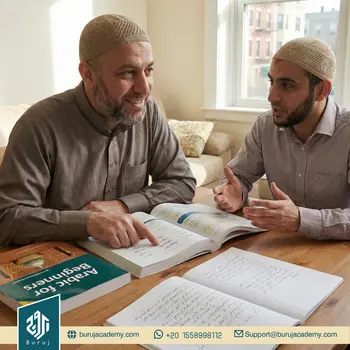
Sarah decided to take the first step. To begin with, she enrolled in an online beginner’s Arabic class, focusing specifically on Quranic Arabic. Undoubtedly, this was a game-changer. Learning the Arabic alphabet, understanding basic grammar, and practicing pronunciation slowly began to demystify the sacred text.
Admittedly, it was challenging at first. The new sounds, the different script – consequently, it all required immense focus and repetition. Nevertheless, Sarah persevered. Subsequently, she dedicated time each day to her studies, practicing her letters and short surahs. Furthermore, with each new word she recognized, a sense of accomplishment washed over her, replacing the earlier feelings of being left out.
The Transformation of Understanding Through Recitation Mastery for the Muslim Revert Learning Arabic
As Sarah progressed, simultaneously, she started noticing the incredible precision of the Arabic language in the Quran. Indeed, a single word could convey layers of meaning, and the rhythm of the verses was captivating. Therefore, she began to understand the importance of each diacritical mark, each elongated vowel, and each silent letter.
For example, understanding the difference between a long ‘a’ sound and a short ‘a’ could change the meaning of a word entirely. Although this meticulousness was initially intimidating, it became a source of wonder for Sarah. Ultimately, she realized that the rules of Tajweed were not arbitrary; they were designed to preserve the Quran’s authenticity and eloquence.
Finding Guidance: The Path to Achieving Proper Recitation
After several months of dedicated study, Sarah felt ready for the next step: formal Tajweed lessons. Consequently, she sought out a qualified female teacher who specialized in guiding reverts. Her teacher, Ustadhah Fatima, was patient, knowledgeable, and incredibly encouraging, making the process achievable for any Muslim revert learning Arabic.
Ustadhah Fatima introduced Sarah to the intricacies of Tajweed. In reality, it was a rigorous process, involving listening, reciting, and correcting.
“It’s like learning to play a musical instrument,” Ustadhah Fatima explained. “Therefore, each note must be precise, each melody perfect, to truly convey the composer’s intent. Similarly, with the Quran, the composer is Allah, and the notes are His divine words.”
Sarah diligently practiced. Often, she would record her recitation, listen back, and compare it to her teacher’s. Hence, she spent hours repeating verses, focusing on each letter, each pause, each subtle nuance.
The Spiritual Rewards of Proper Recitation and Quranic Study – Muslim Revert Learning Arabic
Beyond the technical aspects, Sarah discovered a profound spiritual reward in her pursuit of proper recitation. As a result, as her pronunciation improved and her understanding deepened, her prayers became more meaningful. Now, the words she recited during Salat were no longer just sounds; they carried weight, purpose, and a direct connection to Allah.
In fact, she experienced moments of intense tranquility and emotional connection while reciting. The feeling of being “behind” gradually faded, replaced by a sense of belonging and deep gratitude. Finally, she was no longer just listening to the Quran; she was actively engaging with it. Therefore, the goal of obtaining an Ijazah in Quran Recitation felt like a natural progression of her profound journey.
Reaching for the Pinnacle: The Ijazah Aspiration
While Sarah is still on her journey, the aspiration for an Ijazah has become a tangible goal. Ultimately, she understands that it represents a commitment to upholding the sacred tradition of Quranic transmission.
The path to Ijazah is long and demands unwavering dedication, but Sarah is resolute. Nevertheless, she knows that every hour spent practicing, every mistake corrected, brings her closer to that beautiful accomplishment.
For any new Muslim who feels lost or disconnected from the Quran, Sarah’s story offers a powerful message: the journey of Muslim revert learning Arabic and mastering Tajweed is not just about memorizing rules; rather, it is about forging an unbreakable bond with the words of Allah. Indeed, it is about transforming a feeling of being “left out” into a profound sense of belonging and spiritual fulfillment.
Ready to Take the Next Step? Essential Resources for Your Journey – Muslim Revert Learning Arabic
If Sarah’s journey resonates with you and you are ready to start or continue your path, we have resources that will guide you further. For instance, dive deeper into understanding the certification she seeks by reading our detailed article What is Ijazah in Quran. Furthermore, discover convenient learning options with our guide Arabic Language Learning. Also, don’t miss our comprehensive breakdown of Tajweed for Beginners. These resources will help you build your foundation and confidently pursue your goals.



Leave a Reply