 Quran
Surah Al-Fath holds a place unlike almost any other chapter in the Quran because of what the Prophet ﷺ himself said about it. When the news reached him during a night journey, he described it in words that non-Arabic speaking students often find startling in their intensity.
Surah Al-Fath’s core benefit is textually and narratively confirmed: the Prophet ﷺ declared it more beloved to him than the entire world in an authentic hadith recorded by Imam al-Bukhari. Its opening verses also carry a direct, named promise of forgiveness – a benefit unmatched in specificity across most Surahs.
Table of Contents:
1. The Prophet Muhammad ﷺ Called Surah Al-Fath More Beloved Than the Entire World
This is the single most authenticated virtue connected to Surah Al-Fath, and it comes directly from the Prophet’s own words rather than a later scholarly opinion. `Umar ibn al-Khattab (RA) reported that during a night journey, the Prophet ﷺ did not answer his questions for a time, then called him over and said a Surah had just been revealed that was dearer to him than everything the sun rises upon.
The Hadith is recorded in Sahih al-Bukhari, graded authentic (Sahih) by Imam al-Bukhari himself.
إِنَّا فَتَحْنَا لَكَ فَتْحًا مُّبِينًا
Inna fatahna laka fathan mubeena
“Indeed, We have given you, [O Muhammad], a clear conquest.” (Al-Fath 48:1)
This is the opening verse the Prophet ﷺ recited to `Umar (RA) immediately after describing his love for the Surah.
In our sessions at Buruj Academy, we’ve noticed that students who learn this hadith before memorizing Surah Al-Fath recite it with a different quality of attention.
Knowing the Prophet ﷺ himself treasured these exact words changes the emotional weight of every syllable.
This kind of context — understanding not just what a Surah says, but why the Prophet ﷺ loved it — is something our Online Quran Recitation Course builds into every lesson, rather than treating recitation as sound production alone.
Book your first FREE recitation lesson

2. Surah Al-Fath Contains a Direct Promise of Forgiveness for the Prophet Muhammad ﷺ
The second verse of Surah Al-Fath states plainly that Allah has forgiven the Prophet ﷺ for what preceded and what would follow of his sin, a promise unique in its explicitness among Quranic chapters. This is part of why the Surah struck the companions so powerfully when it was revealed.
لِّيَغْفِرَ لَكَ اللَّهُ مَا تَقَدَّمَ مِن ذَنبِكَ وَمَا تَأَخَّرَ وَيُتِمَّ نِعْمَتَهُ عَلَيْكَ وَيَهْدِيَكَ صِرَاطًا مُّسْتَقِيمًا
Liyaghfira lakal-lāhu mā taqaddama min dhanbika wa mā ta’akhkhara wa yutimma ni’matahu ‘alayka wa yahdiyaka ṣirāṭam mustaqīmā
“That Allah may forgive for you what preceded of your sin and what will follow and complete His favor upon you and guide you to a straight path.” (Al-Fath 48:2)
This verse follows directly from the “clear victory” announced in ayah 1, linking the historical event to a spiritual reward.
When this verse was revealed, the companions responded with visible joy, understanding it as glad tidings specifically for the Prophet ﷺ. Scholars note this promise came after the apparent hardship of the Hudaybiyyah treaty, reframing what looked like a setback as a spiritual victory.
Students working through Tafsir at the beginner level sometimes assume the entire Surah is about military conquest. In our experience teaching Islamic Studies to non-Arabic speakers, clarifying this distinction early prevents a shallow reading of the whole chapter.
Read also:Benefits of Surah Al-Hadid: 7 Authentic Virtues Every Muslim Should Know
3. Surah Al-Fath Describes Allah Sending Divine Tranquility Into Believers’ Hearts
Ayah 4 of Surah Al-Fath states that Allah sent down Sakinah, meaning tranquility or calm reassurance, into the hearts of the believers to increase their faith. This verse is directly tied to the emotional distress the companions felt at Hudaybiyyah before understanding the treaty’s wisdom.
هُوَ الَّذِي أَنزَلَ السَّكِينَةَ فِي قُلُوبِ الْمُؤْمِنِينَ لِيَزْدَادُوا إِيمَانًا مَّعَ إِيمَانِهِمْ
Huwa alladhi anzala as-sakinata fi qulubil-mu’minina liyazdadu imanam ma’a imanihim
“It is He who sent down tranquillity into the hearts of the believers that they would increase in faith along with their [present] faith.” (Al-Fath 48:4)
Sakinah here is described as an active, faith-increasing gift — not merely the absence of anxiety.
Classical commentary connects this verse to the specific psychological state of the 1,400 companions at Hudaybiyyah, who had prepared for pilgrimage but were forced to accept a treaty many perceived as humiliating. Their inner turmoil was met with divine calm rather than external resolution first.
Read also: The Best Way to Memorize Surah Rahman
4. Reciting Surah Al-Fath Connects Believers to a Moment the Prophet ﷺ Recited It Publicly During Travel
`Abdullah ibn al-Mughaffal (RA) reported witnessing the Prophet ﷺ reciting Surah Al-Fath while riding his camel, in a vibrating and melodious tone, during one of his journeys. This is recorded by both Al-Bukhari and Muslim, making it a doubly authenticated account of the Prophet’s own recitation style for this specific Surah.
Mu’awiyah, who narrated part of this account, added that he feared attempting to imitate the beauty of that recitation would draw too large a crowd around him. This detail illustrates how memorable the Prophet’s recitation of this particular Surah was to those who witnessed it directly.
For students working on Tarteel and recitation beautification, this authentic account offers something folk claims never can: a verified historical model of how the Prophet ﷺ himself approached this Surah vocally, not through invented spiritual formulas.
Learning to recite with this kind of attentiveness and beauty is central to what our Online Tajweed Classes teach, using the Buruj Method’s sound-before-rules approach so students internalize correct articulation before layering on rule terminology. Related foundational skills are covered in our guide to Tajweed for beginners.
Book Your FREE Trial Lesson to Begin Your Tajweed Journey
5. Surah Al-Fath Records Allah’s Pleasure With the Companions Who Pledged Under the Tree
Ayah 18 of Surah Al-Fath states that Allah was pleased with the believers who pledged allegiance to the Prophet ﷺ under a tree at Hudaybiyyah, an event known as Bay’ah al-Ridwan. Roughly 1,400 companions took this pledge, and Allah’s pleasure with them is recorded explicitly in this verse.
لَّقَدْ رَضِيَ اللَّهُ عَنِ الْمُؤْمِنِينَ إِذْ يُبَايِعُونَكَ تَحْتَ الشَّجَرَةِ
Laqad radiyal-lahu ‘anil-mu’minina idh yubayi’unaka tahtash-shajarah
“Certainly was Allah pleased with the believers when they pledged allegiance to you, [O Muhammad], under the tree.” (Al-Fath 48:18)
This verse gave the pledge its name, Bay’ah al-Ridwan — “the pledge of pleasure” — because Allah’s contentment with participants is directly stated.
According to authentic reports recorded in Sahih Muslim, the Prophet ﷺ stated that none of those who pledged allegiance under the tree would enter the Fire. This is among the strongest documented virtues attached to any group of companions in the entire Quran.
This is a foundational moment students encounter when studying 10 manners of reading the Quran, since understanding the historical weight behind a verse shapes how attentively a student engages with its recitation.
6. Surah Al-Fath Ayah 27 Confirms That Allah’s Promises Are Fulfilled on His Timeline
Ayah 27 records that Allah confirmed the truth of the Prophet’s vision that the believers would enter Masjid al-Haram safely, a promise fulfilled the following year despite the companions being turned away at Hudaybiyyah itself. This verse directly addresses the gap between a divine promise and its visible fulfillment.
لَّقَدْ صَدَقَ اللَّهُ رَسُولَهُ الرُّؤْيَا بِالْحَقِّ ۖ لَتَدْخُلُنَّ الْمَسْجِدَ الْحَرَامَ إِن شَاءَ اللَّهُ آمِنِينَ
Laqad sadaqal-lahu rasulahur-ru’ya bil-haqq, latadkhulunnal-masjidal-harama insha’Allahu aminin
“Certainly has Allah showed to His Messenger the vision in truth. You will surely enter al-Masjid al-Haram, if Allah wills, in safety.” (Al-Fath 48:27)
The companions were prevented from entering Makkah at the time of this revelation; the promise was fulfilled during the following year’s pilgrimage.
This verse is one many students return to during a Hifz plateau or a period when a specific goal, memorizing a Juz, completing an Ijazah, or simply reading fluently, seems to be taking longer than expected. It is a reminder from an authentic, explicit Quranic text that delay is not denial.
We’ve observed in our own classrooms that students who reflect on this verse specifically during a memorization slump often regain consistency faster than those who push through on willpower alone.
Our Quran revision timetable builds in the kind of steady, sustainable pacing this verse encourages, rather than expecting instant results.
Discover the Buruj Academy Difference
Step into our virtual classrooms and see how our expert instructors make learning Quran and Arabic intuitive and clear. We focus on overcoming the specific hurdles non-native speakers face, building your confidence and connection with the Quran.
Excel in Your Quranic Studies
Join Buruj Academy and master the Quran with our structured, professional curriculum.
Book Your Free Trial7. Surah Al-Fath Ayah 29 Gives One of the Quran’s Most Detailed Descriptions of the Believing Community
The final verse of Surah Al-Fath, ayah 29, describes Muhammad ﷺ as the Messenger of Allah and his companions as firm against disbelievers yet merciful among themselves, marked by the visible trace of prostration on their faces. This is among the most comprehensive single-verse character portraits in the entire Quran.
مُّحَمَّدٌ رَّسُولُ اللَّهِ ۚ وَالَّذِينَ مَعَهُ أَشِدَّاءُ عَلَى الْكُفَّارِ رُحَمَاءُ بَيْنَهُمْ
Muhammadur-rasulullah, wal-ladhina ma’ahu ashiddau ‘alal-kuffari ruhama’u baynahum
“Muhammad is the Messenger of Allah; and those with him are forceful against the disbelievers, merciful among themselves.” (Al-Fath 48:29)
The verse continues describing their prayer, their sincerity, and their comparison to a growing crop — a parable found in both the Torah and the Gospel according to the verse itself.
Classical Tafsir notes that this verse deliberately pairs the name “Muhammad” directly with “Messenger of Allah” as a permanent testimony recorded in the Quran itself, a detail scholars highlight as intentional and significant.
Read also:Benefits of Surah Yunus: Authentic Virtues Every Muslim Should Know
What Are the Benefits of Surah Al-Fath for Success in Difficult Circumstances?
Surah Al-Fath’s relevance to success lies in its central theme: Allah reframing an apparent setback, the Hudaybiyyah treaty, as a “clear victory” before its worldly benefits were even visible. This makes it a Surah believers often turn to during periods where outcomes feel delayed or unclear.
The historical backdrop matters here. The treaty initially looked unfavorable to the Muslims, yet the Quran calls it fathan mubeena, an open and unambiguous victory, well before the conquest of Makkah itself occurred.
For students memorizing this Surah during a plateau in their own progress, we’ve found that reflecting on this theme — victory disguised as delay — often restores motivation faster than generic encouragement alone. Understanding why a Surah addresses hardship makes memorization meaningful rather than mechanical, a principle explored further in our guide on how to stay motivated during Hifz.
This is not a promise that reciting the Surah produces worldly success in a transactional sense. Rather, its authenticated theme is that Allah’s plan may look like hardship before it looks like victory, which is a matter of reflection, not a guaranteed formula.
Does Surah Al-Fath Guarantee Financial or Career Success When Recited?
No authentic hadith attaches guaranteed financial or career success to reciting Surah Al-Fath a set number of times. This is a common folk claim without a traceable, verified source in the major hadith collections.
What is authentically established is the Surah’s thematic content: it reframes apparent setbacks as concealed victories, which believers can draw genuine spiritual encouragement from during difficult seasons, without treating the Surah as a mechanical charm for specific worldly outcomes.
What Does Surah Al-Fath Teach About Marriage and Family Relationships?
Surah Al-Fath does not contain specific verses addressing marital relationships directly, and any claim that it produces marital harmony through recitation is not supported by an authentic hadith. This is one of the areas where folk tradition has significantly outpaced verified sources.
We want to be direct with our students about this, because honest scholarship matters more to us than telling people what popularizes well. According to authentic Islamic scholarship, no Surah functions as a guaranteed ritual formula for a specific worldly outcome like marital harmony.
What the Surah does offer married believers is its broader theme of Sakinah, tranquility descending upon hearts, which appears in ayah 4. Reflecting on this concept in a shared family context, understanding that inner peace is a divine gift rather than something manufactured through circumstance alone, is a legitimate and valuable spiritual application.
We would rather tell our students the honest scholarly position than repeat an unverified claim simply because it circulates widely online. This same standard applies across everything we teach, whether in Tajweed, Hifz, or Tafsir.
Read also: Surah Al-A’la Benefits and Importance: Authentic Virtues Every Muslim Should Know
Is It Authentic That Surah Al-Fath Should Be Read After Zuhr Prayer?
No, the specific claim that Surah Al-Fath must be recited after Zuhr prayer traces back to a narration that hadith scholars have been unable to locate in any authentic hadith book. Islamic scholarly bodies examining this exact claim have explicitly stated it should be approached with caution.
The circulating narration lists five Surahs assigned to the five daily prayers, including Surah Al-Fath after Zuhr specifically. When this claim was examined by hadith specialists, they concluded it is untraceable in the primary hadith collections and should not be quoted as if it were verified.
This does not mean reciting Surah Al-Fath after Zuhr is discouraged. There is no prohibition on reciting any Surah after any prayer as personal, voluntary remembrance. The issue is only with presenting this specific pairing as a proven Prophetic instruction when it is not.
We think this distinction matters. A student can recite Surah Al-Fath after Zuhr as a personal act of devotion without needing to believe it fulfills an authenticated hadith that does not actually exist in verified form.
Establishing a consistent personal time, whether during a regular Quran session or after any prayer, is a matter of personal spiritual routine rather than religious obligation.
Our guide on the best time to read Quran covers this principle in more depth for students building a daily habit.
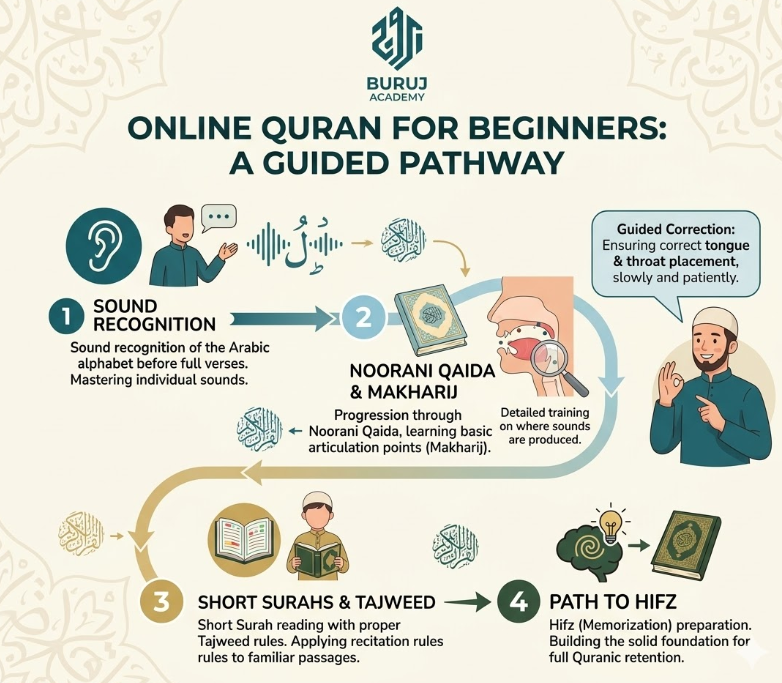
Building any consistent recitation habit benefits from structured guidance rather than guesswork, which is exactly what our online Quran classes for beginners are designed to provide through personalized scheduling with Ijazah-certified instructors.
Begin Learning Quran With a FREE Trial Lesson
Learn Surah Al-Fath With Buruj Academy’s Expert Instructors
Understanding Surah Al-Fath authentically, separating verified Hadith from folk tradition, deepens both recitation and reflection. Buruj Academy’s Ijazah-certified instructors and Al-Azhar University graduates bring this same rigor to every Surah we teach.
Our Online Quran Classes use the Buruj Method, prioritizing sound-before-rules and context-before-abstraction, so students understand not just what they’re reciting, but why it matters historically and spiritually. Every session is personalized to the student’s age, level, and learning pace.
With flexible 1-on-1 scheduling available globally and real-time correction from patient, experienced teachers, students build lasting connection to the Quran rather than memorized formulas.
Book a free trial lesson today and experience the difference firsthand.
Take the next step in your learning journey today by enrolling in one of our specialized programs:
- Online Quran Classes
- Online Quran Classes for Beginners
- Online Quran Classes for Adults
- Online Quran Classes for Ladies
- Online Quran Classes for Kids
- Quran Reading Course
- Quran Recitation Course
- Online Ijazah Course
- Online Qirat Course
Don’t wait to transform your relationship with the Holy Quran. Join our global community of students and book your free evaluation session now!
Excel in Your Quranic Studies
Join Buruj Academy and master the Quran with our structured, professional curriculum.
Book Your Free TrialDiscover the Buruj Academy Difference
Step into our virtual classrooms and see how our expert instructors make learning Quran and Arabic intuitive and clear. We focus on overcoming the specific hurdles non-native speakers face, building your confidence and connection with the Quran.
Conclusion
Surah Al-Fath’s true weight rests on what can be verified: the Prophet’s own testimony of his love for it, its explicit promise of forgiveness, and its historically anchored themes of tranquility, patience, and delayed victory. These authenticated points carry far more spiritual substance than any unverified claim ever could.
Approaching this Surah honestly means accepting that some popular claims, like guaranteed marital harmony or a fixed post-Zuhr recitation requirement, simply lack a traceable source. That honesty doesn’t diminish the Surah’s value; it protects the genuine weight of what is actually established.
Students who learn Surah Al-Fath through its real history, the Hudaybiyyah treaty, the Bay’ah al-Ridwan, and the Prophet’s own recorded joy, tend to carry it with them differently than those handed a list of unverified promises.
Frequently Asked Questions About Surah Al-Fath Benefits
Is Surah Al-Fath a Makki or Madani Surah?
Surah Al-Fath is a Madani Surah, revealed after the Prophet’s migration to Madinah, specifically following the Hudaybiyyah treaty. It contains 29 verses and is the 48th chapter of the Quran, positioned in the 26th Juz.
What Is the Historical Event Behind Surah Al-Fath’s Revelation?
Surah Al-Fath was revealed shortly after the Treaty of Hudaybiyyah, an agreement many companions initially perceived as unfavorable. The Surah reframed the treaty as a “clear victory,” a reading later confirmed by the conquest of Makkah.
Are There Authentic Hadiths About Reciting Surah Al-Fath a Specific Number of Times?
No authentic hadith specifies a set number of recitations of Surah Al-Fath for a particular reward. Verified narrations focus on the Prophet’s love for the Surah and its historical revelation, not a formulaic repetition count.
Can Beginners Memorize Surah Al-Fath Early in Their Hifz Journey?
Surah Al-Fath is a longer, 29-verse Madani Surah with less repetitive structure than short Surahs, so many instructors introduce it after a student has built consistency with shorter chapters. Our Hifz program sequences Surahs based on individual readiness.
Where Can I Verify Hadiths Mentioned About Surah Al-Fath Myself?
All hadiths referenced regarding Surah Al-Fath, including the Prophet’s love for it, can be verified directly on Sunnah.com, which hosts the full text and authenticity grading for Sahih al-Bukhari and other major collections.The article is complete above, delivered directly in chat per your instructions.