 Arabic
| Key Takeaways |
| Arabic future tense is formed by adding the prefix سَـ (sa-) or the word سَوْفَ (sawfa) directly before a present-tense verb. |
| The present-tense verb stem stays unchanged; only the subject prefix or suffix signals who performs the future action. |
| سَـ indicates the near future; سَوْفَ implies a more distant, emphatic, or certain future event in formal Arabic. |
| All 13 Arabic subject pronouns require distinct present-tense conjugations, each of which accepts the future prefix identically. |
Knowing how to express future intentions is one of the first practical milestones in Arabic grammar. Whether you are reading Quranic Arabic, studying Modern Standard Arabic (MSA), or aiming to understand Arabic news and literature, the future tense appears constantly — in promises, plans, prophecies, and everyday speech.
Arabic future tense conjugation is simpler than most English speakers expect. You do not learn a new set of verb forms.
Instead, you place سَـ (sa-) or سَوْفَ (sawfa) before an already-conjugated present-tense verb, and the meaning shifts cleanly into the future. The verb structure beneath that prefix does all the heavy lifting.
Table of Contents:
What Is the Arabic Future Tense?
The Arabic future tense expresses actions that have not yet occurred. It is formed by attaching the prefix سَـ (sa-) or the independent particle سَوْفَ (sawfa) to the المضارع (al-muḍāriʿ), the present/imperfect tense verb. No new conjugation table exists for the future — the present-tense verb form is used exactly as-is, with the future marker prepended.
This is one of the most learner-friendly features of Arabic grammar. Once you have internalized present-tense conjugation — which we cover thoroughly in our beginner’s guide to Arabic grammar — adding the future tense costs you almost nothing.
The Difference Between سَـ and سَوْفَ in the Arabic Future Tense
Both markers indicate future time, but they carry a subtle distinction that matters in formal Arabic:
| Marker | Form | Implied Time | Register |
| سَـ (sa-) | Prefix attached directly to verb | Near or general future | Formal and everyday MSA |
| سَوْفَ (sawfa) | Independent word before verb | Distant, emphatic, or certain future | Formal, literary, Quranic |
In practice, سَـ is the more common marker in MSA writing and speech. سَوْفَ appears frequently in the Quran and classical texts, often carrying a weight of certainty or solemnity. Consider this Quranic example:
وَلَسَوْفَ يُعْطِيكَ رَبُّكَ فَتَرْضَىٰ
Wa la-sawfa yuʿṭīka rabbuka fa-tarḍā
“And your Lord is going to give you, and you will be satisfied.” (Ad-Duha 93:5)
Here سَوْفَ carries strong certainty — a divine promise of future fulfillment, not a casual prediction.
Arabic Future Tense Conjugation Chart
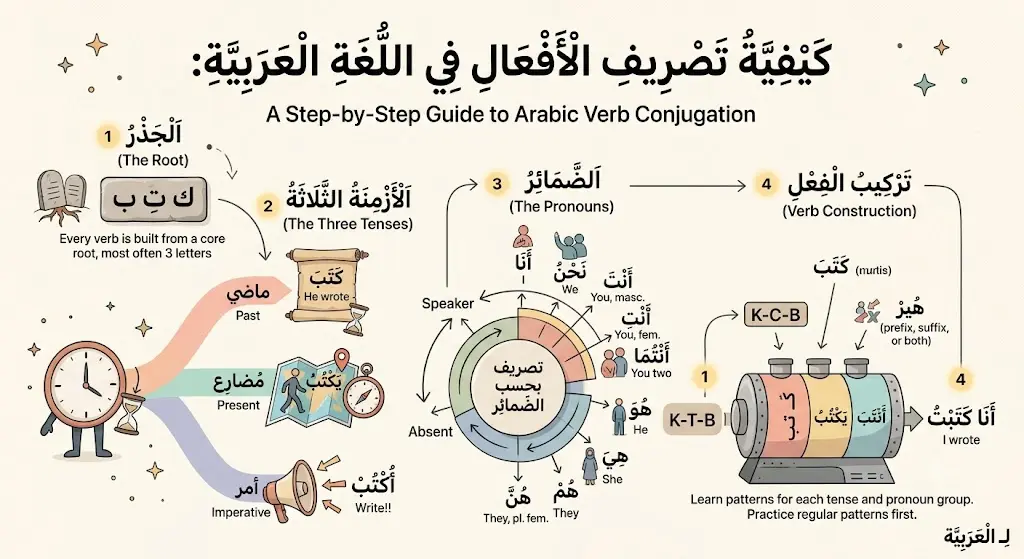
The backbone of Arabic future tense conjugation is the present-tense verb. We use the root كَتَبَ (kataba — to write) to build our conjugation chart, as it is one of the most regular and commonly taught verb patterns.
The present-tense base form يَكْتُبُ (yaktubu — he writes) shifts to سَيَكْتُبُ (sayaktubu — he will write) simply by adding سَـ.
Full Conjugation Chart: سَ + يَكْتُبُ (to write — future tense)
| Pronoun | Arabic Pronoun | Present Tense | Future Tense | Transliteration |
| He | هُوَ | يَكْتُبُ | سَيَكْتُبُ | sayaktubu |
| She | هِيَ | تَكْتُبُ | سَتَكْتُبُ | sataktubu |
| You (m. sing.) | أَنْتَ | تَكْتُبُ | سَتَكْتُبُ | sataktubu |
| You (f. sing.) | أَنْتِ | تَكْتُبِينَ | سَتَكْتُبِينَ | sataktubīna |
| I | أَنَا | أَكْتُبُ | سَأَكْتُبُ | saʾaktubu |
| They (m. pl.) | هُمْ | يَكْتُبُونَ | سَيَكْتُبُونَ | sayaktubūna |
| They (f. pl.) | هُنَّ | يَكْتُبْنَ | سَيَكْتُبْنَ | sayaktubna |
| They (m. dual) | هُمَا | يَكْتُبَانِ | سَيَكْتُبَانِ | sayaktubāni |
| They (f. dual) | هُمَا | تَكْتُبَانِ | سَتَكْتُبَانِ | sataktubāni |
| You (m. pl.) | أَنْتُمْ | تَكْتُبُونَ | سَتَكْتُبُونَ | sataktubūna |
| You (f. pl.) | أَنْتُنَّ | تَكْتُبْنَ | سَتَكْتُبْنَ | sataktubna |
| You (m. dual) | أَنْتُمَا | تَكْتُبَانِ | سَتَكْتُبَانِ | sataktubāni |
| We | نَحْنُ | نَكْتُبُ | سَنَكْتُبُ | sanaktubu |
This single table reveals an important pattern: the future marker سَـ attaches uniformly to every form. The variety lives entirely inside the present-tense verb — its prefixes and suffixes signal gender, number, and person.
Through Buruj Academy’s Arabic Grammar Course, we walk students through exactly this kind of systematic table-building — because seeing the pattern clearly is what makes conjugation stick rather than float as memorized fragments.
Understand the Arabic Grammar with Buruj’s free trial lesson

Arabic Future Tense Conjugation Examples Across Multiple Common Verbs
One verb pattern is not enough. Arabic future tense conjugation examples across different roots reveal how consistent the system is — and build the confidence you need to apply it beyond classroom exercises.
We use four high-frequency verbs here, each showing how سَـ or سَوْفَ attaches regardless of root type.
Verb 1: ذَهَبَ (to go) — Root: ذ-هـ-ب
| Pronoun | Future Tense | Meaning |
| هُوَ | سَيَذْهَبُ | He will go |
| هِيَ | سَتَذْهَبُ | She will go |
| أَنَا | سَأَذْهَبُ | I will go |
| نَحْنُ | سَنَذْهَبُ | We will go |
| أَنْتَ | سَتَذْهَبُ | You (m.) will go |
Example sentence:
سَيَذْهَبُ الطَّالِبُ إِلَى الْمَدْرَسَةِ غَدًا
Sayaḏhabu al-ṭālibu ilā al-madrasa ghadan.
The student will go to school tomorrow.
Verb 2: قَرَأَ (to read) — Root: ق-ر-أ
| Pronoun | Future Tense | Meaning |
| هُوَ | سَيَقْرَأُ | He will read |
| هِيَ | سَتَقْرَأُ | She will read |
| أَنَا | سَأَقْرَأُ | I will read |
| هُمْ | سَيَقْرَؤُونَ | They (m.) will read |
Example sentence:
سَأَقْرَأُ الْقُرْآنَ بَعْدَ صَلَاةِ الْفَجْرِ
Saʾaqraʾu al-Qurʾāna baʿda ṣalāti al-fajri.
I will read the Quran after Fajr prayer.
Master the Arabic Language
Join our expert-led courses and build a strong foundation in Classical and Modern Arabic.
Get Your Free TrialVerb 3: دَرَسَ (to study) — Root: د-ر-س
| Pronoun | Future Tense | Meaning |
| هِيَ | سَتَدْرُسُ | She will study |
| أَنْتِ | سَتَدْرُسِينَ | You (f.) will study |
| نَحْنُ | سَنَدْرُسُ | We will study |
| هُمْ | سَيَدْرُسُونَ | They will study |
Example sentence: سَتَدْرُسُ الطَّالِبَةُ اللُّغَةَ الْعَرَبِيَّةَ كُلَّ يَوْمٍ. Satadrusu al-ṭālibatu al-lugha al-ʿarabiyyata kulla yawmin. “The female student will study Arabic every day.”
Verb 4: فَهِمَ (to understand) — Root: ف-هـ-م
| Pronoun | Future Tense | Meaning |
| هُوَ | سَيَفْهَمُ | He will understand |
| أَنَا | سَأَفْهَمُ | I will understand |
| أَنْتُمْ | سَتَفْهَمُونَ | You (m. pl.) will understand |
Example sentence:
سَوْفَ تَفْهَمُ الْقَوَاعِدَ بَعْدَ التَّدْرِيبِ
Sawfa tafhamu al-qawāʿida baʿda al-tadrībi.
You will understand the rules after practice.
In our sessions at Buruj Academy, we notice that students who practice future tense across multiple verbs early — rather than drilling one verb exhaustively — build much stronger pattern recognition.
The structure clicks faster when you encounter it across varying roots. If you want to strengthen your vocabulary alongside grammar, our guide to mastering Arabic vocabulary pairs well with this stage.
Our Online Arabic Classes at Buruj Academy build this bridge explicitly, taught by Al-Azhar graduates specializing in Arabic linguistics.
Book your FREE Arabic trial online Arabic class at Buruj

How the Arabic Future Tense Appears in the Quran
Quranic Arabic uses سَوْفَ and سَـ extensively — especially in verses discussing divine promise, warning, and the Day of Judgment. Recognizing these future markers inside Quranic text is a profound motivator for students, because it connects grammar study directly to worship and understanding.
A clear سَـ future example:
فَسَيَكْفِيكَهُمُ اللَّهُ
Fasayakfīkahumu Allāh
“And Allah will be sufficient for you against them.” (Al-Baqarah 2:137)
The prefix سَـ on يَكْفِي— present tense of “to suffice” — converts it directly to a future promise. The root verb structure remains entirely intact.
Students in our Quranic Arabic Classes regularly experience breakthroughs when they first identify these prefixes in live recitation. Grammar that once felt abstract becomes a living tool for comprehension.
Begin Understanding Quranic Arabic with a FREE Lesson

Arabic Future Tense Conjugation Exercises to Reinforce the Pattern
Passive reading of conjugation charts does not build fluency. Active production does. Below are structured exercise types we use at Buruj Academy to help students internalize future tense conjugation.
Exercise Type 1: Prefix Transformation Drill
Take a present-tense sentence and convert it to future tense by adding سَـ:
| Present Tense Sentence | Future Tense (Your Answer) | Answer |
| يَكْتُبُ الْوَلَدُ الدَّرْسَ. | ؟ | سَيَكْتُبُ الْوَلَدُ الدَّرْسَ. |
| تَذْهَبُ الْبِنْتُ إِلَى الْمَسْجِدِ. | ؟ | سَتَذْهَبُ الْبِنْتُ إِلَى الْمَسْجِدِ. |
| نَدْرُسُ الْعَرَبِيَّةَ كُلَّ يَوْمٍ. | ؟ | سَنَدْرُسُ الْعَرَبِيَّةَ كُلَّ يَوْمٍ. |
| أَقْرَأُ الْكِتَابَ فِي الْمَسَاءِ. | ؟ | سَأَقْرَأُ الْكِتَابَ فِي الْمَسَاءِ. |
Exercise Type 2: Choose سَـ or سَوْفَ
Identify which marker fits the context better:
- A casual plan: “I will call you tomorrow.” → سَأَتَّصِلُ بِكَ غَدًا. (سَـ — near, informal future)
- A solemn promise with certainty: “He will surely succeed.” → سَوْفَ يَنْجَحُ. (سَوْفَ — emphatic, certain)
- A scheduled event: “The class will start at 6.” → سَيَبْدَأُ الدَّرْسُ السَّاعَةَ السَّادِسَةَ. (سَـ — routine future)
Exercise Type 3: Sentence Building from Pronouns
Given a pronoun and a verb root, build the full future tense sentence:
| Pronoun | Verb | Intended Meaning | Answer |
| هِيَ | فَهِمَ | She will understand | سَتَفْهَمُ |
| أَنْتُمْ | كَتَبَ | You (pl.) will write | سَتَكْتُبُونَ |
| هُمَا | ذَهَبَ | They (dual m.) will go | سَيَذْهَبَانِ |
| نَحْنُ | قَرَأَ | We will read | سَنَقْرَأُ |
Understanding Arabic sentence structure will help you place these future-tense verbs correctly within full sentences, especially when adding objects and adverbs of time.
Discover the Buruj Academy Difference
Step into our virtual classrooms and see how our expert instructors make learning Quran and Arabic intuitive and clear. We focus on overcoming the specific hurdles non-native speakers face, building your confidence and connection with the Quran.
Learn Arabic Future Tense with Buruj Academy’s Expert Instructors
Arabic future tense conjugation is one building block in a complete Arabic grammar system — and that system is best built with structured, expert guidance.
At Buruj Academy, our Al-Azhar University graduates and Ijazah-certified instructors teach Arabic grammar through the Buruj Method: context before abstraction, meaning you encounter grammar inside real sentences and real text before you memorize rules in isolation.
Our Arabic Grammar Course covers verb conjugation systematically across all tenses, with personalized 1-on-1 sessions, flexible scheduling, and real-time correction.
Whether you are starting from zero or deepening existing knowledge, our instructors adapt to your pace and learning style.
Book your free trial lesson today and experience the difference structured guidance makes.
Begin your transformation today by choosing the path that fits your goals:
- Online Arabic Classes (General & Comprehensive)
- Arabic Course for Beginners
- Arabic Alphabet Learning Course
- Online Arabic Classes for Kids
- Arabic Classes for Adults
- Arabic Grammar Course (Nahw & Sarf)
- Intermediate Arabic Course (B1/B2)
- Arabic Speaking Course (Conversational Fluency)
- Arabic Reading Course (Literary Excellence)
- Learn Arabic Writing Course (Calligraphy & Composition)
Ready to speak with confidence? Join the global community at Buruj Academy and book your free placement interview today!
Master the Arabic Language
Join our expert-led courses and build a strong foundation in Classical and Modern Arabic.
Get Your Free TrialConclusion
Arabic future tense conjugation rewards students who invest in the present tense first — because the future is literally built on top of it. Attach سَـ or سَوْفَ to any correctly conjugated present-tense verb, and you have expressed a future action. The elegance of the system is in its consistency.
What separates confident Arabic readers from struggling ones is not intelligence — it is structured exposure and intelligent practice.
Work through varied examples, return regularly to the conjugation chart, and use real sentences from the start. Insha’Allah, the pattern will become second nature faster than you expect.
Frequently Asked Questions About Arabic Future Tense Conjugation
Do I need to learn a separate conjugation table for the Arabic future tense?
No. Arabic future tense uses the present-tense verb without any changes. You simply add سَـ directly before the verb or place سَوْفَ before it. All gender, number, and person distinctions remain inside the present-tense verb form itself, which is why mastering present-tense conjugation is the essential first step.
How do I know which present-tense verb form to use before adding the future prefix?
The present-tense verb must agree with its subject in gender (masculine/feminine) and number (singular, dual, plural). Once you have the correct present-tense form for your subject, add سَـ directly. The chart in this article covers all 13 Arabic pronoun forms using the verb كَتَبَ as a reference model.
Is Arabic future tense used in Modern Standard Arabic (MSA) and spoken Arabic?
Yes to MSA — future tense with سَـ and سَوْفَ is standard in formal writing, news media, and academic Arabic. In spoken dialects, the future is often marked differently (e.g., حَيَـ or رَح in Levantine Arabic), but for Quranic Arabic and MSA — which are the focus of most structured language learning — the rules in this article apply directly. For more on how to learn Modern Standard Arabic, our dedicated guide covers where to begin.