 Arabic
| Key Takeaways |
| Arabic past tense verbs conjugate by adding suffixes to a three-letter root, changing form for every pronoun. |
| The base form of any Arabic past tense verb is the third-person masculine singular — equivalent to “he did.” |
| Arabic past tense distinguishes gender in second and third person, requiring separate forms for masculine and feminine subjects. |
| Most Arabic past tense verbs follow predictable suffix patterns, making the conjugation chart learnable in a structured sequence. |
When English speakers first meet Arabic grammar, verb conjugation is the moment everything changes. Unlike English, where “he, she, they” all share the same verb form, Arabic assigns a unique suffix to every single pronoun — and that suffix shifts based on gender, number, and person.
The Arabic past tense conjugation system is built on a three-letter root, modified by suffixes that carry all the grammatical meaning. Once you internalize this suffix pattern through the complete conjugation chart, you gain the key to thousands of Arabic verbs simultaneously.
Table of Contents:
What Is the Arabic Past Tense?
The Arabic past tense — called الماضي (al-māḍī) — expresses completed actions. It covers everything English expresses with simple past (“he wrote”), perfect (“he has written”), and pluperfect (“he had written”). One tense, multiple English equivalents — which actually simplifies things considerably for learners.
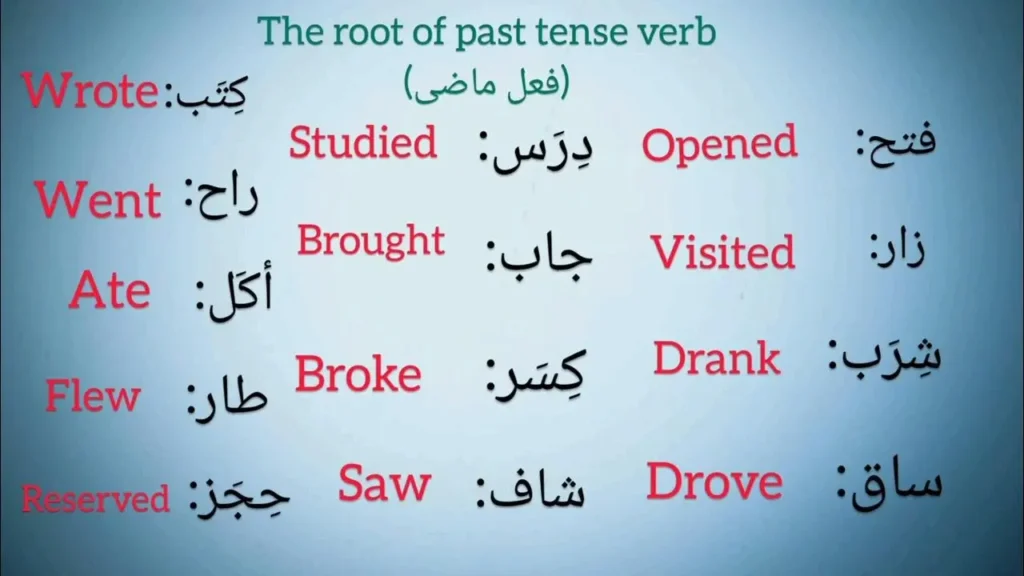
Every Arabic past tense verb is built from a three-letter root (الجذر — al-jidhr). The most commonly used root in teaching is ك-ت-ب (k-t-b), meaning “to write.” The past tense base form is كَتَبَ (kataba) — “he wrote.” All conjugations branch from this base by attaching suffixes.
Understanding this root-based structure is the foundation of learning Arabic grammar. Mastering one verb pattern genuinely teaches you the pattern for all regular verbs.
The Complete Arabic Past Tense Verb Conjugation Chart
The Arabic past tense conjugation chart covers fourteen distinct pronoun forms. Arabic distinguishes singular, dual, and plural — plus masculine and feminine in second and third person. The table below uses كَتَبَ (kataba — to write) as the model verb.
Third-Person Conjugations (He, She, They) of Arabic Past Tense
| Pronoun | Arabic Pronoun | Conjugated Verb | Transliteration | Meaning |
| He | هُوَ | كَتَبَ | kataba | He wrote |
| She | هِيَ | كَتَبَتْ | katabat | She wrote |
| They (m. dual) | هُمَا | كَتَبَا | katabā | They two (m.) wrote |
| They (f. dual) | هُمَا | كَتَبَتَا | katabatā | They two (f.) wrote |
| They (m. pl.) | هُمْ | كَتَبُوا | katabū | They (m.) wrote |
| They (f. pl.) | هُنَّ | كَتَبْنَ | katabna | They (f.) wrote |
The third-person masculine singular كَتَبَ is the dictionary base form — you will find every verb listed this way in Arabic dictionaries and Quranic glossaries.
Second-Person Conjugations (You) of Arabic Past Tense
| Pronoun | Arabic Pronoun | Conjugated Verb | Transliteration | Meaning |
| You (m. sg.) | أَنْتَ | كَتَبْتَ | katabta | You (m.) wrote |
| You (f. sg.) | أَنْتِ | كَتَبْتِ | katabti | You (f.) wrote |
| You (m./f. dual) | أَنْتُمَا | كَتَبْتُمَا | katabtumā | You two wrote |
| You (m. pl.) | أَنْتُمْ | كَتَبْتُمْ | katabtum | You (m.) wrote |
| You (f. pl.) | أَنْتُنَّ | كَتَبْتُنَّ | katabtunna | You (f.) wrote |
First-Person Conjugations (I, We) of Arabic Past Tense
| Pronoun | Arabic Pronoun | Conjugated Verb | Transliteration | Meaning |
| I | أَنَا | كَتَبْتُ | katabtu | I wrote |
| We | نَحْنُ | كَتَبْنَا | katabnā | We wrote |
First person has no gender distinction — كَتَبْتُ means “I wrote” regardless of whether the speaker is male or female. This is a welcome simplification for beginners.
How to Read the Suffix Pattern in Arabic Past Tense Conjugation?
The suffixes are the real system here — once you memorize them, you apply them to any regular verb. We see this consistently in our Buruj Academy Arabic Grammar course sessions: students who learn the suffix table separately before drilling full conjugations progress significantly faster than those who try to memorize each form in isolation.
Understand the Arabic Grammar with Buruj’s free trial lesson

The Core Suffix in Arabic Past Tense Conjugation Table
| Suffix | Transliteration | Attached To | Person/Number/Gender |
| ـَ | -a | Base | 3rd m. sg. |
| ـَتْ | -at | Base | 3rd f. sg. |
| ـَا | -ā | Base | 3rd m. dual |
| ـَتَا | -atā | Base | 3rd f. dual |
| ـُوا | -ū | Base | 3rd m. pl. |
| ـْنَ | -na | Base | 3rd f. pl. |
| ـْتَ | -ta | Base | 2nd m. sg. |
| ـْتِ | -ti | Base | 2nd f. sg. |
| ـْتُمَا | -tumā | Base | 2nd dual |
| ـْتُمْ | -tum | Base | 2nd m. pl. |
| ـْتُنَّ | -tunna | Base | 2nd f. pl. |
| ـْتُ | -tu | Base | 1st sg. |
| ـْنَا | -nā | Base | 1st pl. |
Notice the pattern: second-person and first-person forms all use ـْ (sukoon) on the final root letter before the suffix. Third-person feminine forms all include ـَتْ. These internal patterns make the chart self-reinforcing once you spot them.
For learners who want structured exercises with teacher correction, Buruj Academy’s Arabic Grammar course provides systematically graded conjugation exercises with Al-Azhar-trained instructors giving real-time feedback.
Understand the Arabic Grammar with Buruj’s free trial lesson

Arabic Past Tense Conjugation Examples Across Multiple Verbs
Seeing the same suffix pattern applied to different verbs is the fastest way to internalize it. Below are five common roots conjugated in key forms.
Verb: ذَهَبَ (dhahaba — to go)
| Form | Arabic | Transliteration |
| He went | ذَهَبَ | dhahaba |
| She went | ذَهَبَتْ | dhahabat |
| They (m. pl.) went | ذَهَبُوا | dhahabū |
| I went | ذَهَبْتُ | dhahabtu |
| We went | ذَهَبْنَا | dhahababnā |
Verb: فَعَلَ (fa’ala — to do)
| Form | Arabic | Transliteration |
| He did | فَعَلَ | fa’ala |
| She did | فَعَلَتْ | fa’alat |
| You (m. sg.) did | فَعَلْتَ | fa’alta |
| I did | فَعَلْتُ | fa’altu |
| We did | فَعَلْنَا | fa’alnā |
Verb: سَمِعَ (sami’a — to hear)
This verb follows the فَعِلَ (fa’ila) pattern — middle vowel is kasra rather than fatha. The suffixes remain identical.
| Form | Arabic | Transliteration |
| He heard | سَمِعَ | sami’a |
| She heard | سَمِعَتْ | sami’at |
| They (f. pl.) heard | سَمِعْنَ | sami’na |
| You (f. sg.) heard | سَمِعْتِ | sami’ti |
Master the Arabic Language
Join our expert-led courses and build a strong foundation in Classical and Modern Arabic.
Get Your Free TrialVerb: خَرَجَ (kharaja — to exit/leave)
| Form | Arabic | Transliteration |
| He left | خَرَجَ | kharaja |
| They (m. dual) left | خَرَجَا | kharajā |
| You (m. pl.) left | خَرَجْتُمْ | kharajtum |
| We left | خَرَجْنَا | kharajnā |
This variety of examples matters. When students at Buruj Academy work only with كَتَبَ, they sometimes mistake the pattern for something specific to that verb.
Introducing ذَهَبَ, سَمِعَ, and خَرَجَ early makes the universality of the suffix system clear. If you want to build vocabulary alongside grammar, our guide to mastering Arabic vocabulary will complement this conjugation work effectively.
At Buruj Academy, our Online Arabic Classes are led by Al-Azhar University graduates with 12+ years of experience teaching non-Arabic speakers worldwide.
Book your FREE Arabic trial online Arabic class at Buruj

How Does Arabic Past Tense Conjugation Appear in the Quran?
The past tense is one of the most frequent verb forms in the Quran — Allah ﷻ often narrates prophetic stories and divine acts using الماضي. Recognizing conjugation forms directly improves Quran comprehension, which is why our Buruj Academy Quranic Arabic Classes integrate verb conjugation from the earliest stages.
Consider this verse:
قَالَ رَبِّ إِنِّي وَهَنَ الْعَظْمُ مِنِّي
Qāla rabbi innī wahana al-‘aẓmu minnī
“He said, ‘My Lord, indeed my bones have weakened.'” (Maryam 19:4)
(Grammar Note: قَالَ (qāla) is third-person masculine singular past tense from the root ق-و-ل — “he said.” وَهَنَ (wahana) is also third-person masculine singular past tense from و-ه-ن — “it weakened.” Both follow the standard فَعَلَ pattern with the base suffix -a.)**
Another example showing the feminine singular form:
قَالَتِ امْرَأَتُ الْعَزِيزِ
Qālatim-ra’atu l-‘azīz
“The wife of al-‘Aziz said.” (Yusuf 12:51)
قَالَتْ (qālat) is the third-person feminine singular past tense — the same verb قَالَ, now with the ـَتْ suffix marking feminine subject.
These two verses together illustrate exactly how gender marking works in Quranic Arabic past tense — one root, two suffixes, two distinct grammatical meanings.
Begin Understanding Quranic Arabic with a FREE Lesson

Common Mistakes Non-Native Speakers Make in Arabic Past Tense Conjugation
In our experience teaching non-Arabic speakers at Buruj Academy over 12+ years, the same errors appear repeatedly. Knowing them in advance is the fastest way to avoid them.
1. Confusing Second-Person Masculine and Feminine Singular
كَتَبْتَ (katabta) and كَتَبْتِ (katabti) look nearly identical in written form without vowel marks. In spoken and written Arabic, the distinction is real and grammatically significant. English has no equivalent distinction, which is why this trips up English-speaking learners consistently.
The fix: always practice these two forms together in pairs, not in isolation.
2. Dropping the Sukoon Before Consonant Suffixes
When the suffix begins with a consonant (as in ـْتَ, ـْتِ, ـْتُ), the final root letter takes a sukoon (ـْ). Students frequently miss this and pronounce the final root letter with a vowel instead, producing a form that sounds like third-person rather than second or first person.
3. Treating Dual Forms as Optional
Learners familiar with European languages often skip dual forms, assuming they are rare or archaic. In Arabic — especially Quranic Arabic — the dual is grammatically active and appears frequently. كَتَبَا (katabā — they two wrote) and كَتَبَتَا (katabatā — they two, feminine, wrote) are forms you will encounter regularly in both classical and Modern Standard Arabic.
If you are building pronunciation accuracy alongside grammar, our resource on Arabic pronunciation addresses the phonetic challenges that underlie many of these conjugation errors.
Buruj Academy’s Arabic Grammar course systematically addresses all three of these error patterns through structured drills, live correction sessions with Al-Azhar-trained instructors, and progressive exercises that move from voweled to unvoweled text — mirroring the real reading challenge students face.
How to Memorize the Arabic Past Tense Conjugation Chart Efficiently?
Memorization without structure rarely holds. Based on our instructors’ experience, a sequence-based approach works significantly better than trying to memorize all fourteen forms at once.
Step One: Anchor the Base Form
Start with هُوَ كَتَبَ — third-person masculine singular. Every other form is a modification of this anchor. Never begin with “I” or “you” — the dictionary form is always “he,” and working outward from it makes grammatical logic visible.
Step Two: Learn Third Person as a Block
Third person (he, she, they-dual, they-plural) introduces the key gender and number suffixes. Master this block before touching second or first person. Third person is also what you will encounter most frequently in Quranic narrative.
Step Three: Add Second Person as a Block
All second-person forms share the ـْتَ / ـْتِ / ـْتُمَا / ـْتُمْ / ـْتُنَّ suffix family. Recognizing the shared ت across all second-person forms makes the block feel cohesive rather than arbitrary.
Step Four: Close with First Person
كَتَبْتُ and كَتَبْنَا are the two simplest forms structurally. Placing them last means you close memorization sessions on a feeling of consolidation rather than overwhelm.
For students who are simultaneously building reading fluency, the guide on how to learn Arabic provides complementary strategies for integrating grammar study with broader language acquisition.
Discover the Buruj Academy Difference
Step into our virtual classrooms and see how our expert instructors make learning Quran and Arabic intuitive and clear. We focus on overcoming the specific hurdles non-native speakers face, building your confidence and connection with the Quran.
Master Arabic Verb Conjugation with Buruj Academy’s Expert Instructors
Arabic past tense conjugation is learnable — but the speed and accuracy of your progress depend heavily on systematic instruction and real-time correction.
At Buruj Academy, our Online Arabic Classes are led by Al-Azhar University graduates with 12+ years of experience teaching non-Arabic speakers worldwide.
We use the Buruj Method — context-before-abstraction — meaning you practice conjugation inside real sentences and Quranic phrases from day one, not just isolated drills.
Every session is 1-on-1, scheduled flexibly around your routine, with personalized correction and progression tracking.
Book your free trial lesson and experience the difference structured, expert-led Arabic grammar instruction makes.
Begin your transformation today by choosing the path that fits your goals:
- Online Arabic Classes (General & Comprehensive)
- Arabic Course for Beginners
- Arabic Alphabet Learning Course
- Online Arabic Classes for Kids
- Arabic Classes for Adults
- Arabic Grammar Course (Nahw & Sarf)
- Intermediate Arabic Course (B1/B2)
- Arabic Speaking Course (Conversational Fluency)
- Arabic Reading Course (Literary Excellence)
- Learn Arabic Writing Course (Calligraphy & Composition)
Ready to speak with confidence? Join the global community at Buruj Academy and book your free placement interview today!
Master the Arabic Language
Join our expert-led courses and build a strong foundation in Classical and Modern Arabic.
Get Your Free TrialConclusion
Arabic past tense conjugation follows a precise, rule-governed system — and that is genuinely good news for learners. Once the suffix table is internalized, every regular Arabic verb becomes conjugable. The fourteen forms divide logically into three blocks (third, second, first person), the gender distinctions follow consistent patterns, and the Quranic applications make the grammar immediately meaningful.
Consistent practice with varied verbs — not just كَتَبَ — is what builds real fluency. Work through the charts systematically, apply them to Quranic vocabulary, and seek live instructor feedback to catch errors before they solidify into habits. Insha’Allah, this foundation will serve you across every stage of your Arabic learning.
Frequently Asked Questions About Arabic Past Tense Conjugation
What Is the Base Form of an Arabic Past Tense Verb?
The base form of any Arabic past tense verb is the third-person masculine singular — for example, كَتَبَ (kataba — he wrote). This is the form listed in Arabic dictionaries and Quranic glossaries. All other conjugations are formed by attaching suffixes to this base form according to the pronoun’s gender, number, and person.
Does Arabic Past Tense Change Based on Gender?
Yes. Arabic past tense distinguishes masculine and feminine in both second and third person. “He wrote” is كَتَبَ (kataba) while “she wrote” is كَتَبَتْ (katabat). This gender distinction extends to plural forms — كَتَبُوا (katabū) for masculine plural and كَتَبْنَ (katabna) for feminine plural — making gender awareness essential in conjugation.
How Many Conjugation Forms Does the Arabic Past Tense Have?
Arabic past tense has fourteen distinct conjugated forms, covering singular, dual, and plural across three persons (first, second, third), with gender distinctions in second and third person. English uses one or two forms per verb in the past tense; Arabic’s fourteen forms carry full grammatical information without needing separate pronoun words in many contexts.