 Arabic
| Key Takeaways |
| The Arabic past tense (الماضي / al-māḍī) expresses completed actions and follows one core three-letter root pattern. |
| Past tense verbs conjugate across 14 forms based on the subject’s gender, number, and person in Arabic grammar. |
| Negating the Arabic past tense requires the particle لَمْ (lam) combined with the present tense verb in jussive form. |
Every Arabic learner reaches the same turning point: the moment they realize that mastering verb forms is not optional — it is the entire architecture of the language.
Arabic builds meaning through roots and patterns, and the past tense is where that system becomes beautifully visible.
The Arabic past tense — known in grammar as الفعل الماضي (al-fi’l al-māḍī, “the past verb”) — describes actions that have been completed. The Arabic past tense serves as the base form from which all other verb forms are derived, making it the single most important starting point in Arabic verb grammar.
Table of Contents:
What Is the Arabic Past Tense?
The Arabic past tense الفعل الماضي (al-fi’l al-māḍī) expresses a completed action — something that has already happened. Unlike English, which uses auxiliary verbs (“I have eaten,” “she had gone”), Arabic encodes all this information directly into the verb’s ending.
The default form — the dictionary entry — is always the third-person masculine singular past tense, such as كَتَبَ (kataba, “he wrote”).
This is why Arabic dictionaries list كَتَبَ, ذَهَبَ, فَعَلَ rather than infinitives. The past tense form is the root in action.
In Arabic grammatical tradition — specifically in علم الصرف (‘ilm al-ṣarf, “morphology”) — the past tense verb is characterized by a فتحة (fatḥa, a short “a” vowel) on the final letter of its base form. This is what distinguishes it structurally from the present tense (المضارع / al-muḍāri’), which takes a prefix.
If you are building your Arabic foundation, our guide on how to learn Arabic grammar easily provides the broader framework into which past tense verbs fit naturally.
Pattern recognition, not rote memorization of individual verbs, is the key to long-term retention. Our Arabic for Beginners course structures exactly this progression.
Begin learning Arabic at Buruj with a FREE trial lesson

What Are the 14 Forms of the Past Tense in Arabic?
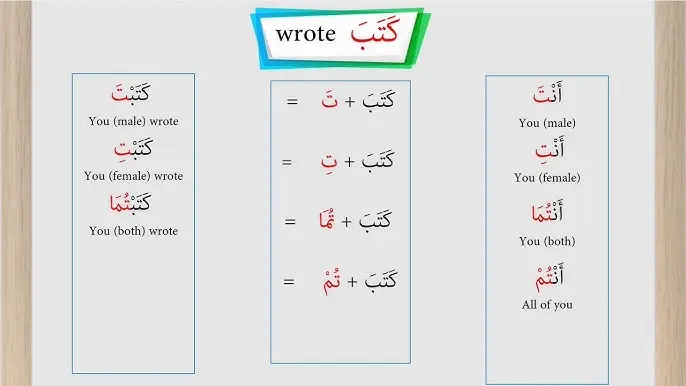
The 14 conjugation forms of the Arabic past tense represent every possible combination of person, gender, and number. Arabic grammar does not use separate pronoun words the way English does — instead, the subject is baked into the verb ending through suffixes called ضمائر (ḍamā’ir, “pronouns”).
The root verb used in the table below is كَتَبَ (kataba, “he wrote”) — one of the clearest teaching examples in classical Arabic morphology.
Read also:Understanding Gender in Arabic
The 14 Past Tense Conjugation Forms (الماضي / al-māḍī)
| Arabic Pronoun | Transliteration | Verb Form | Transliteration | Meaning |
| هُوَ | Huwa | كَتَبَ | kataba | He wrote |
| هِيَ | Hiya | كَتَبَتْ | katabat | She wrote |
| هُمَا | Humā (m) | كَتَبَا | katabā | They two (m) wrote |
| هُمَا | Humā (f) | كَتَبَتَا | katabatā | They two (f) wrote |
| هُمْ | Hum | كَتَبُوا | katabū | They (m) wrote |
| هُنَّ | Hunna | كَتَبْنَ | katabna | They (f) wrote |
| أَنْتَ | Anta | كَتَبْتَ | katabta | You (m, s) wrote |
| أَنْتِ | Anti | كَتَبْتِ | katabti | You (f, s) wrote |
| أَنْتُمَا | Antumā (m) | كَتَبْتُمَا | katabtumā | You two (m) wrote |
| أَنْتُمَا | Antumā (f) | كَتَبْتُمَا | katabtumā | You two (f) wrote |
| أَنْتُمْ | Antum | كَتَبْتُمْ | katabtum | You (m, pl) wrote |
| أَنْتُنَّ | Antunna | كَتَبْتُنَّ | katabtunna | You (f, pl) wrote |
| أَنَا | Anā | كَتَبْتُ | katabtu | I wrote |
| نَحْنُ | Naḥnu | كَتَبْنَا | katabnā | We wrote |
Notice the consistent pattern: third-person forms add suffixes to the root, while first and second-person forms add ـتُ / ـتَ / ـتِ (-tu / -ta / -ti) endings. This regularity is what makes the past tense the most learnable tense in Arabic — once you know the pattern, it applies across thousands of verbs.
In our Arabic Grammar Course, our instructors spend the first weeks drilling exactly these 14 forms across multiple verb roots until the pattern becomes instinctive — because fluency in Arabic always begins here.
Understand the Arabic Grammar with Buruj’s free trial lesson

What Are Common Arabic Past Tense Verbs with Examples?
Arabic past tense verbs all follow the same conjugation logic regardless of meaning. The key is building vocabulary through exposure to real, common roots. Below is a working list of high-frequency past tense verbs with examples drawn from everyday speech and Quranic Arabic.
Arabic Past Tense Verbs List with Example Sentences
| Verb (Māḍī) | Transliteration | Meaning | Example Sentence | Translation |
| ذَهَبَ | dhahaba | He went | ذَهَبَ الوَلَدُ إِلَى المَدْرَسَةِ | The boy went to school |
| أَكَلَ | akala | He ate | أَكَلَ الطِّفْلُ التُّفَّاحَةَ | The child ate the apple |
| شَرِبَ | shariba | He drank | شَرِبَتِ الفَتَاةُ المَاءَ | The girl drank water |
| قَرَأَ | qara’a | He read | قَرَأَ الطَّالِبُ الكِتَابَ | The student read the book |
| سَمِعَ | sami’a | He heard | سَمِعَ المُعَلِّمُ الجَوَابَ | The teacher heard the answer |
| فَتَحَ | fataḥa | He opened | فَتَحَ اللهُ عَلَيْنَا | Allah opened (granted) for us |
| عَلِمَ | ‘alima | He knew | عَلِمَ الرَّجُلُ الحَقِيقَةَ | The man knew the truth |
| رَجَعَ | raja’a | He returned | رَجَعَ المُسَافِرُ إِلَى بَيْتِهِ | The traveler returned to his home |
| نَزَلَ | nazala | He descended | نَزَلَ القُرْآنُ بِالعَرَبِيَّةِ | The Quran was revealed in Arabic |
| خَرَجَ | kharaja | He exited | خَرَجَ مِنَ البَيْتِ | He exited from the house |
In our experience at Buruj Academy, students learning Quranic Arabic find that this verb list overlaps heavily with Quranic vocabulary — particularly verbs like نَزَلَ, عَلِمَ, and فَتَحَ, which appear dozens of times across the Quran.
This is why we always connect grammar lessons to Quranic text from the very first sessions.
A powerful Quranic example of the past tense in use:
قَدْ أَفْلَحَ الْمُؤْمِنُونَ
Qad aflaḥa l-mu’minūn
“Certainly the believers have succeeded.” (Al-Mu’minun 23:1)
أَفْلَحَ (aflaḥa) is the ماضي form of the root ف-ل-ح, third-person masculine singular. The particle قَدْ (qad) before a ماضي verb adds emphasis and certainty to the completed action.)
For learners building reading fluency alongside grammar, our Arabic Reading Course connects these verb forms to real texts from the earliest stages.
Read Arabic fluently with a free Buruj trial

How Is the Arabic Past Tense Used in Real Sentences?
The Arabic past tense الماضي (al-māḍī) covers several usage functions that go beyond the simple English “I did something” — understanding these usages prevents confusion when encountering Arabic in speech, text, or Quran.
Usage 1 — Simple Completed Action (الماضي البسيط)
This is the most direct use: an action that happened and is done.
ذَهَبَتْ فَاطِمَةُ إِلَى المَسْجِدِ
Dhahabat Fāṭimatu ilā l-masjid
“Fatima went to the mosque”.
كَتَبَ الطُّلَّابُ الدَّرْسَ
Kataba l-ṭullābu l-darsa
The students wrote the lesson.
Usage 2 — Past Tense with قَدْ (Qad) for Emphasis
Adding قَدْ (qad) before a ماضي verb intensifies its certainty or emphasizes the completion of the action. This is extremely common in Quranic Arabic.
قَدْ سَمِعَ اللهُ
Qad sami’a Allāhu
“Certainly has Allah heard”. (Al-Mujadila 58:1)
Usage 3 — Conditional Sentences (الشرط / al-Sharṭ)
In Arabic conditional structures, the ماضي is used in both parts of the condition, even when referring to future meaning.
إِنْ جَاءَ مُحَمَّدٌ أَكْرَمْتُهُ
In jā’a Muḥammadun akramtuhu
If Muhammad comes, I will honor him.
Usage 4 — Storytelling and Narrative (السرد / al-Sard)
Arabic narrative, classical prose, and Quranic storytelling rely almost entirely on the ماضي to sequence events. This is why Arabic sentence structure in classical texts follows a consistent past-tense chain.
How Do You Negate the Arabic Past Tense?
Negating the Arabic past tense is one of the first grammar points that surprises English speakers — because Arabic does not simply add “not” to a past tense verb. Instead, it uses a specific negation particle that changes the verb’s tense form entirely.
Read also:A Guide to Arabic Adverbs
Negation Method 1 — لَمْ (Lam) + Present Jussive (المضارع المجزوم)
لَمْ (lam) is the standard negation particle for the past tense. It negates a past action but requires the verb to shift into the present tense jussive form (المضارع المجزوم / al-muḍāri’ al-majzūm) — not the past form.
| Positive (Māḍī) | Negative (Lam + Muḍāri’ Majzūm) | Meaning |
| ذَهَبَ (dhahaba) | لَمْ يَذْهَبْ (lam yadhhab) | He did not go |
| كَتَبَتْ (katabat) | لَمْ تَكْتُبْ (lam taktub) | She did not write |
| أَكَلُوا (akalū) | لَمْ يَأْكُلُوا (lam ya’kulū) | They did not eat |
| فَهِمْتُ (fahimtu) | لَمْ أَفْهَمْ (lam afham) | I did not understand |
Master the Arabic Language
Join our expert-led courses and build a strong foundation in Classical and Modern Arabic.
Get Your Free TrialNegation Method 2 — مَا (Mā) + Past Tense Form
مَا (mā) is an older negation particle that directly precedes the ماضي form without changing it. It is common in Quranic Arabic and classical texts.
مَا فَعَلْتُ هَذَا
Mā fa’altu hādhā
I did not do this.
مَا قَالَ الرَّجُلُ شَيْئًا
Mā qāla l-rajulu shay’an
The man said nothing.
In our Online Arabic Classes, we find that students initially confuse لَمْ and مَا negation because the verb forms differ. The rule is simple: لَمْ always triggers the jussive; مَا leaves the ماضي unchanged.
Book your FREE Arabic trial online Arabic class at Buruj

How Does the Arabic Past Tense Compare to Other Arabic Tenses?
Arabic has three primary verb forms, each with a distinct function, structure, and marker in علم الصرف (‘ilm al-ṣarf, Arabic morphology). Understanding their differences clears up enormous confusion for learners.
Arabic Tenses Comparison Chart
| Feature | الماضي (al-Māḍī) — Past | المضارع (al-Muḍāri’) — Present/Future | الأمر (al-Amr) — Imperative |
| Meaning | Completed action | Ongoing or future action | Command or request |
| Structural Marker | Fatḥa on final letter (base form) | Prefix: يَـ / تَـ / أَـ / نَـ | Drops prefix; often adds sukūn |
| Example (root ك-ت-ب) | كَتَبَ (kataba) — He wrote | يَكْتُبُ (yaktubu) — He writes/will write | اُكْتُبْ (uktub) — Write! |
| Negation Particle | لَمْ + jussive OR مَا + māḍī | لَا (lā) / لَنْ (lan) | لَا (lā) + present jussive |
| I’rab (إعراب) — Case | Mabnī (fixed — no i’rab) | Mu’rab (variable endings) | Mabnī (fixed) |
| Quranic frequency | Very high (narrative, decree) | High (descriptions, commands) | Moderate (instructions) |
The key distinction in علم النحو (‘ilm al-naḥw, Arabic syntax) is that the ماضي is مبني (mabnī, “built” — unchanging in its final vowel based on grammatical position), while the مضارع is معرب (mu’rab, “case-inflected” — its ending changes based on syntax). This is why intermediate students suddenly find the present tense harder than the past.
For a broader picture of how these tenses connect to overall Arabic structure, our beginner’s guide to Modern Standard Arabic explains the grammatical framework in accessible terms.
What Patterns Do Arabic Past Tense Verbs Follow Beyond the Triliteral Root?
Most Arabic past tense verbs are built on الجذر الثلاثي (al-jadhr al-thulāthī, “the triliteral root”) — three consonants carrying a core meaning. But Arabic also uses الرباعي (al-rubā’ī, four-letter roots) and المزيد (al-mazīd, “augmented” — roots with added letters that modify meaning).
Derived Verb Patterns — الأوزان (al-Awzān)
The Arabic verb system organizes augmented forms into أوزان (awzān, “patterns” or “measures”) — 10 primary patterns (بابات / bābāt) built from the triliteral root. Here is how the root ك-ت-ب (k-t-b, “writing”) behaves across key patterns in the ماضي:
| Pattern (وزن) | Verb Form | Transliteration | Meaning |
| فَعَلَ (I) | كَتَبَ | kataba | He wrote |
| فَعَّلَ (II) | كَتَّبَ | kattaba | He made (someone) write repeatedly |
| فَاعَلَ (III) | كَاتَبَ | kātaba | He corresponded with |
| أَفْعَلَ (IV) | أَكْتَبَ | aktaba | He dictated to |
| تَفَعَّلَ (V) | تَكَتَّبَ | takattaba | He enrolled / registered |
| تَفَاعَلَ (VI) | تَكَاتَبَ | takātaba | They corresponded with each other |
| اِنْفَعَلَ (VII) | اِنْكَتَبَ | inkataba | It was written (passive-like) |
| اِفْتَعَلَ (VIII) | اِكْتَتَبَ | iktataba | He subscribed / copied for himself |
| اِسْتَفْعَلَ (X) | اِسْتَكْتَبَ | istaktaba | He asked someone to write for him |
Each pattern shifts the verb’s meaning in a predictable way. Pattern II (فَعَّلَ) intensifies or causativizes; Pattern VI (تَفَاعَلَ) adds reciprocity; Pattern X (اِسْتَفْعَلَ) adds a “seeking” meaning. Once a student learns the patterns, thousands of verbs become deducible — not memorized one by one.
In our experience at Buruj Academy, this pattern-recognition breakthrough typically happens for dedicated students around weeks 6–8 of structured grammar study.
The moment a student recognizes اِسْتَغْفَرَ (istaghfara, “he sought forgiveness”) as a Pattern X verb from غ-ف-ر (gh-f-r, “forgiveness”), Quranic vocabulary starts making sense at a structural level — not just a lexical one.
Building Arabic vocabulary through root recognition is explored further in our guide to mastering Arabic vocabulary.
Discover the Buruj Academy Difference
Step into our virtual classrooms and see how our expert instructors make learning Quran and Arabic intuitive and clear. We focus on overcoming the specific hurdles non-native speakers face, building your confidence and connection with the Quran.
Start Mastering Arabic Grammar with Buruj Academy’s Expert Instructors
The Arabic past tense is not one isolated grammar rule — it is the foundation of the entire Arabic verb system. Mastering it properly, with correct pronunciation and confident pattern recognition, requires structured guidance from qualified instructors, not just memorizing tables.
Buruj Academy’s Arabic Grammar Course and Online Arabic Classes are taught by Al-Azhar University graduates with 12+ years of experience teaching non-native speakers.
Through the Buruj Method — context-before-abstraction — we connect every grammar rule to real usage from day one.
Our personalized 1-on-1 online sessions, flexible scheduling, and real-time feedback ensure you build genuine fluency, not just textbook knowledge. Book your free trial lesson today.
Begin your transformation today by choosing the path that fits your goals:
- Online Arabic Classes (General & Comprehensive)
- Arabic Course for Beginners
- Arabic Alphabet Learning Course
- Online Arabic Classes for Kids
- Arabic Classes for Adults
- Arabic Grammar Course (Nahw & Sarf)
- Intermediate Arabic Course (B1/B2)
- Arabic Speaking Course (Conversational Fluency)
- Arabic Reading Course (Literary Excellence)
- Learn Arabic Writing Course (Calligraphy & Composition)
Ready to speak with confidence? Join the global community at Buruj Academy and book your free placement interview today!
Master the Arabic Language
Join our expert-led courses and build a strong foundation in Classical and Modern Arabic.
Get Your Free TrialConclusion
The الفعل الماضي (al-fi’l al-māḍī) is where Arabic grammar begins to reveal its elegant internal logic. Its 14 conjugation forms, built from three-letter roots through predictable suffix patterns, give learners a reusable key that opens the entire verb system. Understanding how negation works with لَمْ and مَا, and how the past tense contrasts with the مضارع and أمر, transforms isolated vocabulary into real grammatical competence.
Most importantly, the ماضي is not just a grammar topic — it is the language of the Quran’s narrative, the medium through which Allah’s words describe creation, prophecy, and divine decree.
Approaching it with that awareness makes every conjugation table a step toward deeper comprehension. Alhamdulillah, the structure is already there — consistent, logical, and learnable with the right guidance.
Frequently Asked Questions About Arabic Past Tense
What Is the Difference Between لَمْ and مَا for Negating the Arabic Past Tense?
لَمْ (lam) negates a past action but requires the verb to appear in the present tense jussive form (المضارع المجزوم). مَا (mā) directly precedes the past tense form unchanged. Both mean “did not,” but لَمْ is standard in Modern Standard Arabic while مَا is more common in Quranic and classical contexts.
How Many Conjugation Forms Does the Arabic Past Tense Have?
The Arabic past tense has 13 distinct conjugation forms when counting the standard pronoun-verb pairings (some grammarians present 14 by separating dual masculine and feminine in third person). All forms are built by adding suffixes to the base triliteral root, with no auxiliary verbs needed.
Is the Arabic Past Tense the Same in Quranic Arabic and Modern Standard Arabic?
Yes — the ماضي conjugation rules are identical in both Quranic Arabic (Classical Arabic / الفصحى) and Modern Standard Arabic. The vocabulary differs, and Quranic Arabic uses additional particles like قَدْ for emphasis, but the underlying morphological system is unchanged. This makes past tense study directly applicable to Quran comprehension.
Why Does Arabic Use the Past Tense in Conditional Sentences About the Future?
Arabic conditional sentences (الجملة الشرطية / al-jumla al-sharṭiyya) use the ماضي in both the condition and result clauses even when referring to future events. This reflects the Arabic grammatical concept that a conditional event is treated as “already determined” once the condition is set — a feature deeply connected to the language’s philosophical and theological precision.
What Is the Best Way to Memorize Arabic Past Tense Conjugations?
The most effective approach — and what we consistently apply at Buruj Academy — is drilling the 14 forms across 4–5 high-frequency verbs (like ذَهَبَ, كَتَبَ, قَرَأَ) until the suffix pattern is automatic, then expanding vocabulary.