 Arabic
| Key Takeaways |
| Classical Arabic (Fusha) is the language of the Quran, Hadith, and classical Islamic scholarship, distinct from modern dialects. |
| Mastering the Arabic alphabet and short vowel system (harakat) is the non-negotiable first step before any grammar study. |
| Classical Arabic grammar (nahw and sarf) follows a root-based system; understanding trilateral roots unlocks thousands of words simultaneously. |
| Guided instruction from qualified teachers dramatically accelerates progress and prevents deeply embedded pronunciation and grammar errors. |
Classical Arabic is one of the most grammatically precise and historically significant languages ever written. For Muslims seeking to understand the Quran directly, access classical scholarship, or deepen their spiritual connection, learning it is among the most rewarding intellectual and religious commitments they can make.
To learn classical Arabic effectively, you need a structured sequence: alphabet mastery first, then grammar fundamentals, then vocabulary building through authentic classical texts.
Skipping steps creates gaps that compound over time — but with the right approach and qualified instruction, fluency in reading classical Arabic is entirely achievable for non-native speakers.
Table of Contents:
What Is Classical Arabic?
Classical Arabic (الفصحى, Al-Fusha) is the standardized, literary form of Arabic preserved in the Quran, the Hadith corpus, and the full canon of Islamic scholarship from the 7th century onward.
Classical Arabic differs from spoken dialects and even from Modern Standard Arabic (MSA) in vocabulary, grammatical complexity, and register.
Understanding this distinction from day one prevents one of the most common mistakes we see at Buruj Academy: students who study Egyptian Arabic or MSA for months, then discover they still cannot understand a single verse of the Quran in depth. Classical Arabic is its own discipline.
Classical Arabic vs Modern Arabic
| Feature | Classical Arabic | Modern Standard Arabic | Spoken Dialects |
| Primary Use | Quran, Hadith, classical texts | Media, formal writing | Daily conversation |
| Grammar Complexity | Highest — full case system | Simplified in some areas | Largely absent |
| Vocabulary | Classical roots, Quranic terms | Modernized borrowings | Regional variation |
| Relevance for Quran | Direct | Partial | Minimal |
The table above shows why learning classical Arabic specifically is the only path to genuine Quranic understanding. MSA is useful for communication, but it will not give you access to Ibn Kathir’s Tafsir or Imam Nawawi’s commentaries.
If you want to understand why learning Arabic is one of the most spiritually and intellectually consequential decisions a Muslim can make, that article will ground your motivation before you begin.
1. Master the Classical Arabic Alphabet
The classical Arabic alphabet consists of 28 letters, all consonants, written right to left in a cursive script where most letters change shape depending on their position in a word. Before any grammar study begins, you must be able to recognize, write, and produce every letter correctly.
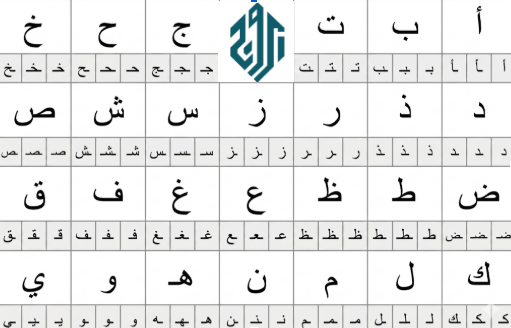
This is not a step to rush. In our experience teaching non-Arabic speakers at Buruj Academy, students who spend 3–4 weeks properly mastering letter forms and their positional variants make dramatically faster progress in grammar than those who pushed ahead with shaky letter recognition. The alphabet is the foundation — and cracks in foundations spread upward.
How to Learn Classical Arabic Writing From the Alphabet Up?
Focus on three competencies in this order:
- Recognition: Identify all 28 letters in isolated, initial, medial, and final positions
- Pronunciation: Produce the correct articulation for each letter, especially the emphatic letters (ص، ض، ط، ظ) and the pharyngeal sounds (ع، ح، غ، خ)
- Script writing: Practice handwriting each letter from right to left with correct stroke order
The short vowel system — harakat (فتحة، ضمة، كسرة) — must be learned alongside the letters, as classical texts are fully voweled and these marks are essential for grammatical decoding.
Our Arabic alphabet learning course builds this foundation systematically, ensuring both visual recognition and accurate pronunciation before any grammar introduction.
Get a free trial now in Buruj’s Alphabet course
2. Build Your Classical Arabic Grammar Foundation in Nahw and Sarf
Classical Arabic grammar divides into two sciences: Nahw (النحو) — syntax and case endings — and Sarf (الصرف) — morphology and word derivation. Both are essential, and neither can be skipped.
Nahw governs how words relate to one another in a sentence. The Arabic case system (i’rab) marks every noun and adjective with a grammatical ending that signals its role — subject, object, possessive, and more. This is what makes Arabic sentences analyzable with precision.
Sarf governs how words are built from three-letter roots, enabling you to derive dozens of related words once you know a single root.
How to Learn Classical Arabic Grammar Using the Root System?
The trilateral root system is classical Arabic’s greatest structural gift to the learner. Consider the root (ك-ت-ب), meaning “writing.” From it comes:
| Word | Meaning | Pattern |
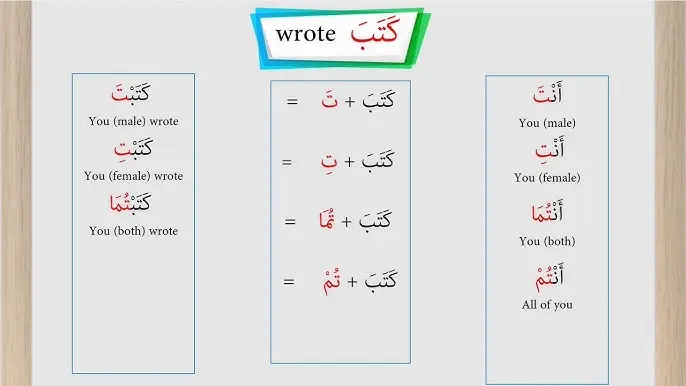
| كَتَبَ | He wrote | Past tense verb |
| يَكْتُبُ | He writes | Present tense verb |
| كِتَابٌ | Book | Noun of instrument |
| كَاتِبٌ | Writer | Active participle |
| مَكْتُوبٌ | Written | Passive participle |
| مَكْتَبٌ | Office/desk | Noun of place |
Once a student internalizes a root, they gain access to its entire word family. This is why our Arabic Grammar course instructors at Buruj Academy teach root recognition from week two onward — it multiplies vocabulary acquisition exponentially.
For a structured overview of Arabic grammatical principles, our guide on how to learn Arabic grammar easily covers the foundational concepts in a beginner-accessible way.
Understand the Arabic Grammar with Buruj’s free trial lesson
3. Study Classical Arabic Sentence Structure Systematically
Classical Arabic sentence structure differs significantly from English. Arabic has two primary sentence types: the nominal sentence (jumlah ismiyyah) beginning with a noun, and the verbal sentence (jumlah fi’liyyah) beginning with a verb. Understanding this binary from the start prevents the confusion that plagues self-taught learners.
In verbal sentences, the verb typically precedes the subject — the opposite of standard English word order.
Case endings then carry the grammatical information that English expresses through word order alone. This means a classical Arabic sentence can arrange its words in multiple orders without losing meaning, as long as the i’rab endings are correct.
Our detailed resource on Arabic sentence structure walks through these patterns with worked examples designed for English-speaking learners.
Read also: How to Learn Arabic Fusha?
4. Build Vocabulary Through Classical Arabic Texts, Not Word Lists
Isolated vocabulary memorization is the least efficient way to learn classical Arabic words. Classical Arabic has a vast lexicon, but the vocabulary of the Quran alone — the single most important classical text for Muslim learners — comprises approximately 77,430 words built from only around 1,750 unique roots. This means targeted, text-based vocabulary acquisition is both possible and productive.
Begin vocabulary building through the Quran itself, then expand to classical texts. Reading with a teacher who can explain grammatical context means every new word is learned with its morphological pattern, its root family, and its usage — not as a disconnected label.
The Most Effective Classical Arabic Books for Beginners
Several classical pedagogical texts have been used for centuries to teach Arabic grammar and vocabulary in a sequenced manner:
| Text | Level | Focus |
| Al-Ajrumiyyah (الآجرومية) | Beginner | Core nahw in concise form |
| Matn al-Bina wal-Asas | Beginner–Intermediate | Sarf patterns |
| Al-Alfiyyah of Ibn Malik | Advanced | Complete nahw in verse |
| Madinah Arabic Books | Beginner–Intermediate | Quranic Arabic through structured lessons |
For English-speaking beginners, the Madinah Arabic series (by Dr. V. Abdur Rahim) has proven particularly accessible in our classroom experience, as it introduces classical structures through Quranic vocabulary from the first lesson.
Our article on mastering Arabic vocabulary gives practical techniques for retention that apply directly to classical Arabic word acquisition.
Master the Arabic Language
Join our expert-led courses and build a strong foundation in Classical and Modern Arabic.
Get Your Free Trial5. Develop Arabic Reading Fluency Through Daily Voweled Text Practice
Reading classical Arabic fluently requires the ability to decode harakat (vowel markings) accurately and with speed. The Quran is the ideal practice text because it is fully voweled, meaning every grammatical case ending is marked — the exact information you need to read correctly.
Daily reading practice of 15–20 minutes on voweled classical text consolidates everything you have learned. The goal in this stage is not speed — it is accuracy.
Read slowly enough to identify the grammatical function of each word as you decode it. Over time, grammatical recognition becomes automatic.
We consistently observe at Buruj Academy’s Quran Reading classes that students who practice reading directly from a mushaf (even before completing grammar study) develop grammatical intuition faster than those who defer reading until they feel “ready.” The text teaches alongside the teacher.
Improving your reading fluency also involves attention to pronunciation accuracy. Our resource on Arabic pronunciation addresses the sounds that most commonly challenge English speakers in classical Arabic reading.
Book your Free trial lesson and start reading the Quran
6. Begin Reading Classical Arabic Texts With a Qualified Teacher
Classical Arabic texts — Tafsir, Hadith commentaries, Fiqh manuals — are the ultimate destination of this entire learning process. But reading them independently, before your grammar is secure, produces misreadings that can distort meaning significantly. Classical Arabic scholarship is too precise for independent guessing.
Working through a classical text with a qualified teacher — ideally an Al-Azhar University graduate with Ijazah with experience teaching non-native speakers — gives you live grammatical analysis, vocabulary in context, and the ability to ask the questions a textbook cannot answer.
This is where classical Arabic comes alive as a language of scholarship rather than a set of rules.
Book a FREE trial session with one of Buruj’s Azhari Quran tutors

7. Use Dictation and Writing Practice to Cement Classical Arabic Mastery
Writing classical Arabic from dictation (imla’) is one of the most underused but effective consolidation tools available. When you write Arabic under dictation, you are simultaneously processing phonology, morphology, spelling conventions, and script — all at once. This multi-channel engagement accelerates retention more than re-reading does.
Begin with short classical phrases and Quranic verses once your alphabet and basic grammar are secure. Dictation forces active recall rather than passive recognition, and the errors it reveals are precisely the gaps that need targeted attention.
Our Arabic writing course integrates dictation from the intermediate level onward, and our article on improving Arabic writing with dictation details the exact techniques our instructors use with adult learners.
Book your free trial to start writing Arabic
How Long Does It Take to Learn Classical Arabic?
Most adult non-Arabic speakers reach functional classical Arabic reading comprehension — meaning they can read a voweled classical text with a dictionary — in 12–18 months of structured daily study (30–45 minutes per day).
Independent reading of unvoweled classical texts typically requires 3–5 years of consistent study.
These are honest estimates based on our instructors’ experience, not guarantees. Prior language learning experience, daily study consistency, and quality of instruction all affect the timeline significantly.
| Goal | Estimated Time | Daily Study |
| Read voweled Quran with basic understanding | 6–10 months | 30 minutes |
| Read classical texts with teacher support | 12–18 months | 45 minutes |
| Independent unvoweled text reading | 3–5 years | 45–60 minutes |
| Scholarly fluency | 7–10+ years | Sustained daily practice |
The single most reliable accelerator is live instruction from a qualified teacher. Students in Buruj Academy’s 1-on-1 sessions consistently progress faster than those using self-study resources alone, because errors are caught and corrected before they become habits.
Where to Learn Classical Arabic?
Classical Arabic can theoretically be self-studied, but the practical limitations are significant. Grammar textbooks cannot correct your i’rab errors in real time.
Recordings cannot answer your specific questions about a particular sentence. And without accountability, most self-study efforts plateau within three months.
Structured online classical Arabic instruction — particularly 1-on-1 sessions — solves all three problems. You receive qualified correction, personalized pacing, and a teacher who can explain why a grammatical rule applies in a specific sentence, not just what the rule is.
Buruj Academy’s Arabic classes and Quranic Arabic classes both offer live 1-on-1 instruction from Al-Azhar-trained instructors, with flexible scheduling designed for adult learners balancing family and work commitments.
Begin Understanding Quranic Arabic with a FREE Lesson
Discover the Buruj Academy Difference
Step into our virtual classrooms and see how our expert instructors make learning Quran and Arabic intuitive and clear. We focus on overcoming the specific hurdles non-native speakers face, building your confidence and connection with the Quran.
Learn Classical Arabic with Buruj Academy’s Expert Instructors
Classical Arabic is a discipline that repays every hour of serious study — and the right instruction makes that study far more productive. Buruj Academy’s Al-Azhar University graduates and Ijazah-certified instructors have guided non-Arabic speakers from complete beginners to confident classical Arabic readers for over 12 years.
Our approach follows the Buruj Method: context-before-abstraction, meaning you encounter real language before abstract rules. Every session is 1-on-1, personalized to your level and pace, with flexible 24/7 scheduling.
Book your free trial lesson and begin your classical Arabic study with qualified, experienced guidance from day one.
Begin your transformation today by choosing the path that fits your goals:
- Online Arabic Classes (General & Comprehensive)
- Arabic Course for Beginners
- Arabic Alphabet Learning Course
- Online Arabic Classes for Kids
- Arabic Classes for Adults
- Arabic Grammar Course (Nahw & Sarf)
- Intermediate Arabic Course (B1/B2)
- Arabic Speaking Course (Conversational Fluency)
- Arabic Reading Course (Literary Excellence)
- Learn Arabic Writing Course (Calligraphy & Composition)
Ready to speak with confidence? Join the global community at Buruj Academy and book your free placement interview today!
Master the Arabic Language
Join our expert-led courses and build a strong foundation in Classical and Modern Arabic.
Get Your Free TrialConclusion
Classical Arabic is not simply a language — it is the key to an entire civilization of scholarship, spirituality, and Quranic depth. The path to mastering it is sequential: alphabet first, then grammar, then vocabulary, then text — each stage building on the last with precision.
What separates students who reach genuine classical comprehension from those who stall is not aptitude. It is structured instruction, consistent daily practice, and the guidance of qualified teachers who can correct errors before they calcify.
Start where you are, stay consistent, and — Insha’Allah — the texts of classical Islamic scholarship will open to you one page at a time.
Frequently Asked Questions About Classical Arabic
Is Classical Arabic Still Spoken Today?
Classical Arabic is not a native spoken language in any community today, but it is actively used in formal Islamic scholarship, Quranic recitation, and religious education worldwide. Scholars trained in traditional Islamic sciences read, write, and discuss in classical Arabic regularly. It is a living scholarly language, even though it is not a spoken vernacular.
What Is the Difference Between Classical Arabic and Modern Standard Arabic?
Classical Arabic refers to the language of the Quran, Hadith, and pre-modern Islamic scholarship, with a complete grammatical case system (i’rab) and classical vocabulary. Modern Standard Arabic (MSA) is a standardized contemporary form used in media and formal writing, with simplified grammar in some areas and modernized vocabulary. For Quranic study, classical Arabic is the necessary target.
What Are the Best Books to Learn Classical Arabic for Beginners?
The most proven beginner resources are Al-Ajrumiyyah for core grammar (nahw), the Madinah Arabic Books series for structured Quranic vocabulary, and Matn al-Bina wal-Asas for morphology (sarf). These texts have been used in traditional Islamic education for centuries. Working through them with a qualified teacher produces faster and more accurate results than self-study alone.
How to Learn Classical Arabic Writing as a Complete Beginner?
Begin with the 28-letter alphabet in all four positional forms, alongside the six basic harakat (vowel markings). Practice handwriting from right to left daily, beginning with isolated letters before joining them in words. Once you can write accurately from dictation at the letter level, move to short classical phrases. Our Learn Arabic Writing course guides this process systematically.
Do I Need to Learn Classical Arabic Before I Can Understand the Quran?
Understanding the Quran directly — beyond translation — requires at least foundational classical Arabic grammar and vocabulary. Translation gives you the meaning; classical Arabic gives you the structure, nuance, and linguistic miracle of the text itself. Even 6–10 months of structured study produces a noticeable deepening in how you engage with Quranic verses during salah and personal recitation.