 Arabic
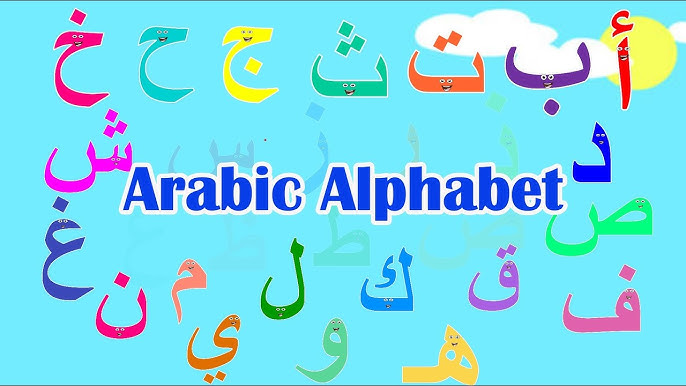
Learning to read Arabic feels impossible at first glance — a flowing script with no capital letters, read right to left, and letters that change shape depending on where they appear in a word. That initial overwhelm is something almost every student brings to their first session with us.
The good news: memorizing the Arabic alphabet is far more structured than it looks. With the right sequencing — grouping similar letters, training your ear before your pen, and anchoring each letter to a real Quranic word — non-Arabic speakers regularly achieve full letter recognition within 3–4 weeks of consistent daily practice.
Table of Contents:
1. Understand the Arabic Alphabet’s Structure Before You Memorize Anything
The Arabic alphabet contains 28 letters, all consonants, written from right to left. Every letter changes shape depending on its position — initial (start of word), medial (middle), final (end), or isolated — giving you up to four forms per letter. Knowing this upfront prevents confusion and sets realistic expectations from day one.
Understanding the system matters as much as memorizing individual letters. Arabic letters are not random symbols — they follow logical visual patterns. Many letters share a base shape and are distinguished only by the number and placement of dots.
For example, ب (Ba), ت (Ta), and ث (Tha) share the same curved base shape; only their dots differ.
This is why we always tell students at the beginning of our Arabic Alphabet Learning Course: you are not memorizing 28 unrelated symbols. You are learning a system of roughly 17 base shapes with dot variations layered on top. That reframe alone cuts the cognitive load significantly.
| Letter Position | Description | Example Letter ن (Nun) |
| Isolated | Stands alone | نْ |
| Initial | Connected at start of word | نَـ |
| Medial | Connected on both sides | ـنـ |
| Final | Connected at end of word | ـنْ |
Recognizing all four forms of each letter is the real goal — not just isolated letter recognition.
Get a free trial now in Buruj’s Alphabet course
2. Train Your Ear to Each Letter’s Sound Before Writing a Single Letter
To memorize Arabic letters effectively, listen to their sounds repeatedly before attempting to write or recognize them visually. Each Arabic letter represents a specific phoneme, and several sounds — like ع (Ayn), غ (Ghayn), ح (Ha), and خ (Kha) — have no English equivalent and must be heard, not imagined.
This is the foundation of the Buruj Method’s Sound-before-rules approach, and it applies to alphabet learning just as much as Tajweed. In our experience, students who skip this step and go straight to visual memorization consistently struggle when they first try to read aloud — they recognize the letter but cannot produce its sound. The letter becomes a shape without a voice.
Spend the first two to three days purely listening. Use reliable audio resources to hear each letter pronounced correctly. Our Arabic Pronunciation resource covers Arabic phonetics specifically for non-native speakers and is a strong starting point.
| Sound Category | Letters | Challenge Level for English Speakers |
| Familiar sounds | ب م س ن | Low — close English equivalents exist |
| Partially familiar | ر ل ف ك | Medium — require slight adjustment |
| No English equivalent | ع ح خ غ ق | High — require dedicated ear training |
Do not rush past this step. Correct sound production from the start prevents deeply ingrained mispronunciation that is far harder to correct later.
3. Group Letters by Visual Similarity to Reduce Memorization Load
Rather than memorizing all 28 Arabic letters in alphabetical sequence, group them by shared base shapes. This technique — used consistently in our Arabic for Beginners Course — reduces the effective memorization task from 28 distinct symbols to roughly 17 base shapes with dot variations.
Begin learning Arabic at Buruj with a FREE trial lesson

Alphabetical sequence (Alif, Ba, Ta, Tha…) is traditional but cognitively inefficient for beginners. Visual grouping is faster, more logical, and produces stronger retention because your brain stores similar shapes together. Here is how we sequence letter families in our structured teaching:
| Letter Family | Letters | Shared Feature |
| Dot-variation family | ب ت ث | Same base shape, 1/2/3 dots below/above |
| Curve family | ج ح خ | Same hook base, differentiated by dots |
| Loop family | س ش | Same wave base, dots above for Shin |
| Circle family | ص ض | Same oval base, dot for Dad |
| Tall stem family | ط ظ | Same vertical loop, dot for Dha |
| Eye family | ع غ | Same open-eye shape, dot for Ghayn |
| Bridge family | ف ق | Same base, one vs. two dots |
Work through one family per day. By day seven, you will have covered all major visual groupings — a far more efficient path than rote sequential repetition.
4. Use Arabic Alphabet Mnemonics to Lock Each Letter into Memory
Arabic alphabet mnemonics — memory devices linking each letter’s shape or sound to a familiar image or word — are among the most effective tools for non-Arabic speaking beginners. A strong mnemonic answers the question your brain keeps asking: why should I remember this shape?
We have seen mnemonics reduce the time to full letter recognition by roughly 30–40% in our beginner cohorts, particularly for adult learners who benefit from logical anchors. The key is consistency: use the same mnemonic system throughout, rather than mixing multiple methods.
What Makes an Effective Arabic Mnemonic?
The best mnemonics connect the letter’s visual shape to a memorable image, and ideally its sound to a familiar English sound. For example:
- ن (Nun) — looks like a bowl with a dot; “Nun” sounds like “noon,” imagine the sun at noon over a bowl.
- ع (Ayn) — looks like a fishhook; the sound comes deep from the throat, like a hook catching in the throat.
- ك (Kaf) — looks like a tilted “k”; the sound is identical to English “k.”
Should You Create Your Own Mnemonics or Use Pre-Made Ones?
Self-created mnemonics are more memorable because they draw on personal associations. However, pre-made mnemonic systems are useful for letters whose shapes don’t naturally suggest anything.
A hybrid approach works best: use a structured system as a starting scaffold, then replace any mnemonic that doesn’t stick with your own personal association.
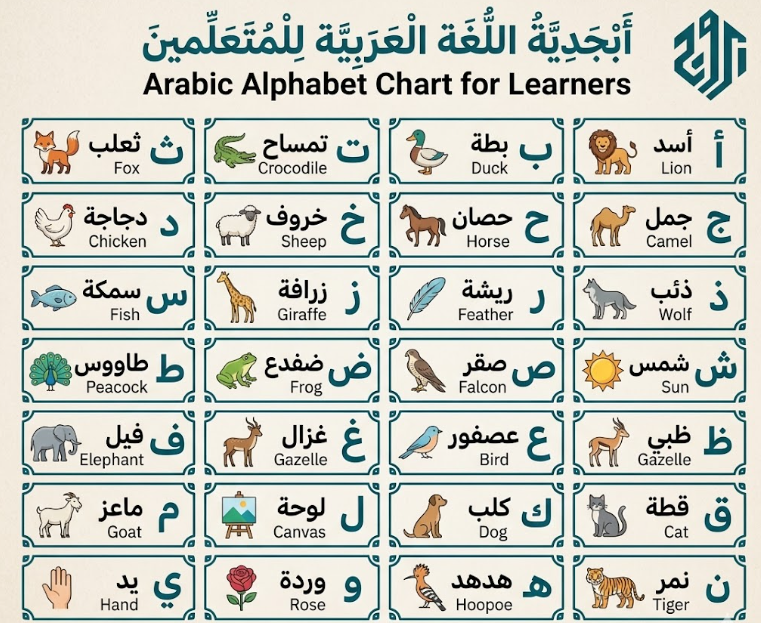
Read also: Learn Arabic Alphabet Games, Activities, and Crossword
5. Learn Each Letter Alongside a Real Quranic Word from Day One
Anchor every Arabic letter to a Quranic word that begins with — or prominently features — that letter. This dual-context learning builds letter recognition and early Quranic familiarity simultaneously, making every memorization session an act of worship and language learning at once.
This approach is grounded in the same principle behind our Quranic Arabic Classes: context-before-abstraction. A letter seen only in isolation is an abstract symbol. A letter seen inside the word بِسْمِ (Bismi — “In the name of”) or رَبِّ (Rabbi — “Lord”) immediately carries meaning, sound, and spiritual weight.
For example:
بِسْمِ اللَّهِ الرَّحْمَٰنِ الرَّحِيمِ
Bismillāhir-raḥmānir-raḥīm
“In the name of Allah, the Entirely Merciful, the Especially Merciful.” (Al-Fatiha 1:1)
This single phrase alone introduces students to ب (Ba), س (Sin), م (Mim), ل (Lam), ه (Ha), ر (Ra), ح (Ha), ن (Nun), and ي (Ya) — nine letters from one of the most recited phrases in Islamic life.
Begin Understanding Quranic Arabic with a FREE Lesson

6. Practice Writing Each Letter Across All Four Positional Forms
After sound and visual recognition are established, begin writing practice — covering isolated, initial, medial, and final forms of each letter. Writing reinforces recognition through motor memory, adding a third learning channel alongside auditory and visual input.
The most common mistake adult beginners make at this stage is practicing only the isolated form. When they then encounter the same letter mid-word during Quran reading, they do not recognize it. This is avoidable with deliberate positional practice from the beginning.
Master the Arabic Language
Join our expert-led courses and build a strong foundation in Classical and Modern Arabic.
Get Your Free TrialA Practical Daily Writing Drill
For each new letter family, spend five minutes on this sequence:
- Write the isolated form 5 times.
- Write the initial form 5 times, connecting it to a simple vowel.
- Write the medial form 5 times, placed between two simple letters.
- Write the final form 5 times.
This drill takes under ten minutes per letter family and produces significantly stronger retention than writing the same isolated form repeatedly. Our Arabic Writing Course covers positional forms systematically with structured writing exercises for each letter group.
Book your free trial to start writing Arabic
7. Add Arabic Vowel Marks (Harakat) to Your Alphabet Practice Early
Introduce the three short vowel marks — Fatha (َ), Kasra (ِ), and Damma (ُ) — alongside letter memorization rather than treating them as a separate advanced topic. Harakat are the vowel system that makes Arabic letters fully pronounceable, and learning them early prevents a common beginner plateau.
Many students memorize all 28 letters in isolation and then struggle when they first attempt to read because they do not know how to sound the letters together. Harakat are the bridge between letter recognition and actual reading.
Our detailed resource on vowels in Arabic covers all diacritical markers — including Sukoon, Shadda, and Tanwin — with clear explanations suited for English-speaking beginners.
Introduce Fatha first (the most common vowel), then Kasra, then Damma, applying each to the letters you have already learned before moving to new ones.
8. Build a 15-Minute Daily Practice Routine Around Spaced Repetition
Consistent short daily sessions outperform long irregular ones for alphabet memorization. Fifteen to twenty minutes per day, structured around spaced repetition — reviewing older letters at increasing intervals — produces lasting recognition faster than two-hour weekend sessions.
Spaced repetition works because memory consolidates during rest, not during study. Reviewing ج ح خ on day one, then again on day three, then day seven, then day fourteen, builds long-term retention far more effectively than reviewing them five times in a single sitting.
A Sample Weekly Alphabet Schedule
| Day | New Letters | Review |
| 1 | ب ت ث | — |
| 2 | ج ح خ | ب ت ث |
| 3 | د ذ ر ز | ب ت ث + ج ح خ |
| 4 | س ش ص ض | All previous |
| 5 | ط ظ ع غ | All previous |
| 6 | ف ق ك ل | All previous |
| 7 | م ن ه و ي | Full review all 28 |
In our instructors’ experience, students who commit to this schedule consistently complete full 28-letter recognition within their first two to three weeks.
For more guidance on getting started with Arabic as a complete beginner, see our easiest way to learn Arabic guide.
Read also: How to Exercise the Arabic Alphabet?
What Is the Easiest Way to Memorize Arabic Letters for Complete Beginners?
The easiest way to memorize Arabic letters for complete beginners is to combine three elements: visual grouping by base shape, audio immersion before writing, and daily 15-minute spaced repetition sessions. Avoid rote alphabetical memorization. Instead, learn dot-variation letter families together, anchor each letter to a Quranic word, and review using flashcards with audio.
This approach — the foundation of how we teach in our Online Arabic Classes — removes the three biggest barriers beginners face: overwhelming quantity (managed by grouping), sound confusion (solved by audio-first learning), and forgetting (addressed by spaced repetition).
For children specifically, the approach adapts with additional visual aids, songs, and games. Our learning Arabic alphabet for kids resource covers age-specific strategies in detail, and our Online Arabic Classes for Kids offers structured instruction from instructors trained in child-friendly phonics pedagogy.
Book a FREE Arabic trial for your Child

Discover the Buruj Academy Difference
Step into our virtual classrooms and see how our expert instructors make learning Quran and Arabic intuitive and clear. We focus on overcoming the specific hurdles non-native speakers face, building your confidence and connection with the Quran.
Start Mastering the Arabic Alphabet with Buruj Academy’s Expert Instructors
Memorizing the Arabic alphabet is the gateway to Quran reading, Tajweed, and Arabic language fluency — and it is a goal every student can reach with the right guidance.
Buruj Academy’s Arabic Alphabet Learning Course provides structured, step-by-step instruction from Al-Azhar University graduates with 12+ years of experience teaching non-Arabic speakers worldwide.
- Ijazah-certified instructors trained in phonetics and Arabic pedagogy
- The Buruj Method: Sound-before-letters, Context-before-abstraction
- Personalized 1-on-1 online sessions, flexible scheduling
- Real-time pronunciation correction from day one
- Clear progression from letter recognition to full Quran reading
Book your free trial lesson and begin your Arabic alphabet mastery today, Insha’Allah.
Begin your transformation today by choosing the path that fits your goals:
- Online Arabic Classes (General & Comprehensive)
- Arabic Course for Beginners
- Arabic Alphabet Learning Course
- Online Arabic Classes for Kids
- Arabic Classes for Adults
- Arabic Grammar Course (Nahw & Sarf)
- Intermediate Arabic Course (B1/B2)
- Arabic Speaking Course (Conversational Fluency)
- Arabic Reading Course (Literary Excellence)
- Learn Arabic Writing Course (Calligraphy & Composition)
Ready to speak with confidence? Join the global community at Buruj Academy and book your free placement interview today!
Master the Arabic Language
Join our expert-led courses and build a strong foundation in Classical and Modern Arabic.
Get Your Free TrialConclusion
Memorizing the Arabic alphabet is not a matter of talent — it is a matter of method. When you group letters by visual similarity, train your ear before your pen, and practice daily in short structured sessions, the 28-letter alphabet becomes manageable within weeks rather than months.
The steps above are not theory — they reflect what actually works across thousands of non-Arabic speaking students we have guided at Buruj Academy. Start with sound, build with structure, anchor with meaning, and repeat consistently. The alphabet is the first door to the Quran, and Alhamdulillah, it opens for every student who approaches it with patience and the right plan.
Frequently Asked Questions About How to Memorize the Arabic Alphabet
How Long Does It Take to Memorize the Arabic Alphabet?
Most non-Arabic speaking adults can recognize all 28 Arabic letters within 2–4 weeks of structured daily practice of 15–20 minutes. Reading fluency — recognizing letters in all four positional forms with vowel marks — typically takes an additional 4–6 weeks of consistent practice, depending on prior language learning experience.
Is the Arabic Alphabet Hard to Learn for English Speakers?
The Arabic alphabet presents initial challenges for English speakers — right-to-left direction, unfamiliar sounds like ع and ح, and four positional forms per letter. However, the alphabet’s logical dot-variation system and consistent phonetic rules make it more learnable than it first appears. Most beginners achieve solid recognition within one month.
What Are the Best Arabic Alphabet Mnemonics for Beginners?
Effective mnemonics connect each letter’s visual shape to a familiar image. For example, ن (Nun) resembles a bowl with a single dot; ع (Ayn) looks like a fishhook. Self-created mnemonics based on personal associations tend to be the most memorable. A structured mnemonic system used consistently outperforms memorizing letters in isolation without memory anchors.
Should Children Learn the Arabic Alphabet Differently Than Adults?
Yes. Children benefit from songs, colorful visual aids, tracing activities, and short 10-minute sessions rather than adult-style study blocks. Letter-to-image matching games and audio repetition work especially well for ages 4–10. Adults learn more effectively through logical grouping, mnemonic systems, and explicit phonetic explanation. Our how to learn Arabic for kids resource covers age-specific strategies in detail.
Do I Need a Teacher to Learn the Arabic Alphabet?
Self-study is possible for visual letter recognition, but a qualified teacher significantly accelerates correct sound production — especially for letters with no English equivalent like ع, ح, خ, and غ. Mispronunciation habits formed during self-study are considerably harder to correct later. For Quran reading goals, accurate pronunciation from the beginning is essential, making qualified instruction strongly recommended.
Related Articles
Arabic