 Quran
Quran

| Key Takeaways |
| Short, consistent Quran sessions of 10–15 minutes daily build stronger habits than long, infrequent ones for children. |
| Connecting Quran verses to stories of the Prophets gives children meaningful context that deepens engagement and retention. |
| Reward systems, group recitation, and visual progress trackers are proven tools for sustaining a child’s Quran motivation. |
| Starting with short surahs like Al-Fatiha and Al-Ikhlas gives children early wins that fuel continued enthusiasm. |
| Online Quran courses designed specifically for children use age-appropriate methods that blend learning with structured fun. |
Every parent in the West raising Muslim children faces the same quiet struggle: how do you make the Quran feel like a gift rather than a chore? Between school, sports, and screens, carving out meaningful Quran time can feel like an uphill climb.
The good news is that children are naturally drawn to the Quran when it is introduced through play, story, sound, and connection. Making Quran reading enjoyable is not about lowering standards — it is about meeting children where they are, then gently guiding them higher.
Table of Contents:
1. Start with Short Daily Sessions That Build Confidence Before Pressure
The most effective way to make Quran reading enjoyable for kids is to keep sessions short — between 10 and 15 minutes daily. Children’s attention spans are not designed for long study blocks, and ending a session while their energy is still high leaves them wanting more rather than dreading the next time.
In our experience at Buruj Academy, children who begin with just five minutes of focused recitation and gradually build from there develop far more durable habits than those pushed into 40-minute sessions from the start. The key principle here is consistency before duration — a child who reads one line daily for a year will outpace a child who reads one page once a week.
Why the First Session Sets the Tone for Everything After
A child’s first impression of Quran reading shapes their emotional relationship with it for years. Keep the first few sessions celebratory — no corrections, no pressure. Let them hear the beauty of the words before asking them to produce it.
This mirrors the Buruj Method’s core principle: sound before rules, which applies equally to children as it does to adult learners.
Book Your Kid a Free Trial Lesson With One of
Buruj’s Quran Tutors for Children
2. Choose Short Surahs That Give Children Early Wins
Children thrive on achievable goals. Beginning with the shortest, most melodic surahs — such as Surah Al-Ikhlas, Al-Kawthar, and Al-Asr — gives them the experience of completing something real. That sense of completion is a powerful motivator.
قُلْ هُوَ ٱللَّهُ أَحَدٌ
Qul huwa Allahu ahad
“Say, He is Allah, the One.” (Al-Ikhlas 112:1)
This verse is ideal for beginners — three words, clear rhythm, and a complete theological statement children can understand and feel proud to memorize.
Our instructors consistently recommend starting with the easiest surahs to memorize because early success removes the fear of difficulty.
When a child recites a full surah correctly for the first time, the pride on their face is something every parent — and every teacher — recognizes immediately.
3. Connect Every Surah to a Story That Brings It Alive
Children do not engage with abstract concepts — they engage with stories. Every surah in the Quran carries a context, a theme, or a connection to the life of a Prophet or a moment in Islamic history.
Tapping into that storytelling dimension transforms recitation from mechanical repetition into meaningful connection.
Before a child reads Surah Al-Fil, tell them the story of the elephant army. Before Surah Al-Kawthar, explain the gift of Al-Kawthar and why it was revealed. This approach gives the words emotional weight, and children remember what they feel far longer than what they simply hear.
For parents looking for structured, child-friendly Islamic context to support this, our article on Prophets in Islam for kids offers excellent story-based material that connects directly to Quranic themes.
How Storytelling Activates Long-Term Retention
When a child associates a verse with a vivid story, they create a memory anchor. This is not just pedagogy — it reflects how the Quran itself was revealed: in response to events, questions, and human moments. Restoring that context for children restores the Quran’s living quality.
4. Use Visual Progress Trackers That Make Achievement Visible
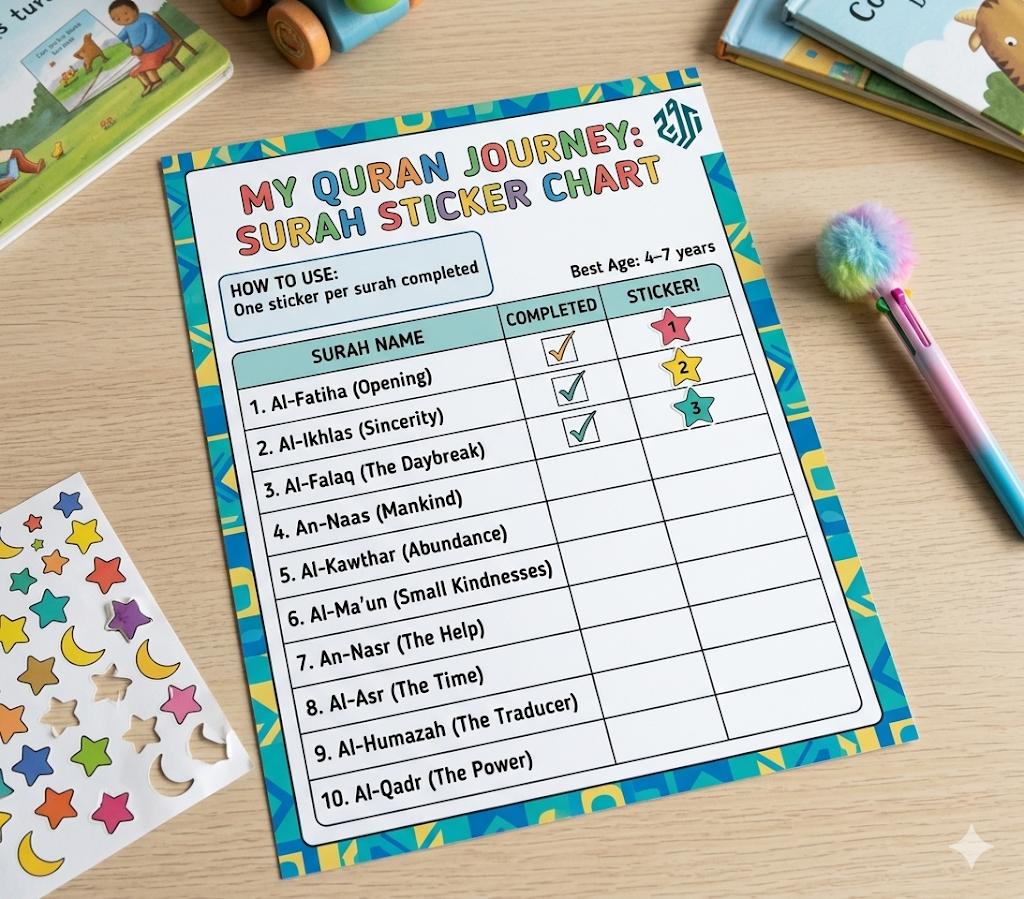
Children respond powerfully to seeing their own progress. A simple surah chart on the wall — where they colour in a star or place a sticker every time they complete a surah — gives tangible, visual evidence that they are moving forward.
This is one of the most underused tools in home Quran education. Progress trackers work because they shift the child’s focus from “how long do I have to sit here” to “how close am I to my next star.” The goal becomes their goal, not yours.
| Progress Tracker Type | Best Age | How to Use |
| Surah sticker chart | 4–7 years | One sticker per surah completed |
| Juz colouring map | 8–12 years | Colour each page or section memorized |
| Digital app milestones | 10+ years | Use Quran apps with built-in progress features |
| Weekly recitation log | All ages | Written record of what was read each day |
Pair the tracker with a weekly family review — even five minutes where a child reads aloud what they have learned that week. The audience matters enormously to a child.
5. Integrate Fun Quran Activities That Reinforce What They Are Learning
Learning does not only happen during recitation. Quran-themed colouring pages, letter-matching games for Arabic letters, and surah-themed crafts all reinforce what children hear and read during formal sessions.
These activities build familiarity with the text without the child even realising they are studying.
Buruj Academy’s online Quran classes for kids course weaves age-appropriate engagement strategies into every lesson, ensuring that children aged 4–15 experience structured learning that feels genuinely enjoyable.
Our instructors — Al-Azhar University graduates trained in child pedagogy — understand that a distracted child is not a difficult child; they are simply a child who needs a different door into the material.
For parents building a home activity library, our resource on Quran activities for kids provides practical, ready-to-use ideas that complement formal lessons perfectly.
Help your child start learning the Quran with a FREE trial
6. Introduce Group Recitation to Replace Isolation with Energy
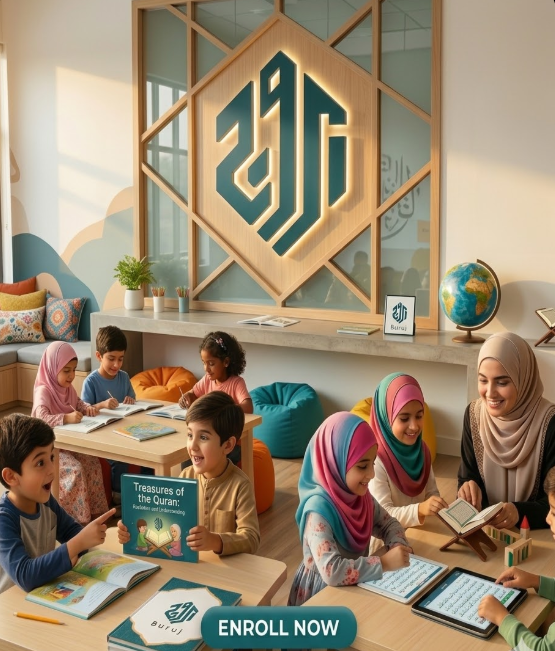
One of the fastest ways to make Quran reading feel like a burden is to make it a solitary, silent obligation. Children are social learners — they draw energy from each other. Group recitation, whether with siblings, cousins, or classmates in an online class setting, changes the entire emotional atmosphere.
When children recite together, they naturally correct each other, encourage each other, and compete gently in the best sense.
Our instructors at Buruj Academy regularly observe that children who join our group online sessions for kids progress faster in fluency and confidence than those in purely solo settings — not because the instruction is better, but because the social dimension activates a different kind of motivation.
Excel in Your Quranic Studies
Join Buruj Academy and master the Quran with our structured, professional curriculum.
Book Your Free TrialHow to Integrate Group Quran Reading at Home?
Even without a formal class, parents can create a group experience. Recite together as a family after Fajr or Maghrib — even two minutes of collective recitation builds a shared ritual.
Making that recitation a family act multiplies both the reward and the child’s positive association with it.
Read also: Overcoming Challenges in Teaching the Quran for Children
7. Use Reward Systems That Celebrate Effort, Not Just Perfection
Reward systems work for children — but only when they reward the right things. Rewarding effort, attendance, and consistency produces children who love the process. Rewarding only perfect recitation produces children who fear making mistakes.
A simple reward structure might look like this:
| Behaviour Rewarded | Example Reward | Frequency |
| Sitting for the full session | Small treat or extra story time | Daily |
| Completing a new surah | A special family celebration | Per milestone |
| Reading without being reminded | A privilege of their choice | Weekly |
| Helping a sibling practise | Extra screen time or activity | As it happens |
The most effective rewards are time and attention from parents — not objects. Choosing to read together, or asking the child to “teach” you a surah they have learned, communicates that their Quran learning is genuinely valued.
8. Select the Right Learning Tools That Match Your Child’s Learning Style
Not every child learns the same way. Some children absorb information through audio — they need to hear correct recitation repeatedly before attempting it themselves.
Others are visual learners who benefit from colour-coded Tajweed Qurans or Arabic letter flashcards. Kinaesthetic learners often need to write or trace letters to make them stick.
Our resource covering the best Quran learning tools for kids walks parents through the most effective tools currently available, from interactive apps to printed Qaida books designed specifically for non-Arabic speaking children.
Understanding which tools match your child’s style is one of the highest-impact decisions a parent can make. It is also something our instructors assess in the first few sessions — which is why personalised, 1-on-1 online learning produces faster results than generic classroom approaches.
9. Start Quran Memorization at the Right Age with the Right Expectations
Parents often ask us when to begin formal Quran memorization. The answer depends on the child, but most children are ready for structured memorization between the ages of 5 and 7 — when phonemic awareness is strong and the memory is at its most receptive. Our detailed guide on the best age to memorize Quran covers this in depth.
The important point for making memorization enjoyable is to calibrate expectations to the child’s age. A five-year-old memorizing three short surahs in a month is achieving something remarkable.
Treating it as remarkable — with genuine celebration — builds the intrinsic motivation that sustains a child through the longer memorization years ahead.
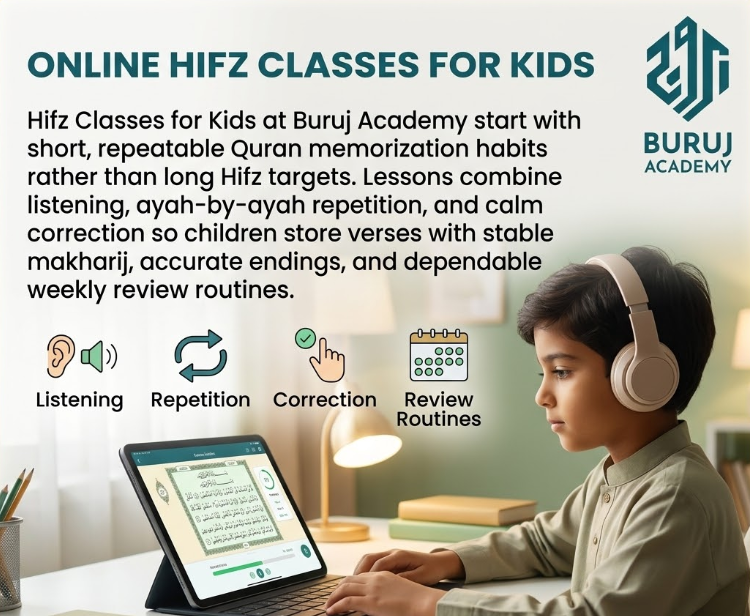
Buruj Academy’s Hifz for Kids course uses short daily sessions, positive reinforcement, and age-appropriate revision techniques to build memorization habits that grow with the child — never overwhelming, always moving forward.
Start your child’s Hifz classes with a free session
10. Teach Basic Tajweed as a Game, Not a Grammar Lesson
Many parents assume Tajweed is too technical for young children — but children actually absorb pronunciation rules more naturally than adults do, precisely because they have not yet developed fixed phonetic habits. The key is framing: Tajweed rules introduced as sound games rather than written rules become genuinely enjoyable.
Qalqalah letters, for example, can be introduced as the “bouncing letters” — a description that makes children laugh and immediately remember the echo sound. Ghunnah becomes the “nose sound,” which children find amusing to exaggerate and then refine. Our article on Tajweed rules for kids demonstrates exactly how these rules can be introduced in child-friendly, playful language without sacrificing accuracy.
Why Early Tajweed Habits Prevent Years of Correction Later
In our instructors’ experience, a child who learns correct pronunciation through sound-based play before age eight requires far fewer corrections as a teenager than one who learns letters without any Tajweed awareness. Building the right habits early is a gift that compounds for life.
Discover the Buruj Academy Difference
Step into our virtual classrooms and see how our expert instructors make learning Quran and Arabic intuitive and clear. We focus on overcoming the specific hurdles non-native speakers face, building your confidence and connection with the Quran.
Start Your Child’s Quran Experience the Right Way with Buruj Academy
Making Quran reading enjoyable for children is both an art and a science — and it is precisely what Buruj Academy’s teaching team has dedicated 12+ years to mastering.
Buruj Academy’s Online Quran Classes for Kids course offers:
- Ijazah-certified, Al-Azhar University-trained instructors specialising in child pedagogy
- Personalised 1-on-1 sessions tailored to your child’s age, level, and learning style
- The Buruj Method: sound-before-rules, consistency-before-speed
- Flexible scheduling to fit your family’s routine
- A free trial lesson — no commitment required
Book your child’s free trial today and let them experience what Quran learning feels like when it is done right.
Enroll your child in one of our specialized, kid-friendly tracks today:
- Online Quran Classes for Kids
- Tajweed Classes for Kids
- Hifz Classes for Kids
- Online Arabic Classes for Kids
- Quranic Arabic Course for Kids
- Noorani Qaida Course for Kids
- Islamic Studies Classes for Kids
Ready to watch your child grow in knowledge and character? Join the Buruj Academy family and book a free trial session for your child today!
Excel in Your Quranic Studies
Join Buruj Academy and master the Quran with our structured, professional curriculum.
Book Your Free TrialConclusion
Making Quran reading enjoyable for children is not about making it easy — it is about making it meaningful, social, and appropriately challenging. When children associate the Quran with warmth, celebration, and achievable goals, they carry that association into adulthood.
The ten steps above are not tricks; they are the result of years of classroom observation and genuine love for this work. Start small, stay consistent, and trust the process — the results, Insha’Allah, will speak for themselves.
Read also: Best Quran Tafseer for Kids
Frequently Asked Questions About Making Quran Reading Fun for Kids
How Long Should a Quran Reading Session Be for Young Children?
For children aged 4–7, sessions of 10–20 minutes are ideal. Children aged 8–12 can sustain 15–30 minutes comfortably. The goal is to end every session before the child’s energy drops — leaving them with a positive feeling about the next session rather than relief that it is over.
What Are the Benefits of Making Quran Reading Fun for Children?
When Quran reading is enjoyable, children develop intrinsic motivation that persists without parental pressure. They build stronger retention, more accurate pronunciation habits, and a genuine love for recitation that continues into adulthood. The emotional relationship formed in childhood with the Quran is one of the most durable gifts a parent can give.
What Is the Purpose of Making Quran Reading Fun Rather Than Purely Formal?
The purpose is to align the learning environment with how children actually learn — through play, story, social interaction, and positive emotion. Formal drilling without engagement produces compliance, not love. The Quran deserves to be approached with joy, and children who love their recitation maintain it far beyond the years when parents can enforce it.
How Do You Integrate Quran Reading with Fun Group Activities at Home?
Family recitation circles after Salah, sibling surah competitions with small rewards, Quran-themed arts and crafts, and shared listening sessions using quality recordings are all effective. Even five minutes of collective recitation after Maghrib builds a family ritual that children associate with belonging and warmth — not obligation.
Which Surahs Should Kids Start With to Build Confidence?
The shortest surahs in the Quran — Al-Kawthar, Al-Ikhlas, Al-Asr, Al-Nasr, and Al-Masad — are ideal starting points. They are melodic, brief, and complete in meaning. A child who memorizes three short surahs in their first month has a foundation of genuine achievement to build upon