 Quran
Quran
| Key Takeaways |
| Children aged 4–7 learn best through phonics-based Noorani Qaida before attempting full Quran reading. |
| Short, consistent sessions of 15–20 minutes daily outperform longer weekly sessions for kids’ Quran retention. |
| Memorization should begin with the shortest surahs of Juz Amma, building confidence before longer passages. |
| Qualified, child-trained instructors dramatically reduce the frustration that causes children to disengage from Quran learning. |
| Online 1-on-1 Quran classes give Western children structured expert instruction without requiring local Islamic school access. |
For Muslim parents raising children in the West, teaching kids the Quran is one of the most deeply felt responsibilities — and one of the most practically challenging to get right. Between school schedules, extracurriculars, and the absence of a supportive Islamic learning environment, knowing where to even begin can feel overwhelming.
The good news is that children are neurologically at their peak for language acquisition and pattern recognition between ages 4 and 12.
With the right structure — phonics first, consistency over intensity, and a teacher who understands child pedagogy — kids can progress from complete beginners to confident Quran readers in far less time than most parents expect.
Table of Contents:
1. Start with the Arabic Alphabet Before Opening the Quran
Children cannot read the Quran before they can recognize and pronounce Arabic letters. This sounds obvious, yet it is one of the most commonly skipped steps we see in our sessions at Buruj Academy — parents eager to hear their child recite feel the urge to jump straight into Surah Al-Fatiha, and the result is a child who memorizes sounds without any reading foundation.
The correct starting point is systematic Arabic letter recognition: learning each letter’s name, its sound, and its three written forms (beginning, middle, and end of word). For non-Arabic speaking children, this stage typically takes four to eight weeks with daily 15-minute practice.
Why Phonics Accuracy Matters From Day One for Kids to Learn Quran
Arabic is a phonetically consistent language — every letter has a predictable sound. Building correct phonics habits early means children do not develop the mispronunciation patterns that become extremely difficult to correct later.
In our experience, children who rush past phonics and begin Quran reading early almost always require remedial correction within six months.
A practical example: the letter ع (Ayn) has no equivalent in English. A child who learns it correctly through proper mouth-position training early on will produce it naturally. A child who approximates it as a simple vowel sound will carry that error into every word containing Ayn for years.
2. Use the Noorani Qaida as Your Child’s First Quran Textbook
Once Arabic letters are established, the Noorani Qaida is the correct bridge between alphabet knowledge and actual Quran reading. It is not simply a beginner book — it is a scientifically structured phonics curriculum specifically designed to introduce Arabic reading rules in a logical, graduated sequence.
Buruj Academy’s Noorani Qaida for Kids course uses the original Qaida structure with child-friendly visual aids, repetition games, and audio modeling from qualified instructors.
For children aged 4–10, this course typically spans eight to sixteen weeks depending on session frequency.
Each stage must be mastered before progressing. Rushing a child from Stage 3 to Stage 5 is the most common instructor mistake we observe in unqualified teaching environments.
For more tools that support this stage, explore our guide on Quran learning tools for kids.
Sign up your kid for a free Noorani Qaida lesson
3. Introduce Tajweed Gradually — Rules Come After Sounds
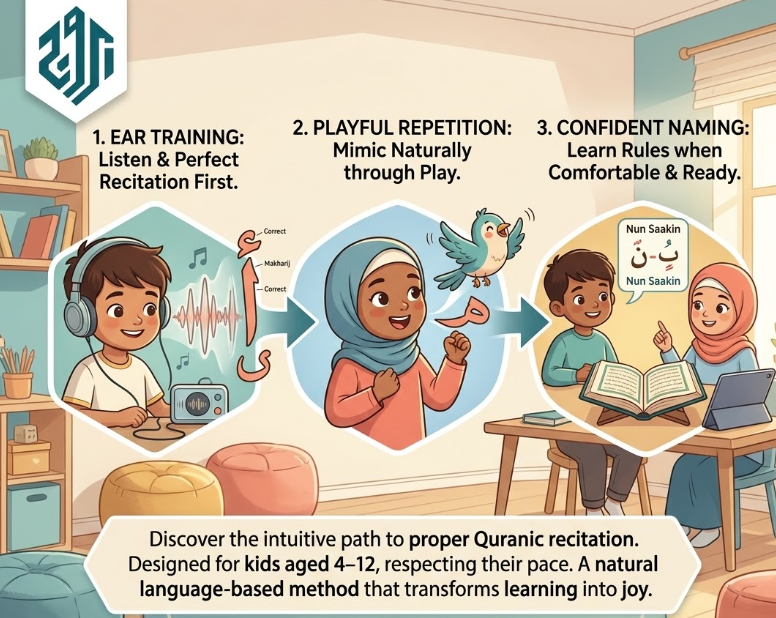
One of the most well-intentioned mistakes parents make is introducing Tajweed rules too early. Children aged 4–8 do not learn Tajweed through grammatical explanation.
They learn it through ear training and imitation — hearing correct recitation modeled repeatedly until it becomes instinctive.
The Prophet ﷺ said: “The one who recites the Quran skillfully will be with the noble, righteous scribes.” (Sahih Muslim 798) This hadith is often cited to motivate Tajweed — but notice it speaks of skilled, beautiful recitation, not rule memorization. For children, skill comes through repetition before explanation.
When to Introduce Formal Tajweed Rules for Kids
In our instructors’ experience, formal rule introduction works best around age 8–11, after a child has already been reading fluently for six to twelve months.
At that point, naming the rules they have already been applying intuitively makes the concepts click immediately.
For younger children (ages 4–8), focus entirely on accurate teacher modeling, repetition, and listening. For older children ready for structured Tajweed, our Tajweed for Kids course provides a structured, age-appropriate path through the essential rules.
Book your child’s free Tajweed trial lesson today
4. Begin Quran Reading with Surah Al-Fatiha and Short Juz Amma Surahs
Once a child completes the Noorani Qaida, the first Quran reading practice should start with Surah Al-Fatiha. It is the most recited surah in a Muslim’s life — prayed seventeen times daily in obligatory prayers alone — making it both spiritually significant and practically essential.
After Al-Fatiha, progress through the short surahs of Juz Amma (the 30th Juz) in reverse order from the end of the Quran: Surah An-Nas, Al-Falaq, Al-Ikhlas, and so on.
These surahs are short, frequently heard in prayer, and phonetically accessible. You can explore our detailed guidance on easy surahs of the Quran to memorize for a prioritized list.
Building Reading Fluency Before Memorization
Many parents want their child to memorize before they can read fluently. We always counsel patience here. A child who reads accurately and comfortably will memorize faster and retain longer than a child who memorizes through pure repetition without reading skill.
Reading fluency — the ability to look at any Quranic text and recite it correctly — is the foundation everything else builds upon.
5. Build a Consistent Daily Routine That Fits a Child’s Attention Span
Consistency is more powerful than duration for children. A child who practices Quran for 15 minutes every day will outperform one who studies for 90 minutes on weekends within three months — and will retain far more over a year.
The science behind this is straightforward: children’s working memory consolidates during sleep, meaning daily short sessions create stronger neural pathways than infrequent long ones.
This mirrors what the best time to memorize Quran research confirms about memory consolidation.
Read also: How to Learn Quran for Non-Arabic Speaking Kids?
Age-Appropriate Daily Session Lengths
| Age Group | Recommended Session Length | Sessions Per Day |
| Ages 4–6 | 10–15 minutes | 1 session |
| Ages 7–9 | 15–20 minutes | 1–2 sessions |
| Ages 10–12 | 20–30 minutes | 1–2 sessions |
| Ages 13+ | 30–45 minutes | 1–2 sessions |
The best times for children are immediately after Fajr (if the schedule permits) or after the school day before evening activities begin.
We have seen that families who tie Quran time to an existing daily anchor — a fixed meal, prayer time, or bedtime routine — sustain the habit far more reliably than those who schedule it flexibly.
Excel in Your Quranic Studies
Join Buruj Academy and master the Quran with our structured, professional curriculum.
Book Your Free Trial6. Introduce Quran Memorization (Hifz) at the Right Age and Pace
The question of the best age to memorize Quran has a clear answer from both Islamic tradition and neuroscience: ages 5–12 represent the optimal window, with the peak typically falling between ages 7 and 10.
During this period, children’s phonological memory is at its strongest and their capacity for pattern retention is exceptional.
However, the right age to begin Hifz also depends on the individual child. A child who cannot yet sit still for 15 minutes, who is still building foundational reading skills, or who is under significant academic pressure is not ready for formal Hifz — regardless of age.
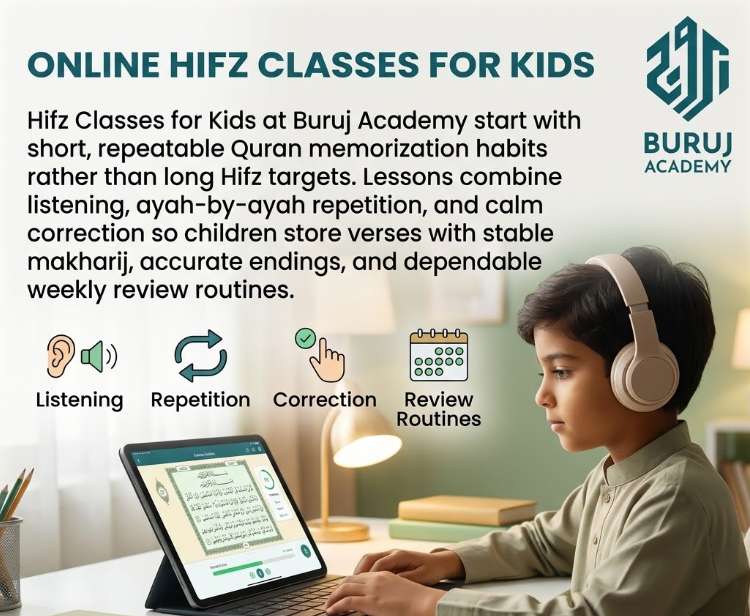
Buruj Academy’s Hifz for Kids course uses short daily memorization targets, structured revision systems, and positive reinforcement to make memorization sustainable without burning children out.
Start your child’s Hifz classes with a free session
A Realistic Memorization Progression for Kids
Start with the shortest surahs to memorize — Surah Al-Ikhlas (4 verses), Al-Kawthar (3 verses), and An-Nasr (3 verses) — before moving to longer surahs. This builds genuine confidence before the challenge increases.
A child memorizing 3–5 new lines per day with proper revision can complete Juz Amma (the 30th Juz, comprising 37 surahs) in approximately 12–18 months, depending on consistency and starting level.
7. Make Quran Learning Engaging Through Activities and Positive Reinforcement
Children learn through engagement, not obligation. A child who dreads Quran time will develop negative associations that can persist into adulthood. Creating a positive, rewarding learning environment is not indulgence — it is sound pedagogy.
Practical engagement strategies that work in our instructors’ classrooms include: short recitation challenges between siblings, reward charts for completed lessons, listening to beautiful recitation by scholars like Sheikh Mishary Rashid during car rides, and Quran-themed activities that reinforce letter recognition and surah knowledge.
Our curated Quran activities for kids resource offers specific, tested ideas for home use.
Making Quran Part of Family Culture, Not Just School
Children internalize values they see modeled. A parent who recites Quran visibly — not just in isolation — signals to the child that this is a living practice, not a homework assignment. Even non-Hafiz parents can model Quran recitation by reading from the mushaf daily in view of their children.
Alhamdulillah, many of our students’ parents tell us that starting their child’s Quran education prompted them to improve their own recitation.
Learning alongside a child — even one step behind — is one of the most powerful motivational environments we have observed.
8. Choose a Qualified Online Quran Teacher Trained in Child Pedagogy
A qualified teacher changes everything. The difference between a child who progresses joyfully and one who stagnates or disengages almost always comes down to the quality of their instruction. Not every Quran teacher — even one with Ijazah — is trained to work with children from non-Arabic speaking Western backgrounds.
Buruj Academy’s Online Quran Classes for Kids course connects children with Al-Azhar-trained, Ijazah-certified instructors who specialize in teaching non-Arabic speaking children.
Every teacher on our platform undergoes a multi-stage selection process and ongoing training in child-appropriate pedagogy, patience, and engagement techniques.
Help your child start learning the Quran with a Free trial
What to Look for in a Quran Teacher for Your Child
| Quality | Why It Matters |
| Child pedagogy training | Explains concepts at age-appropriate levels without frustration |
| Tajweed certification (Ijazah) | Ensures pronunciation correction is accurate, not approximate |
| Experience with non-Arabic speakers | Understands the specific phonetic challenges English-speaking children face |
| Positive reinforcement approach | Builds confidence alongside competence |
| Flexible pacing | Adapts to the child’s speed, not a fixed curriculum timeline |
One-on-one online sessions are particularly effective for children because they receive the teacher’s undivided attention — something group classes, even local ones, cannot provide.
Read also: Worksheet Arabic Numbers for Kids
Discover the Buruj Academy Difference
Step into our virtual classrooms and see how our expert instructors make learning Quran and Arabic intuitive and clear. We focus on overcoming the specific hurdles non-native speakers face, building your confidence and connection with the Quran.
Start Your Child’s Quran Learning with Buruj Academy’s Expert Teachers
Every step in this guide works best with a qualified teacher guiding the process. At Buruj Academy, our Al-Azhar University graduates and Ijazah-certified instructors have spent 12+ years teaching Quran to children from non-Arabic speaking Western families — and we know exactly where children struggle and how to keep them moving forward.
Our Online Quran Classes for Kids offer:
- Personalized 1-on-1 sessions tailored to your child’s exact level
- Flexible scheduling that works around school and family life
- Child-trained instructors who make learning engaging, not stressful
- Real-time pronunciation correction from certified specialists
- Clear progression from Noorani Qaida through confident Quran reading
Book a free trial lesson today and see the difference expert, child-focused instruction makes from the very first session.
Enroll your child in one of our specialized, kid-friendly tracks today:
- Online Quran Classes for Kids
- Tajweed Classes for Kids
- Hifz Classes for Kids
- Online Arabic Classes for Kids
- Quranic Arabic Course for Kids
- Noorani Qaida Course for Kids
- Islamic Studies Classes for Kids
Ready to watch your child grow in knowledge and character? Join the Buruj Academy family and book a free trial session for your child today!
Excel in Your Quranic Studies
Join Buruj Academy and master the Quran with our structured, professional curriculum.
Book Your Free TrialConclusion
Teaching children the Quran in a Western context is absolutely achievable — but it requires sequence, consistency, and the right support. Beginning with Arabic phonics through the Noorani Qaida, progressing to fluent reading before memorization, keeping sessions short and daily, and selecting a teacher trained in child pedagogy are the pillars every successful Quran learning experience rests on.
Children who learn this way do not just complete the Quran — they carry it with love. And that, Insha’Allah, is what every parent is truly working toward.
Frequently Asked Questions About How Kids Learn the Quran
What Is the Right Age to Start Teaching a Child the Quran?
Children can begin Arabic letter recognition through the Noorani Qaida as early as age 4. Formal Quran reading typically begins around ages 5–6, and Hifz (memorization) is most effective between ages 7 and 12. Starting earlier builds comfort with Arabic sounds, even before structured reading begins.
How Long Does It Take a Child to Learn to Read the Quran?
A child who begins with the Noorani Qaida and practices 15–20 minutes daily typically completes foundational reading within 4–12 months. Reaching fluent, independent Quran reading — able to read any passage correctly — generally takes 9–24 months of consistent, qualified instruction depending on age and starting level.
Can My Child Learn the Quran Online Effectively?
Yes. Online 1-on-1 Quran instruction is highly effective for children, particularly because undivided teacher attention accelerates progress. Children as young as 4 learn successfully through structured online sessions when the teacher is trained in child engagement. The key is a qualified instructor, not the format.
How Do I Keep My Child Motivated to Continue Quran Learning?
Short daily sessions prevent fatigue. Visible reward systems — charts, small celebrations for milestones — maintain momentum. Connecting learning to prayer by having children recite memorized surahs in salah gives Quran learning immediate real-life purpose. Most importantly, modeling Quran recitation yourself as a parent signals that this practice matters beyond homework. See our Quran activities for kids resource for specific engagement ideas.