 Quran
Quran
| Key Takeaways |
| Memorizing the entire Quran requires learning 604 pages across 30 Juz’, typically taking 3–10 years depending on consistency. |
| The one who struggles with Hifz earns double the reward — the Prophet ﷺ confirmed this in a verified hadith from Sahih Muslim. |
| Non-Arabic speakers face additional challenges with pronunciation and retention, but structured Tajweed training significantly reduces these barriers. |
| Daily consistency of 20–30 minutes produces more reliable long-term memorization than sporadic longer sessions, according to our instructors’ experience. |
| A qualified Hifz teacher reduces memorization time by catching errors early before they become deeply ingrained habits. |
Memorizing the Quran is one of the most demanding acts of worship a Muslim can commit to — and also one of the most deeply rewarding. Many students come to us with the same honest question: is this something I can actually do, or is it only for those born into Arabic-speaking households?
The direct answer is that Hifz is genuinely difficult, but it is absolutely achievable for non-Arabic speakers at any life stage.
Table of Contents:
Is It Hard to Memorize the Quran as a Non-Arabic Speaker?
Honestly, yes, memorizing the Quran as a non-Arabic speaker is harder than it is for native Arabic speakers, but not because of any intellectual limitation. The core difficulty is phonological: you are simultaneously learning correct pronunciation, retention, and recitation in a language your ear has never processed before.
For native Arabic speakers, memorization draws on years of unconscious language exposure.
For English-speaking students, every word must be learned from scratch at the level of sound, meaning, and script. This adds a layer of cognitive effort that cannot be shortcut — but it can be systematically managed.
How Hard Is It to Memorize the Quran?
The hard part in memorizing the Quran is the timeline is long, and the effort is significant — but with the right method, the right teacher, and realistic expectations, thousands of students worldwide complete it every year. The difficulty is manageable when you understand exactly what you are facing.
In our sessions at Buruj Academy, we consistently observe that students who begin with proper Tajweed training memorize more durably than those who start memorizing immediately.
When the sounds are internalized first, the brain encodes meaning-rich phonetic patterns rather than disconnected syllables. This is the foundation of our approach in the Online Hifz Program.
Start Hifz today with a FREE trial session
Specific Challenges to Prepare For When You Begin Hifz
Hifz difficulty comes from several distinct sources. Understanding each one lets you prepare strategically rather than being surprised by them.
1. Similar Verses Cause the Most Confusion
The Quran contains many verses that share similar wording, especially across Surahs like Al-Baqarah, Al-Imran, and An-Nisa’. These near-identical passages are the primary source of memorization errors for intermediate students.
In our instructors’ experience, students who encounter these passages without preparation often merge them incorrectly — reciting a verse from one Surah mid-way through another.
This is not a sign of weak memory. It is a natural response to structural similarity, and it requires deliberate comparative study rather than simple repetition.
2. Revision Is Harder Than New Memorization
New memorization feels productive because you are adding something. Revision feels like maintenance — less exciting, but more critical. Without consistent revision, previously memorized sections deteriorate within weeks.
Our Hifz specialists recommend a revision-to-new ratio of at least 3:1 — for every new page memorized, three previously learned pages should be reviewed.
Students who skip revision to accelerate new learning almost always reach a breaking point where everything weakens simultaneously. This is the most common cause of Hifz abandonment among adult learners.
3. Pronunciation Errors Compound Over Time
An error in pronunciation, if left uncorrected, becomes reinforced with every repetition. After weeks of incorrect recitation, the wrong version feels correct to the student’s ear. This is why early-stage Tajweed instruction is not optional for serious Hifz students.
Our Online Hifz Program for Adults integrates Tajweed correction from the first session precisely because errors caught in week two cost minutes to fix — errors caught in month six require weeks of retraining.
Book Your Free Trial Lesson with Burruj’s Hifz Course for Adults

What Does Islam Say About the One Who Struggles With Hifz?
This question — about the one who struggles with Hifz — carries profound spiritual weight, and the answer from prophetic tradition is one of the most encouraging in all of Islamic scholarship.
The Prophet ﷺ said, as recorded in Sahih Muslim 798:
“The one who recites the Quran and is proficient in it will be with the noble, righteous scribes (the angels). And the one who recites the Quran and finds it difficult, stammering through it, will have a double reward.”
This hadith reframes the entire question of difficulty. Struggling is not a sign of failure — it is a spiritually elevated state that carries its own reward.
Many of our students carry this hadith as a source of daily motivation through the hardest phases of memorization.
The point is not to romanticize difficulty. Real challenges require real strategies. But the student who is making sincere effort, even imperfectly, is in an honored position according to the Sunnah.
Excel in Your Quranic Studies
Join Buruj Academy and master the Quran with our structured, professional curriculum.
Book Your Free TrialWhat Do You Need to Know of the Quran’s Structure Before Memorizing?
Before estimating difficulty, students need a clear picture of the Quran’s structure. Memorizing the full Quran means retaining every word of 604 pages, 30 Juz’, 114 Surahs, and approximately 6,236 verses.
| Structural Element | Number |
| Total Juz’ | 30 |
| Total Pages (Mushaf) | 604 |
| Total Surahs | 114 |
| Approximate Verses | 6,236 |
| Average Pages per Juz’ | ~20 |
This scale matters because it reframes the question. You are not memorizing isolated vocabulary.
You are building a continuous, interconnected structure where each verse connects to those before and after it — and any gap in revision causes surrounding sections to weaken.
Understanding this structure helps with planning. Our Quran memorization schedule guide walks through how to divide this realistically across weeks and months.
Read also: What Are the Common Mistakes in Quran Memorization?
How Long Does It Realistically Take to Memorize the Quran?
For non-Arabic speaking adults memorizing consistently, the realistic range is 3 to 10 years depending on daily time investment, prior Quran reading ability, and quality of instruction.
| Daily Time Commitment | Estimated Pages per Week | Approximate Completion Timeline |
| 15–20 minutes | 1–2 pages | 7–10 years |
| 30–45 minutes | 3–4 pages | 4–6 years |
| 60–90 minutes | 5–7 pages | 2–4 years |
| Full-time (3–4 hours) | 1+ Juz’ | 1–2 years |
These are instructors’ estimates based on experience, not guaranteed timelines. Individual variation is significant. A student who has already memorized Juz’ Amma and reads Quran fluently will progress far faster than a complete beginner.
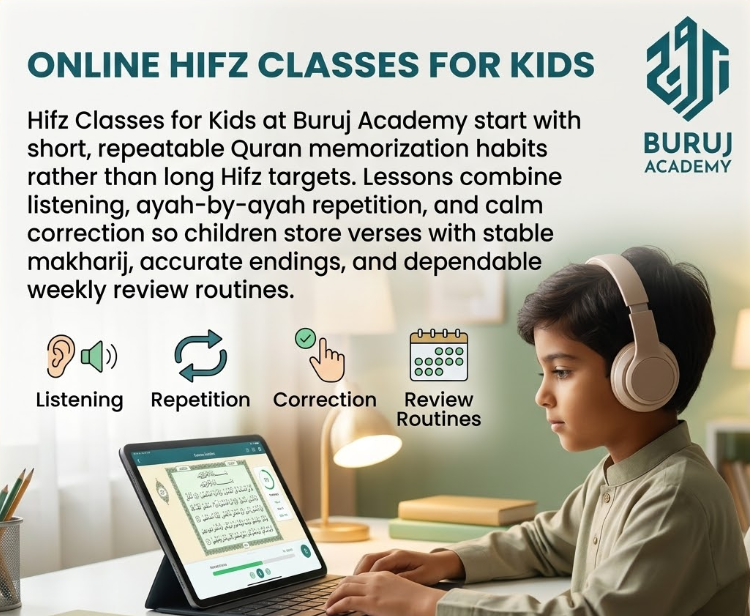
Children, who have greater neuroplasticity and fewer competing responsibilities, often complete Hifz in 2–4 years in structured programs. Buruj Academy’s Hifz for Kids course uses age-appropriate techniques designed for this stage of cognitive development.
Start your child’s Hifz classes with free session
Practical Strategies That Make Hifz Achievable for Busy Adults
Adults balancing work, family, and Hifz face a specific challenge: consistency is harder to maintain than it is for full-time students. But consistency, not session length, is the primary predictor of success.
Three strategies our instructors recommend consistently:
1. Anchor memorization to existing routines
The best time for new memorization is after Fajr, when the mind is rested and distraction is minimal. Our article on the best time to memorize Quran details the neuroscientific and spiritual reasoning behind this.
2. Use spaced repetition for revision
Rather than revising the same pages daily, rotate through memorized sections on a structured schedule. This approach prevents the illusion of retention that comes from reviewing too recently.
3. Record and listen to yourself
Students who record their recitation and listen back catch pronunciation errors their own recitation masks. This self-correction method is one of the most efficient tools available without a teacher present.
For a structured approach, our guide on how to memorize Quran faster provides practical, step-by-step techniques that our instructors use with students across age groups.
Discover the Buruj Academy Difference
Step into our virtual classrooms and see how our expert instructors make learning Quran and Arabic intuitive and clear. We focus on overcoming the specific hurdles non-native speakers face, building your confidence and connection with the Quran.
Start Your Hifz with Buruj Academy’s Expert Instructors
Hifz is diffic ult, but it becomes manageable with the right guidance from the start. Buruj Academy’s Online Hifz Program pairs students with Al-Azhar-trained Hifz specialists who have 12+ years of experience teaching non-Arabic speakers across six continents.
Our approach follows the Buruj Method’s Consistency-before-speed principle: we build durable memorization habits before pushing volume, ensuring what you memorize stays memorized.
- Ijazah-certified instructors with verified chains of transmission
- Personalized learning plans adapted to your schedule and level
- Integrated Tajweed correction from session one
- Flexible 1-on-1 sessions with 24/7 scheduling availability
Book your free trial lesson and begin your Hifz with a qualified teacher who understands exactly where you are starting from.
Take the first step toward this lifelong blessing by enrolling in a program tailored to your pace:
- Online Hifz Program (Comprehensive Quran Memorization)
- Juz 30 Memorization Course (Perfect for focused starts)
- Hifz Classes for Kids (Engaging and interactive)
- Hifz Classes for Adults (Flexible scheduling for busy lives)
- Hifz Classes for Sisters (Private, supportive learning)
- Short Surah Memorization Course (Ideal for daily prayers)
- Hifz Ijazah Course (For advanced students seeking certification)
Don’t let another day pass without moving closer to your goal. Join Buruj Academy today and schedule your free trial session to begin your Hifz journey!
Excel in Your Quranic Studies
Join Buruj Academy and master the Quran with our structured, professional curriculum.
Book Your Free TrialConclusion
Memorizing the Quran is genuinely hard — and that difficulty is precisely what makes it meaningful. The scale is large, the timeline is long, and the revision demands are ongoing.
But the students who succeed are not necessarily the fastest or the most naturally gifted. They are the ones who build consistent habits, work with qualified teachers, and return after every setback.
The one who struggles with Hifz and persists carries a double reward according to the Prophet ﷺ. That is not consolation — it is an elevated station. Understanding the real challenges ahead, structuring your approach carefully, and beginning with proper Tajweed and a reliable teacher are what transform a daunting goal into a completed one.
Read also: How Long Does It Take to Read 1 Juz of the Quran?
Frequently Asked Questions About Memorizing the Quran
Is it hard to memorize the Quran if you don’t speak Arabic?
It is harder than it is for native Arabic speakers because you are learning correct pronunciation simultaneously with retention. However, thousands of non-Arabic speakers complete Hifz every year. Beginning with Tajweed training before memorization significantly reduces this difficulty by giving your brain phonetically accurate patterns to encode and retain.
How many pages of Quran should I memorize per day as a beginner?
Most Hifz instructors recommend beginners start with half a page per day — roughly 10–15 lines — and maintain that pace consistently before increasing. Starting with too much too quickly leads to weak retention and discouragement. Consistency at a modest daily amount outperforms irregular bursts of intensive memorization over any extended period.
What is the best age to memorize the Quran?
Children between ages 6–14 typically memorize fastest due to greater neuroplasticity and fewer competing demands. However, adults successfully complete Hifz at every age. The advantage adults hold is motivation and discipline — qualities that compensate meaningfully for the relative ease of childhood memorization when properly channeled.
Can I memorize the Quran without a teacher?
Self-study memorization is possible but carries significant risks: pronunciation errors become deeply ingrained before being caught, and without accountability, revision consistency suffers. A qualified teacher catches errors in real time and maintains the structured accountability that prevents the gradual deterioration of previously memorized sections.
How hard is Juz’ Amma to memorize compared to the rest of the Quran?
Juz’ 30 (Amma) is the most accessible section of the Quran to memorize. Its Surahs are short, rhythmically distinct, and frequently recited in prayer — meaning most students already have partial familiarity before formal memorization begins. It is the near-universal starting point recommended by Hifz instructors for both children and adults.