 Quran
Quran
| Key Takeaways |
| Quranic Arabic learning for kids begins with Arabic alphabet mastery before progressing to vowel signs and word recognition. |
| Children aged 4–7 learn best through short 10–15 minute daily sessions using visual aids, songs, and letter games. |
| Noorani Qaida provides the structured phonetic foundation kids need before attempting direct Quranic text reading. |
| Vocabulary-building through high-frequency Quranic words (like رَبّ and رَحْمَة) accelerates children’s comprehension significantly. |
| Qualified instruction from Al-Azhar-trained teachers prevents early mispronunciation habits that become difficult to correct later. |
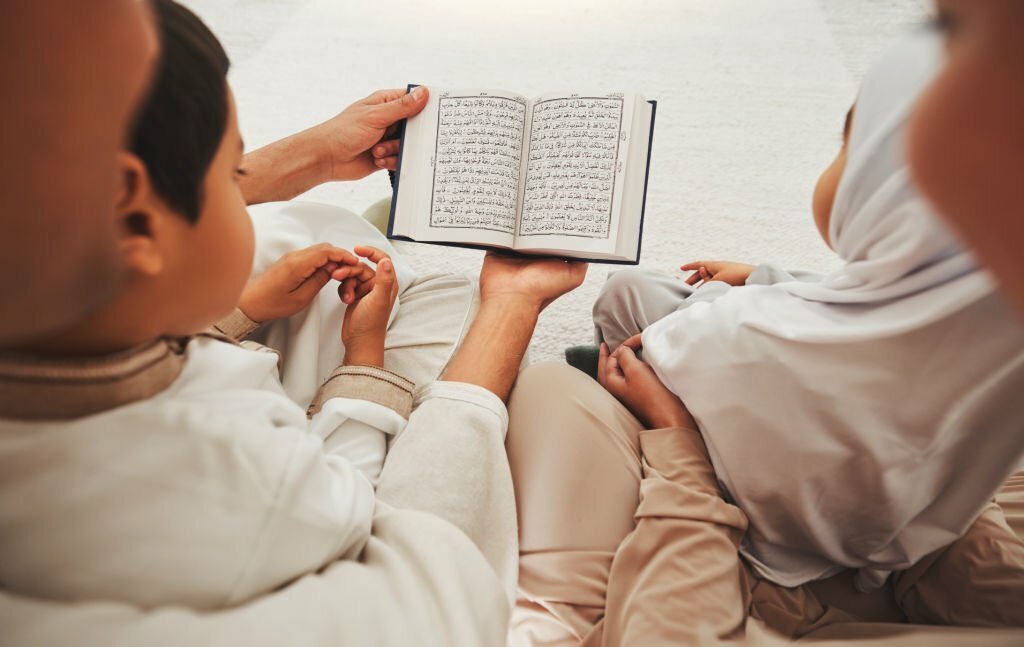
Children who begin Quranic Arabic early develop a natural relationship with the Quran that lasts a lifetime. The sounds, rhythms, and words become familiar before they are abstract — and that early familiarity is the foundation of genuine comprehension.
Teaching a child Quranic Arabic requires a gradual, phonics-first approach: start with letter recognition, build toward voweled words, then introduce common Quranic vocabulary before tackling grammar. Each stage must be secure before the next begins.
Table of Contents:
1. Build Arabic Letter Recognition
Arabic letter recognition is the non-negotiable starting point for any child learning Quranic Arabic.
A child who cannot identify ب from ت, or ع from غ, cannot read a single word — let alone understand one. This foundation must be solid before vowels, words, or grammar are introduced.
In our sessions at Buruj Academy, we consistently find that children who rush past letter recognition struggle later with reading fluency.
Spending two to four weeks on letters alone — through flashcards, tracing, and phonics songs — produces dramatically better outcomes than moving quickly.
How Many Letters Does a Child Need to Learn First?
The Arabic alphabet contains 28 letters, and children learn them most effectively in phonetically grouped clusters rather than alphabetical order. Grouping similar-looking letters together — such as ب، ت، ث or ج، ح، خ — reduces confusion and accelerates recognition.
| Letter Group | Letters | Shared Feature |
| Group 1 | ب ت ث | One body, varying dots |
| Group 2 | ج ح خ | Same shape, different marks |
| Group 3 | د ذ | Simple paired letters |
| Group 4 | ر ز | Short, curving forms |
| Group 5 | س ش | Teeth-shaped letters |
Each group should be practiced for two to three days before introducing the next. Visual matching games and tracing worksheets reinforce the muscle memory children need for reading.
2. Introduce Short Vowels (Harakat) Through Listening Before Writing
Short vowels — the Fathah (َ), Kasrah (ِ), and Dhammah (ُ) — transform static letters into readable syllables. Children learn these best by hearing them repeatedly before they write them. The ear must lead the eye at this stage.
Buruj Academy’s Quranic Arabic Course for Kids introduces harakat through sound-repetition exercises before asking children to identify them visually. This mirrors how children learn spoken language — through listening saturation first.
Try Buruj’s Quranic Arabic Course for Kids for free now
What Are the Three Core Short Vowels in Quranic Arabic?
| Vowel | Name | Sound | Example Letter |
| َ | Fathah | Short “a” (as in “cat”) | بَ = “ba” |
| ِ | Kasrah | Short “i” (as in “bit”) | بِ = “bi” |
| ُ | Dhammah | Short “u” (as in “put”) | بُ = “bu” |
Once children can produce these three sounds reliably on any letter, introduce Sukoon (ْ) — the vowelless marker — and Shaddah (ّ) — the doubling marker. A child who masters harakat can read any voweled Arabic text, including fully voweled Quranic editions.
A simple Quranic example that uses clear harakat and introduces children to a beloved verse is:
بِسْمِ اللَّهِ الرَّحْمَٰنِ الرَّحِيمِ
Bismillāhi r-raḥmāni r-raḥīm
“In the name of Allah, the Entirely Merciful, the Especially Merciful.” (Al-Fatihah 1:1)
Notice how every word is voweled — ideal for beginner reading practice with young learners.
3. Use Noorani Qaida as the Structured Phonetic Bridge
Noorani Qaida is the most proven foundational tool for teaching children to read Arabic phonetically before they engage with the Quran directly. It introduces letters, vowels, joined letters, and syllable patterns in a carefully sequenced progression that prevents confusion and builds reading confidence.
We recommend Noorani Qaida for every child beginning Quranic Arabic, regardless of age or background. It is not a shortcut — it is the correct foundation.
Children who complete it properly can read any voweled Arabic text accurately, which is the prerequisite for Quranic reading.
Buruj Academy’s Noorani Qaida for Kids integrates basic Tajweed principles from the very beginning, so children do not need to unlearn habits later. This early integration of correct pronunciation is one of the most important investments a parent can make in a child’s Quranic education.
For a deeper overview of how Tajweed principles are introduced to young learners, our guide on Tajweed rules for kids explains the age-appropriate approach in detail.
Sign up your son for a free Noorani Qaida lesson

4. Teach High-Frequency Quranic Vocabulary to Build Comprehension Early
Quranic Arabic has a relatively concentrated core vocabulary. Researchers in classical Arabic pedagogy note that approximately 50–100 high-frequency words account for a significant portion of the Quran’s total word occurrences.
Teaching these words to children early creates immediate comprehension bridges.
Rather than teaching random vocabulary, we focus on words that appear across multiple surahs children already recite in salah.
This creates instant recognition moments — the child hears a word in prayer and understands it. That connection is powerful for motivation and retention.
Which Quranic Words Should Children Learn First?
| Arabic Word | Transliteration | Meaning | Appears In |
| رَبّ | Rabb | Lord | Al-Fatihah, An-Nas, Al-Falaq |
| رَحْمَة | Rahmah | Mercy | Throughout the Quran |
| اللَّه | Allah | Allah | Every surah |
| عَبْد | ‘Abd | Servant/Worshipper | Multiple surahs |
| نُور | Noor | Light | An-Nur and others |
| كِتَاب | Kitab | Book | Multiple surahs |
Teaching five new words per week — with visual flashcards, sentence repetition, and connection to memorized surahs — builds a working Quranic vocabulary within months.
Children respond especially well when they realize they already know these words from memory; they simply did not know what they meant.
Read also: Stories to Learn Arabic for Kids
Discover the Buruj Academy Difference
Step into our virtual classrooms and see how our expert instructors make learning Quran and Arabic intuitive and clear. We focus on overcoming the specific hurdles non-native speakers face, building your confidence and connection with the Quran.
5. Connect Vocabulary to Surahs Already Memorized in Salah
One of the most effective strategies we use at Buruj Academy is teaching Quranic Arabic meaning through surahs children have already memorized.
Instead of introducing Arabic as something new and foreign, we show children that they already hold Quranic words in their memory — they simply need to understand them.
Begin with Surah Al-Fatihah, which most children memorize early. Break each word open:
اَلْحَمْدُ لِلَّهِ رَبِّ الْعَالَمِينَ
Al-ḥamdu lillāhi rabbi l-‘ālamīn
“All praise is due to Allah, Lord of all the worlds.” (Al-Fatihah 1:2)
Children can identify رَبّ from their vocabulary list and immediately understand “Lord” — creating a live comprehension moment.
This approach — meaning through familiar text — builds confidence rapidly. The child is not starting from zero; they are discovering that they already know something.
That psychological shift changes everything in how they engage with Quranic Arabic learning.
For parents whose children are already building their memorization, our Quran memorization schedule guide provides practical daily structures that complement Quranic Arabic study.
Excel in Your Quranic Studies
Join Buruj Academy and master the Quran with our structured, professional curriculum.
Book Your Free Trial6. Introduce Basic Quranic Grammar Patterns Gradually and Concretely
Quranic Arabic grammar (النَّحْو, an-naḥw) introduced too early overwhelms children. Introduced gradually through patterns rather than rules, however, it becomes intuitive. Children do not need to name grammatical terms — they need to recognize patterns.
The three most accessible grammar patterns for young learners are:
Pattern 1 — Ism (Noun) + Adjective agreement
Children learn that adjectives follow nouns and match in gender. Example: الْكِتَابُ الْكَرِيمُ (The Noble Book) — both words carry the same markers.
Pattern 2 — الـ (Al-) as the definite article
Every time children see الـ, they know the word is definite. This is one rule with no exceptions in form, making it ideal for early introduction.
Pattern 3 — Verb-Subject order
Arabic often places the verb before the subject. Recognizing this pattern prevents children from misreading sentences. Example: قَالَ اللَّهُ — “Allah said” (verb first, then subject).
Buruj Academy’s Quranic Arabic Grammar Course introduces these patterns through Quranic examples at every stage, so grammar always feels connected to real meaning rather than abstract rules.
Get Your Free Trial Quranic Arabic Grammar Lesson

7. Use Age-Appropriate Learning Methods Matched to Each Stage
Children at different ages require fundamentally different instructional approaches for Quranic Arabic.
The content may be the same, but the delivery must match cognitive and emotional development. Teaching a 5-year-old the same way as a 12-year-old produces frustration on both sides.
| Age Range | Primary Method | Session Length | Key Focus |
| 4–6 years | Tracing, visual cards | 10–15 minutes | Letter recognition, letter sounds |
| 7–9 years | Games, repetition, short stories | 20–25 minutes | Voweled reading, basic vocabulary |
| 10–12 years | Structured exercises, pattern drills | 30–40 minutes | Grammar patterns, word analysis |
| 13+ years | Text analysis, translation exercises | 40–50 minutes | Contextual comprehension |
For children aged 4–6, the goal is purely phonetic familiarity — letter sounds, basic vowels, and enjoyment. For older children, structured vocabulary and grammar build comprehension.
Pushing grammar onto very young children produces resistance; phonics and vocabulary for older children without grammar limits their understanding.
8. Practice Reading Directly from the Mushaf With a Qualified Teacher
Reading from the actual Mushaf (Quranic text) is a distinct skill that must be practiced under qualified supervision. Children who read independently without correction develop mispronunciation habits — particularly with letters like ع، غ، ح، خ — that become increasingly difficult to correct.
At Buruj Academy, our Al-Azhar-trained instructors provide real-time correction during every reading session.
We have seen, consistently, that children who practice even 10 minutes of supervised Mushaf reading per session progress far faster than those who practice more hours independently.
Connecting proper reading to the broader Tajweed framework early is essential. Our guide on how to read Quran with Tajweed walks through the technical foundations that apply even to young learners beginning this stage.
9. Build Consistency Through Short Daily Practice Over Long Weekly Sessions
Quranic Arabic acquisition in children follows a simple neurological principle: spaced repetition across short daily intervals outperforms longer, infrequent sessions.
A child practicing 15 minutes daily retains significantly more than a child practicing 90 minutes once a week.
In our instructors’ experience, the children who make the most progress are almost never those with the most lesson time — they are the ones whose parents build daily micro-habits at home.
Even 10 minutes of letter review, vocabulary flashcards, or reading a few lines from the Mushaf creates compounding progress over months.
A practical daily structure for a child aged 7–10 might look like this:
| Activity | Time |
| Letter / vocabulary review (flashcards) | 5 minutes |
| Supervised Mushaf reading | 10 minutes |
| Vocabulary connection to a memorized surah | 5 minutes |
This 20-minute structure, maintained consistently five days a week, produces measurable Quranic Arabic progress within 3–4 months. Insha’Allah, consistency is the single most powerful factor in a child’s success.
Read also: How to Speak Arabic for Kids?
Start Your Child’s Quranic Arabic Learning With Buruj Academy’s Expert Teachers
Giving a child the gift of Quranic Arabic understanding is one of the most lasting contributions a parent can make to their child’s relationship with the Quran. Every step above works best under qualified guidance.
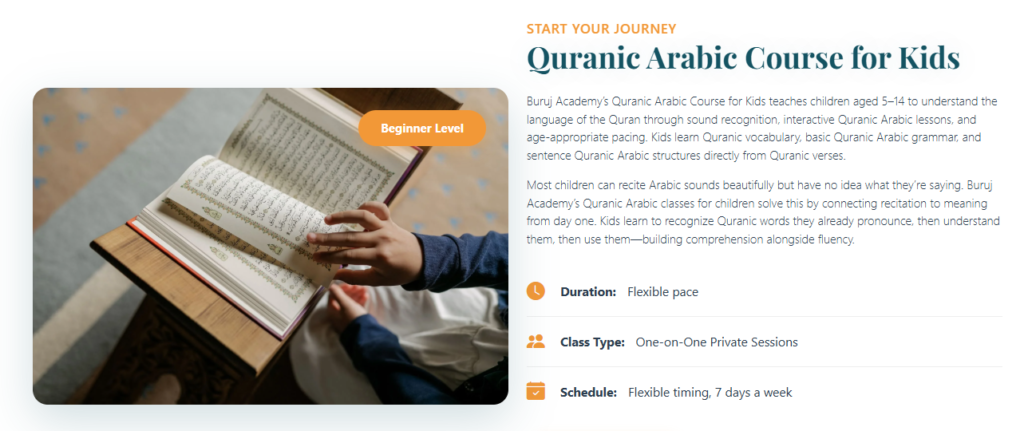
Buruj Academy’s Quranic Arabic Course for Kids provides:
- Al-Azhar University graduates and Ijazah-certified instructors with 12+ years teaching non-Arabic speakers
- Personalized 1-on-1 online sessions tailored to each child’s age, level, and learning style
- The Buruj Method: phonics-first, context-before-abstraction, patience-before-performance
- Flexible scheduling to fit your family’s routine, available globally
- Real-time pronunciation correction from day one
Book your child’s free trial lesson today and see the difference structured, expert-led Quranic Arabic instruction makes.
EBegin your journey of understanding by enrolling in a specialized track today:
- Quranic Arabic Classes (General & Immersive)
- Quranic Arabic Course for Kids (Interactive & Engaging)
- Quranic Arabic Course for Beginners (Foundation Building)
- Quranic Arabic Grammar Course (Syntax & Morphology)
Are you ready to understand what you recite? Join Buruj Academy today and book your free introductory session to begin your journey of discovery!
Excel in Your Quranic Studies
Join Buruj Academy and master the Quran with our structured, professional curriculum.
Book Your Free TrialConclusion
Learning Quranic Arabic is not a single skill — it is a sequence of connected skills, each building on the last. For children, the path runs from letter recognition through phonetic reading, vocabulary building, and finally grammatical understanding, always anchored in the surahs they already love.
The most important factor is not how fast a child moves through these steps, but how securely each stage is established before the next begins. With qualified instruction, daily consistency, and the right age-appropriate methods, children develop a genuine, lasting connection to the language of the Quran. That connection, Alhamdulillah, serves them for life.
Frequently Asked Questions About Learning Quranic Arabic for Kids
What Age Should a Child Start Learning Quranic Arabic?
Children can begin Arabic letter recognition as early as age 4, starting with phonics-based activities and tracing. Formal Quranic Arabic vocabulary and grammar are best introduced around ages 7–9, once basic reading through Noorani Qaida is established. Early phonetic exposure, however, creates an invaluable foundation regardless of when formal instruction begins.
How Long Does It Take for a Child to Read the Quran in Arabic?
Most children with consistent daily practice of 15–20 minutes complete Noorani Qaida within 3–6 months and begin reading the Mushaf independently within 6–12 months. Progress depends on lesson frequency, teacher quality, and home practice. Children with qualified instructor supervision typically progress faster due to early error correction.
Can a Child Learn Quranic Arabic Without Speaking Modern Arabic?
Yes — Quranic Arabic and Modern Standard Arabic are related but distinct. Children can develop strong Quranic reading and comprehension skills without conversational Arabic ability. The Quranic Arabic for Beginners course focuses specifically on classical Quranic vocabulary and grammar relevant to Quran understanding, not everyday conversation.
Is Noorani Qaida Necessary Before Starting Quranic Arabic?
For children with no prior Arabic reading experience, Noorani Qaida is highly recommended as a prerequisite. It establishes the phonetic accuracy and syllable-reading skills that Quranic text requires. Children who skip this foundation often develop reading habits that require significant correction later — making Qaida a time investment that saves time overall.
How Can Parents Support Quranic Arabic Learning at Home?
Parents can reinforce learning by reviewing vocabulary flashcards with children for 5–10 minutes daily, listening to Quranic recitation together, and connecting words to surahs memorized in salah. Consistency at home between lessons accelerates progress significantly. Even parents with no Arabic background can support review sessions using the materials their child’s instructor provides.