 Arabic
| Key Takeaways |
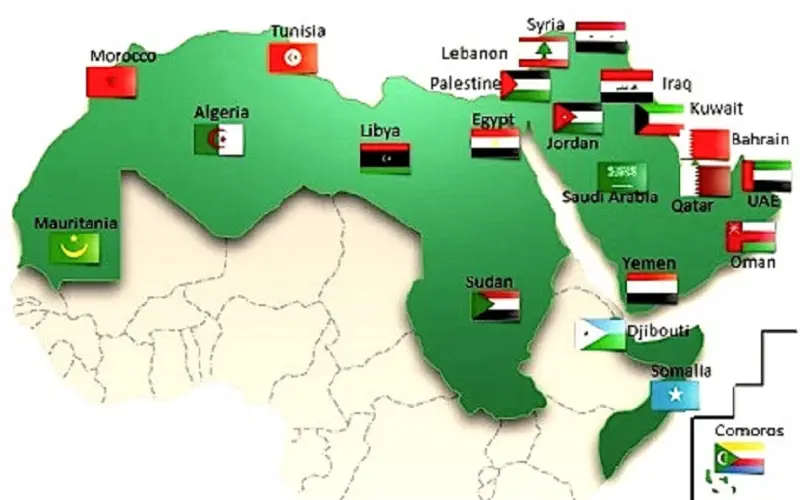
| Arabic is the official language of 22 countries, all members of the Arab League, spanning the Middle East and North Africa. |
| Approximately 400 million people speak Arabic as a native language, making it the fifth most spoken language globally. |
| African countries account for 11 of the 22 Arabic-speaking nations, making Africa the continent with the most Arabic-speaking countries. |
| Not all Middle Eastern countries speak Arabic as a primary language — Iran, and Turkey are notable exceptions in the region. |
| Modern Standard Arabic (MSA) is understood across all Arabic-speaking countries, while spoken dialects vary significantly by region. |
Arabic is spoken across a vast geographic stretch that most English speakers underestimate. From the Atlantic coast of Morocco to the Arabian Gulf, Arabic connects over 400 million people across continents, cultures, and centuries of shared civilization.
There are 22 countries where Arabic holds official language status, forming the Arab League.
These nations span two continents — Africa and Asia — and range from densely populated Egypt to the smaller Gulf states, all united by the Arabic language while each carrying its own distinct dialect.
Table of Contents:
How Many Countries Have Arabic as an Official Language?
Arabic is the official language of exactly 22 countries, all of which are member states of the Arab League. These nations collectively span the Middle East and North Africa (commonly abbreviated as the MENA region), with a combined population exceeding 400 million native speakers.
Arabic also holds co-official status in several additional countries and territories, extending its reach even further.
The Full List of Arabic-Speaking Countries by Region
The 22 Arab League member states are most clearly understood by region:
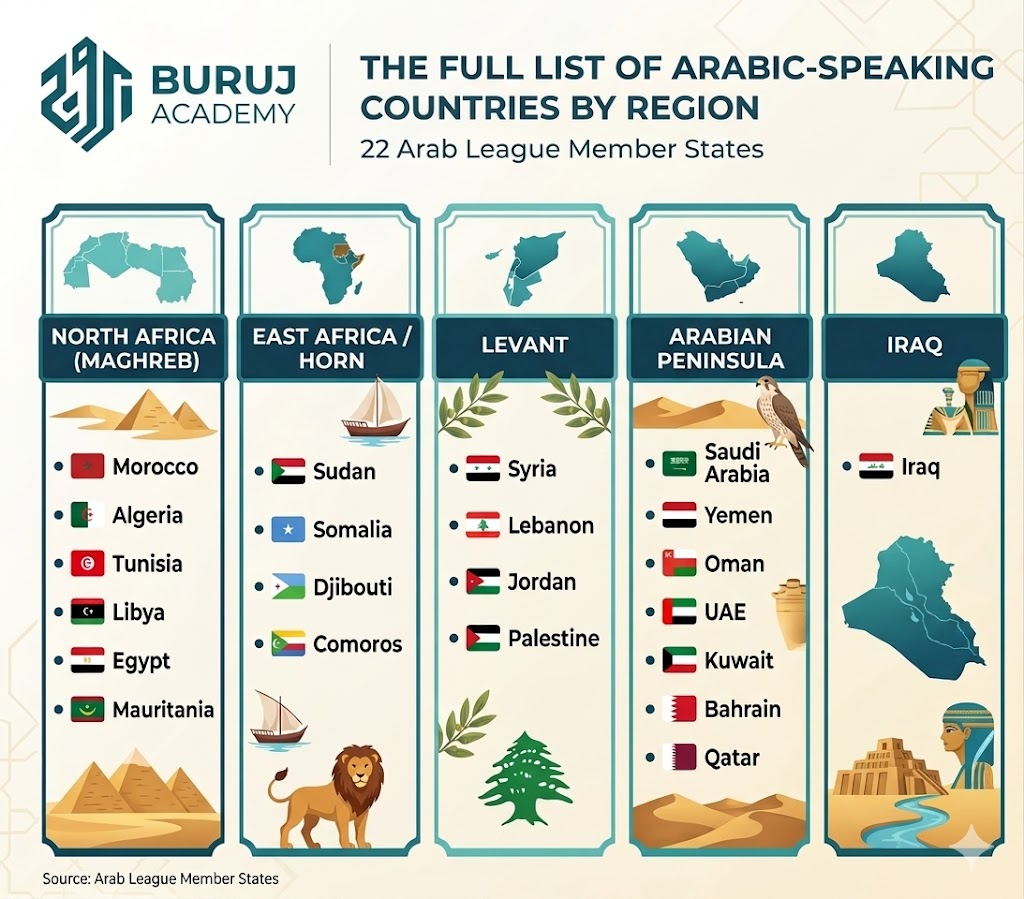
Somalia and Comoros are partial cases — Arabic holds co-official status alongside Somali and Comorian respectively, but Arabic is not the primary spoken language for most of the population in daily life.
At Buruj Academy, our Online Arabic Classes consistently attract students who are surprised to discover just how geographically diverse the Arabic-speaking world truly is — and how that diversity shapes the dialect landscape they will encounter.
Book your FREE Arabic trial online Arabic class at Buruj

What African Countries Speak Arabic?
Eleven of the 22 Arabic-speaking countries are located on the African continent. This surprises many learners who associate Arabic exclusively with the Middle East. Africa is, in fact, the continent with the greatest number of Arabic-speaking nations.
The African Arabic-speaking countries are Egypt, Libya, Tunisia, Algeria, Morocco, Mauritania, Sudan, Somalia, Djibouti, Comoros, and Chad. Chad is a notable addition — while not an Arab League member, Arabic holds official status alongside French.
Sudan sits geographically in northeastern Africa and is a full Arab League member with Arabic as its primary official language.
How Arabic Spread Across Africa
Arabic reached North Africa through the 7th-century Islamic expansion, when Arab Muslim armies moved westward across the continent. The language took root not only as a religious medium but as a language of trade, governance, and daily life across the Maghreb and the Nile Valley.
In sub-Saharan and East African contexts — Somalia, Djibouti, Comoros — Arabic holds official or religious importance primarily through Islamic scholarship and the Quran, while indigenous languages dominate daily spoken life.
Do All Middle Eastern Countries Speak Arabic?
No — and this is one of the most common misconceptions we encounter. Several significant Middle Eastern countries do not speak Arabic as a primary language, despite being geographically surrounded by Arab nations.
| Country | Primary Language | Arabic Status |
| Iran | Persian (Farsi) | Minority language in Khuzestan |
| Turkey | Turkish | No official status |
| Cyprus | Greek / Turkish | No official status |
| Afghanistan | Dari / Pashto | No official status |
Iran has an Arab minority concentrated in the Khuzestan province, where Arabic is spoken alongside Persian. However, Persian (Farsi) is unambiguously the national language.
Do All Arab Countries Speak the Same Arabic?
Modern Standard Arabic (MSA) — called الفصحى (al-fuṣḥā) in Arabic — is the formal, written standard understood across all 22 Arabic-speaking countries. It is used in news broadcasts, formal writing, official documents, and the Quran. However, the spoken dialects (al-ʿāmmiyyah) vary considerably from country to country in Arab countries.
A Moroccan Darija speaker and a Gulf Arabic speaker may struggle to understand each other in casual conversation, yet both can communicate through MSA.
This diglossia — the coexistence of formal and colloquial registers — is a defining feature of the Arabic-speaking world that every language learner should understand before choosing what Arabic to study.
Read also: Best Websites to Learn Arabic for Free
A Comparison of Major Arabic Dialect Groups
| Dialect Group | Countries | Mutual Intelligibility with MSA |
| Egyptian Arabic | Egypt | High — widely understood due to media |
| Levantine Arabic | Syria, Lebanon, Jordan, Palestine | High |
| Gulf Arabic | Saudi Arabia, UAE, Kuwait, Bahrain, Qatar, Oman | Moderate |
| Maghrebi Arabic | Morocco, Algeria, Tunisia, Libya | Low — heaviest Berber and French influence |
| Iraqi Arabic | Iraq | Moderate |
| Sudanese Arabic | Sudan | Moderate |
Egyptian Arabic deserves special mention: because of Egypt’s dominant film, television, and music industry, Egyptian dialect is the most widely understood colloquial Arabic across the entire Arab world.
If someone asks us which dialect is most practically useful for a new learner, Egyptian Arabic and Levantine Arabic are consistently our first recommendations.
Our beginners’ guide to Modern Standard Arabic covers exactly how MSA relates to dialects and which form to prioritize based on your learning goals.
Master the Arabic Language
Join our expert-led courses and build a strong foundation in Classical and Modern Arabic.
Get Your Free TrialIn What Countries Are People Learning Arabic?
Arabic is one of the six official languages of the United Nations, and interest in learning Arabic has grown significantly among non-native speakers worldwide. People are actively learning Arabic across several contexts:
1. Western countries
The United States, United Kingdom, Canada, and Australia all have substantial Muslim communities where Quranic Arabic is taught in mosques and Islamic schools. University Arabic programs have expanded in response to geopolitical and economic interest in the region.
Discover the Buruj Academy Difference
Step into our virtual classrooms and see how our expert instructors make learning Quran and Arabic intuitive and clear. We focus on overcoming the specific hurdles non-native speakers face, building your confidence and connection with the Quran.
2. Muslim-majority countries outside the Arab world
In Pakistan, Indonesia, Malaysia, Bangladesh, Turkey, and Iran, Arabic is taught primarily as the language of the Quran rather than as a spoken vernacular.
Hundreds of millions of Muslims in these nations learn to read Arabic for prayer and Quran recitation without necessarily speaking it conversationally.
3. Sub-Saharan Africa
Countries like Nigeria, Senegal, Mali, and Niger have significant Islamic scholarly traditions with deep roots in classical Arabic education.
In our experience teaching at Buruj Academy, the majority of our Arabic students come from the UK, US, Canada, and Australia — English-speaking Muslims who grew up reading the Quran without fully understanding it.
The motivation to understand Allah’s words directly, without translation, is the most powerful driver we see. Our Arabic for Beginners course was built specifically for this audience, starting from absolute zero with no assumed prior knowledge.
Improving Arabic pronunciation is one of the first hurdles these learners encounter — and it’s one we address systematically from the first session.
Begin learning Arabic at Buruj with a FREE trial lesson

Arabic-Speaking Countries and Their Unique Linguistic Profiles
Every Arabic-speaking country carries a distinct linguistic identity shaped by its history of conquest, trade, and cultural exchange. Understanding these profiles helps learners set realistic expectations.
Egypt is the most linguistically influential Arab country. Egyptian Arabic is the closest thing to a pan-Arab colloquial standard, understood from Morocco to the Gulf due to Egypt’s media output.
Morocco, Algeria, and Tunisia speak Maghrebi dialects heavily influenced by Berber (Tamazight), French, and Spanish. Darija — Moroccan colloquial Arabic — incorporates so much French and Berber vocabulary that many Eastern Arabs describe it as nearly incomprehensible.
Lebanon and Syria produce a Levantine dialect widely regarded as melodic and relatively accessible to new learners — it is popular in Arabic-language television drama.
Saudi Arabia and the Gulf states speak varieties of Gulf Arabic (Khaleeji) with distinctive phonological features, including the pronunciation of certain letters differently from MSA.
Iraq occupies a unique transitional position between Gulf and Levantine dialects, with Mesopotamian Arabic reflecting its ancient linguistic crossroads.
Learning about Arabic sentence structure reveals how these dialects all derive their grammar from the same classical foundation — the structures differ in vocabulary and pronunciation far more than in core grammatical logic.
How to Start Learning Arabic Effectively as a Non-Native Speaker?
For English-speaking Muslims learning Arabic, the starting point matters enormously. The most productive path we have seen over 12+ years at Buruj Academy begins with the Arabic alphabet, then builds to Quranic reading, and finally moves to grammar and comprehension.
A learner who has already spent time learning Arabic words has a measurable head start when moving into sentence construction.
Vocabulary retention and Arabic grammar reinforce each other — understanding why a word takes a certain form builds memory far more effectively than rote repetition alone.
For those whose goal is specifically Quranic understanding, we recommend focusing on Quranic Arabic rather than a regional dialect. The Quran’s Arabic is MSA in its purest classical form — learning it gives access to 14 centuries of Islamic scholarship and to the Quran as intended.
Read also: The Best Programs to Learn Arabic
Start Learning Arabic with Buruj Academy’s Expert Instructors
Arabic connects you to the Quran, to Islamic scholarship, and to 400 million people across 22 countries. The path forward is straightforward with the right guidance.
Buruj Academy’s Online Arabic Classes are taught by Al-Azhar University graduates with 12+ years of experience teaching non-native speakers.
Our Arabic Speaking course and Arabic Grammar course follow the Buruj Method — Context-before-abstraction, Consistency-before-speed — building real competence from the first lesson.
All sessions are personalized 1-on-1, scheduled around your availability, with real-time instructor feedback. Book your free trial lesson today.
Begin your transformation today by choosing the path that fits your goals:
- Online Arabic Classes (General & Comprehensive)
- Arabic Course for Beginners
- Arabic Alphabet Learning Course
- Online Arabic Classes for Kids
- Arabic Classes for Adults
- Arabic Grammar Course (Nahw & Sarf)
- Intermediate Arabic Course (B1/B2)
- Arabic Speaking Course (Conversational Fluency)
- Arabic Reading Course (Literary Excellence)
- Learn Arabic Writing Course (Calligraphy & Composition)
Ready to speak with confidence? Join the global community at Buruj Academy and book your free placement interview today!
Master the Arabic Language
Join our expert-led courses and build a strong foundation in Classical and Modern Arabic.
Get Your Free TrialConclusion
The Arabic-speaking world is far broader than most learners realize. Twenty-two countries across Africa and Asia share Arabic as an official language, yet each carries a distinct linguistic personality shaped by centuries of history.
MSA unites them formally; dialects distinguish them culturally. Whether your goal is Quranic understanding, travel, professional communication, or connecting with your heritage, Arabic opens doors across two continents and multiple civilizations.
The first step is simply knowing where the language lives — and now you do. Alhamdulillah, the path forward begins with that knowledge.
Frequently Asked Questions About Arabic-Speaking Countries
How Many Countries Speak Arabic in the World?
Twenty-two countries have Arabic as an official language, all members of the Arab League. Additionally, Arabic holds co-official or special status in countries like Chad, and Eritrea. Including communities where Arabic is widely spoken without official status, Arabic functions as a significant language in over 25 nations worldwide.
Do All Arab Countries Speak Arabic the Same Way?
No. While Modern Standard Arabic (MSA) is the shared formal written and broadcast standard, each Arab country has its own spoken dialect. Dialects differ in vocabulary, pronunciation, and occasionally grammar. Egyptian Arabic is the most widely understood dialect across the Arab world due to Egypt’s media influence.
Which African Countries Speak Arabic?
Eleven African countries have Arabic as an official or co-official language: Egypt, Libya, Tunisia, Algeria, Morocco, Mauritania, Sudan, Somalia, Djibouti, Comoros, and Chad. Arabic reached Africa through 7th-century Islamic expansion and remains central to religious, educational, and governmental life across North and Northeast Africa.
Is Arabic Spoken in All Middle Eastern Countries?
No. Iran speaks Persian (Farsi), Turkey speaks Turkish, and Afghanistan speaks Dari and Pashto. The Middle East is linguistically diverse — Arabic dominates the Arab-majority nations but is absent from several major regional countries.
What Is the Difference Between Arabic-Speaking Countries and Arab Countries?
An Arab country is one whose people identify ethnically and culturally as Arab, with Arabic as the primary language. Arabic-speaking countries include nations where Arabic is officially recognized but may not be the daily spoken language for most citizens — Somalia and Comoros are examples where Arabic holds official status alongside dominant indigenous languages.