 Quran
Quran
| Key Takeaways |
| Quranic Arabic uses three grammatical cases — Raf’, Nasb, and Jarr — marked by short vowel endings called I’rab. |
| Arabic nouns are either masculine or feminine by default, and this gender controls agreement with verbs, adjectives, and pronouns. |
| The definite article ال (Al) is the only one in Arabic, and its pronunciation changes based on the first letter of the word it precedes. |
| Quranic verbs follow root-based patterns; most roots are three letters, and recognizing these patterns unlocks vocabulary across the entire Quran. |
| Mastering basic Quranic grammar dramatically improves both Quran comprehension and the quality of recitation with correct pause and continuation rules. |
Millions of Muslims recite the Quran daily without understanding what they are reading — and that gap between recitation and comprehension is one of the most common frustrations we hear from students.
Basic Quranic Arabic grammar is the structural system that connects the sounds of recitation to their meanings.
The good news is that Quranic Arabic grammar follows precise, learnable rules. The core structures — noun cases, verb patterns, sentence types, and particle functions — repeat throughout the Quran constantly, meaning that mastering a small set of rules gives students access to a remarkably large portion of Quranic text.
Table of Contents:
1. Quranic Sentence Is Either a Nominal Sentence or a Verbal Sentence
Quranic Arabic has exactly two sentence types: the Jumlah Ismiyyah (nominal sentence) and the Jumlah Fi’liyyah (verbal sentence). A nominal sentence begins with a noun or pronoun and always requires a subject (Mubtada’) and a predicate (Khabar). A verbal sentence begins with a verb and follows the pattern: verb, then subject, then object if present.
This distinction is not abstract — it determines word order and grammatical endings throughout the Quran.
What Is the Difference Between a Nominal and Verbal Sentence in Quranic Arabic?
In a nominal sentence, the subject (Mubtada’) carries the Raf’ case (Dammah ending), and the predicate (Khabar) also carries Raf’. Consider the opening of Surah Al-Ikhlas:
اللَّهُ أَحَدٌ
Allahu Ahadun
“Allah is One.” (Al-Ikhlas 112:1)
Both words carry Dammah — this is a nominal sentence where “Allah” is the Mubtada’ and “Ahad” is the Khabar.
In verbal sentences, the verb comes first and the subject follows. Recognizing which sentence type you are reading immediately tells you what grammatical roles the words are performing.
2. Arabic Nouns Have Three Grammatical Cases That Change Their Endings
I’rab — the system of case endings — is the grammatical backbone of Quranic Arabic. Every noun, adjective, and certain pronouns in the Quran carry one of three cases: Raf’ (nominative), Nasb (accusative), or Jarr (genitive).
The case is marked by short vowel endings: Dammah (ـُ) for Raf’, Fathah (ـَ) for Nasb, and Kasrah (ـِ) for Jarr.
These endings are not decorative — they tell the reader the function of each word in its sentence.
How Do the Three Cases Function in Quranic Verses?
| Case | Name | Vowel Marker | Primary Function |
| Nominative | Raf’ | Dammah (ـُ) | Subject of sentence, predicate of nominal sentence |
| Accusative | Nasb | Fathah (ـَ) | Object of verb, object of certain particles |
| Genitive | Jarr | Kasrah (ـِ) | After prepositions, second word in Idafah construction |
In our Quranic Arabic Grammar Course, this is one of the first tables students study — because once you see these three cases clearly, the vowel endings on every Quranic word begin to carry meaning rather than appearing random.
Get Your Free Trial Quranic Arabic Grammar Lesson

3. The Idafah Construction Is Frequent Noun Structure in the Quranic Arabic
Idafah (إضافة) is a two-noun possessive construction meaning “of” or belonging. It appears hundreds of times throughout the Quran and is formed by placing two nouns directly together — the first noun (Mudaf) loses its nunation (Tanwin) and the definite article ال, while the second noun (Mudaf Ilayhi) takes the Jarr case (Kasrah ending).
The construction does not require a separate word for “of” — the relationship is expressed through positioning and case endings alone.
Why Does Understanding Idafah Change How You Read the Quran?
Consider the most recited phrase in the Quran:
بِسْمِ اللَّهِ الرَّحْمَٰنِ الرَّحِيمِ
Bismi Allahir-Rahmanir-Raheem
“In the name of Allah, the Entirely Merciful, the Especially Merciful.” (Al-Fatihah 1:1)
Here, “Ism” (name) is the Mudaf, and “Allah” is the Mudaf Ilayhi — a clear Idafah. The word “Allah” carries Jarr (Kasrah) because it is the second noun in this construction.
Students who learn Idafah early begin recognizing this pattern instinctively across the entire Quran, which accelerates both comprehension and vocabulary retention.
4. Quranic Arabic Verbs Are Built on Three-Letter Roots That Carry Core Meanings
The Arabic root system is the most efficient vocabulary-building tool in the language. Most Quranic verbs derive from three-letter roots (Fi’l Thulathi), and the root carries a central meaning that runs through every word derived from it.
The root ك-ت-ب (K-T-B) relates to writing: كَتَبَ (he wrote), كِتَاب (book), كَاتِب (writer), مَكْتُوب (written).
Recognizing roots allows students to decode unfamiliar Quranic vocabulary using words they already know.
What Are the Most Important Verb Tenses in Quranic Arabic?
Quranic Arabic uses two primary tenses:
| Tense | Arabic Name | Marker | Example |
| Past tense | Fi’l Madi | Fathah on final letter | كَتَبَ (he wrote) |
| Present/future tense | Fi’l Mudari’ | Prefix letters (ن، ي، ت، أ) | يَكْتُبُ (he writes/will write) |
| Command form | Fi’l Amr | Distinct prefix/stem change | اكْتُبْ (write!) |
The Fi’l Amr (command form) appears prominently throughout the Quran in divine directives — recognizing it immediately tells you the verse contains a command from Allah.
5. Quranic Arabic Nouns Are Either Masculine or Feminine, and This Controls the Entire Sentence
Every Arabic noun carries grammatical gender — Mudhakkar (masculine) or Mu’annath (feminine) — and this gender agreement governs verbs, adjectives, pronouns, and demonstrative words throughout each sentence.
Feminine nouns are typically marked by a Ta Marbuta (ة) at the end, though some nouns are feminine by convention without this marker (such as أرض — earth, and شمس — sun).
This is not optional information — a verb must match its subject’s gender, and an adjective must match its noun’s gender.
Discover the Buruj Academy Difference
Step into our virtual classrooms and see how our expert instructors make learning Quran and Arabic intuitive and clear. We focus on overcoming the specific hurdles non-native speakers face, building your confidence and connection with the Quran.
How Does Gender Agreement Appear in Quranic Arabic?
Consider how the verb changes with gender:
| Subject Gender | Arabic | Transliteration | Meaning |
| Masculine singular | ذَهَبَ | Dhahaba | He went |
| Feminine singular | ذَهَبَتْ | Dhahabat | She went |
| Masculine plural | ذَهَبُوا | Dhahaboo | They (m) went |
| Feminine plural | ذَهَبْنَ | Dhahabna | They (f) went |
In our experience teaching students through Buruj Academy’s Quranic Arabic for Beginners course, gender agreement is the single grammar point that causes the most confusion early on — especially for English speakers whose language has no grammatical gender system.
Once students internalize this pattern, their reading comprehension accelerates significantly.
Begin Understanding Quranic Arabic with a FREE Lesson
6. The Definite Article ال Has Two Different Pronunciations Depending on the Following Letter
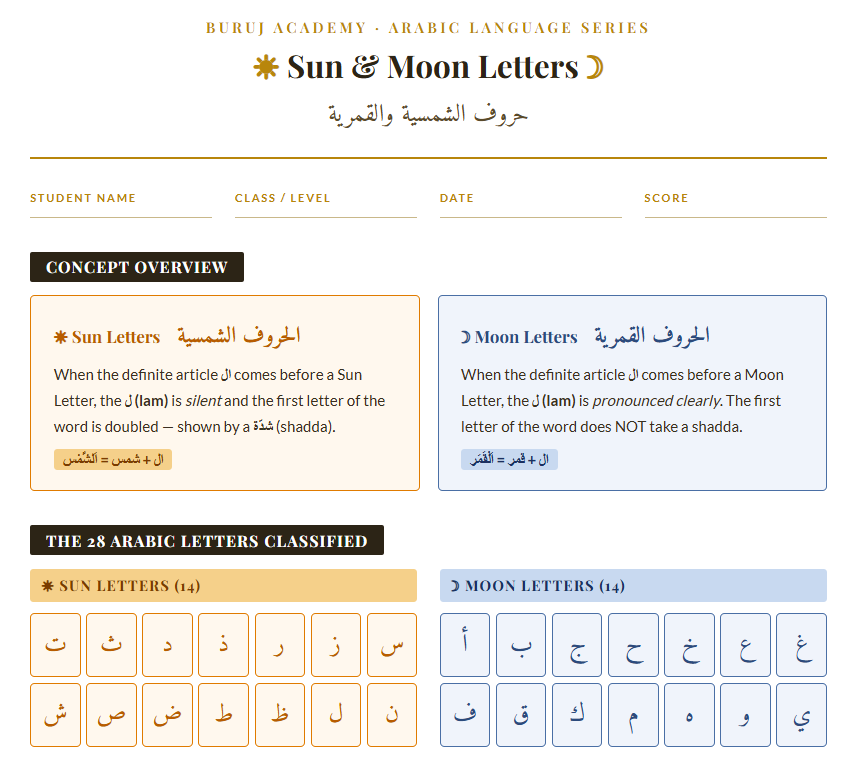
The definite article ال (Al) is the only definite article in Arabic — there is no indefinite article. When ال precedes a Shamsiyyah (solar) letter, the Lam of ال is assimilated into the following letter, and that letter is doubled. When it precedes a Qamariyyah (lunar) letter, the Lam is fully pronounced.
This rule connects directly to Tajweed — specifically to the rules of assimilation — making it relevant to both grammar and recitation simultaneously.
Read also: How to Learn Quranic Arabic?
What Are the Solar and Lunar Letters in Quranic Arabic?
| Category | Letters | Example |
| Shamsiyyah (Solar — Lam assimilates) | ت ث د ذ ر ز س ش ص ض ط ظ ل ن | الشَّمْس → Ash-Shams (not Al-Shams) |
| Qamariyyah (Lunar — Lam pronounced) | أ ب ج ح خ ع غ ف ق ك م و ه ي | الْقَمَر → Al-Qamar (Lam fully pronounced) |
A reliable teaching method we use is grouping the Shamsiyyah letters by their shared articulation zones — students find this more intuitive than memorizing the list in isolation.
Buruj Academy · Sun&Moon Letters WORKSHEET.pdf
7. Prepositions in Quranic Arabic Always Cause the Following Noun to Take the Jarr Case
Arabic prepositions — called Huruf al-Jarr — are short words that govern the noun following them, forcing it into the Jarr (genitive) case marked by Kasrah.
The most frequent Quranic prepositions are بِ (by/with), لِ (for), مِن (from), إلى (to/toward), عَلى (upon), فِي (in), and عَن (from/about).
Recognizing these words instantly tells you that the noun following them will carry a Kasrah ending — regardless of what it would carry in other positions.
فِي سَبِيلِ اللَّهِ
Fi sabeelil-lah
“In the path of Allah.”
The preposition “Fi” places “Sabeel” into Jarr case — Kasrah on the Lam. “Allah” then takes Jarr as the Mudaf Ilayhi in a chained Idafah.
This phrase alone — recurring throughout the Quran — illustrates three grammar rules simultaneously: preposition, Jarr case, and Idafah.
8. Quranic Arabic Pronouns Vary by Gender, Number, and Person
Arabic pronouns are far more specific than English pronouns. The Quran uses distinct pronouns for masculine singular (هُوَ), feminine singular (هِيَ), masculine dual (هُمَا), masculine plural (هُمْ), feminine plural (هُنَّ), and more. These pronouns also appear as attached suffixes on nouns, verbs, and prepositions — making them one of the most high-frequency grammar elements in the entire Quran.
Understanding pronoun suffixes unlocks a significant portion of Quranic vocabulary immediately.
Excel in Your Quranic Studies
Join Buruj Academy and master the Quran with our structured, professional curriculum.
Book Your Free TrialHow Do Attached Pronouns Work in Quranic Arabic?
| Pronoun Suffix | Meaning | Example | Translation |
| ـهُ | His/It | رَبُّهُ | His Lord |
| ـهَا | Her/Its | رَبُّهَا | Her Lord |
| ـهُمْ | Their (m) | رَبُّهُمْ | Their Lord (m) |
| ـنَا | Our | رَبُّنَا | Our Lord |
| ـكَ | Your (m. sg.) | رَبُّكَ | Your Lord |
These suffix pronouns attach to the end of words with no space — a source of significant confusion for beginners reading Quranic text without grammatical training.
9. Arabic Adjectives Always Follow Their Nouns and Must Match in Four Ways
In Quranic Arabic, adjectives come after the nouns they describe — the opposite of English word order. Beyond position, every adjective must agree with its noun in four properties: gender (masculine/feminine), number (singular/dual/plural), definiteness (definite/indefinite), and case (Raf’/Nasb/Jarr).
Missing any one of these agreements is a grammatical error — making adjective agreement one of the more demanding but most rewarding areas of Quranic grammar to master.
الصِّرَاطَ الْمُسْتَقِيمَ
As-sirat al-mustaqeem
“The straight path.” (Al-Fatihah 1:6)
Here, “Al-Mustaqeem” (straight) follows “As-Sirat” (path), matches it in definiteness (both have ال), case (both Nasb — Fathah), and gender (both masculine).
This single phrase from Al-Fatihah — recited in every rak’ah of salah — is a perfect live example of full adjective agreement.
10. Nunation (Tanwin) Marks Indefinite Nouns and Disappears in Specific Grammatical Contexts
Tanwin is the doubling of the short vowel at the end of an Arabic noun, producing the sounds -un, -an, -in. It marks indefiniteness — meaning the noun has no ال and is not the first part of an Idafah construction.
Understanding Tanwin is essential because its presence or absence immediately signals the definiteness status of a noun, which affects both grammar and Tajweed recitation rules.
Tanwin disappears entirely in three situations: when ال is added, when the noun becomes the first part of an Idafah, and in certain broken plural patterns.
| Form | Arabic | Transliteration | Meaning |
| Indefinite (Tanwin) | كِتَابٌ | Kitabun | A book |
| Definite (Al) | الْكِتَابُ | Al-Kitabu | The book |
| Idafah (no Tanwin, no Al) | كِتَابُ اللَّهِ | Kitabul-lah | The Book of Allah |
For students studying Tajweed rules, Tanwin is also significant because Noon Sakinah and Tanwin share identical rules — connecting grammar directly to recitation accuracy.
Read also: How to Read the Quran in Arabic Easy?
11. Waqf Rules Determine Where You May Pause, and Grammar Determines Waqf
Waqf (pause rules in recitation) is directly governed by grammatical structure. You may pause at the end of a complete grammatical unit — a full sentence or independent clause.
Pausing mid-Idafah, mid-adjective agreement, or between a preposition and its noun is grammatically and recitatively incorrect. This means Quranic grammar and Tajweed recitation are inseparable disciplines.
Students who learn grammar alongside Tajweed develop a far more accurate instinct for natural pause and continuation than those who study either in isolation.
Understanding the grammatical boundary of each phrase — where the Idafah ends, where the adjective completes its agreement, where the prepositional phrase concludes — directly informs the Waqf markers placed throughout the Uthmani Mushaf.
This is precisely why our Al-Azhar-trained instructors at Buruj Academy teach grammar and recitation together from the intermediate level onward.
Build Your Quranic Arabic Foundation with Buruj Academy’s Expert Instructors
These twelve grammar rules are the structural core of Quranic Arabic — and mastering them requires consistent, guided practice with instructors who understand how non-Arabic speakers learn.
Buruj Academy’s Quranic Arabic Grammar Course is taught by Al-Azhar University graduates with 12+ years of experience teaching non-Arabic speakers.
Our Quranic Arabic Classes use the Buruj Method — Context-before-abstraction — so students understand grammar through real Quranic examples before encountering abstract rules. Every session is personalized, 1-on-1, and scheduled flexibly around your life.
Begin your journey of understanding by enrolling in a specialized track today:
- Quranic Arabic Classes (General & Immersive)
- Quranic Arabic Course for Kids (Interactive & Engaging)
- Quranic Arabic Course for Beginners (Foundation Building)
- Quranic Arabic Grammar Course (Syntax & Morphology)
Are you ready to understand what you recite? Join Buruj Academy today and book your free introductory session to begin your journey of discovery!
Book your free trial lesson today and begin reading the Quran with genuine understanding.
Excel in Your Quranic Studies
Join Buruj Academy and master the Quran with our structured, professional curriculum.
Book Your Free TrialConclusion
Quranic Arabic grammar is not an obstacle between a student and the Quran — it is the key that makes the Quran’s words come alive. The twelve rules covered here — from I’rab and Idafah to verb roots, gender agreement, and Waqf — are not exhaustive, but they represent the grammatical foundation that makes everything else learnable.
What makes this foundation powerful is how interconnected these rules are. Understanding Idafah informs how you read Tanwin. Understanding I’rab informs where you pause. Understanding verb roots unlocks vocabulary you have never studied.
For anyone ready to move from recitation to comprehension, starting with these core structures is the most direct path forward, Insha’Allah.
Frequently Asked Questions About Basic Quranic Arabic Grammar
What Is the Difference Between Quranic Arabic and Modern Standard Arabic Grammar?
Quranic Arabic is Classical Arabic — the most precise and established form of the language. Modern Standard Arabic (MSA) is derived from it, so the core grammar rules, including I’rab, Idafah, and verb patterns, are shared. However, Quranic Arabic includes classical vocabulary and grammatical constructions that appear rarely or never in MSA usage today.
Do I Need to Learn the Arabic Alphabet Before Starting Quranic Grammar?
Yes — alphabet and basic reading fluency are prerequisites for grammar study. Students who cannot yet read Arabic script should begin with a Noorani Qaida with Tajweed course before moving to grammar. Attempting grammar without reading ability creates confusion that slows both skills down simultaneously.
How Long Does It Take to Learn Basic Quranic Arabic Grammar?
In our instructors’ experience at Buruj Academy, students with no prior Arabic background typically need four to six months of consistent weekly sessions to develop solid command of the core grammar rules covered in this article. The timeline varies significantly based on session frequency, daily review habits, and whether the student is simultaneously reading the Quran and applying grammar in context.
Is Quranic Arabic Grammar Necessary for Memorizing the Quran?
Grammatical understanding is not a requirement for Quran memorization, but it significantly supports retention. Students who understand the meaning and grammatical structure of what they are memorizing retain it more accurately and recover forgotten sections faster than those memorizing sounds alone.
Can Children Learn Quranic Arabic Grammar, and at What Age?
Children can begin structured Quranic Arabic grammar from approximately age nine to ten, when abstract reasoning develops sufficiently for case-ending rules. Younger children benefit more from vocabulary exposure and sentence-pattern recognition. Buruj Academy’s Quranic Arabic Course for Kids is structured to introduce grammar age-appropriately, building readiness for formal grammar study gradually.