 Quran
Quran
| Key Takeaways |
| Non-Arabic speakers can read Quran by learning the Arabic script through a structured phonetic system like Noorani Qaida. |
| Tajweed rules govern correct pronunciation; even beginners must learn foundational rules before reading independently. |
| Transliterations are a temporary bridge only — they cannot replace Arabic script learning for accurate Quran reading. |
| A qualified teacher corrects mispronunciations in real time, preventing errors that become permanent habits within weeks. |
| Reading Quran in Arabic carries immense reward even without understanding; comprehension is a separate, later stage of learning. |
Millions of Muslims worldwide recite the Quran daily without speaking a word of conversational Arabic. This is not a contradiction — it reflects a foundational distinction between reading Arabic script and speaking the Arabic language.
Learning to read Quran without knowing Arabic is achievable through a structured phonetic approach.
The Arabic letters, their sounds, and the rules governing their pronunciation can be mastered systematically by any motivated adult or child — regardless of native language or prior exposure to Arabic.
Table of Contents:
1. Understand the Difference Between Reading Arabic and Speaking Arabic
Reading Quran and speaking Arabic are two separate skills, and confusing them is the single most common reason beginners feel paralyzed before they begin. You do not need Arabic fluency to read the Quran correctly and beautifully.
Arabic script is phonetically consistent — each letter produces a specific sound, and those sounds follow predictable, learnable rules. Unlike English spelling, Arabic pronunciation rarely surprises you once the letters are internalized.
In our experience at Buruj Academy, students who understand this distinction from day one progress significantly faster.
The moment they realize they are learning a reading system — not a language — the task becomes concrete and manageable rather than overwhelming.
| Goal | Skill Required | Timeline (Average Adult) |
| Read Quran aloud accurately | Arabic script + Tajweed rules | 3–6 months with daily practice |
| Understand Quran meaning | Quranic Arabic comprehension | Separate, longer study path |
| Speak conversational Arabic | Full Arabic language study | Independent from Quran reading |
This clarity matters because it allows you to begin immediately — with the right tools, in the right sequence.
2. Start with Noorani Qaida to Build Your Arabic Letter Foundation
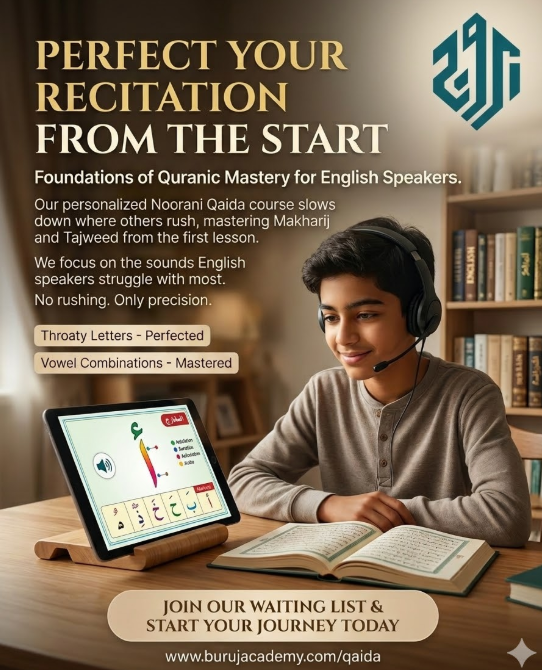
The first and most important practical step is mastering the Arabic alphabet through a structured phonetic primer. Noorani Qaida is the most widely used and pedagogically sound method for this purpose, specifically designed for non-Arabic speakers learning to read Quran from scratch.
Noorani Qaida introduces Arabic letters in a logical progression — isolated letters first, then joined forms, then voweled syllables, then words — building reading confidence layer by layer before moving to actual Quranic text.
Buruj Academy’s Noorani Qaida Online Course provides systematic letter-by-letter instruction with qualified teachers trained in phonetics and beginner pedagogy for non-Arabic speakers, ensuring correct sound production from the very first lesson.
Book your FREE trial lesson in the Noorani Qaida course
Why Is Transliteration Not a Substitute for Arabic Script in Reading the Quran?
Transliterations (writing Arabic sounds in English letters, e.g., Alhamdulillahi Rabbil ‘Alameen) are widely available and genuinely useful as a temporary reference. However, they cannot replace Arabic script for several critical reasons.
No transliteration system accurately captures Arabic sounds that have no English equivalent — the letters ع (ʿayn), غ (ghayn), ح (ha), and خ (kha) are routinely approximated in ways that lead to permanent mispronunciation.
Reading Quran through transliteration alone means reading an approximation, not the actual text.
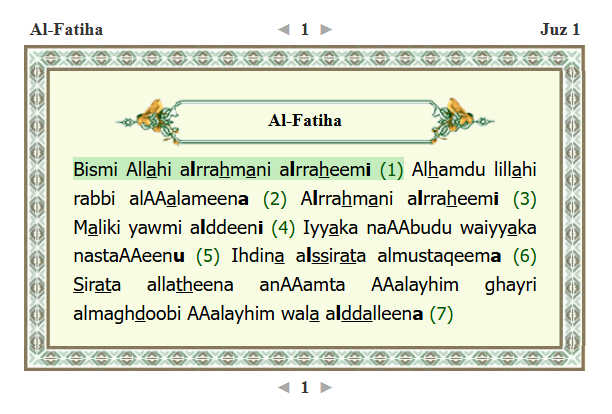
Use transliteration as a short-term bridge — a sound reference while your eyes are still learning to decode Arabic letters. Within 4–8 weeks of consistent study, most beginners can begin reading directly from Arabic script with increasing fluency.
3. Learn the Arabic Vowel System Before Attempting Quran Text
Arabic letters alone do not tell you how to pronounce a word — the vowel markers (harakat) carry that information. Mastering this system is non-negotiable before any student reads actual Quran text.
The three primary vowel markers are: Fatha (short ‘a’ sound), Kasra (short ‘i’ sound), and Damma (short ‘u’ sound).
Each appears as a small mark above or below the letter, and the Quran text (Mushaf) includes all vowel markings — making it one of the most readable Arabic texts available to beginners.
| Vowel Marker | Arabic Symbol | Sound | Example Letter + Vowel |
| Fatha | ـَ | Short ‘a’ (as in “cat”) | بَ = “ba” |
| Kasra | ـِ | Short ‘i’ (as in “bit”) | بِ = “bi” |
| Damma | ـُ | Short ‘u’ (as in “put”) | بُ = “bu” |
| Sukoon | ـْ | No vowel — consonant stop | بْ = “b” (stopped) |
| Shadda | ـّ | Doubled/intensified consonant | بّ = “bb” |
Two additional markers require close attention: Tanween (nunation — the doubling of vowel sounds to produce an ‘n’ ending) and Madd (vowel elongation).
Both appear constantly throughout Quranic text and must be understood before reading progresses to full verses.
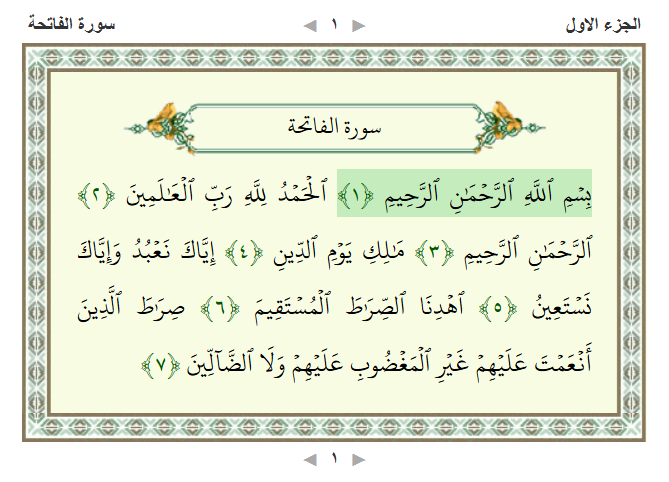
4. Begin Reading Short Surahs with Proper Tajweed from the Start
Once letters and vowels are established, the natural next step is reading actual Quranic text — and the wisest place to begin is Juz ‘Amma (the 30th Juz), which contains the shortest surahs most Muslims already know by sound.
Beginning with familiar surahs — Surah Al-Fatiha, Al-Ikhlas, Al-Falaq, An-Nas — allows you to cross-reference your reading against audio you have heard since childhood. This auditory check is one of the most effective self-correction tools available to new readers.
Tajweed — the science of correct Quran recitation — must be introduced at this stage, not treated as an advanced topic for later. Even a handful of foundational rules applied consistently protects the meaning of the text and the validity of your recitation.
Begin with Tajweed for beginners covering these essential rules: proper articulation of letters from their correct makhraj (articulation point), the rule of Ghunnah (nasal resonance), basic Madd (elongation) rules, and Waqf (stopping) etiquette.
Our detailed guide on how to read Quran with Tajweed walks through each of these in practical sequence.
Discover the Buruj Academy Difference
Step into our virtual classrooms and see how our expert instructors make learning Quran and Arabic intuitive and clear. We focus on overcoming the specific hurdles non-native speakers face, building your confidence and connection with the Quran.
Which Surahs Should You Start Reading First?
| Surah | Verses | Why Begin Here |
| Al-Fatiha (1) | 7 | Recited in every prayer — familiar by ear |
| Al-Ikhlas (112) | 4 | Extremely short, phonetically straightforward |
| Al-Falaq (113) | 5 | Simple structure, excellent for letter practice |
| An-Nas (114) | 6 | Closes Quran — psychologically motivating |
| Al-Kawthar (108) | 3 | Shortest surah — confidence-building first read |
Read also: Is It Haram to Force Your Child to Read the Quran?
5. Train Your Ear Before You Read with Your Eyes
One of the most effective — and most overlooked — strategies for learning to read Quran without knowing Arabic is intensive listening before independent reading. The ear is your most powerful teacher at this stage.
Listen repeatedly to a single reciter you find clear and melodically accessible. Many students find Sheikh Mahmoud Khalil Al-Husary’s Murattal (slow, pedagogically paced) recitation particularly useful for this purpose, as his pronunciation is exceptionally clear and his pace allows the listener to follow text simultaneously.
At Buruj Academy, our Buruj’s Azhari Quran tutors consistently observe that students who spend two to three weeks listening to a target surah before reading it independently make far fewer errors and require significantly less correction.
Book a FREE trial session with one of Buruj’s Azhari Quran tutors

The ear pre-loads the correct sounds, and the mouth follows. This is a core element of our Buruj Method — sound before rules, and sound before reading.
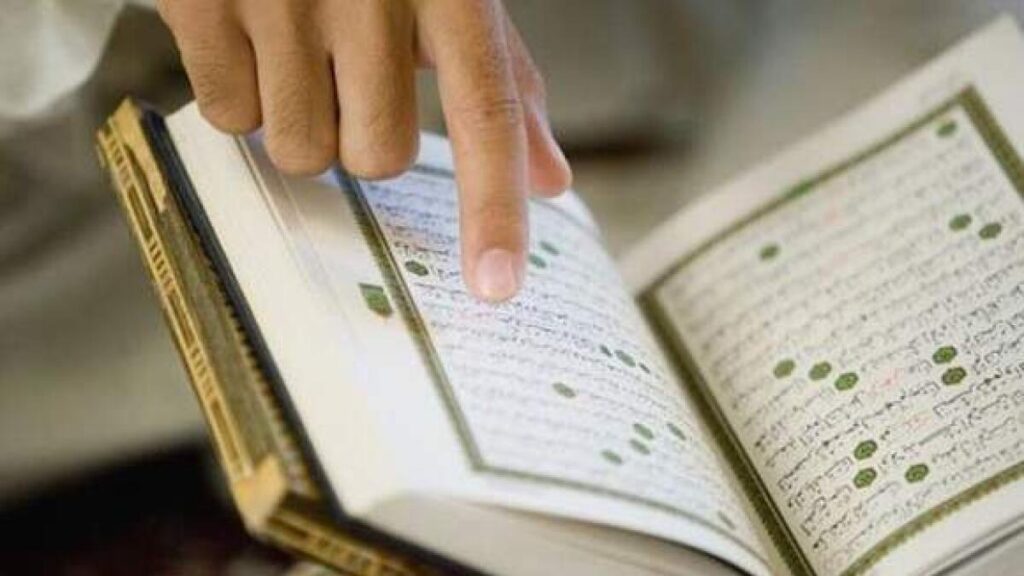
Follow the listening with shadow reading: open the Mushaf, play the audio at slow speed, and track the text with your finger as you listen. Shadow reading bridges the gap between passive listening and active reading without the pressure of independent production.
Excel in Your Quranic Studies
Join Buruj Academy and master the Quran with our structured, professional curriculum.
Book Your Free Trial6. Work with a Qualified Teacher for Real-Time Pronunciation Correction
Reading Quran is a transmitted oral tradition — it has been passed from teacher to student in an unbroken chain (sanad) since the time of the Prophet ﷺ. This is not merely historical context; it has direct practical implications for how you learn.
Pronunciation errors in Arabic Quran reading, if left uncorrected, solidify into permanent habits within four to six weeks of daily practice.
A teacher identifying and correcting a mispronunciation in week two prevents that same error from being embedded in hundreds of recitations by week eight.
Self-study through apps and audio alone cannot provide this correction. Apps can tell you which surah you are on; they cannot tell you that your Ra is slightly too heavy, your Qaf is being softened, or your Ghunnah is cutting short of the required two counts.
Buruj Academy’s Quran Reading Course connects students with Ijazah-certified instructors and Al-Azhar University graduates in personalized 1-on-1 sessions, providing real-time correction that no app can replicate.
Book your Free trial lesson and start reading the Quran
Our instructors are specifically experienced in the pronunciation challenges non-Arabic speakers face — including the common difficulty distinguishing ح from ه, or properly articulating ع without strain.
Is It Mandatory to Read Quran in Arabic?
Reading the Quran in Arabic is obligatory for Salah (the five daily prayers) — there is scholarly consensus that Salah must be performed in Arabic, including the recitation of Surah Al-Fatiha. This ruling is well-established across the four major madhabs.
Outside of Salah, a Muslim who cannot yet read Arabic may engage with translations and transliterations to access meaning and maintain connection with the text.
However, the original Arabic is the Quran itself — no translation, regardless of quality, carries the same weight, legal standing, or spiritual station as the Arabic.
The Prophet ﷺ said:
“The one who is proficient in the Quran will be with the honourable, righteous scribes (angels), and the one who reads it and stumbles over it, finding it difficult, will have a double reward.” (Sahih Muslim 798)
This hadith offers direct encouragement to those who struggle — the difficulty of learning to read does not diminish the reward. It increases it.
Read also: What is the Importance of Reading the Quran with Understanding?
Why Is It Important to Read the Quran in Arabic?
Reading the Quran in Arabic is important because the Arabic text is the preserved, uncreated speech of Allah — and any translation is a human interpretation of that meaning, not the Quran itself.
Even the most careful translation cannot capture the phonetic precision, grammatical structure, and spiritual weight of the original Arabic.
Consider Surah Al-Ikhlas:
قُلْ هُوَ ٱللَّهُ أَحَدٌ
Qul huwa Allahu ahad
“Say, “He is Allah, [who is] One,” (Al-Ikhlas 112:1)
Each word carries a grammatical precision that no English equivalent fully replicates — Ahad meaning the Uniquely One, distinct from Wahid meaning simply “one in number.”
Beyond theology, reading in Arabic connects you to 1,400 years of the Muslim Ummah reciting the same words in the same sounds.
Every Muslim, regardless of native language or nationality, recites the same Arabic text in Salah. That shared recitation is itself an act of unity.
Practically, reading in Arabic also opens the path toward understanding. Once you can read fluently, you can begin Quranic Arabic study — and the meaning of what you recite becomes accessible layer by layer.
For a foundational guide, our article on reading the Quran for the first time addresses this transition in detail.
How to Read Quran If You Don’t Know Arabic?
For complete beginners, the question of how to read Quran if you don’t know Arabic is best answered with a structured, time-bounded plan rather than open-ended advice.
| Week | Focus | Daily Practice Time | Milestone |
| 1–2 | Arabic letters (isolated forms) via Noorani Qaida | 20 minutes | Recognize all 28 letters by sight and sound |
| 3–4 | Joined letter forms + vowel markers | 20 minutes | Read basic voweled syllables (ba, bi, bu, etc.) |
| 5–8 | Voweled words + Sukoon + Shadda | 25 minutes | Read short voweled words without hesitation |
| 9–12 | Surah Al-Fatiha + Al-Ikhlas with teacher | 30 minutes | Read both surahs with basic Tajweed accuracy |
| 13–16 | Juz ‘Amma short surahs + foundational Tajweed rules | 30 minutes | Read 5–10 surahs independently |
This timeline assumes consistent daily practice and weekly teacher-guided sessions. Students working with a qualified instructor at Buruj Academy consistently reach the 12-week milestone — reading short surahs accurately — within this window.
For those ready to take the next step toward memorization, our Quran memorization schedule and guide on how to memorize Quran faster provide the structured systems that make retention sustainable.
Begin Your Quran Reading with Buruj Academy’s Expert Instructors
Learning to read Quran without knowing Arabic is one of the most rewarding commitments a Muslim can make — and the right guidance makes all the difference between years of slow progress and months of genuine, measurable advancement.
Buruj Academy’s Online Quran Reading Course is built specifically for non-Arabic speakers at every level — from complete beginners who cannot yet identify a single letter, to those who read hesitantly and need targeted Tajweed correction.
Our instructors are Al-Azhar University graduates and Ijazah-certified with 12+ years of experience. Every student receives personalized 1-on-1 sessions, flexible scheduling, and real-time pronunciation correction through the Buruj Method.
Book your free trial lesson today and read your first surah with a qualified teacher by your side.
Take the next step in your learning journey today by enrolling in one of our specialized programs:
- Online Quran Classes
- Online Quran Classes for Beginners
- Online Quran Classes for Adults
- Online Quran Classes for Ladies
- Online Quran Classes for Kids
- Quran Reading Course
- Quran Recitation Course
- Online Ijazah Course
- Online Qirat Course
Don’t wait to transform your relationship with the Holy Quran. Join our global community of students and book your free evaluation session now!
Excel in Your Quranic Studies
Join Buruj Academy and master the Quran with our structured, professional curriculum.
Book Your Free TrialConclusion
Reading the Quran without knowing conversational Arabic is not only possible — it is the reality for the vast majority of the world’s 1.8 billion Muslims. The path is structured and learnable: master the Arabic letter system, internalize the vowel markers, apply foundational Tajweed from the beginning, and work consistently with a qualified teacher who can protect you from errors before they become habits.
Understanding the Quran in depth is a separate and longer path — and a beautiful one. But reading it accurately and reverently, in the language Allah revealed it, is available to you far sooner than most beginners believe. Begin with one letter. Then one word. Then one verse. The rest follows.
Frequently Asked Questions About How to Read Quran Without Knowing Arabic
Can I Learn to Read Quran on My Own Without a Teacher?
You can make initial progress using Noorani Qaida apps and audio resources, but independent self-study cannot replace a teacher’s real-time correction. Pronunciation errors in Arabic solidify into permanent habits within weeks. A qualified teacher — even in weekly online sessions — prevents foundational mistakes that become very difficult to undo later.
How Long Does It Take to Read Quran Fluently as a Non-Arabic Speaker?
Most motivated adult beginners reach basic reading fluency — reading short surahs accurately — within three to four months of consistent daily practice with teacher guidance. Full independent fluency across the entire Quran typically takes one to two years, depending on daily practice time, teacher quality, and prior exposure to Arabic sounds.
Is It Sinful to Mispronounce Quran While Learning?
No — mispronunciation during the learning process is not sinful when a student is making genuine effort to learn correctly. The Prophet ﷺ specifically acknowledged the double reward for those who struggle with recitation. The obligation is to seek correction and learn properly, not to achieve perfection before beginning.
What Is the Best Tool for a Non-Arabic Speaker to Start Reading Quran?
Noorani Qaida is the most effective starting tool — it introduces Arabic letters, vowels, and syllables in a systematic phonetic sequence specifically designed for non-native speakers. Paired with a qualified teacher and a voweled Mushaf (the standard printed Quran includes all vowel markings), it provides everything a beginner needs to begin reading accurately.
Does Reading Quran in Arabic Have Reward Even Without Understanding the Meaning?
Yes — according to the hadith narrated in Sahih Muslim, reward is attached to the act of reciting the letters themselves, regardless of comprehension level. Understanding meaning is a separate, additional blessing pursued through Quranic Arabic and Tafsir study — it does not replace or diminish the reward of recitation.