 Tajweed

| Key Takeaways |
| Tanween is a doubled vowel marker added to the end of indefinite nouns in Arabic, pronounced as a trailing “n” sound. |
| There are three tanween signs: tanween al-fath (ـً), tanween al-damm (ـٌ), and tanween al-kasra (ـٍ), each marking a different grammatical case. |
| In Tajweed, tanween follows the same four rules as noon sakinah: Ith-har, Idgham, Iqlab, and Ikhfa, depending on the following letter. |
| Tanween only appears on indefinite nouns — it never combines with the definite article “ال” (al). |
| Recognizing tanween signs and their Tajweed rules is foundational for correct Quranic recitation from the very first lesson. |
Tanween appears on almost every page of the Quran, yet many students read right past it without understanding what it means or how it should sound. That gap between seeing a symbol and knowing what to do with it creates some of the most persistent recitation errors we correct at Buruj Academy.
Tanween is a doubled vowel marker placed at the end of indefinite Arabic nouns, written as two stacked vowel signs and pronounced as a trailing “n” sound. Mastering its three written forms and four Tajweed rules transforms Quranic reading from hesitant guessing into confident, accurate recitation.
Table of Contents:
What Is Tanween in Arabic?
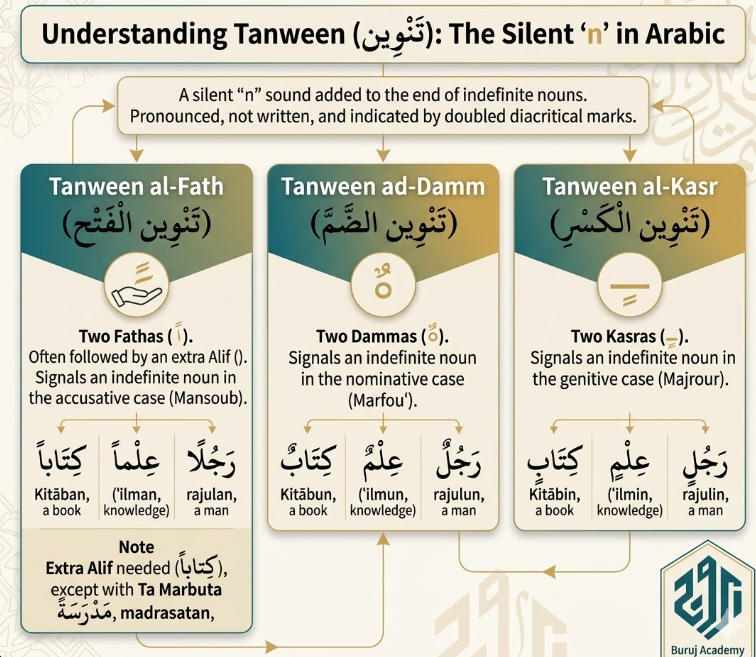
Tanween is a silent “n” added to the end of Arabic nouns in speech but not written as a letter. It appears instead as a doubled diacritical mark — two fathas, two dammas, or two kasras — and signals that a noun is indefinite and grammatically inflected. The word “tanween” (تَنْوِين) itself derives from the root “noon,” reflecting that pronunciation.
Excel in Your Quranic Studies
Join Buruj Academy and master the Quran with our structured, professional curriculum.
Book Your Free TrialWhy Does Tanween Matter for Quran Readers?
For Quran readers, tanween matters because it is not merely a grammar point — it is a Tajweed trigger. Every tanween followed by another word activates one of four recitation rules, affecting whether you pronounce, merge, flip, or conceal the “n” sound. Getting this wrong changes how the Quran sounds in ways a trained ear will immediately notice.
In our experience teaching at Buruj Academy, students who understand tanween as both a grammatical marker and a Tajweed trigger progress through recitation exercises at least twice as fast as those who treat it as a passive marking. Our Tajweed for Beginners course addresses tanween in its foundational units precisely because it appears so frequently in Juz Amma.
Book Your FREE Trial Lesson to Begin Your Tajweed Journey

Read also: Shaddah in Arabic and Tajweed: Meaning, Rules, and Quranic Examples
What Are the Three Tanween Signs in Arabic?
Tanween in Arabic comes in three written forms, each corresponding to a grammatical case. Recognizing these signs instantly is the first practical skill every student needs.
| Tanween Sign | Arabic Symbol | Grammatical Case | Example | Pronunciation |
| Tanween al-Fath | ـً | Accusative (Nasb) | كِتَابًا | kitaaban |
| Tanween al-Damm | ـٌ | Nominative (Raf’) | كِتَابٌ | kitaabun |
| Tanween al-Kasra | ـٍ | Genitive (Jarr) | كِتَابٍ | kitaabin |
Each sign is simply the standard short vowel marker written twice. Tanween al-fath (ـً) adds a written alif in most cases — for example, كِتَابًا — while tanween al-damm and tanween al-kasra do not add any extra letter.
One rule applies to all three: tanween is dropped entirely during a pause (waqf). When you stop at the end of an ayah on a word carrying tanween, you do not pronounce the “n.” This waqf rule trips up many students who apply tanween sounds even when stopping, which is a recitation error our instructors correct consistently.
Discover the Buruj Academy Difference
Step into our virtual classrooms and see how our expert instructors make learning Quran and Arabic intuitive and clear. We focus on overcoming the specific hurdles non-native speakers face, building your confidence and connection with the Quran.
What Are the Four Types of Tanween in Arabic Grammar?
Arabic linguists identify four distinct types of tanween, each serving a different grammatical function. Understanding these types helps students recognize why tanween appears where it does — and why it is absent from some words that seem like they should have it.
1. Tanween al-Tamkeen: The Standard Grammatical Tanween
Tanween al-tamkeen is the most common type. It attaches to fully declinable (muwsarraf) nouns to indicate indefiniteness and grammatical flexibility. The word كِتَابٌ (a book) is the classic example — the tanween marks it as an indefinite noun in the nominative case.
2. Tanween al-Tankeer: Tanween That Distinguishes Indefinite from Definite
This type appears on a small category of indeclinable nouns and particles to distinguish an indefinite usage from a definite one. The example classical grammarians use is صَهْ (sahin — meaning “be silent” in general) versus صَهٍ (sahin — “be silent about a specific matter”). This type is rare and appears primarily in classical Arabic texts.
3. Tanween al-‘Iwad: Tanween That Replaces a Deleted Element
Tanween al-‘iwad compensates for something omitted from the word or sentence. In the word قَاضٍ (qadin — a judge), tanween replaces the deleted final yaa’ of the original form قَاضِي. It also appears after ظ words like يَوْمَئِذٍ (yawma’idhin), where tanween compensates for an omitted following sentence. Quran readers encounter this type regularly in words ending with a kasra-tanween that follows a deleted letter.
4. Tanween al-Muqabalah: Tanween Paired with the Noon of Sound Masculine Plural
Tanween al-muqabalah appears on sound feminine plurals (jam’ mu’annath salim) such as مُسْلِمَاتٌ. It mirrors — and balances — the final noon (نَ) found in sound masculine plurals like مُسْلِمُونَ. This pairing is a structural symmetry in Arabic morphology.
Excel in Your Quranic Studies
Join Buruj Academy and master the Quran with our structured, professional curriculum.
Book Your Free TrialWhat Are the Tajweed Rules for Tanween in Quran Recitation?
In Tajweed, tanween behaves exactly like noon sakinah (a sukoon-marked noon). When tanween ends a word and another word follows, the letter that begins the next word determines which of four rules applies. This is non-negotiable in correct recitation — our Al-Azhar-trained instructors emphasize that tanween rules are among the first Tajweed skills applied in real Quran reading.
Book a FREE trial session with one of Buruj’s Azhari Quran tutors

| Tajweed Rule | Trigger Letters | What Happens | Quranic Example |
| Ith-har Halqi (Clear Pronunciation) | أ هـ ع ح غ خ | “N” pronounced clearly | عَلِيمٌ حَكِيمٌ |
| Idgham (Merging) | ي ر م ل و ن | “N” merges into next letter | غَفُورٌ رَّحِيمٌ |
| Iqlab (Conversion) | ب | “N” converts to a concealed meem | سَمِيعٌ بَصِيرٌ |
| Ikhfa Haqiqi (Concealment) | 15 remaining letters | “N” held between clear and merged | قَوْمًا ضَالِّينَ |
For a detailed breakdown of how Ikhfa operates across all fifteen letters, our article on the Ikhfa letters in Tajweed covers each trigger letter with Quranic examples.
1. Idh-har Halqi: When Tanween Is Pronounced Clearly
Ith-har halqi applies when tanween is followed by one of the six throat letters: ء، هـ، ع، ح، غ، خ. The “n” sound of the tanween is pronounced fully and distinctly, with no merging or reduction. The term “halqi” refers to the throat (halq), where these six letters are articulated.
عَلِيمٌ حَكِيمٌ
‘Aleemun Hakeemun
“Knowing and Wise.”
The tanween on عَلِيمٌ is followed by ح — a throat letter — producing clear, audible “n.”
2. Idgham: When Tanween Merges Into the Following Letter
Idgham occurs when tanween meets one of the six letters collected in the phrase يَرْمَلُونَ (y, r, m, l, w, n). The tanween “n” is absorbed into the following letter. Idgham splits into two categories: with ghunnah (nasal resonance) for the letters ي، ن، م، و, and without ghunnah for ل and ر.
غَفُورٌ رَّحِيمٌ
Ghafoorun Raheem
“Forgiving, Merciful.”
The tanween on غَفُورٌ merges into the ر — idgham without ghunnah.
For a full explanation of both categories, our article on Idgham rules in Tajweed walks through every trigger letter with examples.
3. Iqlab: When Tanween Converts to a Nasal Meem
Iqlab has exactly one trigger letter: ب (ba). When tanween precedes a word beginning with ba, the “n” of the tanween converts to a meem sound, held with ghunnah (nasal resonance). In modern Quran printings, a small meem (مـ) appears above the tanween mark to indicate this rule visually.
سَمِيعٌ بَصِيرٌ
Samee’um Baseer
“All-Hearing, All-Seeing.”
The tanween on سَمِيعٌ converts to a nasal meem before the ب of بَصِيرٌ.
4. Ikhfa Haqiqi: When Tanween Is Partially Concealed
Ikhfa haqiqi applies to the remaining fifteen letters not covered by the other three rules. The tanween “n” is neither fully pronounced nor fully merged — it is held in a middle state with ghunnah for two counts (two beats). This is the most frequently occurring tanween rule in the Quran.
قَوْمًا ضَالِّينَ
Qawman daalleen
“A people gone astray.”
Tanween on قَوْمًا is followed by ض — one of the fifteen Ikhfa letters — requiring partial concealment with ghunnah.
Our dedicated article on ghunnah and its rules explains how to hold the nasal resonance correctly for both Idgham and Ikhfa.
Read also: Leen Letters in Arabic and in Tajweed
What Is the Difference Between Tanween and Noon Sakinah?
Tanween and noon sakinah share the same four Tajweed rules, which is why they are always taught together. However, they differ in origin, position, and how they appear in writing.
| Feature | Tanween | Noon Sakinah |
| Written form | Doubled vowel mark — not a letter | Written as the letter ن with sukoon |
| Position | End of indefinite nouns only | Anywhere in a word or particle |
| Word types | Nouns only | Nouns, verbs, and particles |
| During waqf (pause) | Dropped — not pronounced | Retained — still pronounced |
| In connected speech | Pronounced | Pronounced |
The most important practical difference for Quran students: tanween disappears at a pause, while noon sakinah does not. A student stopping at the end of an ayah on a word like عَلِيمٌ should read it as “Aleem” — dropping the “un” entirely — not “Aleemun.”
Examples of Tanween in the Quran
Recognizing tanween across all three signs, combined with the correct Tajweed rule, is the practical goal. The following Quranic phrases represent some of the most recited examples.
مُحَمَّدٌ رَّسُولُ اللَّهِ
Muhammadur Rasoolullah
“Muhammad is the Messenger of Allah.” (Al-Fath 48:29)
(Tanween al-damm on مُحَمَّدٌ followed by ر — idgham without ghunnah.)
هُدًى لِّلْمُتَّقِينَ
Hudan lil-muttaqeen
“Guidance for the righteous.” (Al-Baqarah 2:2)
(Tanween al-fath on هُدًى followed by ل — idgham without ghunnah.)
خُلُقٍ عَظِيمٍ
Khuluqin ‘Atheem
“A great character.” (Al-Qalam 68:4)
(Tanween al-kasra on خُلُقٍ followed by ع — ith-har halqi, clear “n.”)
Students preparing to read the Quran for the first time will encounter tanween on the very first page. Our guide on reading the Quran for the first time covers exactly how to approach these markers before beginning.
Excel in Your Quranic Studies
Join Buruj Academy and master the Quran with our structured, professional curriculum.
Book Your Free TrialMaster Tanween with Buruj Academy’s Expert Tajweed Instructors
Tanween is one of the highest-frequency Tajweed triggers in the Quran — understanding it correctly changes every page of your recitation.
At Buruj Academy, our Online Tajweed Classes are led by Ijazah-certified instructors and Al-Azhar University graduates with 12+ years of experience teaching non-Arabic speakers worldwide.
Our Tajweed for Beginners course teaches tanween rules through the Buruj Method — sound recognition before rule labeling — so students apply rules in real recitation, not just name them on a test.
Join a supportive learning environment tailored to your pace and lifestyle. Start your journey toward excellence by enrolling in one of our specialized tracks:
- Online Tajweed Classes
- Tajweed Classes for Beginners
- Tajweed Classes for Adults
- Tajweed Classes for Sisters
- Tajweed Classes for Kids
- Advanced Tajweed Course
- Amli Tajweed Course (Practical Application)
We offer personalized 1-on-1 online sessions with flexible 24/7 scheduling and real-time pronunciation correction. Book your free trial lesson today and let our instructors guide you to accurate, confident Quranic recitation from the very first session.
Frequently Asked Questions About Tanween
What Is Tanween in Arabic?
Tanween is a doubled vowel diacritical mark added to the end of indefinite Arabic nouns, representing a trailing “n” sound in pronunciation. It appears in three forms — tanween al-fath (ـً), tanween al-damm (ـٌ), and tanween al-kasra (ـٍ) — corresponding to the three grammatical cases of Arabic. Tanween is written but the “n” it represents is not shown as a letter.
What Are the Tanween Rules in Tajweed?
Tanween follows the same four Tajweed rules as noon sakinah: Ith-har halqi (clear pronunciation before the six throat letters), Idgham (merging before يرملون), Iqlab (conversion to meem before ب), and Ikhfa haqiqi (concealment before the remaining fifteen letters). The rule that applies depends entirely on the first letter of the word that follows the tanween.
What Is the Difference Between Tanween al-Fath, Tanween al-Damm, and Tanween al-Kasra?
Tanween al-fath (ـً) marks the accusative case (nasb) and is usually accompanied by a written alif. Tanween al-damm (ـٌ) marks the nominative case (raf’). Tanween al-kasra (ـٍ) marks the genitive case (jarr). All three function identically in Tajweed — their differences are purely grammatical.
Does Tanween Have a Sound During Waqf?
No. Tanween is dropped entirely when you pause (waqf) at the end of a word. A word like كِتَابٌ is read “Kitaab” — not “Kitaabun” — at a waqf stop. This is one of the most common errors in recitation: students apply the tanween sound even when stopping, which contradicts the rules of proper Tajweed.
Can Tanween Appear on All Arabic Words?
No. Tanween only appears on indefinite, declinable nouns (with limited exceptions for the other three types). It never combines with the definite article ال. Words that are “prevented from declension” (mamnu’ min al-sarf) — such as proper names like إِبْرَاهِيمُ or adjectives on the فَعْلَانُ pattern — do not take tanween. Recognizing which words cannot carry tanween is part of intermediate Arabic grammar study.