 Arabic

| Key Takeaways |
| Hamzatul qat is a true Hamza that is always pronounced — whether you start mid-speech or at the beginning of a word. |
| Hamzatul qat appears in all Arabic pronouns, all prepositions and conjunctions, most nouns, and all four-letter (ruba’i) verbs. |
| Hamzatul wasl is a helper Hamza that sounds when you start a word alone but disappears completely when the word connects to what precedes it. |
| The fastest way to distinguish the two: add waw (و) or fa (ف) before the word — if the Hamza is still heard, it is hamzatul qat. |
| In Mushafs, hamzatul wasl is marked by a small ص (sad) above the alif, while hamzatul qat carries a normal Hamza sign (ء). |
Every student of Tajweed eventually reaches the moment where two alifs look almost identical on the page — yet one must be pronounced and one must vanish.
That moment is where hamzatul qat and hamzatul wasl diverge, and misreading either one changes the recitation entirely.
Table of Contents:
What Is Hamzatul Qat in Arabic?
Hamzatul qat is the Hamza that never disappears. It is pronounced in every context — at the start of speech, in the middle of a sentence, when pausing, when connecting. Understanding exactly where it appears, and how it behaves, is foundational to accurate Quran recitation.
What Is Hamzatul Qat and Why Does It Never Drop?
Hamzatul qat (هَمْزَةُ الْقَطْعِ) is defined in classical Tajweed science as the Hamza that is established in both ibtida (beginning of speech) and wasl (connection to what precedes). Unlike hamzatul wasl, it is never elided. It carries a full vowel — fatha, kasra, or damma — and is written as a Hamza sign (ء) above or below the alif.
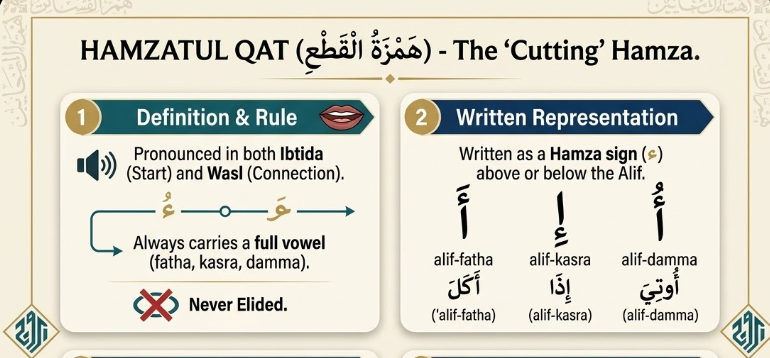
It is called “qat” — meaning “cutting” — because it cuts into the flow of speech. When you connect two words, hamzatul qat forces a full glottal stop before it. It does not merge or soften. It insists on being heard.
At Buruj Academy, our Al-Azhar-trained instructors teach students this key insight first: hamzatul qat is not a decoration — it is a phoneme that carries meaning. Dropping it, even slightly, changes what the word communicates.
Book a FREE trial session with one of Buruj’s Azhari Quran tutors

Read also: Hamzat al Wasl: Definition, Rules, Examples
Where Does Hamzatul Qat Appear in Arabic and the Quran?
Hamzatul qat has four clear categories. Knowing these categories removes all guesswork.
1. Hamzatul Qat in Pronouns
Many of Arabic pronouns begin with hamzatul qat.
| Pronoun | Transliteration | Type |
| أنا | Ana | Hamzatul Qat |
| أنتَ / أنتِ | Anta / Anti | Hamzatul Qat |
| إياكَ | Iyyaka | Hamzatul Qat |
| أنتم | Antum | Hamzatul Qat |
إِيَّاكَ نَعْبُدُ وَإِيَّاكَ نَسْتَعِينُ
Iyyaka na’budu wa-iyyaka nasta’een
“It is You we worship and You we ask for help.” (Al-Fatiha 1:5)
( إياك carries hamzatul qat — both are fully pronounced in all recitation contexts.)
2. Hamzatul Qat in All Conjunctions and Prepositions
Arabic particles begin with hamzatul qat. This includes أنْ, أو, أم, إذا, إلى, and all similar words.
وَأَن لَّيْسَ لِلْإِنسَانِ إِلَّا مَا سَعَىٰ
Wa-an laysa lil-insani illa ma sa’a
“And that there is not for man except that for which he strives.” (An-Najm 53:39)
(The أن here is a particle — its Hamza is hamzatul qat, always pronounced.)
3. Hamzatul Qat in Nouns
The overwhelming majority of Arabic nouns begin with hamzatul qat. A practical rule: any noun whose opening Hamza you learned as part of the word itself is hamzatul qat.
Examples from the Quran include: أَحَد (Ahad), أَرض (Ard), أُمَّة (Ummah), إِنسان (Insan).
قُلْ هُوَ اللَّهُ أَحَدٌ
Qul huwa Allahu ahad
“Say, He is Allah, the One.” (Al-Ikhlas 112:1)
(The Hamza of أَحَد is hamzatul qat — it is fully articulated even when connected to ٱللَّهُ before it.)
4. Hamzatul Qat in Four-Letter (Ruba’i) Verbs
Any verb of four root letters — and its verbal noun (masdar) and command form — begins with hamzatul qat.
| Form | Example | Meaning |
| Past tense | أَشْعَلَ | He ignited |
| Command | أَشْعِلْ | Ignite! |
| Masdar | إِشْعَال | Ignition |
إِنَّا أَعْطَيْنَاكَ الْكَوْثَرَ
Inna a’taynaka al-kawthar
“Indeed, We have granted you al-Kawthar.” (Al-Kawthar 108:1)
(أَعْطَيْنَاكَ is a four-letter verb form — its Hamza is hamzatul qat.)
At Buruj Academy, our Online Tajweed Classes give students structured drills on all four categories above, with live Quran recitation practice so the rule moves from memory into reflex.
Book Your FREE Trial Lesson to Begin Your Tajweed Journey

What Is the Difference Between Hamzatul Qat and Hamzatul Wasl?
Hamzatul qat is always pronounced; hamzatul wasl is pronounced only at the start of speech and drops completely in connected recitation. This is the single most important distinction — and the one that students most commonly blur.
The table below shows the contrast clearly:
| Feature | Hamzatul Qat | Hamzatul Wasl |
| Pronunciation at start | Always pronounced | Pronounced |
| Pronunciation in wasl | Always pronounced | Dropped entirely |
| Written sign | Hamza (ء) above/below alif | Small صـ (sad) above alif in Mushaf |
| Found in | All pronouns, particles, most nouns, ruba’i verbs | Specific nouns, three-letter verb commands, five- and six-letter verb forms |
| Example | أَنَا (Ana) | اِسْمُ (Ismu) — the س is heard when connected |
In our sessions at Buruj Academy, the most consistent error we see is students pronouncing hamzatul wasl as a full Hamza even when connecting words in a flowing recitation. The result sounds choppy and technically incorrect.
The fix is not memorizing more rules — it is drilling the specific words that carry hamzatul wasl until the elision becomes natural.
If you want a deeper look at how these patterns interact with other Tajweed rules governing connected sounds, our guide on Tajweed for beginners walks through the foundational framework step by step.
Master the Arabic Language
Join our expert-led courses and build a strong foundation in Classical and Modern Arabic.
Get Your Free TrialThe Fastest Way to Identify Hamzatul Qat in Any Word
The classical Arabic method — and the one we teach in Tajweed Course for Beginners at Buruj Academy — is the waw/fa test. Place و (waw) or ف (fa) before the word and read it aloud in natural connected speech.
If the Hamza is still audible → hamzatul qat. If the Hamza disappears → hamzatul wasl.
| Test Word | With و/ف | Hamza Heard? | Verdict |
| أَكَلَ (he ate) | وَأَكَلَ | Yes — وَأَكَلَ | Hamzatul Qat |
| إذا (when) | فَإِذَا | Yes — فَإِذَا | Hamzatul Qat |
| اِسْتَغْفَرَ | وَاسْتَغْفَرَ | No — the alif drops | Hamzatul Wasl |
| اِبن (son) | وَابن | No — the alif drops | Hamzatul Wasl |
This test works because it simulates actual connected speech. You are not guessing — you are doing what the rules predict.
Discover the Buruj Academy Difference
Step into our virtual classrooms and see how our expert instructors make learning Quran and Arabic intuitive and clear. We focus on overcoming the specific hurdles non-native speakers face, building your confidence and connection with the Quran.
Hamzatul Qat Rules in the Quran
The standard Uthmani Mushaf distinguishes between the two Hamzas visually. Hamzatul qat is written with the standard Hamza sign — either above the alif (أ or إ) or below it (إ for kasra). Hamzatul wasl is marked with a small صـ (sad) above the alif to indicate that it is a helper letter.
This visual system is not decoration — it is a recitation instruction built into the script itself.

أَلَمْ تَرَ كَيْفَ فَعَلَ رَبُّكَ بِأَصْحَابِ الْفِيلِ
Alam tara kayfa fa’ala rabbuka bi-as-habil fil
“Have you not considered how your Lord dealt with the companions of the elephant?” (Al-Fil 105:1)
(The أَلَمْ opens with hamzatul qat — the Hamza is fully sounded at the start of the surah.)
For students pursuing precise recitation and interested in understanding the full structure of Tajweed rules together, our detailed guide on essential Tajweed rules for Quranic recitation covers how these rules integrate with the complete system.
Buruj Academy’s Tajweed for Beginners course trains students to read these Mushaf markers as active instructions — not after-the-fact labels.
Book Your FREE Trial Lesson to Begin Your Tajweed Journey

Read also: Hamza Types: A Complete Guide to Hamzat al-Qat’ and Hamzat al-Wasl
Hamzatul Qat in Three-Letter Verbs
Three-letter (thulathi) past-tense verbs that begin with Hamza are hamzatul qat — but their command (amr) form is not. This is where many students become confused, and it is worth addressing directly.
The past tense أَخَذَ (he took) and أَكَلَ (he ate) begin with hamzatul qat.
However, the command forms — كُلْ (eat) and خُذْ (take) — drop the Hamza entirely in their standard command forms in the Quran.
وَكُلُوا وَاشْرَبُوا
Wa kulu washrabu
“Eat and drink.” (Al-Baqarah 2:187)
(The كُلُوا here has no opening Hamza — the thulathi command dropped it.)
This contrast — hamzatul qat in the past tense, no Hamza at all in the command — is one of the subtler points that separates a student who has read about Tajweed from one who has studied it properly with a qualified teacher.
Understanding how these rules connect to broader articulation patterns is part of what our step-by-step guide to reading Quran with Tajweed covers in practical detail.
Master the Arabic Language
Join our expert-led courses and build a strong foundation in Classical and Modern Arabic.
Get Your Free TrialMaster Hamzatul Qat with Buruj Academy’s Expert Tajweed Instructors
Knowing the rule is the beginning. Applying it correctly in live recitation — across connected verses, with proper voweling and articulation — requires guided practice with qualified correction.
Buruj Academy’s Online Tajweed Classes offer:
- Ijazah-certified instructors and Al-Azhar University graduates with 12+ years teaching non-Arabic speakers
- The Buruj Method: Sound-before-rules — you hear and produce correct recitation before memorizing terminology
- Personalized 1-on-1 sessions with real-time correction
- Flexible scheduling across all time zones
- Clear progression from foundational rules to full recitation mastery
Begin your transformation today by choosing the path that fits your goals:
- Online Arabic Classes (General & Comprehensive)
- Arabic Course for Beginners
- Arabic Alphabet Learning Course
- Online Arabic Classes for Kids
- Arabic Classes for Adults
- Arabic Grammar Course (Nahw & Sarf)
- Intermediate Arabic Course (B1/B2)
- Arabic Speaking Course (Conversational Fluency)
- Arabic Reading Course (Literary Excellence)
- Learn Arabic Writing Course (Calligraphy & Composition)
Book your free trial lesson today and recite with the accuracy this sacred text deserves.
Frequently Asked Questions About Hamzatul Qat
What Does Hamzatul Qat Mean in Arabic?
Hamzatul qat (هَمْزَةُ الْقَطْعِ) literally means “the Hamza of cutting.” It refers to the Hamza that cuts into speech — producing a full glottal stop that is always articulated, whether the word stands alone or connects to the word before it. It is the standard, non-eliding Hamza.
Is the Hamza in Bismillah a Hamzatul Qat or Hamzatul Wasl?
The Hamza in بِسْمِ اللَّهِ (Bismillah) is hamzatul wasl. When reciting بِسْمِ اللَّهِ الرَّحْمَٰنِ الرَّحِيمِ after another word, the alif of اسم is elided entirely. However, when you begin recitation with Bismillah from silence, the alif is given an opening kasra sound — this is the wasl Hamza being used in ibtida position.
Why Does Hamzatul Wasl Disappear but Hamzatul Qat Does Not?
Hamzatul wasl was introduced into Arabic to make it easier to begin a word that starts with a consonant cluster — it is a phonological helper. Because it serves a structural function rather than a semantic one, it is dropped once the preceding word provides an opening vowel. Hamzatul qat, by contrast, is an original root phoneme — removing it changes the word.
How Do I Know Whether a Noun Has Hamzatul Qat or Hamzatul Wasl?
Most Arabic nouns have hamzatul qat. The exceptions are a small, fixed group of seven nouns that carry hamzatul wasl — all documented in classical Tajweed texts: ابن، ابنة، امرؤ، امرأة، اسم، اثنان، اثنتان. If a noun does not appear in this group, its opening Hamza is hamzatul qat.
Does Hamzatul Qat Affect the Meaning of Quranic Words?
Yes — and significantly. The Hamza in words like أَنزَلَ (He revealed) and آمَنَ (He believed — originally أَأمَنَ) carries grammatical and semantic weight. Dropping or softening hamzatul qat in recitation constitutes an error in Tajweed, and in words where the Hamza distinguishes meaning, it can alter the intended sense of the verse.
Related Articles
Arabic