 Tajweed
| Key Takeaways |
| Ikhfa shafawi occurs when a silent meem (مْ) is followed by the letter Baa (ب), requiring concealment with nasal resonance. |
| It has exactly one letter — Baa (ب) — making it the simplest meem sakinah rule to identify in the Quran. |
| The lips touch lightly during ikhfa shafawi; they must not press firmly together as they would in full idgham or izhar. |
| Ghunnah (nasal resonance) is held for two counts (two harakaat) during ikhfa shafawi, not dropped or shortened. |
| Both ikhfa shafawi and izhar shafawi are valid when meem sakinah meets Baa, though ikhfa is the stronger scholarly position. |
When students reach the meem sakinah rules in Tajweed, they often breeze past ikhfa shafawi because it has only one letter. That single-letter simplicity is deceptive — the lip mechanics and ghunnah timing require precise attention that many learners miss entirely.
Ikhfa shafawi is the concealment of a silent meem before the letter Baa, produced with light lip contact, a sustained nasal sound, and no full closure or shaddah on the meem. Mastering it correctly means understanding both what the lips do and what the voice carries simultaneously.
Table of Contents:
What Is Ikhfa Shafawi in Tajweed?
Ikhfa shafawi is a rule governing meem sakinah (مْ) when followed by the letter Baa (ب). The meem is neither fully pronounced nor merged into the Baa — it is concealed between these two states while the ghunnah resonates for two counts through the nasal passage.
Ikhfa Shafawi in Arabic
The word shafawi (شفوي) means “labial,” referring to the lips, since both meem and Baa are articulated from the two lips (الشفتان).
This rule is one of three rules governing meem sakinah in Tajweed. The other two are idgham shafawi (merging meem into meem) and izhar shafawi (clear pronunciation before all other letters). Understanding where ikhfa shafawi fits among these three helps students apply it without confusion.
At Buruj Academy, our Online Tajweed Classes begin meem sakinah rules only after students have internalized the sound of ghunnah through listening exercises — because without hearing ghunnah first, no written rule description fully clicks into place.
Book Your FREE Trial Lesson to Begin Your Tajweed Journey

What Are the Ikhfa Shafawi Letters?
Ikhfa shafawi has exactly one letter: Baa (ب). This distinguishes it immediately from ikhfa haqiqi, which covers fifteen letters for noon sakinah and tanween.
When a student sees meem sakinah followed by Baa — whether within a single word or across two consecutive words — ikhfa shafawi applies.
What Is The Difference Between Ikhfa Shafawi, Idgham Shafawi, and Izhar Shafawi?
The table below summarizes the three meem sakinah rules together, so the unique position of ikhfa shafawi is clear:
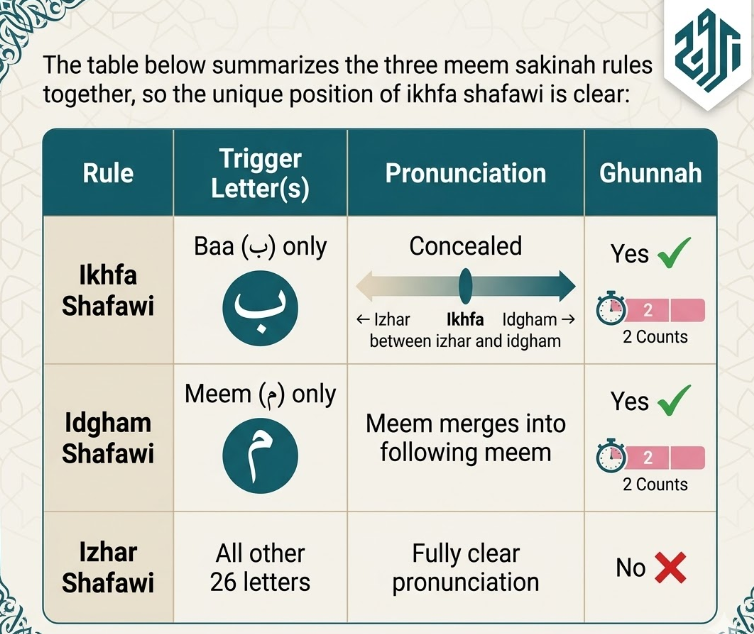
The one-letter scope of ikhfa shafawi makes identification straightforward. The challenge is not finding it — it is producing it correctly once found.
Read also: Madd Asli (Madd Tabee’i)
How Is Ikhfa Shafawi Pronounced Correctly?
Ikhfa shafawi is pronounced by bringing the lips into light contact — touching without pressing — while the nasal passage carries the ghunnah sound for two harakaat (counts).
The meem is not released with the full pop of izhar, nor is it fully dissolved into the Baa as in idgham. It occupies a middle position: concealed but present.
What the Lips Do During Ikhfa Shafawi
The lips touch gently without firm closure. This distinguishes ikhfa shafawi from both full izhar (where lips close and release clearly) and full idgham (where meem disappears entirely).
The moment students press the lips hard, they have exited ikhfa and entered something closer to a paused meem, which is incorrect.
What the Ghunnah Does During Ikhfa Shafawi
The ghunnah runs through the nasal passage simultaneously with the light lip contact. It is held for two counts — the same duration as ghunnah in ikhfa haqiqi and idgham with ghunnah. Shortening the ghunnah to one count or dropping it entirely are the two most frequent errors we observe in our sessions with new students.
How Ikhfa Shafawi Differs from Izhar Shafawi
| Feature | Ikhfa Shafawi | Izhar Shafawi |
| Lips | Light contact, not pressed | Clear closure and release |
| Ghunnah | Present — 2 counts | Absent |
| Meem audibility | Concealed | Fully audible |
| Trigger | Baa only | All letters except Baa and Meem |
Both ikhfa and izhar shafawi are valid when meem sakinah meets Baa, and classical Tajweed scholars accept either reading. The majority position — and the one we teach at Buruj Academy — is that ikhfa shafawi is the stronger (arjah) of the two.
Excel in Your Quranic Studies
Join Buruj Academy and master the Quran with our structured, professional curriculum.
Book Your Free TrialIkhfa Shafawi Examples in the Quran
The following verified examples demonstrate ikhfa shafawi across different Surahs. The meem sakinah and following Baa are marked for clarity.
وَمَا صَاحِبُكُم بِمَجْنُونٍ
Wa mā sāhibukum bi-majnūn
“And your companion is not mad.” (At-Takwir 81:22)
(Meem sakinah in كُمْ meets Baa in بِمَجْنُونٍ — ikhfa shafawi applies across the two words.)
تَرْمِيهِم بِحِجَارَةٍ مِّن سِجِّيلٍ
Tarmīhim bi-ḥijāratin min sijjīl
“Striking them with stones of hard clay.” (Al-Fil 105:4)
(Meem sakinah in هِمْ followed by Baa — the meem is concealed while ghunnah resonates.)
فَإِذَا هُم بِالسَّاهِرَةِ
Fa-idhā hum bis-sāhirah
“And suddenly they will be upon the open plain.” (An-Nazi’at 79:14)
(Classic cross-word example — meem sakinah in هُمْ preceding Baa.)
إِنَّ رَبَّهُم بِهِمْ يَوْمَئِذٍ لَّخَبِيرٌ
Inna rabbahum bihim yawma’idhin la-khabīr
“Indeed, their Lord with them that Day is fully Aware.” (Al-‘Adiyat 100:11)
(Two instances of meem sakinah meeting Baa in close proximity — an excellent training verse.)
The table below organizes additional verified examples of Ikhfa Shafawi in Quran by Surah for easy reference:
| Surah | Verse | Arabic Segment | Notes |
| Al-Qalam 68:40 | سَلْهُمْ أَيُّهُم بِذَٰلِكَ | هُمْ + بِ | Cross-word ikhfa shafawi |
| Al-Mutaffifin 83:17 | كُنتُم بِهِ تُكَذِّبُونَ | تُمْ + بِ | Common recitation verse |
| Al-Inshiqaq 84:24 | فَبَشِّرْهُم بِعَذَابٍ | هُمْ + بِ | Frequently recited in prayer |
| Al-Ghashiyah 88:22 | لَّسْتَ عَلَيْهِم بِمُصَيْطِرٍ | هِمْ + بِ | Cross-word, longer Baa-word |
| Ash-Shams 91:14 | عَلَيْهِمْ رَبُّهُم بِذَنبِهِمْ | هِمْ + بِ | Multiple meem sakinah in verse |
Practicing these verses in order — from shorter to longer — helps students build the reflex for ikhfa shafawi before encountering it unexpectedly in longer Surahs.
Discover the Buruj Academy Difference
Step into our virtual classrooms and see how our expert instructors make learning Quran and Arabic intuitive and clear. We focus on overcoming the specific hurdles non-native speakers face, building your confidence and connection with the Quran.
Why Is Ikhfa Shafawi Called “Shafawi”?
The term shafawi (شفوي) comes from the Arabic root shafa (شفة), meaning lip. It is called labial concealment for two reasons: both the meem (م) and the Baa (ب) are articulated from the two lips (makhraj: الشفتان), and the concealment itself occurs at the lip level — not through the tongue or throat.
This shared articulation point (makhraj) is precisely why concealment is possible: when two sounds share the same exit point, the transition between them allows for this intermediate state of ikhfa.
This is distinct from ikhfa haqiqi, which governs noon sakinah and tanween and involves fifteen letters from various articulation points throughout the mouth and throat.
Read also: Madd ‘Arid Li-Sukoon: Rules, Types, and Quranic Examples
How Is Ikhfa Shafawi Marked in the Mushaf?
In standard printed Masahif (copies of the Quran), ikhfa shafawi is indicated by writing the meem sakinah without a sukoon symbol above it. This absence of sukoon signals to the reciter that the meem is not to be fully pronounced with clear release, but concealed before the Baa that follows.
This scribal convention applies to both the Hafs and Warsh recitation traditions. Students reading directly from the Mushaf — especially those who have learned only Basic Quran reading — sometimes misread an unmarked meem as a fully pronounced one. Recognizing this scribal marker is part of reading Quran with proper Tajweed rather than raw letter-by-letter reading.
For students building this foundation, Buruj Academy’s Tajweed for Beginners course covers Mushaf notation conventions alongside the underlying rules, so students understand both what they see on the page and why it looks the way it does.
Book Your FREE Trial Lesson to Begin Your Tajweed Journey

Common Mistakes Students Make with Ikhfa Shafawi
In our experience teaching non-Arabic speakers at Buruj Academy, ikhfa shafawi produces three consistent error patterns — and knowing them in advance helps students self-correct faster.
Pressing the Lips Too Firmly
The most frequent mistake is treating ikhfa shafawi like a full meem with sukoon — closing the lips completely and holding a firm stop. This produces something close to izhar with a heavy meem, which misses the concealment entirely. The lips should touch as lightly as if preparing to say the Baa that follows, not as if stopping the meem cold.
Dropping the Ghunnah
Some students focus so hard on the lip position that they forget to carry the nasal resonance. Ikhfa shafawi without ghunnah is not ikhfa — the ghunnah is what defines the concealment. We ask students to hum gently through the nose for two counts while maintaining light lip contact, which isolates the ghunnah from the articulation mechanics.
Shortening the Ghunnah to One Count
Even students who remember the ghunnah often shorten it under reading speed. Two counts (two harakaat) is the standard for ikhfa shafawi ghunnah, consistent with ghunnah in other Tajweed rules. Rushing past one count is among the most common errors we catch during live recitation correction.
Understanding ghunnah and its rules in full context helps students develop the ear sensitivity needed to sustain it accurately.
Excel in Your Quranic Studies
Join Buruj Academy and master the Quran with our structured, professional curriculum.
Book Your Free TrialMaster Tajweed with Buruj Academy’s Expert Instructors
Ikhfa shafawi is a precise rule — one letter, specific lip mechanics, and a sustained ghunnah. Getting it right requires both clear instruction and live correction.
Buruj Academy’s Online Tajweed Classes are taught by Ijazah-certified instructors and Al-Azhar University graduates with 12+ years of experience teaching non-Arabic speakers.
Our Buruj Method trains the ear before introducing rules, ensuring what students read on the page matches what they produce in recitation.
Every session is personalized, 1-on-1, with flexible scheduling and real-time correction. Whether you are a beginner encountering meem sakinah rules for the first time or an advanced student refining subtle articulation, our instructors tailor each lesson to your exact level.
Join a supportive learning environment tailored to your pace and lifestyle. Start your journey toward excellence by enrolling in one of our specialized tracks:
- Online Tajweed Classes
- Tajweed Classes for Beginners
- Tajweed Classes for Adults
- Tajweed Classes for Sisters
- Tajweed Classes for Kids
- Advanced Tajweed Course
- Amli Tajweed Course (Practical Application)
Book your free trial lesson today at Buruj Academy — and start reciting with confidence, accuracy, and the beauty the Quran deserves.
Frequently Asked Questions About Ikhfa Shafawi
What Is the Difference Between Ikhfa Shafawi and Ikhfa Haqiqi?
Ikhfa shafawi governs meem sakinah followed by Baa, involving one letter and labial articulation. Ikhfa haqiqi governs noon sakinah and tanween followed by one of fifteen letters across various articulation points. Both require ghunnah for two counts, but they apply to different letters and different triggering sounds entirely.
Does Ikhfa Shafawi Apply Within One Word or Between Two Words?
Ikhfa shafawi applies in both cases. If meem sakinah ends one word and Baa begins the next, the rule applies during connected recitation (wasl). It also applies within a single word when the same letter combination occurs, though this is less common in Quranic text than the cross-word scenario.
How Many Counts Is the Ghunnah in Ikhfa Shafawi?
The ghunnah in ikhfa shafawi is held for two counts (two harakaat). This is consistent with the ghunnah duration in ikhfa haqiqi and idgham with ghunnah. Shortening it to one count is a Tajweed error. The two-count standard applies whether the recitation pace is slow (tarteel) or moderate.
Is Ikhfa Shafawi the Same as Idgham Shafawi?
No. Ikhfa shafawi occurs when meem sakinah meets Baa — the meem is concealed, not merged. Idgham shafawi occurs when meem sakinah meets another meem — the first meem merges fully into the second with a shaddah-like doubling. Both carry ghunnah, but the articulation outcome and trigger letters are completely different.
Why Do Some Masahif Show No Sukoon on the Meem in Ikhfa Shafawi?
The absence of sukoon above the meem in ikhfa shafawi positions is a scribal convention in the Uthmani Rasm. It signals that the meem is not to be released with a clear, full sukoon sound, but concealed before the following Baa. Recognizing this notation is part of reading the Mushaf with proper Tajweed awareness, as explained in our guide to reading the Quran for the first time.