 Islamic
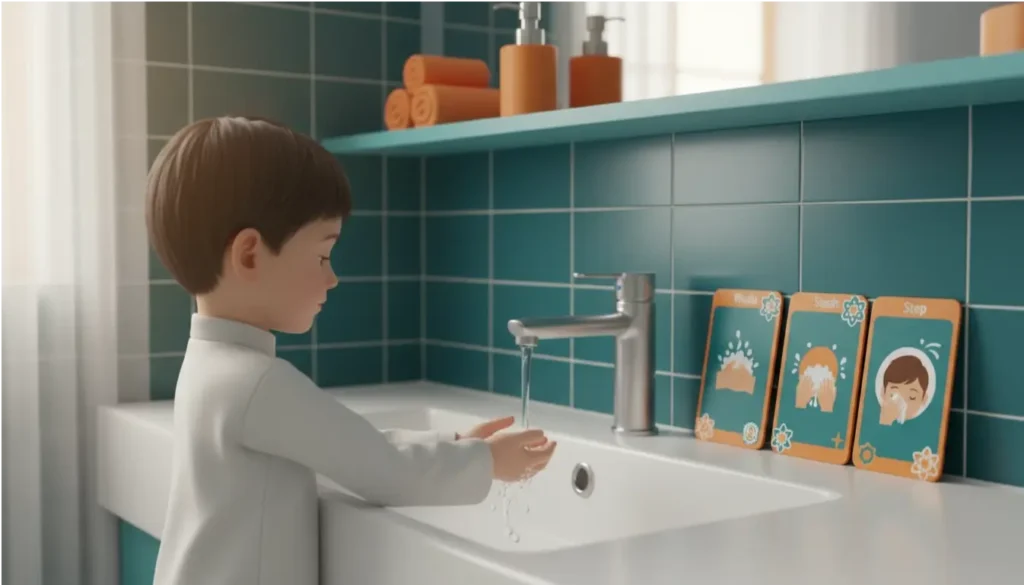
Many parents wonder how to make wudu feel natural for their children rather than a confusing routine they rush through before prayer. When kids understand why each step matters, they approach it with attention and care.
Teaching wudu steps for kids doesn’t have to be complicated. This guide breaks down each step in child-friendly language, with age-specific tips and practical methods that help children build correct, confident wudu habits from an early age.
Step 1: Making the Right Intention Is the First Wudu Step Kids Need to Learn
Niyyah (intention) is the foundation of every act of worship. For young children, intention doesn’t need to be spoken aloud—it simply means thinking “I am making wudu to pray for the sake of Allah.”
Help children aged 4-7 by saying together: “We are making wudu now so we can talk to Allah in our prayer.” This simple framing gives the action purpose.
Older children aged 8-12 can be taught that Allah sees our intentions, which adds mindfulness to their wudu routine.
Step 2: Saying Bismillah Before Starting Wudu
Before touching the water, children say
بِسْمِ اللَّهِ (Bismillah — “In the name of Allah”).
This short phrase signals the beginning of an act of worship, separating wudu from ordinary washing.
Make this a habit from day one. Young children love repetition, so saying “Bismillah first, always!” as a family rule helps it stick. Within weeks, most children say it automatically before turning the tap on, Masha’Allah.
Step 3: Washing Both Hands Three Times Up to the Wrists
Children wash both hands up to the wrists three times, making sure water reaches between the fingers. This step is also excellent for general hygiene, so children already have familiarity with the motion.
For children aged 4-7, parents can demonstrate by washing together at the sink. A simple rhyme like “Wash between the fingers, one, two, three!” makes the repetition fun. Ages 8 and above can check their own fingers independently with minimal parental guidance.
The first session is free in Buruj’s Islamic Studies for Kids

Step 4: Rinsing the Mouth Three Times Using Clean Water
Children rinse their mouths three times with clean water, swishing gently and spitting out. This step often becomes a favorite because of the playful element—kids enjoy the swishing sound and the spitting.
Use this moment positively. Tell children aged 5-10 that rinsing the mouth purifies the same mouth that recites Quran and makes du’aa. This simple connection between physical action and spiritual meaning builds conscious understanding early, Insha’Allah.
Step 5: Sniffing Water Into the Nostrils Three Times
Children sniff a small amount of water into the nostrils three times, then blow it out gently. This step often needs the most parental patience because young children find it uncomfortable at first.
For ages 4-6, start with very gentle sniffing—even just touching water to the outside of the nostril is acceptable while they build comfort.
By ages 7-9, most children manage this step confidently. Never pressure a child; encourage gradual improvement over days and weeks.
Discover the Buruj Academy Difference
Step into our virtual classrooms and see how our expert instructors make learning Quran and Arabic intuitive and clear. We focus on overcoming the specific hurdles non-native speakers face, building your confidence and connection with the Quran.
Step 6: Washing The Entire Face From The Hairline To Chin
Children wash the entire face three times—from the hairline to the chin, and from ear to ear. Water must reach all parts of the face, including the corners of the eyes and the sides of the nose.
A practical tip for parents: place a small mirror at the sink so children can see their own face while washing. This visual feedback helps them confirm full coverage independently. Children aged 7 and above enjoy this self-checking approach because it gives them ownership of the step.

Step 7: Washing Both Arms to the Elbows
Each arm is washed three times from fingertips to elbows, including the elbows themselves. Many children rush this step by washing only the forearms, missing the elbow area entirely.
The table below shows common mistakes children make at this step and how parents can address each one simply:
| Common Mistake | Age Group | Simple Fix |
| Forgetting to include elbows | Ages 4-8 | Draw a dotted line on the arm during practice |
| Washing only once instead of three times | Ages 4-7 | Count aloud together: “One, two, three!” |
| Not switching arms | Ages 5-9 | Use a rhyme: “Right arm first, then left” |
| Rushing through quickly | Ages 7-12 | Time the step with a slow three-count |
Counting aloud while washing builds the three-repetition habit reliably. Most children internalize the correct count within two to three weeks of consistent practice.
Step 8: Wiping the Head Once Is a Wudu Step Kids Should Understand Is Different From Washing
Unlike other steps, the head is wiped once—not washed three times. Children use wet hands to wipe from the forehead to the back of the head and back again in one smooth motion.
This step often confuses children who try to apply three repetitions here as well. Explain clearly: “The head is special—we wipe it gently, only once.” Children aged 8 and above appreciate knowing the reasoning helps them remember the rule more accurately.
The first session is free in Buruj’s Islamic Studies Classes for Kids

Step 9: Wiping Both Ears Completes the Head Wudu Step
Using the same wet hands from the head wipe, children insert their index fingers into the ears while thumbs wipe behind the ears. This single wipe completes purification of the ear area.
Many children skip this step simply because it’s less visible. Create a checklist card with simple drawings of each wudu step and post it near the bathroom sink. Children aged 5-10 especially respond well to visual checklists they can follow and tick off mentally.
Read Also: Ramadan for Kids
Step 10: Washing Both Feet to the Ankles Is the Final Wudu Step
Each foot is washed three times, including between the toes and up to and including the ankles. This step requires attention because water must reach all toe gaps and the ankle bone itself.
The table below gives a quick age-by-age guide for how independently children can manage feet washing:
| Age Group | Expected Independence | Parental Role |
| Ages 4-6 | Needs full parental help | Wash together, explain each part |
| Ages 7-9 | Semi-independent | Supervise and check ankles |
| Ages 10-12 | Mostly independent | Occasional reminders |
| Ages 13+ | Fully independent | Spot-check when starting Salah |
Right foot always comes first, then the left. Reinforce this order through repetition until it becomes instinctive, usually within one to two months of daily practice.
Deepen Your Islamic Knowledge
Study Aqeedah, Fiqh, Seerah, and essential Islamic teachings with experienced instructors in a structured online program.
Try Islamic StudiesRead Also: Top 10 Duas for Kids
Master The Correct Sequence Using A Visual Chart
Sequence matters in wudu. Children who memorize individual steps sometimes perform them out of order, which affects validity. A visual order chart eliminates this problem entirely.
Here is the complete wudu order at a glance:
| Order | Wudu Step | Repetitions |
| 1 | Intention (Niyyah) | Once (in the heart) |
| 2 | Bismillah | Once |
| 3 | Wash hands | 3 times |
| 4 | Rinse mouth | 3 times |
| 5 | Rinse nose | 3 times |
| 6 | Wash face | 3 times |
| 7 | Wash arms to elbows | 3 times each |
| 8 | Wipe head | Once |
| 9 | Wipe ears | Once |
| 10 | Wash feet to ankles | 3 times each |
Print this table, laminate it, and stick it near the bathroom sink. Children aged 5 and above can follow it independently within a few days of consistent use, Alhamdulillah.
The first session is free in Buruj’s Islamic Studies Classes for Kids

Read Also: How to Pray for Kids in Islam?
Give Your Child Confident Wudu and Prayer Foundations with Buruj Academy’s Islamic Studies Classes
Daily wudu practice at home builds habits, but structured Islamic education gives children the full foundation their worship needs.
Buruj Academy’s Islamic Studies Classes for Kids offer:
- Instructors trained in both Islamic education and child pedagogy
- Age-appropriate curriculum for children aged 4-15
- Gamification, stories, and activities—never dry lectures
- Short 20-30 minute sessions matching children’s attention spans
- Al-Azhar graduates with 12+ years teaching non-Arabic speaking children
- Flexible scheduling that fits your family routine
Book your child’s free trial lesson today and watch Islamic learning become something they genuinely love.
Find your child’s perfect match among Buruj’s top courses for kids:
- Arabic Classes for Kids
- Alphabet course
- Noorani Qaida Course for Kids
- Quranic Arabic Course
- Islamic Studies for Kids
- Hifz Classes for Kids
- Quran Classes for Kids
- Tajweed for Kids
Get a free trial for your child today

Conclusion
Wudu becomes a confident, correct habit when children understand each step clearly rather than rushing through a routine they’ve half-memorized. Breaking it into ten distinct steps makes the process manageable at every age.
Age-appropriate expectations matter enormously. A five-year-old mastering three steps correctly is succeeding just as meaningfully as a twelve-year-old performing complete, independent wudu without reminders.
Visual charts, counting aloud, and learning the closing du’aa together build both correct form and spiritual connection simultaneously. With consistent, patient practice at home, children carry this foundation into a lifetime of prayer, Insha’Allah.



Leave a Reply