 Tajweed
| Key Takeaways |
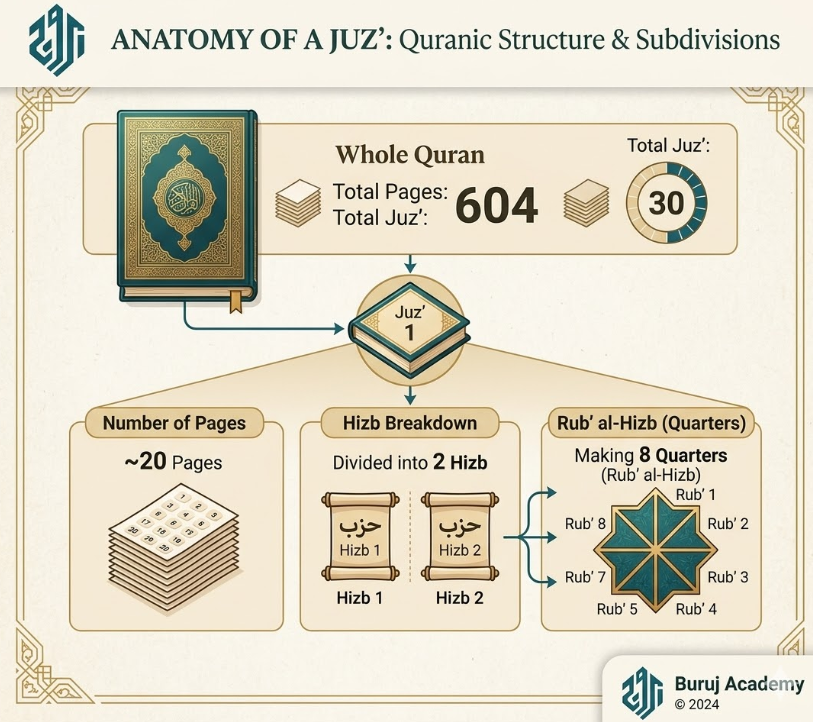
| The Quran is divided into 30 equal sections called Ajza’ (plural of Juz), each containing approximately 20 pages of the standard Mushaf. |
| The Juz division was introduced by early Muslim scholars to help organize daily recitation, not as part of the original Quranic revelation. |
| Each Juz is further subdivided into two Hizb sections, and each Hizb into four Rub’ al-Hizb quarters, enabling precise reading portions. |
| Juz 1 begins with Surah Al-Fatiha and Al-Baqarah, while Juz 30 (Juz Amma) contains the short surahs most commonly memorized first. |
| Completing one Juz daily allows a Muslim to finish the entire Quran in 30 days, aligning with the Sunnah practice during Ramadan. |
When Muslims open the Quran, they encounter a book of 114 surahs — yet the Quran is also divided into 30 structured sections that cut across surah boundaries. These sections form the practical backbone of daily recitation, memorization planning, and the beloved Ramadan Khatm tradition.
A Juz (جُزْء) is one of the 30 equal divisions of the Quran, each spanning approximately 20 pages in the standard 604-page Mushaf. This division was established by early Muslim scholars to make systematic recitation and memorization accessible to the entire Ummah — from new readers to seasoned Huffaz.
What Is the Meaning of Juz in the Quran?
The word Juz (جُزْء) is an Arabic noun meaning “part” or “portion.” In Quranic terminology, it refers specifically to one of the 30 equal divisions of the Quran established by early Muslim scholars for recitation and study purposes. Together, the 30 divisions are called Ajza’ (أَجْزَاء), the Arabic plural of Juz.
The Juz division does not follow surah boundaries. A single Juz may begin in the middle of one surah and end in the middle of another. This structure was designed entirely around achieving equal portions — not around thematic groupings — making it a purely practical organizational system rather than a theological one.
Why Did Scholars Divide the Quran into 30 Parts?
Early Muslim scholars introduced this division to enable Muslims to complete the entire Quran within 30 days by reading one Juz daily. This practice became especially significant during Ramadan, when completing the Quran (Khatm Al-Quran) is a strongly encouraged Sunnah act.
The 30-day alignment with the lunar month of Ramadan made the Juz system a natural fit for the Muslim calendar.
In our teaching experience at Buruj Academy, students who understand the Juz structure from the beginning plan their recitation and memorization far more realistically. Rather than viewing the Quran as an undivided whole, they work section by section — and this shifts overwhelming goals into manageable milestones.
Book a FREE trial session with one of Buruj’s Azhari Quran tutors

Read also: Tajweed Symbols in Quran
How Many Pages Are in Each Juz of the Quran?
Each Juz contains exactly 20 pages in the standard Uthmani Mushaf (the 604-page edition widely used across the Muslim world). This means the full Quran spans 604 pages across 30 Ajza’, with each Juz holding a consistent 20-page reading portion.
Excel in Your Quranic Studies
Join Buruj Academy and master the Quran with our structured, professional curriculum.
Book Your Free TrialWhat Is the Internal Structure of Each Juz?
Each Juz is subdivided into two equal sections called Hizb (حِزْب), meaning “group” or “party.” Each Hizb is itself divided into four quarters called Rub’ al-Hizb (رُبْع الحِزْب). This creates a total of 60 Hizb and 240 Rub’ al-Hizb across the entire Quran.
This layered system gives readers and students highly precise control over their daily recitation portions.
How the Juz, Hizb, and Rub’ System Works Together
| Division | Arabic Term | Total in Quran | Pages Per Unit |
| Part | Juz (جُزْء) | 30 | ~20 pages |
| Half-part | Hizb (حِزْب) | 60 | ~10 pages |
| Quarter | Rub’ al-Hizb (رُبْع الحِزْب) | 240 | ~2.5 pages |
In the printed Mushaf, the beginning of each Rub’ al-Hizb is typically marked with a small circle (۞) or a marginal notation. Recognizing these markers helps readers plan daily recitation portions with precision — a skill we teach explicitly in Buruj Academy’s Online Quran Reading Course.
Book your Free trial lesson and start reading the Quran

Read also: What Do the Small Letters in the Quran Mean?
What Is Juz Amma and Why Is It Learned First?
Juz Amma is the popular name for the 30th and final Juz of the Quran, taking its name from its opening word Amma — the first word of Surah An-Naba (78:1). It contains 37 surahs, all of them short, and represents the most frequently recited portion of the Quran in daily prayers.
جُزْءُ عَمَّ Juz’ ‘Amma Surah An-Naba to Surah An-Nas — the final 37 surahs of the Quran.
Juz Amma is taught first to children and beginners for three clear reasons. First, its surahs are short — many can be memorized in a single focused session. Second, its vocabulary is highly repetitive, which accelerates retention. Third, knowing these surahs enables a Muslim to perform Salah independently without relying on Al-Fatiha alone.
At Buruj Academy, our Juz 30 Memorization course guides students through every surah in Juz Amma with proper Tajweed from the first session. We have found that students who memorize Juz Amma systematically — rather than picking random surahs — build a solid foundation that dramatically accelerates their later Hifz work.
If you are ready to begin, our Hifz for Adults course provides a realistic, structured pathway for those balancing work and family commitments.
Book Your Free Trial Lesson with Burruj’s Hifz Course for Adults

How Is the Juz System Used in Quran Memorization?
The Juz system is the primary unit of measurement in Hifz (Quran memorization). Memorization progress is typically tracked and communicated in terms of completed Ajza’ — “I have memorized 5 Juz,” “I am revising Juz 15” — making the division a practical language shared across the global Hifz community.
For systematic daily memorization planning, the Juz gives students a clear, achievable target. If a student memorizes one page per day, they complete one Juz in 20 days. At half a page per day, one Juz takes 40 days.
A Practical Juz-Based Memorization Rate Chart
| Daily New Memorization | Time to Complete 1 Juz | Time to Complete Full Quran |
| 1 page (15 lines) | 20 days | ~1 year 8 months |
| ½ page (7.5 lines) | 40 days | ~3 years 4 months |
| 2 pages (30 lines) | 10 days | ~10 months |
| ¼ page (4 lines) | 80 days | ~6 years 7 months |
These calculations are based on the standard 604-page Mushaf. Revision time is not included — a complete Hifz schedule must balance new memorization with daily revision of previously learned material. Our Quran memorization schedule guide explains how to build this balance practically.
For deeper strategy, our article on how to memorize Quran faster covers retention techniques that apply directly to Juz-by-Juz progress.
Discover the Buruj Academy Difference
Step into our virtual classrooms and see how our expert instructors make learning Quran and Arabic intuitive and clear. We focus on overcoming the specific hurdles non-native speakers face, building your confidence and connection with the Quran.
What Is the Difference Between Juz, Surah, and Hizb?
These three terms are the most commonly confused divisions in Quranic structure, and understanding their relationship clarifies the entire organizational system of the Mushaf.
A Surah is a chapter of the Quran — a thematically and linguistically unified revelation unit. There are 114 surahs, ranging from Al-Baqarah (286 verses) to Al-Kawthar (3 verses). Surahs are the original revealed structure of the Quran.
A Juz cuts across surah boundaries and is a recitation-convenience division. A Hizb is half a Juz, and exists purely to allow even finer recitation planning.
| Term | Arabic | Meaning | Total Count | Purpose |
| Surah | سُورَة | Chapter | 114 | Revealed unit — thematic |
| Juz | جُزْء | Part | 30 | Recitation planning |
| Hizb | حِزْب | Group | 60 | Finer recitation division |
| Rub’ al-Hizb | رُبْع الحِزْب | Quarter | 240 | Precise daily portion |
| Ayah | آيَة | Verse | 6,236 | Individual revealed statement |
Understanding this distinction matters practically. When a student says “I read one Juz today,” they mean 20 pages regardless of how many surahs that spans. When they say “I read one surah,” the length could be 3 verses or 286 verses. These are two entirely different measurements.
Excel in Your Quranic Studies
Join Buruj Academy and master the Quran with our structured, professional curriculum.
Book Your Free TrialBegin Your Quran Journey with Buruj Academy’s Expert Instructors
The Juz system gives every Muslim a clear, structured pathway through the Quran — whether for daily recitation, Ramadan completion, or full memorization. Understanding how it works is the first step toward using it with confidence.
Buruj Academy’s Online Hifz Program and Online Quran Classes are led by Al-Azhar University graduates and Ijazah-certified instructors with 12+ years of experience teaching non-Arabic speakers worldwide. We offer:
- Personalized 1-on-1 sessions with flexible 24/7 scheduling
- The Buruj Method: Consistency-before-speed for lasting memorization
- Real-time feedback and individualized Tajweed correction
- Structured Juz-by-Juz progression from Juz Amma to full Quran
Join a supportive learning environment tailored to your pace and lifestyle. Start your journey toward excellence by enrolling in one of our specialized tracks:
- Online Tajweed Classes
- Tajweed Classes for Beginners
- Tajweed Classes for Adults
- Tajweed Classes for Sisters
- Tajweed Classes for Kids
- Advanced Tajweed Course
- Amli Tajweed Course (Practical Application)
Book your free trial lesson today and take the first step toward your Quran goals, Insha’Allah.
Frequently Asked Questions About Juz in the Quran
What does Juz mean in simple terms?
Juz (جُزْء) means “part” in Arabic. In Quranic context, it refers to one of the 30 equal sections that scholars divided the Quran into for recitation convenience. Each Juz contains approximately 20 pages of the standard Mushaf, and reading one Juz daily completes the full Quran in 30 days.
Is the Juz division mentioned in the Quran itself?
No. The 30-Juz division is not part of the Quranic revelation. It was introduced by early Muslim scholars after the time of the Prophet ﷺ as a practical tool for organizing recitation and memorization. The surahs and ayat, however, are part of the original revelation.
Which Juz should a beginner memorize first?
Beginners should start with Juz Amma — the 30th Juz. It contains the shortest surahs of the Quran, most frequently used in Salah, making it the most practically beneficial starting point. Its repetitive vocabulary and short verse structure also make it significantly easier to memorize than earlier Ajza’.
How long does it take to memorize one Juz?
The time varies based on daily consistency and individual capacity. A student memorizing one page per day completes one Juz in 20 days. At half a page per day, one Juz takes approximately 40 days. These estimates assume consistent daily sessions and do not account for revision time, which must run alongside new memorization. For more, see our guide on the best way to memorize Quran.
What is the difference between Juz and Para?
Para is the Urdu/Hindi equivalent term for Juz, used widely in South Asian Muslim communities. Both refer to the same 30-part division of the Quran. The Arabic term is Juz (جُزْء), while Para is the regional equivalent used across Pakistan, India, and Bangladesh. The content and structure are identical.