 Tajweed

| Key Takeaways |
| A Hizb is one of 60 equal divisions of the Quran, each representing half of one of the 30 Juz’. |
| The word Hizb comes from Arabic, meaning “group” or “party,” referring to a designated recitation portion. |
| Each Hizb is further divided into four quarters (Rub’ al-Hizb), creating 240 precise sections total. |
| Scholars historically used the Hizb system to structure daily Wird (recitation routine) across the week. |
Many students who open a printed Mushaf notice small markings — circles, quarter symbols, and Arabic notations — scattered throughout the pages without a clear explanation.
These marks are part of an ancient scholarly system for structuring Quran recitation.
What Does Hizb Mean in Quran?
A Hizb is one of 60 equal portions that divide the entire Quran, with each Hizb equaling exactly half of a Juz’. This system, alongside the Juz’ and Rub’ al-Hizb divisions, gives reciters and memorizers a precise, practical framework for daily Quran engagement.
What Does the Word Hizb Mean in Arabic?
The word Hizb (حِزْب) in Arabic carries the primary meaning of “group,” “party,” or “division.” In Quranic sciences, scholars adapted this term to describe a designated portion of the Mushaf assigned for structured recitation — a group of verses set apart for a specific purpose.
The plural form is Ahzab (أَحْزَاب). You will encounter this word directly in the Quran itself in a different but related context, where it refers to confederate groups or parties of people. In Tajweed and Quranic study terminology, however, Hizb carries the specific technical meaning of a recitation division.
How the Term Hizb Entered Quranic Scholarly Practice
Early Muslim scholars developed the Hizb system to help reciters complete the Quran systematically — particularly those who maintained a daily Wird (daily recitation portion) as a devotional practice. The Prophet ﷺ encouraged completing the Quran regularly, and companions structured their recitation using logical divisions.
The Hizb framework became standardized across the Islamic scholarly world, particularly through North and West African Quranic traditions, where the Hizb remains the primary structural unit rather than the Juz’.
Read also: What Does Juz Mean in Quran?
How Is the Quran Divided Into Hizbs?
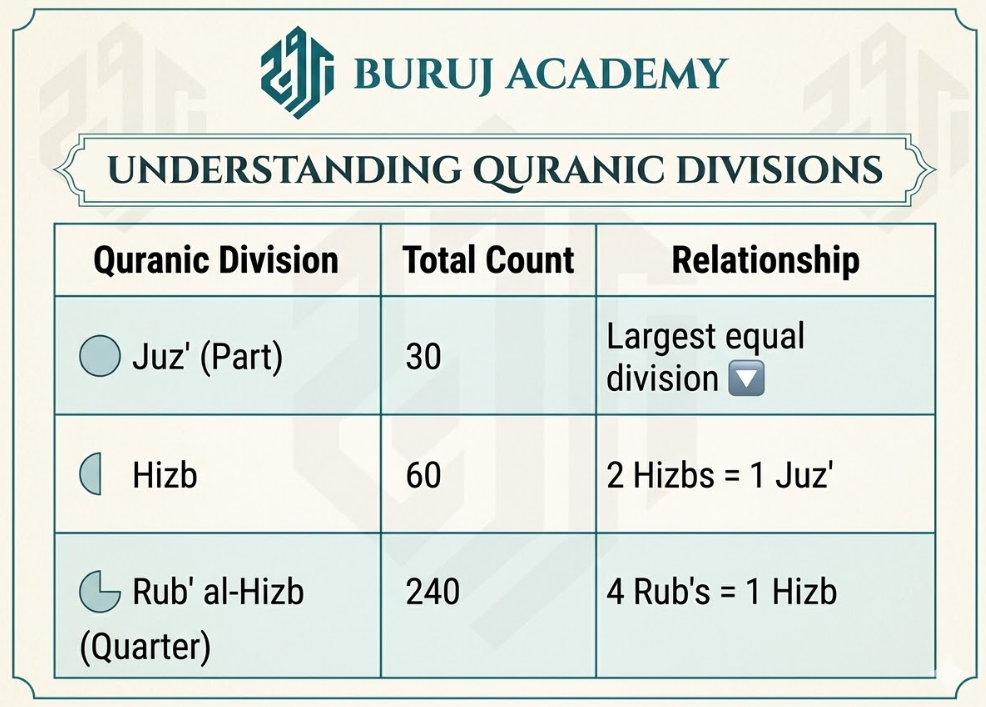
The Quran is divided into 60 Hizbs of equal length, each containing the same approximate volume of Quranic text. The relationship between Hizb and the more commonly known Juz’ system is direct and simple.
How to Identify a Hizb in the Mushaf?
In most standard Mushafs, particularly those printed in Morocco, West Africa, and Egypt, Hizb markers appear as small circles or symbols in the page margins. The Rub’ al-Hizb symbol — a small ornamental circle (۞) — appears directly in the Quranic text at each quarter-Hizb boundary.
In the widely used Medina Mushaf (the standard 604-page edition), each page contains approximately 15 lines, and the divisions fall at consistent points that experienced reciters recognize through practice.
Excel in Your Quranic Studies
Join Buruj Academy and master the Quran with our structured, professional curriculum.
Book Your Free TrialWhat Is the Difference Between a Hizb and a Juz’ in the Quran?
A Juz’ and a Hizb measure the same Quranic text using different scales — the Juz’ is the larger unit, and the Hizb is its half. Understanding both systems prevents confusion when following recitation plans or Hifz schedules.
| Feature | Juz’ | Hizb |
| Total count in Quran | 30 | 60 |
| Approximate pages (Medina Mushaf) | ~20 pages | ~10 pages |
| Common in which tradition | Global (especially South Asian, Middle Eastern) | North African, West African, scholarly tradition |
| Used for daily recitation planning | Yes | Yes — more granular |
| Subdivision | 2 Hizbs | 4 Rub’ al-Hizb |
The Juz’ system dominates in South Asian and Middle Eastern Quran education. The Hizb system is more prevalent in Moroccan, Mauritanian, and West African Quranic schools, where children memorize the Quran using Hizb-based milestones rather than Juz’-based ones.
At Buruj Academy, our Al-Azhar-trained instructors teach students to recognize both systems — because knowing Hizb boundaries dramatically improves recitation planning precision, especially for adults managing busy schedules.
Book a FREE trial session with one of Buruj’s Azhari Quran tutors

Why Did Muslim Scholars Create the Hizb Division System?
Muslim scholars created the Hizb system to make structured, consistent Quran recitation practical for individuals with different daily capacities. The system answers a real challenge: how does a Muslim complete regular Quran recitation without losing track, skipping sections, or repeating the same pages?
The historical context traces to the companions of the Prophet ﷺ, who maintained regular Khatm (completion) cycles. Classical scholars documented that completing the Quran in one week — reciting approximately 7 Hizbs daily — was a recommended practice for devoted reciters.
This created the natural basis for a 60-Hizb structure: 60 ÷ 7 ≈ approximately 8–9 Hizbs over a weekly cycle, adjusted for individual capacity.
The Connection Between Hizb and the Daily Wird
A Wird (وِرْد) is a personal daily recitation commitment. Scholars historically assigned students a specific Hizb or fraction of a Hizb as their daily Wird, calibrated to their memorization level, available time, and recitation speed.
This is a practice we continue at Buruj Academy. In our Online Hifz Program, instructors assign each student a daily Wird based on their capacity — often measured in Rub’ al-Hizb units rather than page counts — because Hizb divisions align with natural textual boundaries, making review more meaningful.
Start Hifz today with a FREE trial session
Read also: Tajweed Symbols in Quran
How Do Students Use the Hizb System for Quran Memorization?
Students use the Hizb system for Quran memorization by treating each Hizb — and its four Rub’ quarters — as precise memorization and revision milestones. Rather than counting pages loosely, a student tracks progress through a system with clear boundaries built directly into the Mushaf’s structure.
In our experience at Buruj Academy, students who memorize with awareness of Hizb boundaries retain material more systematically. A student memorizing Hizb 1 of Juz’ 1 knows they are working through the opening of Surah Al-Baqarah up to a specific, textually marked point — not an arbitrary page number.
Using Hizb Quarters (Rub’ al-Hizb) for Daily Targets
Breaking a Hizb into its 4 Rub’ quarters gives students an even more granular daily target. Consider this practical framework:
| Daily Target | Weekly Completion | Monthly Completion |
| 1 Rub’ al-Hizb per day | 7 Rub’ = 1¾ Hizbs | ~7 Hizbs |
| 2 Rub’ al-Hizb per day | 14 Rub’ = 3½ Hizbs | ~14 Hizbs |
| 1 full Hizb per day | 7 Hizbs | ~30 Hizbs (½ Quran) |
| 2 full Hizbs per day | 14 Hizbs | Full Quran in ~1 month |
This table illustrates how the Hizb system creates scalable, mathematically clean memorization planning. Our Hifz for Adults course uses exactly this approach — assigning Rub’-based daily targets that match each student’s realistic capacity.
Book Your Free Trial Lesson with Burruj’s Hifz Course for Adults

Discover the Buruj Academy Difference
Step into our virtual classrooms and see how our expert instructors make learning Quran and Arabic intuitive and clear. We focus on overcoming the specific hurdles non-native speakers face, building your confidence and connection with the Quran.
What Is the Rub’ al-Hizb and How Is It Marked in the Quran?
The Rub’ al-Hizb (رُبْع الحِزْب) is one quarter of a Hizb, representing 1/240th of the entire Quran. It is the smallest standard division in the Mushaf’s structural system and the most practically useful unit for daily recitation planning.
The Rub’ al-Hizb is marked in the Quran with a distinctive ornamental symbol: ۞ — an eight-pointed star or rosette — placed directly in the text at the boundary point. At the midpoint of each Hizb, you will find the half-Hizb marker, and at the three-quarter point, another Rub’ marker, completing the four-quarter structure.
Why Rub’ al-Hizb Matters for Recitation Accuracy
Knowing where each Rub’ falls helps reciters stop at natural textual boundaries rather than mid-verse or mid-thought. A student who ends their daily recitation at a Rub’ marker is always stopping at a point where the Mushaf’s structure acknowledges a natural pause — a significant advantage in Quran memorization and daily recitation consistency.
We recommend that students beginning their Quran recitation practice consult our guide on reading the Quran for the first time alongside learning these structural divisions, as both together build a strong foundation.
Excel in Your Quranic Studies
Join Buruj Academy and master the Quran with our structured, professional curriculum.
Book Your Free TrialStart Your Quran Journey with Buruj Academy’s Expert Instructors
Understanding the Hizb system is the first step toward structured, intentional Quran engagement — whether for daily recitation or long-term memorization.
Buruj Academy’s Online Hifz Program and Quran Reading Course integrate Hizb-based planning from day one, taught by Al-Azhar University graduates and Ijazah-certified instructors with 12+ years of experience guiding non-Arabic speakers globally.
Our students benefit from:
- Personalized 1-on-1 sessions with structured Hizb-based progress tracking
- The Buruj Method: Consistency-before-speed for memorization, sound-before-rules for recitation
- Flexible 24/7 scheduling for working adults and busy parents
- Real-time feedback and individualized correction every session
Join a supportive learning environment tailored to your pace and lifestyle. Start your journey toward excellence by enrolling in one of our specialized tracks:
- Online Tajweed Classes
- Tajweed Classes for Beginners
- Tajweed Classes for Adults
- Tajweed Classes for Sisters
- Tajweed Classes for Kids
- Advanced Tajweed Course
- Amli Tajweed Course (Practical Application)
Book your free trial lesson today and let our expert team build your personalized Quran plan. Start here.
Frequently Asked Questions About Hizb in the Quran
How many Hizbs are in the Quran?
The Quran contains 60 Hizbs in total. Each of the 30 Juz’ is divided into exactly 2 Hizbs, making the Hizb the intermediate division between a full Juz’ and the quarter subdivision known as Rub’ al-Hizb. The 60-Hizb system gives reciters more precise control over daily recitation planning.
What is the difference between Hizb and Juz’ in the Quran?
A Juz’ is one of 30 equal parts of the Quran, spanning approximately 20 pages in the Medina Mushaf. A Hizb is exactly half a Juz’, equaling approximately 10 pages. Both are equal divisions — Juz’ is the larger unit, Hizb the smaller — used interchangeably depending on regional Quranic tradition and personal recitation planning needs.
What does Rub’ al-Hizb mean?
Rub’ al-Hizb means “quarter of a Hizb” — one fourth of a Hizb, or 1/240th of the entire Quran. It is marked in the Mushaf with a distinctive eight-pointed star symbol (۞). Most standard Mushafs display Rub’ markers directly in the text, making them easy to locate during recitation and memorization sessions.
Which countries use the Hizb system for Quran memorization?
The Hizb system is the primary division framework in North and West African Quranic traditions — particularly Morocco, Mauritania, Senegal, Mali, and Algeria. In these traditions, children memorize the Quran using Hizb milestones from an early age. The Juz’ system is more dominant in South Asian and Middle Eastern Quranic education contexts.
Can beginners use the Hizb system for daily Quran recitation?
Yes — the Hizb system is ideal for beginners precisely because it offers smaller, more manageable units than the full Juz’. A beginner can commit to 1 Rub’ al-Hizb daily (approximately 2–3 pages), building a sustainable recitation habit without feeling overwhelmed. This granular structure makes the Hizb system one of the most practical frameworks for consistent daily Quran engagement.