 Quran
Quran

| Key Takeaways |
| The 3×3 method — memorizing 3 verses, repeating 3 times before moving forward — is one of the most effective techniques for non-Arabic speakers. |
| Spaced repetition, reviewing new verses after 1 day, 3 days, and 7 days, dramatically reduces long-term forgetting in Hifz students. |
| Reciting new memorization aloud in Salah the same day it is learned accelerates retention by creating functional, worship-based repetition. |
| Pairing each verse with its meaning through accessible Tafsir resources builds deeper memory anchors beyond surface-level repetition. |
| Consistent short daily sessions of 20–30 minutes outperform irregular long sessions for sustaining memorization momentum over months. |
Memorizing the Quran is one of the most spiritually rewarding commitments a Muslim can make — and one of the most technically demanding. Without the right technique, even highly motivated students find themselves forgetting more than they retain.
The most effective Quran memorization techniques combine structured repetition, active recall, meaning-based anchoring, and disciplined revision. When applied consistently, these methods allow non-Arabic speakers to build lasting Hifz — verse by verse, surah by surah.
What Is the Best Method to Memorize Quran for Non-Arabic Speakers?
The best method to memorize Quran for non-Arabic speakers combines phonetic accuracy, meaning awareness, and a structured revision system. No single memorization session is complete without all three. Students who focus only on repetition without revision, or memorization without meaning, consistently plateau within weeks.
At Buruj Academy, our Online Hifz Program is built around this three-pillar approach — guided by Al-Azhar-trained Hifz specialists with 12+ years of experience working specifically with English-speaking students.
Start Hifz today with a FREE trial session
Our instructors identify which pillar a student is neglecting, and correct it before the habit sets in.
The table below summarizes how the three pillars work together:
| Pillar | What It Means | Why It Matters |
| Phonetic Accuracy | Correct pronunciation with Tajweed | Prevents memorizing mistakes permanently |
| Meaning Awareness | Basic understanding of each verse | Creates semantic memory anchors |
| Revision System | Structured review schedule | Prevents forgetting previously memorized content |
Each technique described in this article operates within at least one of these pillars. Knowing which pillar a technique strengthens helps you build a balanced Hifz routine.
1. The 3×3 Method for Memorizing Quran
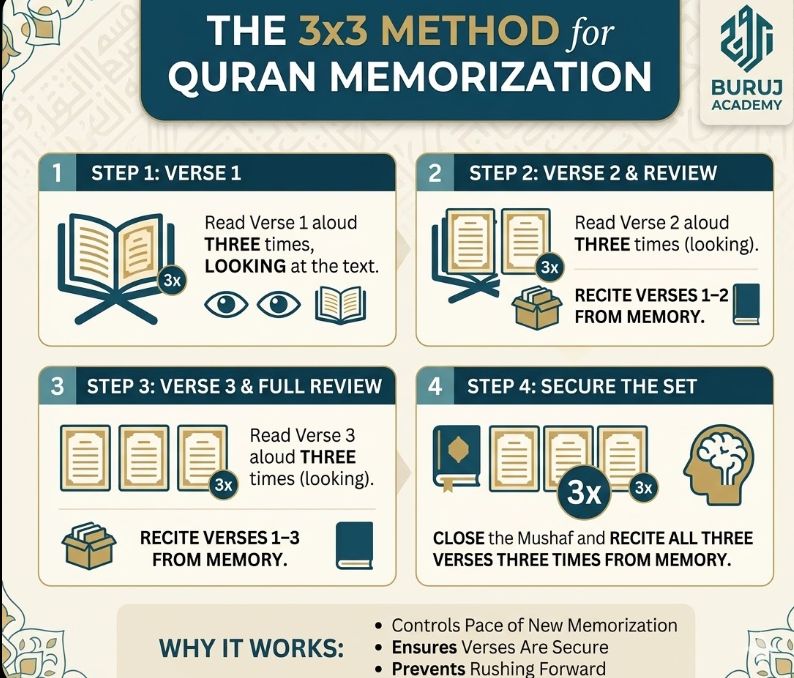
The 3×3 method for memorizing Quran means taking 3 verses, repeating them 3 times before moving to the next group, and then revising the full set 3 times at the end of the session.
This method controls the pace of new memorization and prevents students from rushing forward before verses are secure.
In practice, the method works as follows:
- Read verse 1 aloud three times, looking at the text
- Read verse 2 aloud three times, then recite verses 1–2 from memory
- Read verse 3 aloud three times, then recite verses 1–3 from memory
- Close the Mushaf and recite all three verses three times from memory
This structure forces active recall at every stage — not passive reading. In our sessions at Buruj Academy, students who switch from general repetition to the 3×3 method typically double their retention rate within the first two weeks, without increasing their daily time commitment.
Excel in Your Quranic Studies
Join Buruj Academy and master the Quran with our structured, professional curriculum.
Book Your Free TrialRead also: Shortest Surahs to Memorize: 20 Short Surahs with Arabic, Transliteration & Translation
2. Spaced Repetition Technique Prevents Forgetting in Quran Memorization
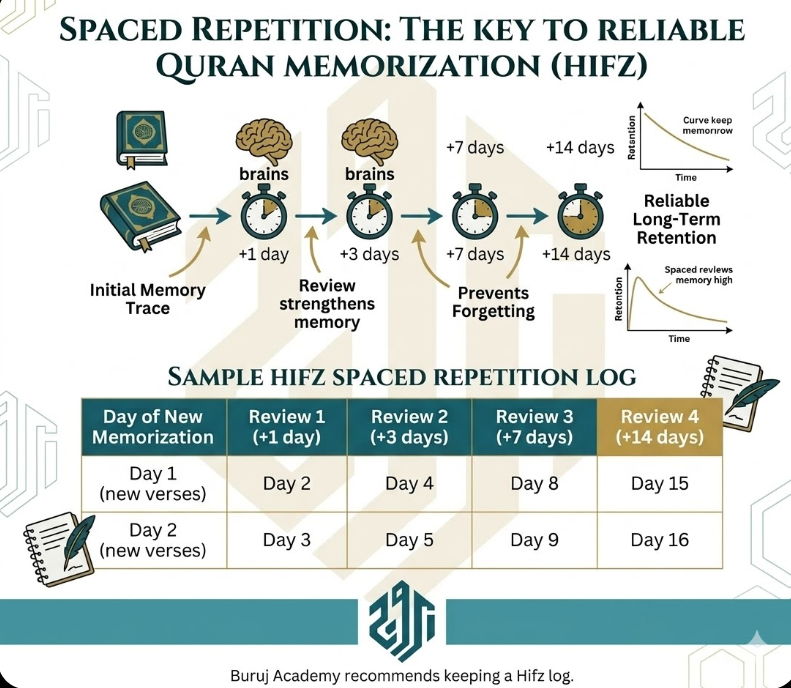
Spaced repetition is a memorization technique that schedules review sessions at increasing time intervals — 1 day, 3 days, 7 days, and 14 days after initial memorization. Each review session re-strengthens the memory trace before it fades, making long-term retention far more reliable than daily single-pass repetition.
What a Spaced Repetition Schedule Looks Like for Hifz
| Day of Memorization | Review Day 1 | Review Day 2 | Review Day 3 | Review Day 4 |
| Day 1 (new verses) | Day 2 | Day 4 | Day 8 | Day 15 |
| Day 2 (new verses) | Day 3 | Day 5 | Day 9 | Day 16 |
This schedule requires tracking, which is why we recommend keeping a simple written Hifz log. Our guide on building a Quran memorization schedule walks through exactly how to set this up for daily life.
Why Do Most Students Skip Revision and What Does It Cost Them?
Most beginners focus entirely on new memorization and neglect old material. Within 30 days, they find that previously “memorized” surahs have become unreliable under pressure — especially in Salah. This is not a memory problem; it is a revision scheduling problem. Spaced repetition solves it systematically.
3. Reciting in Salah Accelerates Quran Memorization
Reciting newly memorized verses in your daily Salah the same day you memorize them is one of the most underused memorization techniques.
Salah creates a high-stakes recall environment — you cannot look at the Mushaf, you must retrieve from memory — which forces the brain into active recall rather than passive recognition.
The Prophet ﷺ said: “The one who is proficient in the recitation of the Quran will be with the honorable and obedient scribes (angels).” (Sahih Muslim: 798)
This hadith motivates accuracy — and accuracy under Salah conditions is exactly what spaced active recall produces.
Students who commit to reciting new memorization in at least two daily prayers report fewer “blank moments” during later revision sessions.
Discover the Buruj Academy Difference
Step into our virtual classrooms and see how our expert instructors make learning Quran and Arabic intuitive and clear. We focus on overcoming the specific hurdles non-native speakers face, building your confidence and connection with the Quran.
4. Understanding Meaning Deepens Quran Memorization
Meaning-based memorization means connecting each verse to its translation and basic Tafsir context before attempting to memorize it.
The brain retains meaningful content far more reliably than phonetic strings it does not understand. For non-Arabic speakers, skipping this step significantly increases forgetting speed.
A Simple Meaning-First Memorization Sequence
- Read the translation of the verses you plan to memorize
- Read a brief Tafsir note — even 2–3 sentences — about the passage’s context
- Then begin repetition using the 3×3 method
Buruj Academy’s article on easy Tafseer in English provides accessible resources for understanding verse meanings without advanced Arabic knowledge.
Students who combine Tafsir awareness with phonetic memorization consistently describe a qualitative difference — the verses feel anchored, not floating.
Begin Understanding Quran With a FREE Trial in
Buruj’s Tafseer Al-Quran Course

How Visualization Supports Meaning-Based Memorization
Pairing a verse with a mental image of its meaning creates an additional memory layer. For example, when memorizing Surah Al-Fil, visualizing the scene of the birds and the army creates a narrative anchor that is far more durable than sound alone. This technique is especially effective for children and visual learners.
Read also: Easy Surahs of Quran to Memorize
5. Memorizing Quran Techniques for Adults Balancing Busy Schedules
Adult Quran memorization requires a fundamentally different time structure than full-time Hifz school programs. The most effective techniques for adults balancing work and family center on short, high-frequency sessions — not long, occasional ones. Twenty focused minutes daily consistently outperforms two hours on weekends.
Buruj Academy’s Hifz for Adults program is designed specifically for this reality. Our Al-Azhar-trained instructors build memorization plans around real-life schedules — accounting for work patterns, family responsibilities, and realistic session lengths — rather than idealized full-time Hifz timelines.
Book Your Free Trial Lesson with Burruj’s Hifz Course for Adults

| Lifestyle | Recommended Daily Session | Weekly New Memorization Target |
| Busy professional | 20 minutes | 5–7 verses |
| Parent with young children | 15–20 minutes | 3–5 verses |
| Student / semi-flexible schedule | 30–40 minutes | 7–10 verses |
| Full-time Hifz focus | 60–90 minutes | 15–20+ verses |
In our experience, adults who attempt to memorize more than their schedule realistically supports burn out within the first month. Consistency-before-speed — one of the core principles of the Buruj Method — is not motivational advice; it is the technically correct approach for sustainable adult Hifz.
For a deeper breakdown of time management in memorization, our article on how to memorize Quran faster offers practical daily planning frameworks.
6. Listening to Recitation Strengthens Quran Memorization
Listening to a qualified reciter recite the verses you are memorizing — before and after your own repetition — reinforces correct pronunciation, melody, and Tajweed simultaneously. This technique is called talaqqi-supported memorization, and it mirrors the method by which the Prophet ﷺ himself received the Quran from Jibreel (عليه السلام).
Practical Listening Techniques for Hifz Students
- Listen to the target verses once before your session begins
- Recite along with the audio, matching rhythm and pausing pattern (Waqf points)
- Listen again after your session to identify pronunciation drift
- Choose one consistent reciter — Sheikh Mahmoud Khalil Al-Husary is widely recommended for clarity and measured pace
Students who use audio support alongside their text-based memorization develop stronger phonetic memory and make fewer Tajweed errors during later review. This is particularly important for non-Arabic speakers whose ear has not yet been trained on Arabic phonemes.
Our resource on Tajweed for beginners covers the foundational Tajweed rules that correct recitation depends on.
Book Your FREE Trial Lesson to Begin Your Tajweed Journey

How Does a Structured Revision System Protect Your Hifz Investment?
A structured revision system is a written schedule that specifies exactly which previously memorized material you review on each day of the week.
Without it, students naturally drift toward revising what feels comfortable and neglect weaker sections — which is precisely the opposite of what retention requires.
The minimum effective revision structure for a student memorizing 5 verses per day:
- Daily: Revise the previous 3 days of memorization before starting new verses
- Weekly: Revise the full previous week’s memorization in one dedicated session
- Monthly: Revise the full previous month’s memorization in one or two sessions
In our Online Hifz Program, every student receives a personalized revision schedule calibrated to their memorization pace and the size of their existing Hifz. Students who follow a written revision system consistently reach completion; those who rely on informal recall almost universally plateau.
The benefits of memorizing Quran extend only as far as the memorization is actually retained — which is why revision is not optional.
Excel in Your Quranic Studies
Join Buruj Academy and master the Quran with our structured, professional curriculum.
Book Your Free TrialEmbark on Your Journey to Becoming a Hafiz
Carry the words of the Divine in your heart and transform your life through the noble pursuit of Hifz. At Buruj Academy, we provide a structured, supportive, and highly personalized environment to help you achieve your memorization goals, whether you are starting with the final chapters or aspiring to complete the entire Quran.
Our experienced tutors employ proven techniques to ensure long-term retention (Mutqin) and spiritual growth, making the path to memorization accessible for every member of the family.
Take the first step toward this lifelong blessing by enrolling in a program tailored to your pace:
- Online Hifz Program (Comprehensive Quran Memorization)
- Juz 30 Memorization Course (Perfect for focused starts)
- Hifz Classes for Kids (Engaging and interactive)
- Hifz Classes for Adults (Flexible scheduling for busy lives)
- Hifz Classes for Sisters (Private, supportive learning)
- Short Surah Memorization Course (Ideal for daily prayers)
- Hifz Ijazah Course (For advanced students seeking certification)
Don’t let another day pass without moving closer to your goal. Join Buruj Academy today and schedule your free trial session to begin your Hifz journey!
Frequently Asked Questions About Quran Memorization Techniques
What Is the 3×3 Method for Memorizing Quran?
The 3×3 method means memorizing 3 verses at a time, repeating each set 3 times before advancing, then revising all three together 3 more times. It controls memorization pace, forces active recall at every stage, and prevents students from moving forward before new material is secure — making it particularly effective for non-Arabic speakers.
How Many Verses Should a Beginner Memorize Per Day?
Beginners should memorize 3–5 verses per day, prioritizing accuracy and correct Tajweed over quantity. Starting with fewer verses and building consistency for 30 days is more productive than attempting large portions unsustainably. Our article on what is the best way to memorize Quran explores beginner pacing in detail.
Is It Possible to Memorize Quran Without Knowing Arabic?
Yes — millions of non-Arabic speaking Huffaz have memorized the Quran through phonetic memorization combined with basic meaning awareness. Knowing Arabic is not a prerequisite, but learning correct pronunciation through a qualified teacher is essential. Memorizing incorrect pronunciation makes later correction significantly harder.
How Do You Stop Forgetting Previously Memorized Surahs?
Forgetting is prevented through a structured spaced repetition revision schedule — not by memorizing more. Allocate dedicated daily revision time for previously memorized material before beginning any new memorization. Students who prioritize revision over speed consistently retain far more than those who race through new portions without reviewing old ones.
How Long Does It Take to Complete Full Quran Memorization?
Full Quran memorization typically takes 3–5 years for students memorizing 5–7 verses daily with consistent revision. Dedicated students memorizing 15+ verses daily under full-time conditions can complete it in 1–2 years. Timeline depends on daily session length, revision consistency, Tajweed accuracy, and the quality of instructor guidance throughout the process.