 Quran

Opening the Quran without pausing first is like walking into a meeting unprepared. Your mind is still scattered across the day’s tasks. We watch new students skip this step constantly, and it shows in their focus.
Table of Contents:
What Do You Say Before Reading Quran?
Before reading Quran, Say the Isti’adhah, “A’udhu billahi min ash-shaytanir-rajim,” followed by the Basmalah, “Bismillahir-Rahmanir-Raheem.” This order is commanded in Surah An-Nahl 16:98 and should precede any recitation, whether from memory, phone, or Mushaf.
What Is the Isti’adhah and Why Do We Say It Before Reading Quran?
The Isti’adhah is the phrase “أَعُوذُ بِاللَّهِ مِنَ الشَّيْطَانِ الرَّجِيمِ” (A’udhu billahi min ash-shaytanir-rajim), meaning “I seek refuge in Allah from the accursed Satan.” Allah commands this directly before any recitation begins.
This instruction comes straight from the Quran itself. We find it in a verse that leaves no ambiguity about when to recite it.
فَإِذَا قَرَأْتَ ٱلْقُرْءَانَ فَٱسْتَعِذْ بِٱللَّهِ مِنَ ٱلشَّيْطَـٰنِ ٱلرَّجِيمِ
Fa idha qara’ta al-Qur’ana fasta’idh billahi min ash-shaytanir-rajim
“So when you recite the Qur’an, [first] seek refuge in Allah from Satan, the expelled [from His mercy].” (Surah An-Nahl 16:98)
In our sessions at Buruj Academy, we notice that beginners often rush past this phrase, treating it as a formality rather than a spiritual reset. Students who slow down here report noticeably better focus through their entire recitation session.
Scholars across the four schools agree that saying the Isti’adhah is at least recommended, with some viewing it as obligatory before reciting. This is not a minor custom — it is the Quran instructing its own reader on proper etiquette.
Learning this etiquette alongside proper pronunciation is exactly why structured guidance matters early on.
Our Online Quran Classes for Beginners walk new students through these foundational practices step by step, pairing correct recitation with the spiritual mindset behind it.
Begin Learning Quran With a FREE Trial Lesson
How Do You Say the Full Dua Before Reading Quran in Arabic?
The complete dua before reading Quran combines two phrases: the Isti’adhah for protection, followed immediately by the Basmalah for blessing. Together they take under ten seconds to recite but frame the entire session.
The table below breaks down both phrases clearly, since many new students confuse the order or mix up the two.
| Phrase | Arabic | Transliteration | Meaning |
| Isti’adhah | أَعُوذُ بِاللَّهِ مِنَ الشَّيْطَانِ الرَّجِيمِ | A’udhu billahi min ash-shaytanir-rajim | I seek refuge in Allah from the accursed Satan |
| Basmalah | بِسْمِ اللَّهِ الرَّحْمَٰنِ الرَّحِيمِ | Bismillahir-Rahmanir-Raheem | In the name of Allah, the Most Gracious, the Most Merciful |
Say the Isti’adhah first, then the Basmalah, then begin reciting your chosen surah or passage. This order stays consistent whether you’re reading a full surah or a single page.
Scholars note one exception worth remembering: if you’re starting mid-surah rather than from the beginning, the Isti’adhah alone is sufficient, though adding the Basmalah remains permissible and encouraged.
The seven canonical Quranic reciters unanimously agreed that Basmalah opens every surah except Surah At-Tawbah, which begins without it by scholarly consensus. This detail trips up many self-taught readers.
We find that students who memorize this order early develop a consistent recitation habit that sticks for years, rather than fumbling through the opening each time they sit down.
Read also:What Is the Dua After Reading Quran? Authentic Sunnah Explained
Do You Have to Make Wudu Before Reading Quran?
Wudu is not obligatory for reciting Quran from memory or from a phone screen, according to the majority of scholars. Wudu becomes obligatory only when physically touching the printed pages of a Mushaf.
This distinction surprises many students who assume ablution is always required before any Quran engagement. The ruling actually hinges on physical contact, not recitation itself.
The requirement to be in wudu before touching a physical Mushaf is grounded in the verse “لَّا يَمَسُّهُ إِلَّا الْمُطَهَّرُونَ” (La yamassuhu illal-mutahharun), “None touch it except the purified.” (Al-Waqi’ah 56:79)
Digital screens and memorized recitation fall outside this specific ruling. Reading Quran from a mobile device without wudu is permissible, since a phone display is not classified as a Mushaf.
Read also: Advantages of Reading the Quran in Its Original Arabic
Can You Recite the Quran If You’re in a State of Major Impurity?
Major ritual impurity (janabah) is treated differently from simply lacking wudu. Scholars generally agree that reciting Quran while in a state of janabah is not permitted until ghusl is performed, regardless of the medium.
This applies whether you’re reading from a physical Mushaf, a phone, or purely from memory. We remind students that wudu and janabah are two separate rulings — don’t confuse minor and major impurity when making this decision.
Even where wudu isn’t strictly required, scholars consistently describe it as mustahabb (recommended) for anyone approaching the Quran, since physical purity reflects the reverence the moment deserves. Making wudu simply because you can is never wasted effort.
Read also: Dua of Khatam Quran: Authentic Guidance After Completing the Quran
Discover the Buruj Academy Difference
Step into our virtual classrooms and see how our expert instructors make learning Quran and Arabic intuitive and clear. We focus on overcoming the specific hurdles non-native speakers face, building your confidence and connection with the Quran.
Excel in Your Quranic Studies
Join Buruj Academy and master the Quran with our structured, professional curriculum.
Book Your Free TrialRead also:What Does Islam Say About Reading the Quran in Shorts?
What Other Dua Can You Say Before Reading Quran for Deeper Connection?
Beyond the obligatory Isti’adhah and Basmalah, many reciters add a personal supplication asking Allah for benefit, understanding, and light through the Quran. This is not a fixed requirement but a well-loved practice among huffaz and teachers.
One widely used addition draws directly from Prophet Musa’s own request for eloquence and ease, found in the Quran itself.
رَبِّ ٱشْرَحْ لِى صَدْرِى وَيَسِّرْ لِىٓ أَمْرِى وَٱحْلُلْ عُقْدَةً مِّن لِّسَانِى يَفْقَهُوا۟ قَوْلِى
Rabbi shrah li sadri wa yassir li amri wahlul uqdatan min lisani yafqahu qawli
“My Lord, expand for me my breast [with assurance] and ease for me my task and untie the knot from my tongue that they may understand my speech.” (Surah Ta-Ha 20:25-28)
Reciters use this dua before memorization sessions or difficult passages specifically, since it asks Allah for clarity of speech and ease of understanding. It is not limited to Prophet Musa’s story alone.
In our experience at Buruj Academy, students preparing for Hifz sessions who pair this personal dua with the standard Isti’adhah report entering their memorization time with noticeably calmer focus. It becomes a signal to the mind that dedicated Quran time has begun.
If deepening this connection through structured memorization interests you, our Online Hifz Program builds these etiquettes directly into every session from day one.
Start Hifz today with a FREE trial session

Recite with Confidence Through Buruj Academy’s Guided Quran Courses
Knowing the correct dua is one part of meaningful recitation; reading with accuracy and confidence is the next. Buruj Academy’s Ijazah-certified instructors and Al-Azhar University graduates guide students through both together.
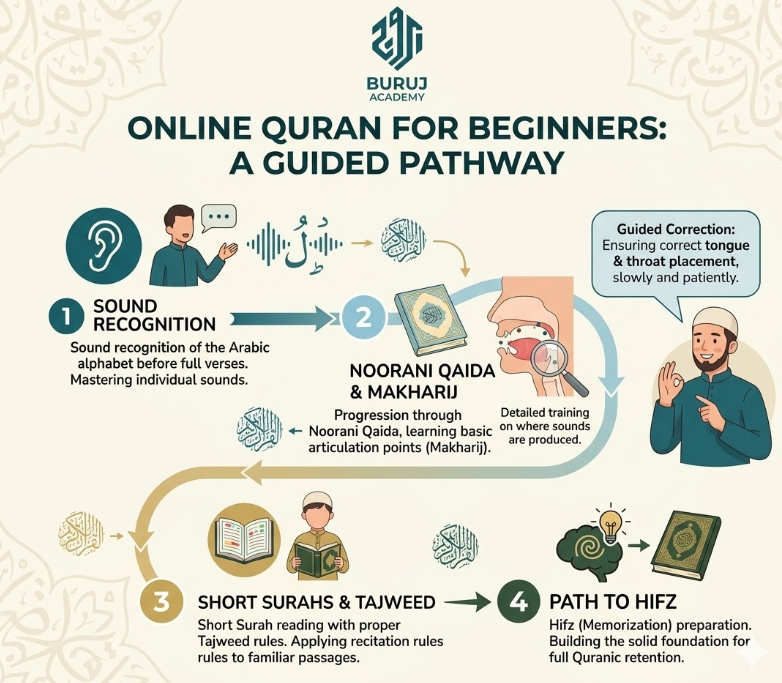
With 12+ years teaching non-Arabic speakers, our teachers apply the Buruj Method — sound-before-rules — so students build correct habits from the very first session, not after months of unlearning mistakes.
Every student receives a personalized learning plan, flexible 1-on-1 online scheduling, and real-time pronunciation correction from instructors who understand exactly where non-Arabic speakers typically struggle.
Ready to recite with the etiquette and accuracy this dua sets in motion? Book your free trial lesson with Buruj Academy today.
Take the next step in your learning journey today by enrolling in one of our specialized programs:
- Online Quran Classes
- Online Quran Classes for Beginners
- Online Quran Classes for Adults
- Online Quran Classes for Ladies
- Online Quran Classes for Kids
- Quran Reading Course
- Quran Recitation Course
- Online Ijazah Course
- Online Qirat Course
Don’t wait to transform your relationship with the Holy Quran. Join our global community of students and book your free evaluation session now!
Excel in Your Quranic Studies
Join Buruj Academy and master the Quran with our structured, professional curriculum.
Book Your Free TrialConclusion
The dua before reading Quran is a small act carrying real weight — two short phrases that turn ordinary reading into deliberate worship. Getting the order right, understanding when wudu genuinely matters, and knowing you can add personal supplication all shape how present you are on the page.
None of this requires perfection from day one. We have watched countless beginners transform hesitant, distracted reading into calm, focused recitation simply by anchoring this small habit consistently, one session at a time.
Frequently Asked Questions About the Dua Before Reading Quran
Do You Have to Make Wudu Before Reading Quran?
No, wudu is not obligatory for reciting from memory or a phone screen. It becomes obligatory only when physically touching a printed Mushaf, according to the majority scholarly position across the four schools of Fiqh.
Is There a Specific Dua for Reading Quran in Arabic Only, or Can You Say It in English?
The Isti’adhah and Basmalah are best recited in Arabic, since they are direct Quranic phrases with precise meaning. Understanding the English translation is encouraged, but the Arabic wording itself carries the intended linguistic and spiritual weight.
Can You Add Your Own Dua Before Starting Reading Quran?
Yes, before the Isti’adhah and Basmalah, many reciters add personal supplications asking for understanding, ease, or light, such as the dua from Surah Ta-Ha 20:25-28. This is encouraged but not a substitute for the core dua.
Do You Say the Dua Before Every Page in the Quran or Only Once?
Say the Isti’adhah before each new sitting of recitation, even if reading multiple pages in one session. If resuming mid-surah after a short pause, the Isti’adhah alone is sufficient without repeating the Basmalah.