 Islamic
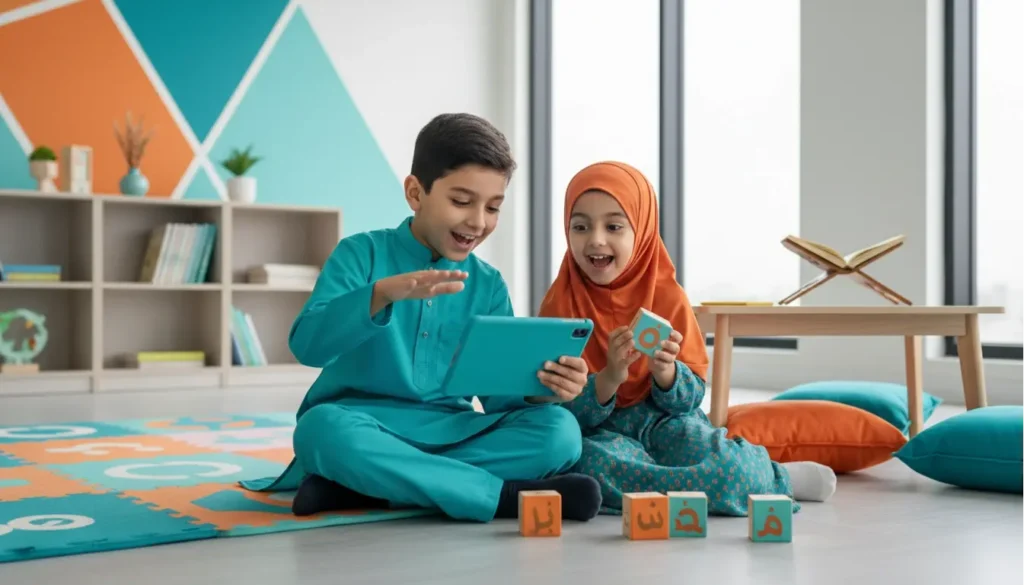
Young children can memorize entire nursery rhymes after a handful of repetitions, yet many parents find Quran learning feels like a struggle. The secret isn’t pushing harder—it’s choosing the right tools that match how children naturally absorb and retain new information.
The right Quran learning tools for kids make a measurable difference between a child who dreads lessons and one who asks to practice. This guide covers the most effective tools available today, with age-specific guidance to help parents choose what genuinely works for their child’s stage and learning style.
1. Quran Learning Apps Are One of the Most Accessible Tools for Kids Today
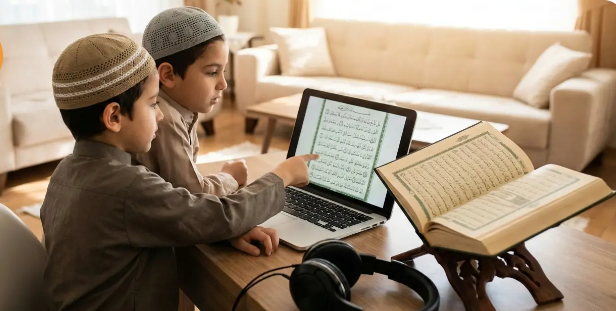
Digital apps have become some of the most practical Quran learning tools for kids, especially for families without access to local teachers. The best apps combine audio recitation, visual tracking, and short interactive sessions children can complete in under fifteen minutes.
Animated apps engage young children through visual rewards
Children in this group respond best to apps with colorful animations and audio repetition.
Apps like Quran Majeed Kids Edition and Kidsumers use visual cues and reward badges to keep young learners engaged during short five-to-ten minute daily sessions.
Color coded systems build recitation independence in older children
Older children benefit from apps that include tajweed color-coding, where each tajweed rule appears in a different color on the screen.
This visual system helps children self-correct their recitation and builds independence without needing constant parent supervision.
AI feedback and progress tracking motivate tech savvy teenagers
Teenagers can move toward more structured apps that track memorization progress by verse, offering review schedules and self-assessment quizzes. Apps like Tarteel use AI-powered listening to give real-time pronunciation feedback, which many older kids find motivating.
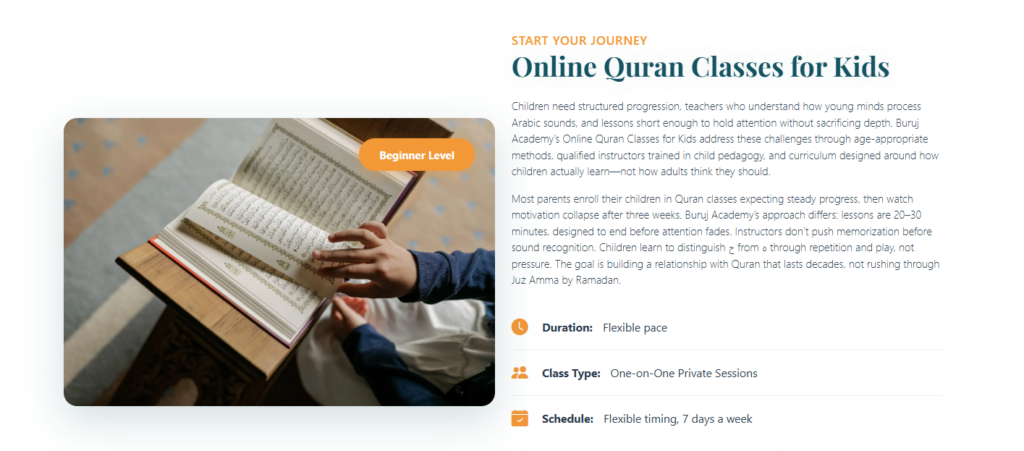
While apps are helpful daily companions, Buruj Academy’s Online Quran Classes for Kids provide what apps simply cannot—a live, patient instructor who understands child psychology and adjusts pacing based on each child’s unique learning speed.
Help your child start reading the Quran with a Free trial
2. Physical flashcards build letter recognition through tactile play
Physical flashcards are low-tech but extraordinarily effective Quran learning tools for kids, particularly for letter recognition and short surah memorization. Children aged four to ten especially benefit from holding, sorting, and physically interacting with learning materials.
Parents can create a flashcard routine in just ten minutes per day. Shuffle five cards, ask your child to identify each letter sound, then celebrate every correct answer enthusiastically. This positive repetition builds confidence faster than silent worksheet drills.
Here is a simple guide to organizing flashcard sessions by age:
| Age Group | Session Length | Cards Per Session | Focus |
| Ages 4–6 | 5–8 minutes | 3–5 cards | Letter recognition only |
| Ages 7–9 | 10 minutes | 6–8 cards | Letter + basic sounds |
| Ages 10–12 | 12–15 minutes | 8–10 cards | Letters + short words |
The table above shows that shorter, focused sessions consistently outperform longer, overwhelming ones—especially for children under eight years old.
Discover the Buruj Academy Difference
Step into our virtual classrooms and see how our expert instructors make learning Quran and Arabic intuitive and clear. We focus on overcoming the specific hurdles non-native speakers face, building your confidence and connection with the Quran.
3. Consistent audio exposure develops a natural ear for recitation
Among all Quran learning tools for kids, audio exposure is the most underused by parents. Children who hear correct Quranic recitation regularly develop an instinctive sense of rhythm, melody, and proper pronunciation before they even begin formal lessons.
Playing recitation by qualified reciters—such as Sheikh Mishary Rashid Al-Afasy or Sheikh Abdul Basit—during car rides, meals, or quiet time creates passive learning that accumulates over weeks. Children begin humming along, then recognizing familiar words, then attempting to repeat phrases independently.
Daily listening routines help children memorize short surahs easily
Start with short surahs children will use in Salah. Playing Surah Al-Fatiha and Surah Al-Ikhlas repeatedly during daily routines means most children can recite them accurately within two to three weeks of consistent audio exposure, even before formal lessons begin.
قُلْ هُوَ ٱللَّهُ أَحَدٌ
Qul Huwa Allahu Ahad
“Say, “He is Allah, [who is] One”
This surah is ideal for young children—it is short, rhythmic, and teaches Tawheed in simple, memorable words. Most children aged five and above can memorize it within a week of repeated listening.
Through Buruj Academy’s Online Hifz Classes for Kids, instructors reinforce at-home audio exposure with live pronunciation correction, ensuring children don’t accidentally memorize incorrect tajweed patterns from unsupervised repetition.
Start your child’s Hifz classes for free
4. Illustrated storybooks connect children to the meaning of verses
Quran storybooks belong in every Muslim child’s learning toolkit. When children understand what they are reciting, memorization becomes easier and more meaningful. Storybooks that retell Quranic stories in age-appropriate language build this essential connection.
Books like My First Quran Storybook by Saniyasnain Khan and Stories of the Prophets for Children introduce Quranic themes through narrative.
Children who hear the story of Prophet Ibrahim (AS) before learning related verses approach those verses with genuine curiosity rather than mechanical repetition.
Selecting age appropriate books keeps young readers engaged
- Ages 4–7: Picture-heavy books with simple sentences and large illustrations
- Ages 8–12: Chapter-based stories with moral lessons and Quranic references
- Ages 13–15: More detailed narrative books connecting stories to specific ayat
Reading together for ten to fifteen minutes before a Quran lesson creates emotional context that dramatically improves both memorization and comprehension. Parents don’t need to be scholars—reading alongside your child and wondering aloud builds beautiful shared learning moments.
Read Also: Quran Books for Kids
5. Visual progress charts and rewards encourage daily consistency
Visual progress tools are among the most practical Quran learning tools for kids aged five and above. Children are naturally motivated by seeing their own progress, and a simple wall chart tracking memorized surahs creates daily motivation without external pressure.
A basic memorization chart works as follows: each row represents one surah, and each column represents a milestone—first attempt, able to recite with help, recites independently, and recites with correct tajweed. Children color in each box as they progress, creating a visual record of genuine achievement.
Here is a sample chart structure parents can recreate at home:
| Surah Name | First Attempt | With Help | Independent | With Tajweed |
| Al-Fatiha | ⬜ | ⬜ | ⬜ | ⬜ |
| Al-Ikhlas | ⬜ | ⬜ | ⬜ | ⬜ |
| Al-Falaq | ⬜ | ⬜ | ⬜ | ⬜ |
| An-Nas | ⬜ | ⬜ | ⬜ | ⬜ |
The four-stage tracking system in this chart helps children understand that memorization is a process with real milestones, which reduces frustration when progress feels slow.
Pair the chart with small, meaningful rewards—an extra story at bedtime, choosing the family’s weekend activity, or earning stickers—to sustain motivation across weeks and months of consistent practice.
Read Also: Quran Learning Apps for Kids
6. Interactive games turn study sessions into an engaging challenge
Quran-themed activities have become genuinely effective Quran learning tools for kids in the eight-to-fourteen age group. Interactive activities that combine learning objectives with competitive or creative elements hold children’s attention far longer than passive reading or listening exercises.
Games like Huruf (an Arabic letter matching game) and online tajweed quizzes available through various Islamic education platforms give children a sense of challenge and achievement. Many parents report their children request game-based Quran practice because it feels like free time rather than study.
A useful activity parents can set up at home requires only paper and a pen. Write ten Arabic letters on separate small pieces of paper, shuffle them, and challenge your child to arrange them in alphabetical order as quickly as possible. Time each attempt and celebrate improvements, no matter how small.
Read Also: Quran Steps for Kids
7. Educational videos help children master correct mouth positioning
Video content has earned a legitimate place among Quran learning tools for kids, provided parents choose quality productions featuring authentic scholars and accurate recitation. Children are visually oriented learners, and watching correct mouth positioning during recitation helps them replicate sounds more accurately.
Animated series like Quran Stories for Kids on YouTube and similar educational channels combine Quranic recitation with visual storytelling. Children watching a reciter’s face during pronunciation automatically absorb articulation patterns they cannot learn from audio alone.
Here is a comparison of common video-based Quran learning formats:
| Format | Best Age | Learning Benefit | Recommended Session |
| Animated recitation | 4–8 | Pronunciation + engagement | 10–15 minutes |
| Reciter close-up video | 8–13 | Tajweed accuracy | 10–20 minutes |
| Quran story animation | 5–12 | Meaning + memorization | 15–20 minutes |
| Interactive video quizzes | 10–15 | Recall + self-assessment | 15–25 minutes |
Parents should watch the first few minutes of any video alongside their child to verify recitation quality before incorporating it into regular routines. Not all online content maintains accurate tajweed standards.
Start Learning the Quran Today
Join our qualified teachers and begin your journey in Quran recitation, Tajweed, and understanding — from the comfort of your home.
Book Your Free TrialRead Also: Free Online Quran Classes for Kids
Help Your Child Learn Quran Effectively with Buruj Academy’s Expert Kids Instructors
Every tool in this guide becomes more powerful when supported by a qualified teacher who genuinely understands children.
- Al-Azhar graduates with 12+ years teaching non-Arabic speaking children
- Age-appropriate curriculum designed specifically for kids aged 4–15
- Gamification, stories, and interactive activities—not dry lectures
- Short 20–30 minute lessons matching children’s natural attention spans
- Patient, encouraging instructors who build confidence, not pressure
- Flexible scheduling to fit your family’s routine
- Personalized pacing based on your child’s individual speed
Book your child’s free trial lesson with Buruj Academy today and experience the difference child-focused Quran instruction makes.
Find your child’s perfect match among Buruj’s top courses for kids:
- Arabic Classes for Kids
- Alphabet course
- Noorani Qaida Course for Kids
- Quranic Arabic Course
- Islamic Studies for Kids
- Hifz Classes for Kids
- Quran Classes for Kids
- Tajweed for Kids
Get a free trial for your child today.

Conclusion
Choosing the right Quran learning tools for kids isn’t about spending money on the most expensive resources—it’s about matching each tool to your child’s age, learning style, and current level. Simple, consistent use beats occasional intensive sessions every time.
Audio exposure, visual charts, and interactive games each serve a distinct purpose in a well-rounded learning routine. Combining two or three tools creates a varied experience that prevents boredom and reinforces learning through multiple channels simultaneously.
Children learn Quran most effectively when they feel capable and encouraged, not pressured or rushed. Whether your child is four or fourteen, Insha’Allah, the right combination of tools and patient guidance will build a lifelong connection to the Quran.



Leave a Reply