 Quran
Quran
Children who discover fascinating things about the Quran naturally develop a deeper connection with it. When a child learns that the Quran has been memorized by millions of people worldwide, their eyes light up with curiosity and wonder.
These Quran facts for kids open conversations, spark questions, and build a genuine love for Allah’s Book. Each fact here is a doorway into meaningful Islamic learning that parents can share at home, in the car, or before bedtime.
1. The Quran Came Down Gradually Over 23 Years
The Quran wasn’t revealed all at once — it came gradually over 23 years, matching the needs of early Muslims as situations arose. This fact helps children understand that Allah’s wisdom guided every single verse at exactly the right moment in history.
When sharing this with younger children, say: “Allah sent the Quran little by little, like puzzle pieces, until the whole picture was complete.” This comparison makes the concept of gradual revelation easy for children aged 4-10 to grasp and remember.
Older children aged 11-15 can explore why gradual revelation mattered — it allowed early Muslims to memorize, practice, and live each verse before the next arrived. This deepens their appreciation for the Quran’s relationship with lived Muslim experience.
2. A Beautiful Quran Fact for Kids Is That the First Word Revealed Means Recite or Read
This single-word verse from Surah Al-Alaq is perfect for children — short, powerful, and directly connected to why we learn Quran today.
اقْرَأْ
Iqra’
“Recite”
The very first word Allah revealed to Prophet Muhammad ﷺ was a command to read. For kids, this is an incredibly empowering fact — Allah’s first message to humanity honored the act of learning itself.
Tell your child: “When Allah wanted to send His message, He started with ‘Read!’ That means learning is one of the most important things you can do.” This framing makes every Quran lesson feel like an act of worship, not just homework.
3. Millions of People Have Memorized the Entire Quran
Millions of people around the world have memorized the entire Quran — every single word of its 6,236 verses. No other book in human history has been memorized by so many people across so many generations and languages.
Children find this fact genuinely astonishing. You can ask your child: “If all the Huffaz in the world stood in a line, the line would stretch thousands of kilometers!” This visual helps children aged 6-12 grasp the scale of this remarkable achievement.
Buruj Academy’s Hifz for Kids program introduces children to this same journey through short daily sessions, age-appropriate techniques, and positive reinforcement — making memorization feel exciting rather than overwhelming.
Start your child’s Hifz classes for free
4. The Quran Contains 114 Surahs of Varying Lengths
The Quran contains exactly 114 Surahs, ranging from the 286 verses of Surah Al-Baqarah down to the 3 verses of Surahs Al-Kawthar, Al-Asr, and Al-Ikhlas. This variety means children can begin their Quran journey with short, manageable chapters.
Here is a simple overview children enjoy learning:
| Fact | Number |
| Total Surahs | 114 |
| Total Verses (Ayat) | 6,236 |
| Shortest Surah (verses) | 3 |
| Longest Surah (verses) | 286 |
| Total Juz | 30 |
This table gives children aged 8 and above a clear picture of the Quran’s structure. Knowing these numbers helps kids set realistic goals — like memorizing one short Surah this month — and feel proud as they reach each milestone.
5. Every Surah Except One Opens with Bismillah
113 out of 114 Surahs begin with
بِسْمِ اللَّهِ الرَّحْمَٰنِ الرَّحِيمِ (Bismillah ir-Rahman ir-Raheem).
The only Surah without it at the beginning is Surah At-Tawbah — a fact scholars have written about for centuries.
Children love this “spot the difference” fact. Ask your child to name which Surah is the exception and watch them recall it confidently every time afterward. This kind of knowledge builds genuine pride in Quranic learning.
Discover the Buruj Academy Difference
Step into our virtual classrooms and see how our expert instructors make learning Quran and Arabic intuitive and clear. We focus on overcoming the specific hurdles non-native speakers face, building your confidence and connection with the Quran.
6. The Quran Is Organized into 30 Equal Parts
The Quran is organized into 30 Juz (parts) of roughly equal length, making it practical for Muslims to read the entire Quran over one month, especially during Ramadan. This organized structure is itself a sign of divine wisdom in how the book was arranged.
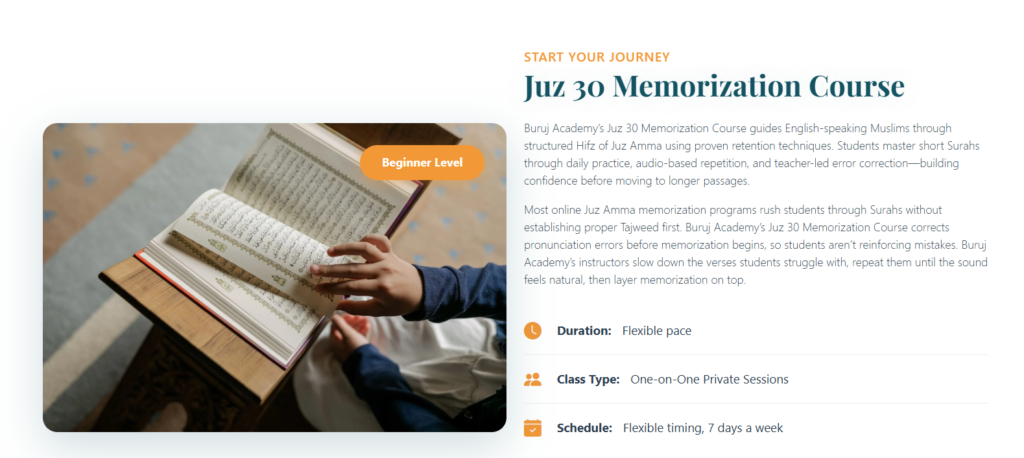
For children beginning Juz 30 Memorization, starting with the last and shortest Juz gives them early wins that build momentum and confidence. Completing Juz Amma feels like a major milestone — because it genuinely is one.
Book Your Kid’s First Session in Buruj’s Juz 30 Memorization Course
7. The Quran Carries Many Beautiful and Meaningful Names
The Quran is known by multiple beautiful names in Islamic tradition, each reflecting a different quality of this holy book. Sharing these names helps children develop a richer relationship with what they’re learning.
| Arabic Name | Meaning | What It Teaches Kids |
| Al-Quran | The Recitation | It is meant to be read aloud |
| Al-Furqan | The Criterion | It helps us know right from wrong |
| Al-Kitab | The Book | It is a complete written guide |
| Al-Huda | The Guidance | It shows us the right path |
| Al-Shifa | The Healing | It brings peace to the heart |
Children aged 8 and above particularly enjoy learning that the book they study has so many layers of meaning. Each name becomes a conversation starter about the Quran’s role in their daily life.
8. The Quran’s Arabic Remains Unchanged After 1400 Years
While spoken Arabic dialects have changed significantly across centuries and regions, the Arabic of the Quran remains exactly as it was revealed 1,400 years ago. Every dot, vowel, and letter has been preserved with extraordinary precision.
This is especially meaningful for children who wonder why they study Quranic Arabic specifically.
Tell them: “When you read Quran, you’re reading the exact same words that the Prophet ﷺ and his companions recited. No other book in the world has been kept this perfectly.”
9. The Quran Describes Natural Phenomena Studied by Scientists
The Quran mentions stars, oceans, embryos, mountains, rain, and bees — describing natural phenomena that scientists have studied for centuries. These verses invite children to see science and faith as connected rather than separate.
Children aged 10-15 particularly respond to this fact. When a child learns that the Quran describes the stages of human development in the womb (Surah Al-Mu’minun), they see the Quran as relevant to the modern world they live in — not just ancient history.
10. Every Single Letter Recited Earns Ten Good Deeds
The Prophet Muhammad ﷺ said that reciting even one letter of the Quran earns ten rewards — and the rewards multiply with each letter. This means every moment a child spends learning Quran is filling their scale of good deeds.
Share this with your child this way: “Every time you read one letter of Quran, you get ten good deeds.
When you read Alif-Lam-Mim at the start of Surah Al-Baqarah, that’s already thirty rewards — just from three letters!” Watch their motivation grow immediately.
11. The Quran Was Revealed in Rich Classical Arabic
The Quran was revealed in classical Arabic — a precise, rich language that carries layers of meaning in every word. This is one reason why learning Arabic opens doors to understanding the Quran directly, without needing translation.
Buruj Academy’s Online Arabic Classes for Kids connect children to this language through storytelling, songs, and visual methods — making Arabic feel like a living, beautiful language rather than a difficult foreign subject.
Book your child’s free Arabic trial now!

12. Children Memorize the Quran Faster Than Adults
Children’s brains between ages 4 and 12 are in a peak period for language acquisition and memorization. This is why many Huffaz begin their memorization journey young — the brain absorbs patterns, sounds, and repetition most efficiently during childhood.
This fact is genuinely encouraging for parents. Starting Quran memorization early isn’t pressure — it’s working with how children’s brains naturally develop.
Short daily sessions of 15-20 minutes are far more effective than longer occasional sessions for young learners.
13. Surah Al Fatiha Is Recited at Least 17 Times Daily
Every Salah includes recitation of Surah Al-Fatiha — making it the most frequently recited text in human history. A Muslim who prays five times daily recites Al-Fatiha at least 17 times every single day.
| Prayer | Minimum Rak’ahs | Al-Fatiha Recitations |
| Fajr | 2 | 2 |
| Dhuhr | 4 | 4 |
| Asr | 4 | 4 |
| Maghrib | 3 | 3 |
| Isha | 4 | 4 |
| Daily Total | 17 | 17 minimum |
When children understand that Surah Al-Fatiha connects every prayer they make to the Quran, learning it properly — with correct Tajweed — becomes deeply meaningful rather than just a memorization task.
14. Quranic Verses Were Revealed Across Two Holy Cities
Quranic verses were revealed in both Makkah and Madinah, and scholars categorize all Surahs as either Makki (revealed in Makkah) or Madani (revealed in Madinah). Each type has recognizable themes and characteristics that even older children can learn to identify.
Makki Surahs often focus on faith, the afterlife, and the nature of Allah. Madani Surahs frequently address community life, rules, and social guidance. This dual structure reflects how the Quran guided Muslims through different stages of their journey.
Read Also: Quran Stories for Kids
15. Tajweed Ensures Every Quranic Letter Is Pronounced Correctly
Tajweed — the rules of Quranic recitation — ensures that every letter is pronounced exactly as it should be, preserving the precise sounds of Arabic. Without Tajweed, meanings can accidentally change through mispronunciation, which is why proper recitation matters.
Through Buruj Academy’s Tajweed for Kids course, children learn these pronunciation rules through games, songs, and interactive practice — turning what sounds like a technical subject into an enjoyable skill children genuinely master with confidence.
Book your child’s free Tajweed trial today
Read Also: Quran Steps for Kids
16. The Quran Brings Peace to Children Connected with It
Allah describes the Quran as a source of peace, guidance, and healing for the heart. Children who develop a daily connection with even a few verses often show increased calm, focus, and sense of purpose in their lives — effects parents frequently notice.
| Age Group | Simple Daily Connection | Time Needed |
| Ages 4-7 | Listen to one short Surah together | 5 minutes |
| Ages 8-12 | Read 5 verses with simple meaning | 10 minutes |
| Ages 13-15 | Read one page with reflection | 15 minutes |
Starting small and staying consistent builds the lifelong Quran relationship every parent hopes for their child, Insha’Allah.
Read Also: Tajweed Rules for Kids
Start Learning the Quran Today
Join our qualified teachers and begin your journey in Quran recitation, Tajweed, and understanding — from the comfort of your home.
Book Your Free TrialRead Also: Tajweed Books for Kids
Help Your Child Build a Lifelong Quran Connection with Buruj Academy’s Expert Instructors
Home learning plants the seeds — structured expert guidance helps them grow deep roots. Children thrive when qualified instructors combine Islamic knowledge with genuine child-focused teaching methods.
- Instructors are Al-Azhar graduates with 12+ years teaching children aged 4-15
- Age-appropriate curriculum for every stage: 4-7, 8-12, and 13-15
- Gamification, storytelling, and interactive activities — never dry lectures
- Short 20-30 minute sessions matched to children’s attention spans
- Flexible scheduling built around your family’s routine
Book your child’s free trial lesson with Buruj Academy today and give them the gift of a genuine Quran connection.
Find your child’s perfect match among Buruj’s top courses for kids:
- Arabic Classes for Kids
- Alphabet course
- Noorani Qaida Course for Kids
- Quranic Arabic Course
- Islamic Studies for Kids
- Hifz Classes for Kids
- Quran Classes for Kids
- Tajweed for Kids
Get a free trial for your child today.
Conclusion
The Quran’s 114 Surahs, 6,236 verses, and 1,400 years of perfect preservation tell a story unlike anything else in human history. Children who understand these facts develop genuine pride in what they are learning, Alhamdulillah.
Connecting these facts to daily life matters more than memorizing numbers. When a child realizes that Surah Al-Fatiha links every prayer to the Quran, or that millions of children worldwide share the same memorization journey, motivation becomes natural and self-sustaining.
Every fact in this collection is a conversation starter between parent and child. Use them at dinner, during car rides, or before bedtime — because the love of Quran grows best through small, consistent moments of shared discovery, Insha’Allah.



Leave a Reply