 Arabic
Teaching Arabic to children often feels overwhelming for parents who don’t speak the language themselves. Yet thousands of non-Arabic speaking families successfully raise bilingual kids by using simple, consistent methods that turn daily moments into natural learning opportunities without requiring fluency or formal teaching experience.
Learning Arabic words for kids works best through multi-sensory repetition, visual associations, and playful contexts that mirror how children naturally acquire their first language. This guide provides age-specific vocabulary lists, practical games parents can implement immediately, and realistic timelines for building Arabic fluency in children aged 4-15, even when Arabic isn’t spoken at home.
Essential Arabic Words for Kids to Learn First
Focus initial Arabic vocabulary for children on five core categories that appear in daily life. These foundational word groups provide maximum conversational utility while keeping learning manageable for both parent and child.
Family members form the emotional core of early vocabulary
Words like أم (umm – mother), أب (ab – father), أخ (akh – brother), and أخت (ukht – sister) connect language learning to a child’s strongest relationships.
Body parts offer built-in learning games
Teaching يد (yad – hand), رأس (ra’s – head), عين (ayn – eye), and رجل (rijl – leg) turns getting dressed or bath time into Arabic practice sessions without requiring special materials or planning.
Common objects children use daily create dozens of practice opportunities
Start with كوب (koob – cup), طبق (tabaq – plate), سرير (sareer – bed), and باب (bab – door) before adding toys and clothing items.
Colors and numbers appear everywhere, making reinforcement effortless
Teaching أحمر (ahmar – red), أزرق (azraq – blue), واحد (wahid – one), and اثنان (ithnan – two) means every car ride or meal becomes vocabulary practice.
Action verbs bring language to life through movement
Words like اجلس (ijlis – sit), قف (qif – stand), كل (kul – eat), and اشرب (ishrab – drink) can be practiced through physical games that channel children’s natural energy into learning.
| Category | Arabic Word | Transliteration | English |
| Family | أم | umm | Mother |
| Body | يد | yad | Hand |
| Objects | كتاب | kitab | Book |
| Colors | أحمر | ahmar | Red |
| Actions | اجلس | ijlis | Sit |
Teach Arabic Words for Kids Through Daily Routines
Consistency beats intensity when teaching Arabic vocabulary to children. Five minutes of Arabic during breakfast, bath time, and bedtime creates more retention than one 30-minute weekend session because spaced repetition cements vocabulary into long-term memory.
Morning routine Arabic starts the day with language.
Say “صباح الخير” (sabah al-khayr – good morning), then label breakfast items: “حليب” (haleeb – milk), “خبز” (khubz – bread), “بيض” (bayd – eggs).
Within two weeks, children start requesting items using Arabic words naturally.
Discover the Buruj Academy Difference
Step into our virtual classrooms and see how our expert instructors make learning Quran and Arabic intuitive and clear. We focus on overcoming the specific hurdles non-native speakers face, building your confidence and connection with the Quran.
Bath time vocabulary makes hygiene fun
Point to body parts while washing, saying “يد” (hand), “وجه” (wajh – face), “شعر” (sha’ar – hair). Add action verbs like “اغسل” (ighsil – wash), “جفف” (jaffif – dry).
The multi-sensory experience—water, touch, repetition—creates strong memory anchors.
Bedtime Arabic ends the day peacefully
Use simple phrases like “تصبح على خير” (tusbih ‘ala khayr – good night), then review 3-5 vocabulary words from the day before sleep, when memory consolidation is strongest according to child learning research.
At Buruj Academy, our Online Arabic Classes for Kids teach vocabulary through storytelling, songs, and games—children learn ب through بيت (house), ت through تفاحة (apple)—making Arabic alphabet mastery enjoyable rather than tedious, all guided by instructors trained in both Arabic education and child pedagogy.
Book your child’s free Arabic trial now!

Fun Games for Kids That Build Arabic Vocabulary Fast
Games transform Arabic vocabulary practice from tedious drilling into activities children request repeatedly. These four games require minimal preparation but deliver maximum engagement and retention for kids learning Arabic words.
1. Hunt for hidden objects using simple Arabic clues
Hide objects around one room and give Arabic clues for children to find them. Say “ابحث عن الكتاب” (ibhath ‘an al-kitab – search for the book) or point to colors: “شيء أحمر” (shay’ ahmar – something red).
This combines physical movement with vocabulary recall, perfect for energetic learners aged 5-10.
2. Match pictures with Arabic words to improve memory
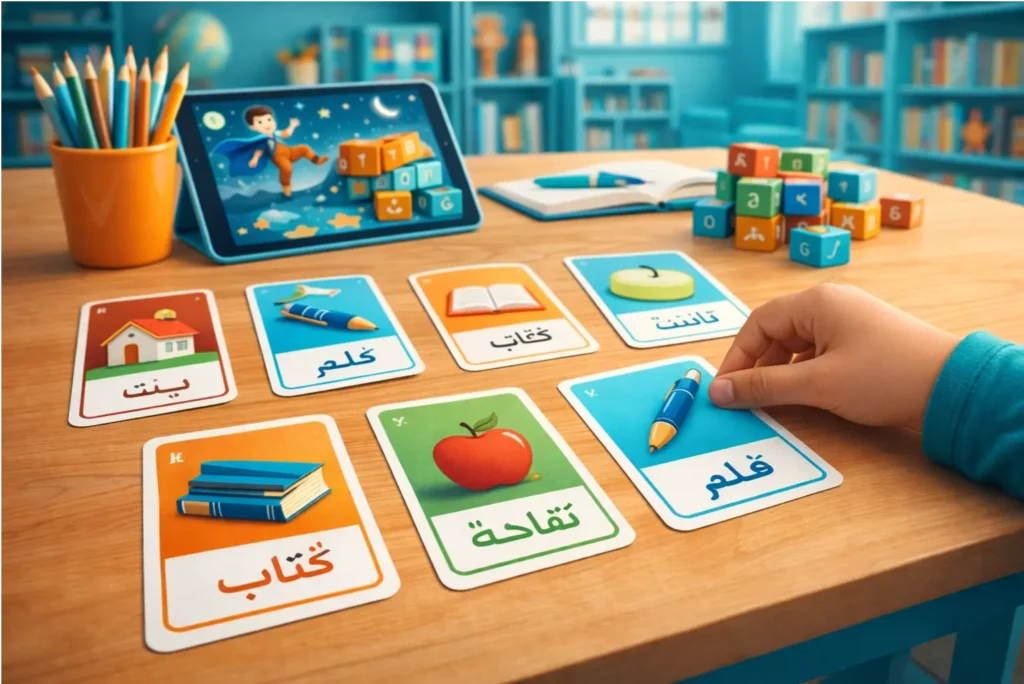
Create simple flashcards with Arabic words on one set and pictures on another. Lay them face-down and let kids flip two at a time to find matches.
Start with 6-8 word pairs for ages 4-6, increase to 12-15 pairs for ages 7-10. This visual memory game builds reading recognition alongside spoken vocabulary.
3. Practice action verbs with a classic movement game
Play the traditional game entirely in Arabic using commands like “قل ‘قف'” (qul ‘qif’ – Simon says stand) or “قل ‘اجلس'” (qul ‘ijlis’ – Simon says sit).
Children learn to distinguish Arabic commands while burning energy. Add new verbs weekly: jump, clap, spin, touch.
4. Motivate older children with a daily word challenge
Challenge children aged 8-15 to use five target Arabic words throughout the day in any context. Track usage on a simple chart.
When kids hit daily goals for one week straight, celebrate with a small reward. This builds accountability and makes vocabulary practice a self-motivated habit.
| Game Type | Best Age | Vocab Focus | Time Needed | Materials |
| Treasure Hunt | 5-10 | Objects, Colors | 10-15 min | Household items |
| Memory Match | 4-10 | Reading, Nouns | 10 min | Paper, markers |
| Simon Says | 4-8 | Action Verbs | 5-10 min | None |
| Daily Challenge | 8-15 | All Categories | Ongoing | Chart, stickers |
Select Appropriate Arabic Vocabulary For Every Age Group
Children’s cognitive abilities and attention spans vary dramatically across developmental stages. These age-specific Arabic word lists match what kids can realistically learn and retain at each developmental milestone.
Focus on basic words for the youngest learners
Young children need ultra-simple vocabulary with strong visual and emotional connections. Limit new words to 3-5 per day maximum to prevent overwhelm and build confidence through mastery.
Focus on: Family members, body parts, basic foods, primary colors, simple animals.
Example words: ماء (ma’ – water), شمس (shams – sun), قطة (qitta – cat), كلب (kalb – dog), بيت (bayt – house).
| Arabic Word | Transliteration | English Meaning | Category |
| أب | Ab | Father | Family |
| أم | Umm | Mother | Family |
| يد | Yad | Hand | Body Part |
| عين | ‘Ayn | Eye | Body Part |
| حليب | Haleeb | Milk | Food |
| تفاح | Tuffah | Apple | Food |
| أحمر | Ahmar | Red | Color |
| أزرق | Azraq | Blue | Color |
| قطة | Qitta | Cat | Animal |
| بيت | Bayt | House | Object |
| كرة | Kura | Ball | Object |
| ماء | Ma’ | Water | Essential |
Expand vocabulary for children in early elementary school
Elementary-age kids can handle expanded vocabulary and simple sentences combining multiple words. Introduce 5-8 new words daily, mixing nouns with basic adjectives and common verbs.
Add: Classroom objects, weather terms, clothing items, numbers 1-20, extended family terms.
Example words: معلم (mu’allim – teacher), مطر (matar – rain), قميص (qamees – shirt), كبير (kabeer – big), صغير (sagheer – small).
| Arabic Word | Transliteration | English Meaning | Category |
| مدرسة | Madrasa | School | Classroom |
| كتاب | Kitab | Book | Classroom |
| قلم | Qalam | Pen/Pencil | Classroom |
| شمس | Shams | Sun | Weather |
| مطر | Matar | Rain | Weather |
| برد | Bard | Cold | Weather/Feeling |
| ثوب | Thawb | Dress/Garment | Clothing |
| حذاء | Hidha’ | Shoe | Clothing |
| واحد إلى عشرة | Wahid to ‘Ashara | Numbers 1-10 | Math |
| كبير | Kabeer | Big | Adjective |
| صغير | Sagheer | Small | Adjective |
| جد / جدة | Jadd / Jadda | Grandfather / Grandmother | Family |
Teach complex phrases to maturing students
Older elementary students can tackle abstract concepts, compound words, and conversational phrases. They can learn 10-15 words daily if motivated and can create simple sentences combining learned vocabulary independently.
Include: Emotions, time expressions, descriptive adjectives, common phrases, everyday verbs.
Example words: سعيد (sa’eed – happy), اليوم (al-yawm – today), جميل (jameel – beautiful), من فضلك (min fadlik – please), شكرا (shukran – thank you).
| Arabic Word | Transliteration | English Meaning | Category |
| سعيد | Sa’eed | Happy | Emotion |
| حزين | Hazeen | Sad | Emotion |
| اليوم | Al-yawm | Today | Time |
| غداً | Ghadan | Tomorrow | Time |
| أمس | Ams | Yesterday | Time |
| جميل | Jameel | Beautiful | Adjective |
| صعب | Sa’b | Difficult | Adjective |
| سهل | Sahl | Easy | Adjective |
| من فضلك | Min fadlik | Please | Phrase |
| أنا أفهم | Ana afham | I understand | Verb/Phrase |
| لا أعرف | La a’rif | I don’t know | Verb/Phrase |
| أريد | Ureed | I want | Verb |
Explore abstract concepts with teenage learners
Teenagers can engage with vocabulary through thematic units that interest them personally—technology, sports, hobbies, social interactions. They can master 15-20 words weekly and benefit from understanding word roots and patterns.
Expand to: Abstract nouns, complex verbs, conversational idioms, Quranic vocabulary. Example words: صداقة (sadaqa – friendship), يفهم (yafham – understands), إن شاء الله (in sha Allah – Allah willing), ما شاء الله (ma sha Allah – what Allah wills).
| Arabic Word | Transliteration | English Meaning | Category |
| صداقة | Sadaqa | Friendship | Abstract |
| حرية | Hurriyya | Freedom | Abstract |
| نجاح | Najah | Success | Abstract |
| حاسوب | Hasoob | Computer | Technology |
| هاتف | Hatif | Phone | Technology |
| موقع | Mawqi’ | Website | Technology |
| صبر | Sabr | Patience | Quranic/Virtue |
| تقوى | Taqwa | God-consciousness | Quranic/Virtue |
| عدل | ‘Adl | Justice | Quranic/Virtue |
| بصراحة | Bi-saraha | Honestly | Idiom |
| ربما | Rubama | Maybe/Perhaps | Connective |
| بالطبع | Bi-tab’ | Of course | Idiom |
Through Buruj Academy’s Arabic Alphabet Learning Course, kids progress from letter recognition to word reading using interactive activities and visual associations that match how children naturally learn language, guided by expert Arabic instructors with 12+ years of experience teaching non-Arabic speaking children.
Get your kid a free trial now in the Best Arabic course
Link Everyday Arabic Vocabulary To Future Quranic Studies
Teaching Arabic vocabulary to children simultaneously prepares them for Quran reading and comprehension. When kids learn Arabic words through daily objects and conversations, they build the foundational vocabulary that appears throughout Quranic text.
Many common Quran words overlap with basic children’s vocabulary. Words like سماء (sama – sky), أرض (ard – earth), ماء (ma’ – water), and نار (nar – fire) appear in both everyday speech and Quranic verses, creating dual reinforcement.
Children who learn Arabic words conversationally transition to Quran reading more smoothly. They already recognize word patterns, letter combinations, and basic grammar concepts, reducing the cognitive load when beginning formal Quran study.
Starting Arabic vocabulary before age 7 creates a pronunciation advantage. Young children’s brains more easily distinguish and produce Arabic sounds like ع (ayn) and ح (ha) that older learners struggle with. This early sound mastery ensures better Tajweed later.
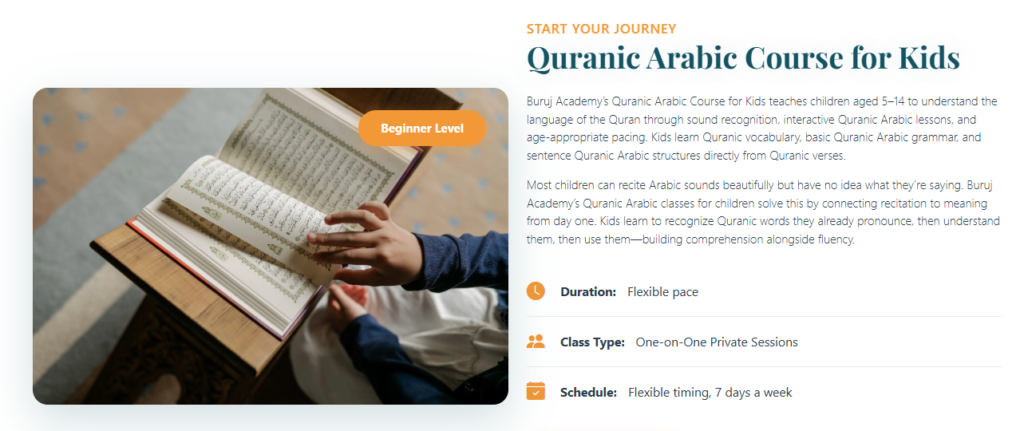
Buruj Academy’s Quranic Arabic Course for Kids introduces classical Arabic through simple Quranic examples children can relate to, building both language skills and Quran connection simultaneously with age-appropriate pacing, taught by Al-Azhar graduates experienced in making Quranic vocabulary accessible to young learners.
Try our Quranic Arabic Course for Kids for free now
Read Also: How to Learn Arabic for Kids?
Surround Your Child With Arabic Throughout Your Home
Environment shapes language exposure more powerfully than structured lessons. Strategic Arabic integration throughout home spaces creates hundreds of daily micro-learning moments that accelerate vocabulary acquisition without requiring additional time or formal teaching.
Label common objects with Arabic sticky notes. Put بَاب (bab) on doors, نافذة (nafitha) on windows, ثلاجة (thallaja) on the refrigerator. Children read these labels passively dozens of times daily, building automatic recognition without effort.
Switch some device settings to Arabic for older children. Changing a tablet or computer interface to Arabic forces reading practice during preferred activities. Start with familiar apps where children know the interface well enough to navigate despite language barriers.
| Environmental Strategy | Best Locations | Age Range | Implementation Time |
| Object Labels | Kitchen, bedroom, bathroom | 4-12 | 15 minutes one-time |
| Device Settings | Tablets, computers | 8-15 | 5 minutes one-time |
| Alphabet Posters | Bedroom, playroom | 4-10 | 5 minutes one-time |
| Arabic-Only Zones | Car, snack time | 6-15 | Ongoing daily practice |
Master the Arabic Language
Develop reading, writing, speaking, and comprehension skills through interactive Arabic lessons for all levels.
Start Arabic ClassesRead Also: Learn Arabic Alphabet for Kids
Help Your Child Build Arabic Vocabulary with Buruj Academy’s Expert Instructors
Teaching Arabic words to kids at home provides a strong foundation, but structured guidance from instructors trained in both Arabic language and child pedagogy accelerates progress while ensuring proper pronunciation and age-appropriate pacing that parents often find challenging to provide alone.
Buruj Academy’s Online Arabic Classes for Kids offer:
- Al-Azhar graduates with 12+ years teaching children from non-Arabic backgrounds
- Age-specific curriculum designed for developmental stages 4-7, 8-12, and 13-15
- Gamification and storytelling that make vocabulary memorable, not boring
- Visual learning tools including colorful flashcards, charts, and interactive activities
- Patient, encouraging approach building confidence through positive reinforcement
- Flexible scheduling fitting family routines and children’s energy patterns
- Personalized pacing adjusted to each child’s individual learning speed
Find your child’s perfect match among Buruj’s top courses for kids:
- Arabic Classes for Kids
- Alphabet course
- Noorani Qaida Course for Kids
- Quranic Arabic Course
- Islamic Studies for Kids
- Hifz Classes for Kids
- Quran Classes for Kids
- Tajweed for Kids
Get a free trial for your child today.

Conclusion
Arabic vocabulary acquisition for children succeeds through consistent daily exposure in playful contexts rather than intensive study sessions. Starting with concrete objects kids encounter daily creates strong memory associations that expand naturally into more complex vocabulary as children mature and develop stronger language processing abilities.
Age-appropriate word targets prevent overwhelm while ensuring steady progress—3-5 words weekly for young children, scaling to 12-20 for motivated teenagers. Multi-sensory learning through games, songs, visual aids, and physical movement creates retention rates far superior to traditional drilling or flashcard-only approaches that bore children and produce minimal results.
Environmental Arabic integration—labeled objects, Arabic music, alphabet posters, designated Arabic-only times—generates hundreds of micro-learning moments weekly without requiring structured lessons. Combined with games and daily routines, this approach builds functional vocabulary that prepares children for both everyday conversations and future Quran study with proper foundations in place.



Leave a Reply