 Islamic
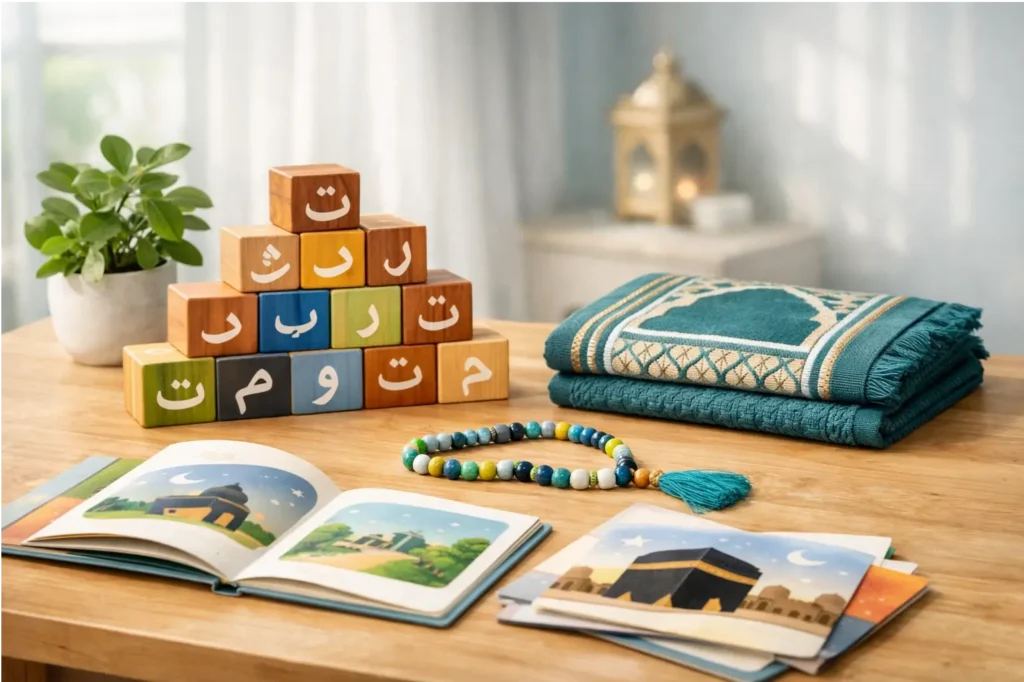
Children absorb what they experience, not just what they’re told. When Islamic values are woven into play, stories, and daily moments, they settle deep into a child’s heart naturally and without resistance.
Raising children with a strong Islamic identity doesn’t require long lectures or rigid schedules. These Islamic activities for kids cover Quran, Arabic, worship habits, and character—giving parents practical, joyful ways to build faith into everyday family life.
1. Storytime with Prophet Stories
Prophet stories are among the most powerful Islamic activities for kids because children are wired for narrative. A well-told story about Prophet Yunus (AS) teaches patience and trust in Allah better than any definition ever could.
Start with short, single-lesson stories before bedtime. For ages 4-7, focus on emotions: “How do you think Prophet Ibrahim felt?” For ages 8-12, add historical context and ask what lessons they’d apply today.
Buruj Academy’s Islamic Studies Classes for Kids use prophet stories as a core teaching method, helping children connect emotionally with Islamic history through engaging, age-appropriate narration guided by experienced educators.
The first session is free in Buruj’s Islamic Studies Classes for Kids
2. Making Dhikr Jars Together
A Dhikr jar is a simple, tactile activity where children move beads or pebbles from one jar to another while saying SubhanAllah, Alhamdulillah, or Allahu Akbar. It makes abstract concepts beautifully concrete for young hands.
Set a family goal of 33 counts each after Salah. Ages 4-7 enjoy the physical movement. Ages 8-12 can track their totals in a notebook and set weekly Dhikr goals they’re proud to meet.
This activity builds the habit of remembering Allah without feeling like a chore. Five minutes daily creates a rhythm children carry into adulthood, Insha’Allah.
3. Islamic Coloring Pages
Coloring pages featuring Arabic letters, mosque architecture, or Islamic phrases give young children a creative entry point into their deen. The quiet focus of coloring is also ideal for introducing basic concepts through gentle conversation.
Print free Islamic coloring pages online or draw simple designs yourself. A crescent moon, a masjid, Arabic letters—these become meaningful symbols when children create them with their own hands.
Discover the Buruj Academy Difference
Step into our virtual classrooms and see how our expert instructors make learning Quran and Arabic intuitive and clear. We focus on overcoming the specific hurdles non-native speakers face, building your confidence and connection with the Quran.
4. Quran Listening Stations
Playing Quran recitation softly during breakfast, car rides, or playtime creates subconscious familiarity with the sound, rhythm, and melody of Allah’s words. Children who grow up hearing Quran develop an ear for correct pronunciation naturally.
Choose clear, melodic reciters like Sheikh Mishary Rashid Al-Afasy for younger children. For ages 8+, occasionally pause and ask: “Which surah do you recognize?” This builds active listening alongside passive absorption.
This is one of the easiest Islamic activities for kids because it requires zero extra time. It fits perfectly into existing routines without adding pressure to already busy family schedules.
5. Islamic Board Games and Card Games
A growing number of beautifully designed Islamic board games now make learning genuinely exciting. Games built around Islamic trivia, prophet stories, Quran memorization, or Arabic vocabulary turn family game night into educational time.
Here is a quick overview of game types that work well across different age groups:
| Game Type | Age Range | Islamic Concept Covered | Play Duration |
| Prophet Story Trivia | Ages 6–10 | Islamic history and character | 20–30 minutes |
| Arabic Alphabet Matching | Ages 4–7 | Letter recognition and sounds | 10–15 minutes |
| Quran Surah Quiz Cards | Ages 8–15 | Quran memorization review | 15–25 minutes |
| Islamic Values Role-Play | Ages 7–12 | Akhlaq and daily worship | 20–30 minutes |
The best games combine competition with cooperation, keeping all children engaged. Even one family game night per week adds up to meaningful Islamic learning over a full year.
6. Ramadan Countdown Calendars
A Ramadan countdown calendar turns one of Islam’s most sacred months into something children genuinely look forward to all year. Each day reveals a small activity, dua, or Islamic fact—making the spiritual depth of Ramadan accessible and exciting.
Parents can create one with a simple cardboard grid, envelopes, or numbered boxes. Fill each with printed duas, a small treat, a kind-deed challenge, or a question about Ramadan’s significance suited to your child’s age.
7. Arabic Alphabet Crafts
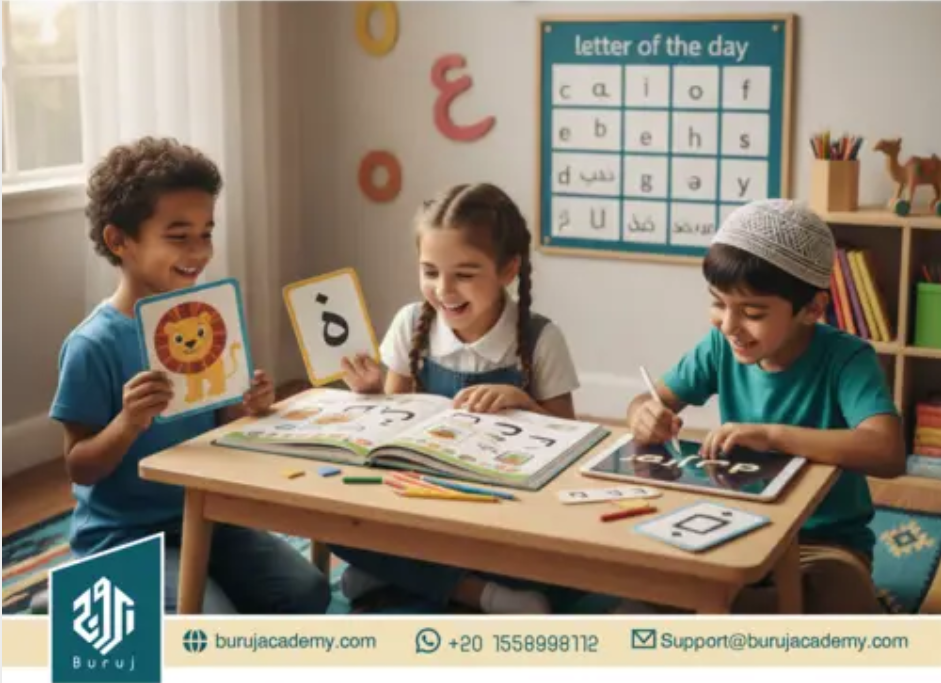
Craft-based Arabic learning connects letter shapes to physical creation. Children who cut, paste, mold, or paint Arabic letters develop spatial memory for letterforms that flashcards alone rarely achieve.
Try these craft approaches by age:
- Ages 4-6: Mold letters from playdough, trace letters in sand trays
- Ages 7-9: Cut letter shapes from magazines, create letter collages with images starting with that sound
- Ages 10-12: Design illuminated Arabic calligraphy using simple geometric patterns
Buruj Academy’s Arabic Alphabet Learning Course builds on this same hands-on philosophy, using visual associations and interactive activities so children progress from letter recognition to word reading confidently.
Get your kid a free trial now in Buruj’s Best Alphabet course
8. Dua Journals
A dua journal is a notebook where children write or draw their personal supplications to Allah. This practice makes dua feel intimate and meaningful rather than memorized and mechanical.
For ages 4-7, parents write while children dictate: “What do you want to ask Allah today?”
For ages 8-12, children write their own duas in English or Arabic.
For ages 13-15, encourage private journals they maintain independently.
Review journals together occasionally and celebrate when duas are answered. This builds a child’s direct relationship with Allah through personal, heartfelt conversation that no formal lesson can fully replace.
9. Islamic Nature Walks Are Outdoor Islamic Activities for Kids
A walk through any park becomes a lesson in Tawheed when parents guide children to notice Allah’s creation intentionally. “Who made that butterfly?” “How many colors did Allah put in those flowers?” These questions plant deep seeds.
Collect leaves, stones, or flowers and create a “Signs of Allah” display at home. Label each item with a simple observation: “Allah made 400,000 types of flowers.” Children who see Allah in nature develop natural gratitude and wonder.
This activity costs nothing, requires no materials, and fits any schedule. Even a 10-minute walk around the block becomes spiritually meaningful when Allah’s names and creation are discussed naturally along the way.
10. Hadith Memorization Games
Short, simple hadith are perfect for children’s memorization because they’re brief, wise, and immediately applicable.
“The best of you are those who learn the Quran and teach it”
takes under a minute to memorize but shapes a lifetime of values.
Play “fill the missing word” where parents pause mid-hadith and children call out the next word.
Keep sessions to 5-10 minutes maximum. One hadith memorized deeply is worth more than ten half-learned ones. Celebrate every completion with enthusiastic praise and let children teach the hadith to a sibling or grandparent.
11. Charity Boxes at Home
A dedicated sadaqah box at home teaches children that generosity is a regular habit, not a rare event. When children physically drop coins into the box themselves, giving becomes embodied and emotionally meaningful.
Set a simple family rule: whenever someone receives money—Eid gifts, pocket money, rewards—a portion goes into the sadaqah box. Monthly, research a cause together and donate as a family. Let children choose the recipient when age-appropriate.
Ages 4-7 enjoy the physical act of dropping coins. Ages 8-12 can research charities online with parents. Ages 13-15 can manage the entire process, calculating amounts and writing the donation themselves.
12. Islamic Nasheed Sessions
Nasheeds—Islamic vocal songs without musical instruments—are among the most effective tools for teaching children duas, Allah’s names, and Islamic phrases. Melody dramatically accelerates memorization and makes recall almost effortless.
Children who learn “Asma ul Husna” through a nasheed often memorize all 99 names faster than peers using traditional methods. The same applies to basic duas, Quran ayat with simple melody, and Islamic phrases like Assalamu Alaikum responses.
Play nasheeds during morning routines, car journeys, and quiet play. By ages 8-10, children can memorize entire nasheed sets covering comprehensive Islamic vocabulary without it ever feeling like study.
13. Quran Revision Reward Charts
A visual reward chart makes Quran revision tangible and exciting for children who need to see their progress clearly. Every completed revision session earns a sticker, star, or stamp—and accumulated rewards unlock meaningful family celebrations.
Here’s a simple reward structure that works across age groups:
| Revisions Completed | Reward Type | Who Decides |
| 5 sessions | Small treat or extra story time | Parent chooses |
| 15 sessions | Family outing or favorite meal | Child chooses |
| 30 sessions | Special celebration or gift | Family decides together |
| 50 sessions | Major milestone celebration | Child presents achievement |
The chart itself becomes a source of pride. Children who can see their progress in stars and colors stay motivated through difficult memorization plateaus far more consistently than those with no visual tracking.
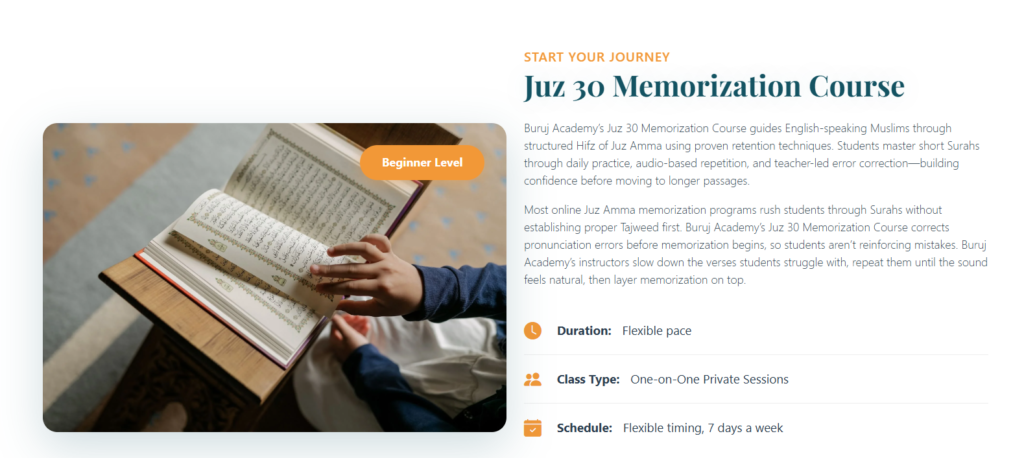
Book Your Kid’s First Session in Buruj’s Juz 30 Memorization Course
14. Eid Craft Projects
When children make their own Eid decorations, lanterns, cards, and gifts, they develop genuine excitement about Islamic celebrations rooted in personal creativity. Eid feels like theirs, not just something that happens around them.
Start preparations one to two weeks before Eid. Ages 4-7 can paint crescent moons and stars. Ages 8-12 can create handmade Eid cards for relatives. Ages 13-15 can plan and lead the entire family decoration project independently.
Children who associate Islam with celebration, creativity, and family joy carry those positive emotional memories into adulthood. These associations become the foundation of a faith chosen and loved, not merely inherited.
15. Mosque Visit Programs
Regular masjid visits—not only for Jumu’ah but for casual familiarization—help children feel at home in Allah’s house. Children who are comfortable in the mosque are more likely to maintain their connection to the community as teenagers.
Before each visit, give children a small mission: “Find three things in the mosque that show respect for Allah.” Afterward, discuss what they noticed. This keeps visits active and observational rather than passive and forgettable.
Ages 4-7 benefit most from sensory familiarization with the masjid environment. Ages 8-12 can meet the imam and ask one prepared question. Ages 13-15 can begin participating in youth programs and volunteer opportunities.
Read Also: Basics of Islam for Kids
Deepen Your Islamic Knowledge
Study Aqeedah, Fiqh, Seerah, and essential Islamic teachings with experienced instructors in a structured online program.
Try Islamic StudiesRead Also: Islamic Books for Kids
Help Your Child Build a Lifelong Islamic Connection with Buruj Academy’s Expert Instructors
Home activities lay wonderful groundwork, but structured expert guidance helps children progress consistently through Quran, Arabic, and Islamic studies with age-appropriate depth.
Buruj Academy’s Islamic Studies Classes for Kids offer:
- Instructors trained in both Islamic education AND child pedagogy
- Al-Azhar graduate teachers with 12+ years working with children ages 4–15
- Gamification, stories, and activities—never dry lectures
- Short 20–30 minute sessions matching children’s attention spans
- Personalized pacing based on each child’s learning speed
- Flexible scheduling to fit busy family routines
Book a free trial lesson today and let your child experience Islamic learning that feels genuinely enjoyable.
Find your child’s perfect match among Buruj’s top courses for kids:
- Arabic Classes for Kids
- Alphabet course
- Noorani Qaida Course for Kids
- Quranic Arabic Course
- Islamic Studies for Kids
- Hifz Classes for Kids
- Quran Classes for Kids
- Tajweed for Kids
Get a free trial for your child today.

Conclusion
Islamic activities for kids work best when they match the child’s age, energy, and natural curiosity. Activities that feel like play—games, crafts, stories, and movement—build the deepest and most lasting connections to faith.
Consistency matters far more than intensity. Ten minutes of daily Islamic engagement through duas, Dhikr, or Quran listening creates stronger foundations than occasional long sessions that exhaust children and discourage continued participation.
Every child’s journey with Islam grows at its own pace. Celebrating small wins, maintaining warmth, and keeping activities joyful ensures that faith becomes something your child genuinely loves—not something they quietly resist, Insha’Allah.


Leave a Reply