Realization 1: Fluency Isn’t Just Speed; It’s Accuracy and Flow.
My first major breakthrough came when I shifted my definition of “fluency.” Initially, I thought fluency meant speed. I saw accomplished reciters gliding through pages, and I yearned to emulate that pace. However, my teacher gently corrected me. “Fluency,” she explained, “is not about how fast you read, but
how correctly and
how smoothly you read. Even a slow, accurate recitation is fluent. A fast, error-ridden recitation is not.”
This realization was a game-changer. It took the pressure off trying to keep up with others and allowed me to focus on precision. I started slowing down deliberately, concentrating on each letter’s articulation (Makharij Al-Huruf) and each vowel’s clarity. I understood that laying a strong foundation in accuracy would naturally lead to speed later. This meant practicing the fundamental rules of Tajweed, even the seemingly small ones, with utmost care. This was my first step towards truly understanding
how to read Quran fluently.
Realization 2: Tajweed is the GPS, Not a Roadblock.
For a long time, the rules of Tajweed felt like an additional burden, another layer of complexity that stood between me and fluent recitation. All the rules about lengthened vowels (Mudood), nasalization (Ghunnah), merging letters (Idgham), and distinct pronunciation (Izhaar) seemed overwhelming. I viewed them as obstacles to memorize, rather than tools for improvement.
My second realization was that Tajweed isn’t a collection of arbitrary rules; it’s the divine instruction manual for
how to read Quran fluently and beautifully. It’s the “GPS” that guides your tongue to the correct pronunciation and ensures you convey the Quran’s message as it was intended. Once I started viewing Tajweed as an aid rather than an impediment, my attitude shifted. I enrolled in a dedicated Tajweed course, focusing specifically on understanding the
why behind each rule, not just the
what.
Learning the correct application of Sukoon, Shaddah, and the different types of Madd (elongation) unlocked a new dimension in my recitation. My stuttering decreased significantly because I knew exactly how long to hold a sound, when to merge, and when to pause. This structured learning provided the framework my hesitant recitation desperately needed.
Realization 3: Consistent, Daily Practice Beats Sporadic Cramming.
Like many, I used to approach Quran recitation sporadically. I’d have bursts of intense practice for a few days, then get busy and neglect it for a week or more. Unsurprisingly, this led to inconsistent progress and a perpetual feeling of starting from scratch.
My third realization was the power of consistency, even if it meant small increments. Instead of aiming for an hour of practice only to miss several days, I committed to just 15-20 minutes
every single day. This small, manageable commitment was far more effective. Just like a muscle, the tongue and vocal cords need regular exercise to develop strength and agility.
During these daily sessions, I would focus on:
- Reviewing previously learned rules: Keeping Tajweed fresh in my mind.
- Targeting problematic letters/verses: Spending extra time on areas where I consistently stumbled.
- Listening and mimicking: Reciting along with a reputable Qari (reciter) to internalize the rhythm and flow.
This consistent, disciplined approach, regardless of how busy my day was, was a turning point in my quest for
how to read Quran fluently. The small daily gains compounded over time, leading to remarkable improvement.
Realization 4: Listening to Expert Reciters is Half the Battle.
I used to think that just reading the Quran with my eyes was enough. However, my fourth crucial realization was that active listening to expert reciters is an indispensable part of learning
how to read Quran fluently. The Arabic language, particularly in Quranic recitation, has a unique melody and intonation that cannot be fully grasped by reading alone.
I started making it a point to listen to renowned Qaris like Sheikh Mishary Alafasy, Sheikh Abdul Basit Abdus Samad, or Sheikh Sudais. I would listen intently, paying attention to:
- Pacing: How they transitioned between verses and surahs.
- Makharij: The precise articulation of each letter, especially the challenging ones.
- Tajweed application: How they executed Ghunnah, Madd, and other rules seamlessly.
- Breath control: Their ability to recite long verses without faltering.
Initially, I just listened. Then, I started reciting along with them, trying to match their pace and pronunciation. This technique, often called “shadowing,” was incredibly effective. It trained my ears to recognize correct sounds and my tongue to produce them naturally, transforming my internal struggle into a harmonious flow.
Realization 5: The Spiritual Connection Fuels Fluency.
Perhaps the most profound realization that truly transformed my journey was understanding that my goal wasn’t just mechanical fluency, but a deeper spiritual connection with Allah’s words. When I focused solely on the technical aspects, it sometimes felt like a chore. But when I approached recitation as an act of worship, a conversation with my Creator, my motivation soared.
Before each session, I would make du’a (supplication) asking Allah to open my heart and tongue to His words. I started reading translations more regularly, even for verses I was just practicing, to grasp the meaning. Understanding what I was reciting added an entirely new dimension. It transformed the letters and words from mere sounds into powerful messages of guidance, mercy, and wisdom.
This spiritual connection removed the internal pressure and replaced it with a yearning to perfect my recitation out of love and reverence for Allah. This holistic approach, combining technical skill with heartfelt devotion, made the process of learning
how to read Quran fluently not just achievable, but profoundly beautiful. My stuttering gave way to a heartfelt flow, and my slow pace evolved into a steady, accurate, and meaningful recitation.
Your Journey to Fluent Recitation – How To Read Quran Fluently
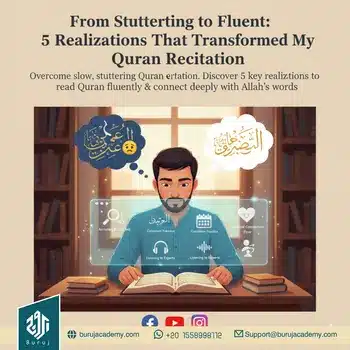
If you’re currently experiencing the frustration of being slow and stuttering in your Quran recitation, please know that it’s a common struggle, and it is absolutely surmountable. Embrace these five realizations:
- Define Fluency as Accuracy + Flow, Not just speed.
- Embrace Tajweed as your guide, not a barrier.
- Practice consistently, even if it’s just 15 minutes daily.
- Listen actively to expert reciters and mimic them.
- Cultivate a deep spiritual connection with the Quran’s meaning.
Your journey to learn
how to read Quran fluently is a blessed one. With patience, persistence, and the right approach, you too can transform your recitation into a smooth, accurate, and deeply moving experience.
 Arabic



Leave a Reply