 Quran
Quran

| Key Takeaways |
| Skype and Zoom Quran classes deliver live, one-on-one instruction from certified teachers directly to your home screen. |
| Stable internet, a quiet space, and a quality headset are the three non-negotiable technical requirements before your first session. |
| Choosing an Ijazah-certified instructor with proven experience teaching non-Arabic speakers is the single most important decision you will make. |
| Buruj Academy’s online Quran courses via Skype and Zoom use the Buruj Method to ensure structured, measurable progress from day one. |
| Consistent daily practice of 20–30 minutes between sessions accelerates recitation accuracy faster than longer, irregular study patterns. |
Millions of Muslims worldwide now have access to qualified Quran teachers without leaving their homes — and Skype and Zoom have made this possible at a level of quality that rivals in-person instruction. What once required proximity to a madrasa or Islamic centre now fits into a lunch break, an early morning slot, or an evening after the children sleep.
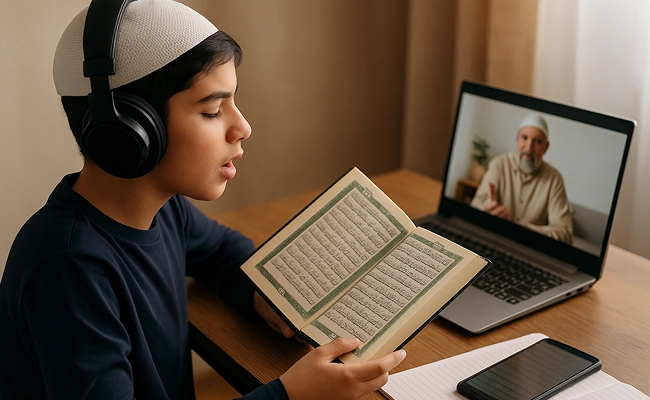
Learning Quran online by Skype and Zoom means connecting live with a certified instructor, receiving real-time correction on your recitation, and following a structured curriculum — all through your screen.
When the platform is paired with the right teacher and a clear learning plan, the results are authentic, measurable, and lasting.
Table of Contents:
1. Understand What Makes Skype and Zoom Quran Classes Genuinely Effective
Online Quran learning via Skype or Zoom works because both platforms support real-time audio and video interaction between student and teacher.
A qualified instructor can hear every pronunciation detail, correct makharij errors immediately, and demonstrate proper mouth positioning through the camera — replicating the core dynamic of a traditional lesson.
The effectiveness depends entirely on three factors: platform stability, teacher qualification, and structured curriculum. Without all three, even motivated students plateau quickly.
In our experience at Buruj Academy, students who switch from unstructured YouTube learning to live Skype sessions with a qualified teacher typically show measurable recitation improvement within the first two to three weeks.
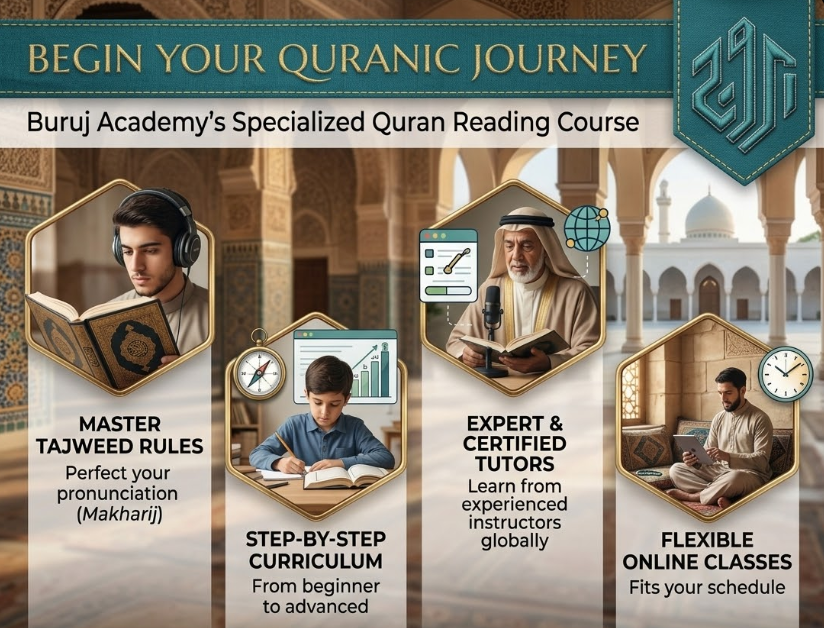
If you are starting from zero, our Quran Reading course provides the structured foundation that makes every subsequent live session productive and purposeful.
Book your Free trial lesson and start reading the Quran
Why Zoom Quran Classes Offer Distinct Advantages Over Pre-Recorded Lessons
Live Zoom sessions include immediate feedback, which pre-recorded content can never replicate. When a student misarticulates the letter ض or rushes a Madd, a live instructor corrects it in the same breath. Pre-recorded content plays the error forward, embedding it deeper.
2. Set Up the Right Technical Environment Before Your First Session
To learn Quran online by Skype or Zoom effectively, your technical setup must support clear, uninterrupted audio.
Recitation correction depends entirely on what the teacher hears — distorted or lagging audio makes meaningful instruction impossible.
| Equipment | Minimum Requirement | Recommended Option |
| Internet Speed | 5 Mbps stable | 15+ Mbps wired connection |
| Microphone | Built-in laptop mic | USB headset with noise cancellation |
| Camera | Built-in webcam | External HD webcam |
| Device | Smartphone or tablet | Laptop or desktop |
| Environment | Quiet room | Dedicated, echo-free space |
Test your audio before every session. A two-minute sound check with your teacher at the start of class prevents a full session lost to technical interference.
Install both Skype and Zoom before your first class — some academies use one platform consistently, while others allow student preference.
Buruj Academy primarily uses Zoom for its superior audio stability during recitation sessions, though Skype Quran classes remain available for students who prefer that platform.
3. Assess Your Current Level Honestly Before Choosing a Course
Choosing the right entry point determines whether you build genuine skills or spend months in mismatched material. Most students overestimate their level when self-assessing — a common pattern we observe repeatedly in intake sessions.
| Level | Characteristics | Recommended Starting Point |
| Complete Beginner | Cannot read Arabic script | Noorani Qaida course |
| Early Reader | Recognizes letters but reads slowly | Quran Reading course |
| Reads Fluently | Reads but without Tajweed rules | Tajweed classes |
| Memorizing | Hifz student needing structure | Hifz program |
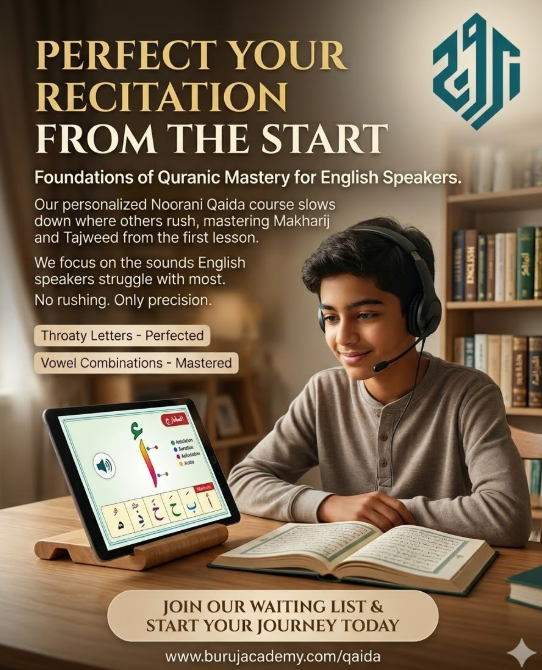
If you are a complete beginner, do not start directly with Quran recitation sessions. Begin with our Noorani Qaida course, which builds letter recognition and sound production before any full Quranic text is introduced.
Attempting recitation before foundational letter mastery produces errors that take significantly longer to correct than to prevent.
Book your FREE trial lesson in the Noorani Qaida course
4. Choose a Qualified Teacher with Verified Credentials and Experience Teaching Non-Arabic Speakers
This is the most consequential decision in your entire online Quran learning path. A teacher’s credential in Quran recitation does not automatically mean they can teach non-Arabic speakers effectively — these are two distinct skill sets.
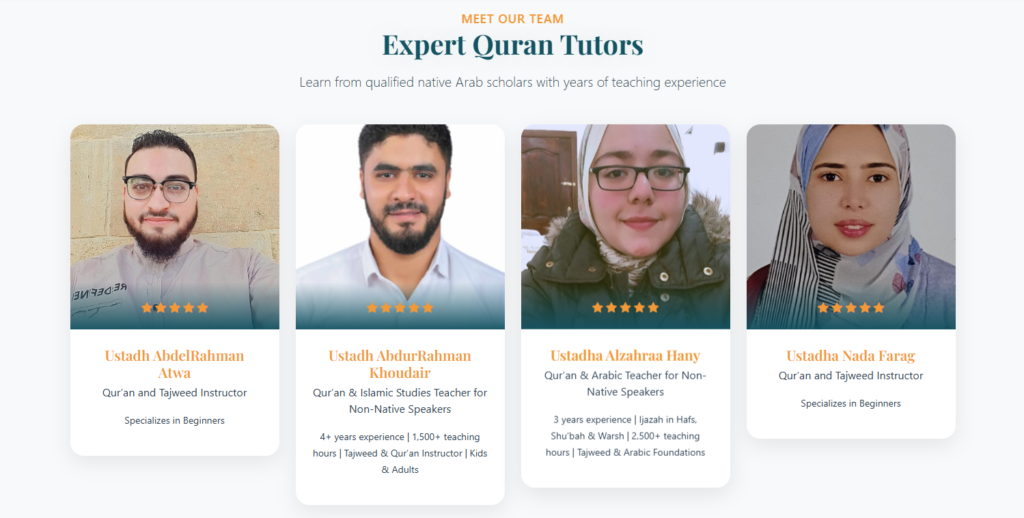
Buruj Academy connects students with Ijazah-certified instructors who hold documented chains of transmission in Hafs ‘an ‘Asim and have 12+ years of experience teaching English-speaking students across North America, Europe, and Australia.
Discover the Buruj Academy Difference
Step into our virtual classrooms and see how our expert instructors make learning Quran and Arabic intuitive and clear. We focus on overcoming the specific hurdles non-native speakers face, building your confidence and connection with the Quran.
What Credentials Should a Skype Quran Teacher Have?
Look specifically for these verified qualifications before committing to any instructor:
- Ijazah in Quran recitation (documented, not self-claimed)
- Graduation from a recognized Islamic institution — Al-Azhar University is the globally recognized gold standard
- Demonstrable experience teaching non-native Arabic speakers
- Ability to explain rules and corrections in clear English
At Buruj Academy, every instructor passes a multi-stage qualification process. Students never receive a teacher whose credentials have not been independently verified by our academic team.
Book a FREE trial session with one of Buruj’s Azhari Quran tutors
Read also: Quranic Numerology – Full Guide
5. Build a Consistent Weekly Schedule That Matches Your Real Life
Consistency is more important than session length. In our instructors’ experience, students who attend two 30-minute sessions per week outperform students who schedule one 60-minute weekly session — provided the shorter-session students also practice independently between classes.
The Prophet ﷺ said:
“The most beloved deeds to Allah are the most consistent ones, even if they are small.” (Sahih al-Bukhari 6464).
This principle applies directly to Quran learning: small, regular sessions produce deeper retention than occasional intensive study.
Excel in Your Quranic Studies
Join Buruj Academy and master the Quran with our structured, professional curriculum.
Book Your Free Trial| Schedule Type | Weekly Sessions | Best For |
| Intensive | 5 sessions × 30 min | Students with Hifz goals |
| Standard | 3 sessions × 45 min | Adult learners balancing work |
| Maintenance | 2 sessions × 30 min | Students in revision phase |
| Beginner Start | 2 sessions × 20 min | New learners building habit |
Build your Skype or Zoom session times around your most alert hours — not your most convenient ones. Recitation demands full cognitive presence. Students who schedule sessions immediately after work often struggle to absorb corrections the way morning learners do.
If you are pursuing memorization alongside recitation, our online Hifz program includes session scheduling guidance built directly into the student onboarding process.
Start Hifz today with a FREE trial session
6. Establish a Structured Learning Curriculum with Clear Milestones
A Skype Quran class without a curriculum is a conversation, not a course. Every effective online Quran program via Zoom or Skype follows a documented progression from entry level to target outcome, with clear milestones the student can track.
Buruj Academy’s online Quran classes for beginners follow this foundational progression:
- Letter recognition and sound production — Arabic alphabet mastery with correct articulation
- Vowel and diacritical mark reading — Fathah, Kasrah, Dammah, Sukoon, Shaddah
- Joined letter reading — reading connected Arabic script fluently
- Basic Tajweed rule application — Noon Sakinah rules, Madd, Qalqalah
- Sura-level recitation — applying rules in actual Quranic text
Each milestone is assessed by the instructor before the student advances. This prevents the common problem of students who “finished” a Quran reading course but cannot recite accurately under light pressure.
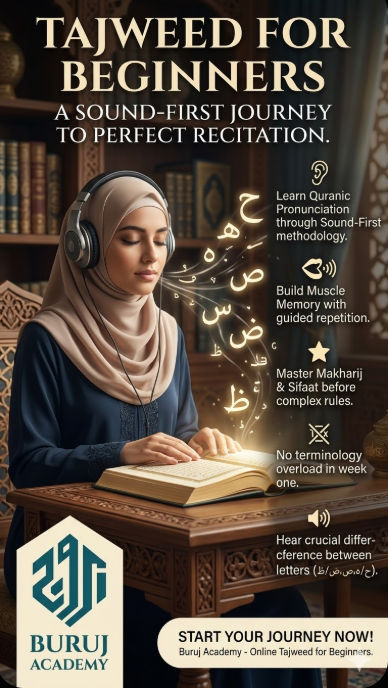
For students ready to focus specifically on rules, our Tajweed for beginners course covers each rule family systematically, starting with the rules most frequently encountered in recitation before progressing to more nuanced applications.
You can also read our guide on Tajweed for beginners to understand what the learning path looks like before you begin.
Book Your FREE Trial Lesson to Begin Your Tajweed Journey
7. Practice Recitation Between Sessions Using a Structured Daily Method
Live Skype and Zoom sessions are where learning is introduced and corrected — but retention happens in the daily practice between sessions. Students who treat their 30-minute class as their only Quran interaction each day progress at roughly half the speed of those who also practice independently.
A reliable 15–20 minute daily independent practice structure includes:
- 5 minutes: Review the previous session’s corrected recitation
- 7 minutes: Read new material from the current lesson slowly, self-monitoring
- 3–5 minutes: Listen to a qualified reciter reading the same passage (tanzil.net provides audio-linked Quranic text for reference)
- 3 minutes: Record yourself and compare to the reference recitation
This method trains the ear alongside the tongue — a core principle of the Buruj Method’s sound-before-rules approach. Students who develop their listening accuracy before focusing on rule terminology internalize Tajweed far more naturally than those who memorize rule definitions without trained ears. For students working toward memorization, our article on how to memorize Quran faster provides retention strategies that integrate directly with daily recitation practice.
8. Track Your Progress and Communicate Openly with Your Teacher
Progress in Quran recitation is measurable — but only if you track it deliberately. Many students confuse familiarity with mastery. Hearing a surah repeatedly creates recognition, which the brain misidentifies as recitation ability.
Your teacher is the accurate mirror; their assessment, not your comfort level, defines your actual progress.
In every Buruj Academy Zoom Quran session, instructors document recitation errors by category: makharij errors, Tajweed rule misapplication, rhythm and Madd length issues, and reading speed problems.
Students receive a brief verbal summary at the end of each session identifying the one or two highest-priority items to focus on before the next class.
If you feel you have plateaued, communicate this directly. A qualified instructor will diagnose whether the cause is technical (a persistent articulation error), structural (curriculum mismatch), or behavioral (insufficient independent practice). All three have clear solutions — but only when the problem is correctly identified.
Read also: What is the Importance of Learning and Teaching Quran?
Take Advantage of Buruj Academy’s Free Trial to Begin Your Quran Learning Today
Starting your Quran learning online does not require a long-term commitment before you experience the quality of instruction.
The most important first step is experiencing a live session with a qualified teacher — hearing your own recitation corrected in real time, understanding what structured Quran learning actually feels like.
Buruj Academy offers everything you need to begin:
- Ijazah-certified, Al-Azhar University graduate instructors
- 12+ years of experience teaching non-Arabic speakers globally
- The Buruj Method: Sound-before-rules, Context-before-abstraction, Consistency-before-speed
- Personalized 1-on-1 sessions via Zoom or Skype — fully flexible scheduling
- Courses for every level: beginner to advanced, children to adults
- Real-time recitation correction with documented progress tracking
Book your free trial lesson today and experience the difference a qualified, structured online Quran class makes from your very first session — no obligation, no pressure, just authentic learning.
Take the next step in your learning journey today by enrolling in one of our specialized programs:
- Online Quran Classes
- Online Quran Classes for Beginners
- Online Quran Classes for Adults
- Online Quran Classes for Ladies
- Online Quran Classes for Kids
- Quran Reading Course
- Quran Recitation Course
- Online Ijazah Course
- Online Qirat Course
Don’t wait to transform your relationship with the Holy Quran. Join our global community of students and book your free evaluation session now!
Excel in Your Quranic Studies
Join Buruj Academy and master the Quran with our structured, professional curriculum.
Book Your Free TrialConclusion
Learning Quran online by Skype and Zoom is no longer a compromise — it is, for millions of students worldwide, the most accessible and effective path to authentic Quran education available. When the right teacher, the right curriculum, and the right personal commitment come together in a live online session, the results are indistinguishable from the best in-person instruction.
The steps above are not theory — they reflect what we have observed in thousands of student sessions at Buruj Academy over more than a decade.
Progress is consistent, measurable, and deeply rewarding when the foundations are built correctly. Begin with your level assessment, choose a verified instructor, protect a consistent schedule, and let the learning compound session by session, Insha’Allah.
Frequently Asked Questions About Learning Quran Online by Skype and Zoom
Is It Possible to Learn Quran Properly Online Without Being in the Same Room as the Teacher?
Yes — live video sessions via Skype or Zoom allow instructors to hear pronunciation in real time, see mouth positioning through the camera, and correct errors immediately. In our experience, students who attend consistent live online sessions with qualified teachers achieve the same recitation accuracy as in-person students, provided audio quality is clear and sessions are regular.
Which Is Better for Quran Classes — Skype or Zoom?
Both platforms support effective Quran instruction. Zoom generally offers more stable audio and clearer video during longer sessions, making it the preferred choice at Buruj Academy for recitation and Tajweed classes. Skype Quran classes work well for shorter sessions and are familiar to many students. The teacher’s qualification matters far more than which platform you use.
How Many Sessions Per Week Do I Need to Make Real Progress in Online Quran Classes?
Two to three live sessions per week, combined with 15–20 minutes of daily independent practice, produces consistent, measurable progress for most adult learners. Students pursuing Hifz typically benefit from four to five sessions weekly. The key variable is not session count alone — it is the quality of practice between sessions that determines how much each live class builds on the last.
Can Children Learn Quran Effectively Through Zoom or Skype Classes?
Yes, and often with excellent results. Children aged five and above adapt quickly to screen-based learning when instructors use age-appropriate engagement methods. Buruj Academy’s Hifz for kids course and Tajweed for children course use visual aids, structured repetition, and positive reinforcement techniques specifically designed for young learners in online environments.
Do I Need to Know Arabic to Start Online Quran Classes via Skype or Zoom?
No prior Arabic knowledge is required to begin. Complete beginners start with the Noorani Qaida, learning Arabic letter recognition and sound production before progressing to Quran reading. All instruction is delivered in English, with Arabic introduced gradually and systematically. You can read our full guide on reading the Quran for the first time to understand exactly what to expect as a new student.